
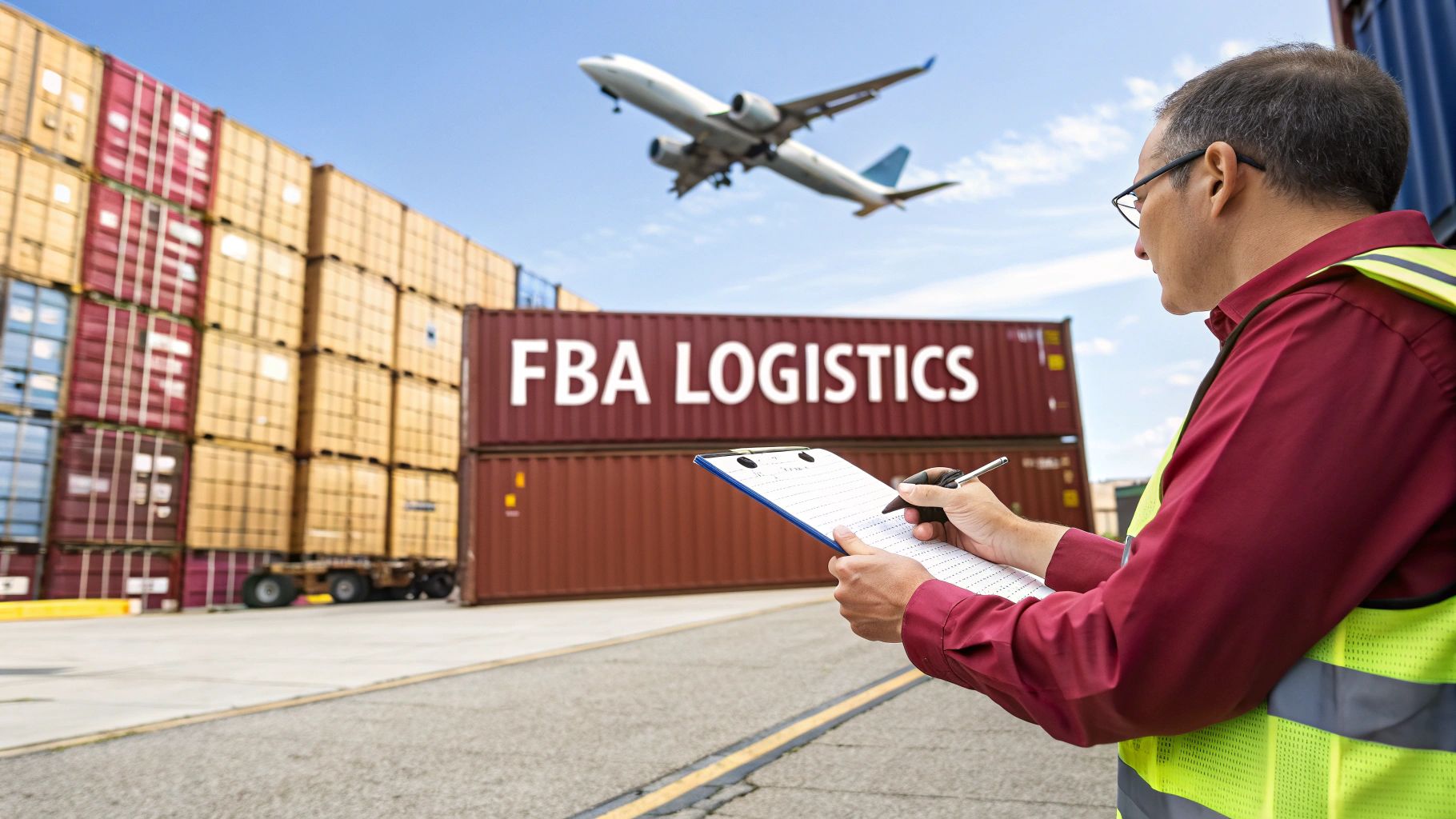
A freight forwarder is the critical link between your manufacturing facility and an Amazon fulfillment center. They coordinate the complex process of international shipping, ensuring your products arrive on schedule and without unexpected fees. Selecting the right freight forwarder directly impacts your inventory health, profitability, and customer satisfaction.
For established Amazon brand owners, integrating a supply chain into Amazon's massive logistics network is a significant operational challenge. A misstep can lead to stockouts, escalating costs, and compliance issues that stall business growth. This analysis is for experienced sellers who need to properly vet, select, and manage a freight forwarder that understands the specific demands of the Amazon FBA ecosystem.
Strategic Freight Forwarding for Your FBA Business
Amazon's logistics operation is immense. For brand owners, figuring out how to plug your supply chain into that system is everything. Get it wrong, and you're staring down the barrel of stockouts, hidden costs, and compliance nightmares that can bring your growth to a screeching halt.
1. Specialized Forwarder Importance
Not all freight forwarders can effectively handle Amazon FBA shipments. Many claim they can, but a forwarder with genuine FBA expertise understands Amazon's stringent requirements for:
- Labeling: Correctly applying FNSKU and carton labels every time.
- Packaging: Adhering to poly bag warnings, box size limits, and dunnage requirements.
- Palletization: Constructing pallets to the exact dimensions, height, and wrapping specifications Amazon requires.
- Delivery Appointments: Using the Carrier Central portal to book mandatory delivery slots.
An error in any of these areas will result in your shipment being rejected at the fulfillment center. This causes a chain reaction of storage fees, re-delivery charges, and the most damaging outcome for an FBA business: costly stockouts.
The scale of Amazon’s network leaves no room for error. The global FBA system processes an estimated 17.2 million orders daily. This volume highlights the necessity for speed and precision in your supply chain.
A competent freight forwarder does more than transport goods; they manage the details of international shipping services so your products enter Amazon’s system seamlessly.
2. Beyond Transportation
A top-tier freight forwarder acts as a project manager, identifying potential issues before they become expensive problems.
For example, they might notice your supplier's master cartons are slightly oversized. This seemingly minor detail is enough to cause an FBA rejection. By identifying this weeks before the shipment departs, they can save you thousands of dollars in rework and fees.
For sellers sourcing from overseas, this proactive management is essential. The goal is to turn your freight forwarder relationship into a strategic asset, not just an operational cost.
Define FBA Shipment Details for Accurate Quotes
Receiving a vague quote from a freight forwarder often leads to surprise fees later. Before requesting pricing, you must compile a detailed shipment profile. This gives a logistics partner the exact data needed to provide a reliable quote that aligns with your budget.
A professional forwarder uses these specifications to plan vessel space, calculate customs duties, and determine final delivery costs to Amazon's warehouse. Getting this right from the start prevents costly and frustrating delays.
1. Volume and Weight
You need two fundamental metrics: total gross weight and total volume in cubic meters (CBM). Your supplier should provide this on a packing list, but you must verify their figures.
- Gross Weight (kg): The total weight of your products, including all packaging materials like cartons and pallets.
- Cubic Meters (CBM): The amount of space your shipment occupies. Calculate this for one carton by multiplying its length, width, and height in meters. Then, multiply that figure by the total number of cartons.
Freight pricing is based on chargeable weight, which is the greater of the actual gross weight or the volumetric weight. Dense, heavy items are typically priced by actual weight, while light, bulky products are priced by volume.
2. Air vs. Sea Freight
The choice between air and sea freight is a strategic decision that affects inventory levels and cash flow.
- Sea Freight: This is the standard for most FBA inventory. It's more cost-effective but slower, with transit times from Asia to the US typically ranging from 30-45 days. Sea freight is ideal for planned stock replenishments with ample lead time.
- Air Freight: This is a faster, more expensive option used to prevent stockouts on best-selling ASINs or for new product launches. Products can arrive at Amazon in as little as 7-10 days.
A common inventory strategy is the 90/10 split: 90% of inventory travels by sea to manage costs, while a strategic 10% is shipped by air to respond to demand fluctuations and avoid stockouts.
3. Incoterms
Incoterms are the standardized rules defining responsibility during the shipping process. For Amazon sellers, the primary options are EXW (Ex Works) and FOB (Free on Board). Your choice has significant implications for both cost and control.
Most Amazon sellers use either EXW or FOB. This table clarifies where your and your supplier's responsibilities begin and end.
Incoterms Responsibility Breakdown for Amazon Sellers
| Shipping Stage | EXW (Ex Works) Responsibility | FOB (Free on Board) Responsibility |
|---|---|---|
| Goods Pickup | You (or your forwarder) | Supplier |
| Transport to Origin Port | You | Supplier |
| Export Customs Clearance | You | Supplier |
| Loading onto Vessel/Plane | You | Supplier |
| Main Freight Journey | You | You |
| Import Customs Clearance | You | You |
| Final Delivery to Amazon | You | You |
With EXW, your responsibility begins when the goods are ready at the factory. Your forwarder must arrange for trucking, export customs, and all subsequent steps. This offers total control but also maximum responsibility.
With FOB, the supplier is responsible for loading your products onto the ship at the origin port. They manage local trucking, port fees, and export documentation. Your responsibility and costs begin once the cargo is on the vessel.
For most Amazon sellers, FOB is the preferred option. It simplifies logistics by assigning origin-country tasks to your supplier, who has the necessary local expertise.
Having these details, from weight and volume to specific Amazon label requirements, allows you to compare quotes from different forwarders accurately. This helps you choose a partner based on real costs and service, not guesswork.
Managing Your FBA Shipment Process
Once you've defined your shipment and selected a forwarder, the next phase is moving your products from the factory to an Amazon fulfillment center.
Small mistakes in this process can create significant delays and unexpected fees. A streamlined process, from Seller Central to Amazon's warehouse, is essential for a successful FBA business. It requires synchronization between you, your supplier, and your forwarder to meet Amazon's strict standards for paperwork and physical preparation.
1. Create Your Amazon Shipment Plan
Before any products leave the factory, you must create a shipment plan in Seller Central. This is a critical step where Amazon generates the unique FNSKU and carton labels required to track and receive your inventory. Do not authorize your supplier to ship until this is complete.
The plan will require details like the "ship-from" address, unit dimensions, and carton count. After submission, Amazon will assign your inventory to specific fulfillment centers. Your freight forwarder needs this destination information for an accurate final-mile delivery quote.
2. Core Shipping Documents
Your freight forwarder needs accurate paperwork to manage the shipment. A simple typo or incorrect value on an invoice can cause significant delays at the port.
You need these three documents:
- Commercial Invoice: The bill of sale for your shipment. It lists you as the buyer, your supplier as the seller, and details the products, quantity, and value. The declared value must match what you actually paid, as customs officials use this to calculate duties.
- Packing List: An inventory sheet for the shipment. It details the contents, net weight, gross weight, and dimensions of each carton. Customs uses this to verify the physical goods match the commercial invoice.
- Bill of Lading (B/L) or Air Waybill (AWB): The official contract between you and the carrier, issued by your forwarder. It's a B/L for sea freight and an AWB for air freight, serving as both a receipt and a document of title.
Pro Tip: Your forwarder will likely request these documents a week before your cargo is ready. Do not assume your supplier will handle this. It's your responsibility to prepare and double-check all paperwork for accuracy.
3. Labeling and Prep
Amazon's preparation requirements are highly specific. Failure to comply will result in your shipment being rejected, and you will be responsible for the costs to fix and re-deliver it.
- FNSKU Labeling: Each unit requires an FNSKU barcode label from your shipment plan. This label must completely cover any existing UPCs. Your supplier must apply these labels before packing.
- Carton Labeling: Each master carton needs an FBA box label, also from your shipment plan. This label identifies the contents and the seller for Amazon's warehouse team.
- Palletization: For LTL shipments, goods must be on pallets that meet Amazon's specifications. These are 40" x 48" 4-way access wooden pallets, with a maximum height of 72 inches. Cartons cannot overhang the pallet edge, and the pallet must be shrink-wrapped and labeled on all four sides.
4. Customs Clearance
Once your goods are in transit, your freight forwarder manages customs clearance. They or their customs broker will submit your commercial invoice and packing list to U.S. Customs and Border Protection (CBP).
They will classify your product with a Harmonized Tariff Schedule (HTS) code, which determines the import duty rate. An experienced forwarder is invaluable here; an incorrect HTS code can lead to overpayment of duties or penalties for underpayment.
After duties are paid and CBP releases the shipment, it proceeds to the final leg of its journey. You can learn more about how to send products to Amazon in our comprehensive guide.
How to Select the Right FBA Forwarding Partner
Choosing a freight forwarder is a strategic decision that affects your inventory, cash flow, and brand reputation. The lowest quote is rarely the best option. An inexpensive forwarder unfamiliar with Amazon's ecosystem can cost you thousands in rejected shipments, storage fees, and lost sales from stockouts.
The right partner functions as an extension of your team, identifying issues at the factory or port before they become major problems. This section provides a framework for evaluating potential partners beyond pricing to find true competence and reliability.
1. Go Beyond the Quote
When vetting a freight forwarder for Amazon FBA, investigate their specific experience with Amazon's strict regulations. A general logistics provider might move containers effectively, but they likely won't know the pallet height restrictions for a specific fulfillment center like ONT8.
Your evaluation process should focus on a few key areas:
- Deep FBA Expertise: Ask them to describe their process for a typical FBA shipment. They should immediately mention booking delivery appointments in Carrier Central, FNSKU labeling, and Amazon's palletization rules. A lack of familiarity is a major red flag.
- Proactive Communication: Inquire how they handle issues. A good forwarder will notify you immediately about potential problems, like a customs delay, and present a solution.
- Solid Tracking Systems: You need more than just a ship's location. A professional forwarder provides a portal with real-time status updates, access to documents like the Bill of Lading, and tracking from the factory to FBA check-in.
The Amazon marketplace is highly competitive. With over 2.5 million active sellers and 82% of them using FBA, the demand for expert logistics is significant. Successful sellers understand this, with 65% using FBA as their primary fulfillment method. In this environment, your forwarder is a critical partner.
2. Specialized FBA Forwarder vs. General Provider
You will encounter two main types of partners: specialized FBA-focused forwarders and large, general logistics companies. For most Amazon brands, a specialist is the better choice. They are experts in Amazon's rules and have relationships with trucking companies approved to deliver to FBA warehouses.
A general provider may offer attractive rates but often lacks the necessary niche knowledge. They may not understand why a shipment was rejected for a minor issue like cartons overhanging a pallet, leaving you to manage the costly resolution.
A specialized freight forwarder for Amazon FBA does more than ship your goods; they protect your business from Amazon's complex compliance requirements. Their focused expertise is a form of operational insurance.
3. Consider Amazon Global Logistics (AGL)
Amazon's own forwarding service, Amazon Global Logistics (AGL), is another option. It offers an integrated experience, moving your goods from a port in China to a US fulfillment center, all managed within Seller Central.
However, AGL has trade-offs. It can be less flexible than a third-party forwarder, costs may be higher on certain routes, and customer service is less personal. An independent forwarder can offer creative solutions, such as routing your shipment to a 3PL for short-term storage and then distributing inventory to FBA as needed. This is a key strategy for managing storage fees and expanding into new markets. For more on this topic, see our guide on selling globally on Amazon.
The best approach is to get quotes from AGL and at least two independent, FBA-specialized forwarders. This allows you to compare not just price, but also service level, transit times, and flexibility. The goal is to find a long-term partner who supports your brand's growth, not just moves your next container.
Control Shipping Costs and Avoid FBA Pitfalls
Shipping costs can significantly impact your product margins. A product that appears profitable can become a loss if you don't accurately calculate your total landed cost. This includes every expense your inventory incurs from the factory to an Amazon fulfillment center.
Your goal should be to proactively manage costs rather than react to problems. This means understanding freight quotes, optimizing packaging, and avoiding common mistakes that affect even experienced sellers. This is fundamental to building a profitable FBA business.
1. Deconstructing Your Freight Quote
A freight forwarding quote is composed of multiple charges for services at each stage of the journey. To save money, you must know what you're paying for.
Here’s a breakdown of common charges:
- Ocean or Air Freight: The core transportation cost, which varies based on carrier space, fuel prices, and seasonal demand.
- Origin Charges: Fees at the port of departure, including Terminal Handling Charges (THC) and document processing.
- Destination Charges: Fees upon arrival in the US, including unloading, customs exams, and port fees.
- Customs Duties and Taxes: A significant cost calculated from your product's HTS code and declared value.
- Final-Mile Delivery: The trucking fee from the port to the assigned Amazon FBA warehouse, which varies by distance and carrier availability.
When comparing quotes, ensure you are comparing similar services. Verify that each forwarder is quoting the same Incoterms and includes all potential destination fees. A suspiciously low quote that omits port fees is a common tactic that results in a much higher final bill.
2. Actionable Cost-Cutting Strategies
While some costs are fixed, you have more control over your total shipping bill than you might think. A few smart operational decisions can lead to significant savings.
- Master Volumetric Weight. Carriers charge based on the greater of actual weight or dimensional (volumetric) weight. Work with your supplier to minimize carton size without compromising product safety. Reducing carton dimensions by even a centimeter can result in substantial savings on a large shipment.
- Consolidate Shipments. Whenever possible, combine multiple smaller orders into one larger shipment. The cost per CBM for a full container load (FCL) is typically lower than for a less-than-container-load (LCL). This also reduces handling and the risk of damage. You can also explore cost-saving shipping methods like slip sheeting.
- Negotiate. Do not hesitate to negotiate, especially if you can offer consistent, regular volume. A long-term relationship with a freight forwarder can give you leverage for better rates over time.
For context, DDP quotes for a shipment from Shanghai to Amazon's Ontario (ONT) fulfillment center can range from $3,650 to $6,800. A recent poll of high-volume Amazon sellers found that reliability and prep accuracy were as important as price. The right logistics partner can reduce your landed costs by 15-30%, making this a critical strategic decision.
3. Avoiding Common Mistakes
Knowing what not to do is as important as knowing what to do. The following mistakes can add thousands in unexpected fees and delays to your shipment.
A customs hold or an FBA rejection is not just a delay; it's a financial liability. Every day your inventory sits at a port or in a third-party warehouse, you incur fees and lose sales.
The most common problems are:
- Customs Holds: These are almost always caused by inaccurate paperwork. A typo on the commercial invoice or a packing list that doesn't match the contents can trigger a physical inspection, leading to long delays and high exam fees.
- Demurrage and Detention Fees: These are penalties from the port or carrier when your container is not picked up and returned on time. Demurrage is charged while the container is at the port; detention applies after pickup. These fees can quickly escalate to hundreds of dollars per day.
- FBA Receiving Rejections: Amazon does not tolerate non-compliance. Improper FNSKU labels, incorrectly built pallets, or a driver arriving late for a delivery appointment will cause your shipment to be turned away. You will be responsible for storage, rework, and re-delivery fees.
Avoiding these issues requires careful planning and clear communication with your forwarder. This should be a core component of your overall Amazon inventory management strategy, as it directly impacts your bottom line.
Common Questions About FBA Freight Forwarding
Even experienced sellers have questions about FBA logistics. Here are answers to some of the most common questions from brand owners working with a freight forwarder for Amazon FBA.
1. Freight Forwarder vs. Customs Broker?
A freight forwarder is the general contractor for your shipment. They organize the entire move, from booking space on a ship to arranging final delivery to Amazon. They manage the end-to-end logistics.
A customs broker is a specialized subcontractor whose sole job is to legally clear your goods into the country. They are licensed experts who handle paperwork, ensure compliance with import laws, and calculate the correct duties and taxes.
While many forwarders have in-house customs brokers or partner with them, their roles are distinct. The forwarder moves the freight; the broker clears it.
2. When to Book an FBA Shipment?
Timing is crucial for saving money and preventing stockouts. The answer depends on your shipping method.
Ocean Freight: Book at least 4 to 6 weeks before your goods are ready to leave the factory. This gives your forwarder time to secure space on a vessel at a competitive rate and provides a buffer for potential delays.
Air Freight: While more flexible, it's best to book 1 to 2 weeks in advance. Last-minute air freight bookings, especially during Q4, can be extremely expensive as capacity is limited.
3. What If Amazon Rejects My Shipment?
A warehouse rejection is costly and usually avoidable. Common causes include incorrect FNSKU labels, non-compliant pallets, or a driver arriving without a proper delivery appointment.
When a rejection occurs, the truck must take your inventory to a local warehouse. You are then responsible for storage fees, rework costs (such as re-labeling or re-stacking pallets), and the fee to book a new delivery appointment with Amazon.
This is where an FBA-experienced freight forwarder is essential. A professional knows Amazon's rules and can identify potential problems before your shipment leaves the factory, preventing these logistical and financial issues.
4. Amazon Global Logistics vs. Third-Party Forwarder?
Amazon Global Logistics (AGL) is a convenient option, especially if you prefer to manage everything within Seller Central. They can handle the entire process from China to a US fulfillment center with integrated tracking.
However, this convenience can come with a higher cost and less flexibility. An independent freight forwarder for Amazon FBA can often find better rates, provide more personalized service, and offer smarter strategies, such as routing your shipment to a 3PL for storage or breaking it into smaller deliveries.
The best approach is to always get quotes from both AGL and at least two other forwarders. Compare the all-in cost, estimated transit times, and service level to make the most informed decision for your business.