

Amazon advertising management services are a strategic partner for brand growth, not just a PPC agency. They integrate pay-per-click efforts with core business functions like inventory planning, SEO, and promotions to drive predictable revenue. This approach turns ad spend into a scalable asset, creating a significant competitive advantage in a crowded marketplace.
Ultimately, these services aim to convert advertising expenditure into a reliable source of growth. They provide the expertise needed to manage the complexities of Amazon's advertising platform, allowing brand owners to focus on product development and building their brand while ensuring their marketing investment yields profitable returns.
The Value Of Professional Ad Management

Amazon's ad platform has become a complex financial ecosystem where every dollar must drive a tangible return. For established brand owners, viewing it as a simple keyword bidding platform is a critical error. A dedicated management service functions as a strategic growth partner, focusing on metrics that reflect true brand profitability.
This means a relentless focus on not just your Advertising Cost of Sale (ACoS), but the far more important metric, Total Advertising Cost of Sale (TACOS). This figure measures your ad spend against your total sales, providing a clear picture of how paid efforts are lifting your entire business. An expert team understands how PPC campaigns directly influence organic rank and overall market share.
1. Growth Integration
Effective management doesn’t operate in a silo. A professional service integrates PPC data with core business operations like inventory planning, organic SEO, and your promotional calendar. This creates a unified growth engine where all parts of the business support one another. You can learn more about this integrated approach by finding the right Amazon seller consultant.
This unified approach involves key activities:
Deep Keyword Harvesting: A continuous process of unearthing and capitalizing on new, profitable search terms that competitors are missing.
Sophisticated Bid Optimization: Using advanced techniques and software to fine-tune bids based on ad placement, time of day, and performance to maximize ROI.
Defensive Campaign Structures: Building ad campaigns specifically to protect your digital shelf space from competitors bidding on your branded terms.
2. Market Navigation
The primary goal of professional Amazon advertising management services is to transform your ad spend from a fluctuating expense into a predictable, scalable revenue stream. This is more critical than ever.
The platform's growth has been substantial. By 2026, Amazon's global advertising revenue is projected to exceed $70 billion, a significant increase driven by heightened competition. This growth creates massive opportunities for brands that can execute with precision.
A professional agency doesn't just manage bids. It builds a competitive moat around your products, using data to inform every decision from keyword selection to creative testing, ensuring your ad budget delivers a clear and measurable return.
This level of strategic oversight gives your business a significant competitive edge. It frees you to focus on product development and brand building while your agency ensures your advertising investment drives profitable growth.
Core Service Functions

A top-tier Amazon advertising management service does more than set up a few Sponsored Products campaigns. The work involves building a multi-layered growth machine where PPC, SEO, creative, and your catalog work together to drive results.
The objective is to turn ad spend into a powerful engine for both immediate sales and long-term organic ranking. When you partner with a true expert, you bring on an extension of your team that understands the Amazon marketplace. Below are the core pillars of what a genuinely elite service delivers.
1. Advanced PPC Architecture
This is the engine of the entire operation. An expert service architects sophisticated campaign structures designed to meet customers at every stage of their buying journey. It's a hands-on, granular approach to targeting and bidding that constantly adapts to market dynamics.
Here’s a look at the components:
Precision Targeting: This involves intricate ASIN targeting, category targeting, and deep keyword segmentation. Campaigns are built to isolate what works, scale it, and cut wasted spend.
Dynamic Bid Management: Top managers use dayparting to push bids higher during peak conversion times and pull back during slower periods. They also use placement modifiers to bid more aggressively for top-of-search positions when the data supports it.
Continuous Optimization: This is a relentless process. It means digging into search term reports daily, harvesting new, high-intent keywords, and building a massive negative keyword list to stop budget drain from irrelevant clicks.
2. Integrated Amazon SEO
On Amazon, paid ads and organic rank are interconnected. A great management service knows that PPC campaigns are most powerful when they support a solid organic foundation. A high conversion rate from your ads sends positive signals to Amazon’s A10 algorithm, which in turn helps boost organic visibility.
This synergy is essential for efficient growth. A seasoned team also understands platform nuances, like the importance of meeting Amazon Brand Registry requirements to access powerful ad types like Sponsored Brands and custom Brand Stores.
3. Creative Asset Optimization
As Amazon becomes more crowded, your ad creative is a major competitive advantage. This is especially true for Sponsored Brands, Sponsored Display, and video ad formats.
A dedicated service doesn't just use your existing product photos. They actively work to improve ad performance by constantly testing and optimizing creative assets.
This means:
A/B Testing Ad Copy: Systematically trying different headlines and calls-to-action to find the language that connects with your ideal customer.
Video Ad Production: Creating and testing short, benefit-driven video ads that stop the scroll and drive more engagement than a static image.
Brand Storefront Design: Building a functional Brand Store that acts as a custom landing page, giving you a space to tell your brand story and increase the average order value.
4. Strategic Catalog Management
None of this matters if your product listings aren't optimized. A critical part of Amazon advertising management services is the proactive management of your product catalog to keep campaigns healthy.
Advertising can't fix a broken listing or an out-of-stock product. A premier service monitors the health of your catalog to ensure that ad spend is never wasted driving traffic to a product that can't be purchased or is poorly presented.
This involves monitoring for listing suppressions, ensuring product info is accurate, and aligning ad campaigns with inventory levels. Nothing is worse than pausing a winning ad because you ran out of stock. This foundational work ensures every dollar spent has the highest possible chance of turning into a sale.
To summarize, here’s how these pieces fit together to drive results.
Key Services Breakdown
A comprehensive management plan is a strategic framework where each component has a specific job and a measurable outcome.
| Service Component | Primary Goal | Key Performance Indicator (KPI) |
|---|---|---|
| Advanced PPC | Drive immediate, profitable sales and gather market data. | Advertising Cost of Sales (ACoS), Return on Ad Spend (RoAS) |
| Amazon SEO | Improve organic keyword rankings and reduce ad dependency. | Total ACoS (TACoS), Organic Rank Position |
| Creative Optimization | Increase ad engagement and conversion rates. | Click-Through Rate (CTR), Conversion Rate (CVR) |
| Catalog Management | Ensure ad spend efficiency and maximize sales potential. | In-Stock Rate, Listing Health Score, Buy Box Percentage |
These services are not silos. They are interconnected gears in a machine built to grow your brand profitably on Amazon.
Selecting The Right Agency
Choosing the right agency is a critical decision for your brand. It's about finding a partner who understands your goals and can turn your ad spend into a predictable growth engine. A misaligned partner can exhaust your budget with poor results, while the right one can capture market share.
1. Vetting Their Strategy
During discovery calls, you need to dig into their actual methodology. Any competent agency will have a clear, data-driven process, so ask direct, tactical questions.
Here are the essentials to ask:
"How do you approach campaign structure for a brand in our category?" You're listening for answers about segmenting campaigns by match type, separating brand vs. non-brand keywords, and setting up campaigns for specific goals.
"What's your process for keyword research and negative keyword management?" A solid answer involves using multiple tools, reviewing search term reports daily, and having a proactive system to stop wasted spend.
"How do you determine the initial budget and bidding strategy?" They should talk about analyzing competitor data, defining clear ACoS targets versus impression share goals, and starting with controlled tests.
"Can you walk me through your approach to Amazon DSP and Sponsored Display?" Their answer reveals if they have a full-funnel mindset or if they are limited to Sponsored Products.
2. Evaluating Their Experience
Case studies are a starting point, but look for proof that they understand how to impact the entire business, not just ad console metrics. A portfolio with brands from completely different categories can be a red flag. The strategies for supplements are different from what works for home goods. You need a partner with hands-on experience in your niche. For more on this, check out our deep dive into the top Amazon PPC agencies.
3. Understanding Their Reporting
You must have a clear window into your performance. Ask for a sample report. Does it just show surface-level data, or does it deliver actionable insights? A great agency partner will explain the "why" behind the numbers. They should clearly show how their ads impact not just ACoS, but more importantly, Total ACoS (TACOS). This is the metric that proves your ad spend is lifting total sales, including organic.
4. Aligning on Pricing
Agency pricing models vary. There's no single "best" option, but you have to understand the incentives each one creates.
Percentage of Ad Spend: This is common but can incentivize an agency to simply spend more. It works best with strict performance targets.
Flat Monthly Retainer: This provides predictable costs, which helps with budgeting. Ensure the scope of work is clear.
Hybrid Model: This often combines a flat fee with a performance bonus, creating alignment as the agency is directly rewarded for hitting your goals.
As of early 2026, Amazon Ads are showing average conversion rates of 9-11%, significantly higher than other platforms. With expert ad management and optimized listings, that number can climb to 10-15%. You can see more of these updated Amazon advertising stats for yourself. Your choice of agency determines whether you capitalize on that opportunity.
The First 90 Days

The initial period after signing a contract is critical for building a foundation for long-term growth. Any professional agency will have a structured process for this. The first 90 days are focused on methodical data collection, strategic alignment, and systematic testing. A disciplined onboarding workflow transforms the relationship into a true strategic partnership.
1. Weeks 1 to 2: Kickoff and Audit
The first two weeks set the tone. It begins with a detailed kickoff meeting where the agency aligns with your core business objectives. This isn't just about ACoS; it's about understanding your profit margins, inventory constraints, and growth targets for the next 12-24 months.
Once aligned, you'll grant secure, limited access to your Seller Central account. The agency’s first move is a comprehensive performance audit of every existing campaign and listing.
A thorough audit is essential. The goal is to find "low-hanging fruit," such as obvious areas of wasted ad spend or untapped keyword opportunities, to secure quick wins while the long-term strategy is being built.
This audit examines everything from campaign structure and keyword match types to historical conversion rates on your top ASINs. You can learn more about what this involves by reviewing the components of a professional Amazon PPC audit.
2. Weeks 3 to 6: Restructuring and Testing
With data from the audit, the agency moves from analysis to action. You'll start to see the first major changes in your account as the team restructures existing campaigns into a more logical, segmented architecture.
This often involves:
Pausing underperforming keywords that generate clicks but no sales.
Building new campaigns based on profitable search terms from historical data.
Implementing a robust negative keyword strategy to stop budget leaks.
Simultaneously, they'll launch controlled tests. This could mean testing new ad copy, experimenting with different bidding strategies, or targeting a new batch of competitor ASINs. The goal is to gather clean, actionable data quickly.
3. Weeks 7 to 12: Optimization and Scaling
By this point, the agency has enough performance data to make informed decisions. Initial tests have revealed what’s working and what isn’t. The focus shifts from broad restructuring to granular, day-to-day optimization and strategic scaling.
During this phase, communication is critical. You should expect regular, detailed performance reports, typically on a weekly or bi-weekly basis. These reports should provide insights into why certain campaigns are performing well and outline the next steps. Successful tests are scaled up. Budgets are carefully increased for winning campaigns, and bids are pushed more aggressively on high-converting keywords. The agency will also begin layering in more advanced tactics, like Sponsored Display for retargeting.
By the end of these first 90 days, you should have a clear, data-backed understanding of your account’s potential and a strategic roadmap for the months ahead.
Measuring Success
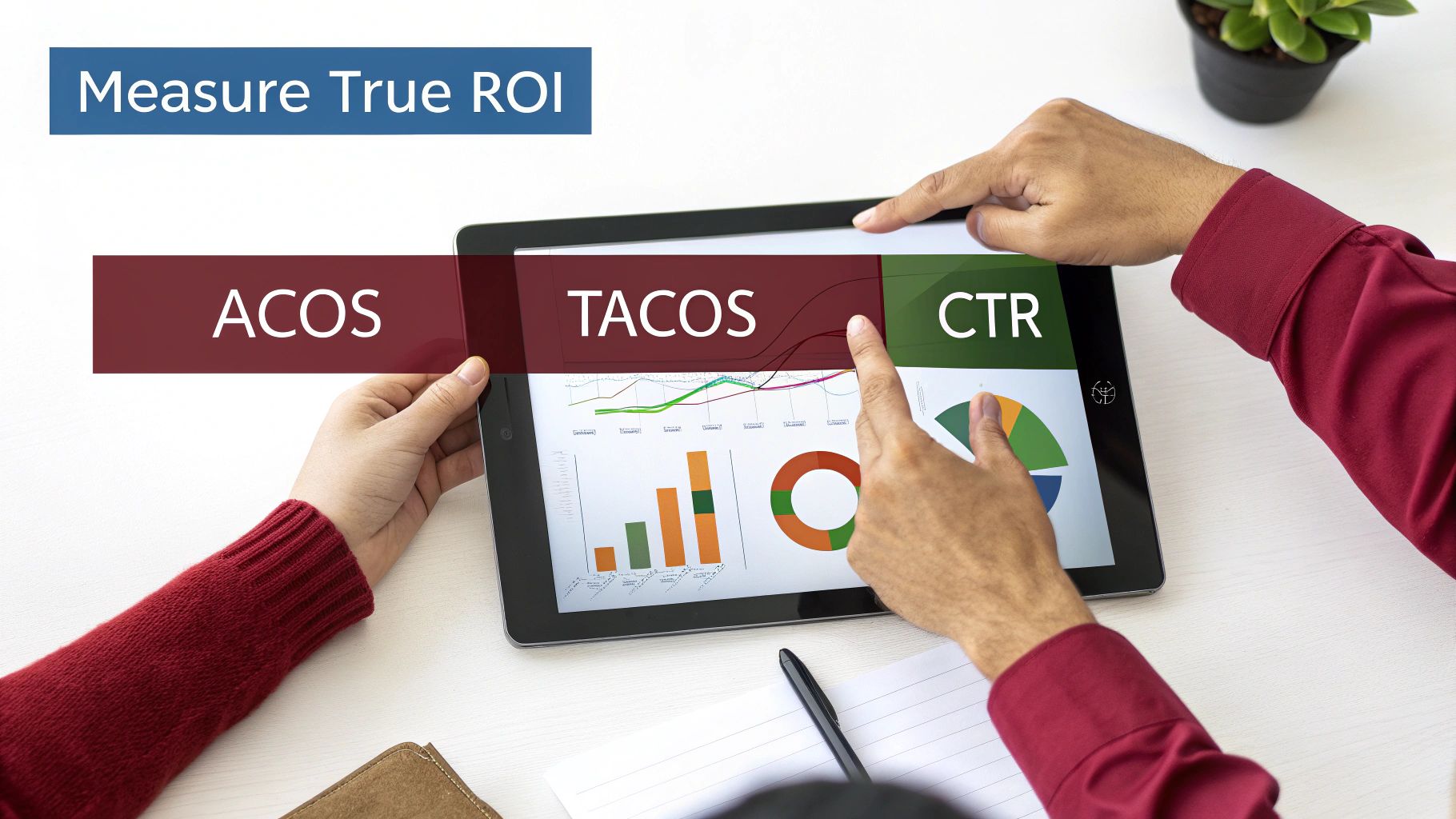
While Advertising Cost of Sale (ACoS) is a useful gauge for campaign efficiency, relying on it alone provides a narrow view. Top-tier Amazon advertising management services measure success by the total effect ads have on brand health, market share, and long-term organic ranking. A low ACoS is not beneficial if it comes at the cost of sales volume or allows competitors to dominate impression share. Viewing your ad budget as a direct investment in brand growth requires smarter performance measurement.
1. The Importance of TACOS
The most important metric for an established brand is Total Advertising Cost of Sale (TACOS). This figure is calculated by dividing your total ad spend by your total revenue (from both ads and organic sales). TACOS tells you exactly what percentage of your overall revenue you're spending on ads.
A downward trend in TACOS over time indicates a healthy growth flywheel. It proves your ads are boosting your organic rank. As more organic sales come in, you become less dependent on paid clicks, making your business more profitable and defensible.
An agency's primary goal should be to lower your TACOS. This demonstrates that their strategies are building a sustainable lift in organic sales, turning your ad spend into a long-term asset, not just a daily expense.
2. Core Campaign KPIs
Beyond TACOS, several other metrics serve as a diagnostic panel for your campaigns. A skilled manager uses these KPIs to spot problems and uncover opportunities at a granular level.
These key metrics include:
Impression Share: Shows the percentage of available ad impressions you're capturing for target keywords. A low impression share means you're losing customers to competitors.
Click-Through Rate (CTR): Measures how compelling your ad is. A low CTR can indicate a problem with your main image, title, price, or review count.
Conversion Rate (CVR): Indicates how effectively traffic converts to sales. A low CVR often points to issues on your product detail page, such as weak bullet points or poor A+ Content.
3. Data Interpretation
Tracking these metrics is only half the battle. The real value of professional Amazon advertising management services is their ability to interpret the data and turn it into an action plan. For example, high impressions but a low CTR might trigger A/B testing of main images. A great CTR but poor conversion rate would prompt a review of the product detail page. You can get a clearer picture by learning to analyze Amazon advertising reports.
Context is critical. A CTR of 0.4% might be excellent for a broad keyword in a competitive category, while a CVR of 8% could be poor for a niche product. An experienced agency understands these nuances and sets realistic targets. This strategic context separates simple data reporting from true performance management.
Costly Advertising Mistakes
Many brands inadvertently waste thousands of dollars on Amazon ads by falling into common traps. These are often basic, avoidable errors that drain budgets and kill momentum. A professional management service acts as a system of checks and balances to prevent these costly mistakes.
1. Broad Match Budget Drain
Letting broad match keywords run without tight control is one of the fastest ways to waste money. For instance, a brand selling "leather dog collars" might find their ads showing for searches like "cheap nylon collars." Every irrelevant click is wasted money. An agency prevents this by continuously harvesting keywords from search term reports and adding irrelevant queries as negative keywords. This simple discipline stops the budget leak.
2. Ignoring Inventory
Running out of stock on a product with a successful ad campaign is a costly error. You lose immediate sales, and Amazon's algorithm penalizes your listing's rank for the stockout. A good agency monitors inventory levels and adjusts campaign budgets accordingly. As stock gets low, they'll reduce ad spend to avoid a complete stockout, protecting both ad performance and organic ranking. If you've had a campaign stop performing, our article on what to do when Amazon PPC stops working provides deeper insights.
A professional agency doesn't just manage your ads; they safeguard your budget. By systematically eliminating wasted spend and aligning campaigns with business realities like inventory, they turn a potential liability into a predictable growth driver.
3. Neglecting Maintenance
Amazon campaigns require constant maintenance. Keywords become more expensive, new competitors emerge, and customer search habits change. A campaign will lose its edge without continuous monitoring and adjustment.
Professional managers handle the routine maintenance that brand owners often lack the time for. This includes:
Bid Optimization: Adjusting bids based on placement, time of day, and profitability.
Search Term Analysis: Finding new keyword opportunities and adding negatives.
Creative Refreshes: Testing new headlines and images to combat ad fatigue.
This ongoing optimization keeps campaigns healthy and ensures your ad spend continues to deliver a strong return over the long term.
Frequently Asked Questions
Even experienced brand owners have questions about hiring an Amazon advertising management service. Here are some of the most common ones.
How Long Until I See Results?
While quick wins, like cutting wasted ad spend, can improve your ACoS in the first 30 days, meaningful growth takes more time. You’ll likely see a stable improvement in metrics like TACOS and organic rank within about 90 days. This period allows an agency to collect clean data, run tests, and build campaigns for long-term success.
What Is a Reasonable Starting Ad Spend?
There’s no single answer. Your starting ad spend depends on your product category's competitiveness and your goals. In a competitive category like supplements, you might need a budget of $3,000 to $5,000 a month just to gather enough data for smart decisions. A good agency will recommend a budget based on your specific situation and what it will take to hit your goals, focusing on Return on Ad Spend (ROAS).
Do I Lose Control Over My Ad Strategy?
You shouldn't. The best agency partnerships are collaborations. While they handle the day-to-day campaign management, your strategic input is essential. You know your brand, products, and business goals better than anyone.
Think of it less like handing over the keys and more like hiring a professional driver. You still set the destination, and they figure out the best route to get you there.
Regular strategy calls and transparent reporting should be standard. This keeps your ad campaigns synced with your broader business objectives, allowing the agency to handle the tactical work while you focus on the big picture.