
The fundamental split between branded and non-branded keywords in Amazon advertising is a direct reflection of shopper intent. Mastering this distinction allows for precise control over ad spend and campaign outcomes. Misunderstanding it leads to inefficient budget allocation and missed growth opportunities. Branded keywords, such as ‘Nike running shoes,’ capture demand from shoppers already familiar with your brand. They are essentially at your digital doorstep, ready to purchase.
Conversely, non-branded keywords, like ‘mens trail running shoes,’ are your primary tool for customer acquisition. These search terms connect you with potential buyers who are still in the discovery phase of their shopping journey. A successful Amazon PPC strategy requires a clear separation and distinct approach for each keyword type, as they serve different, yet equally vital, roles in building and sustaining a brand on the platform.
Defining Branded and Non-Branded Keywords
Failing to separate these two keyword types in your campaigns prevents accurate performance measurement, effective spend control, and the achievement of specific marketing objectives. They operate differently within a comprehensive PPC plan. For those needing a foundational understanding, grasping what is PPC in Amazon is the first step, as it powers these strategic decisions.
1. Branded Keywords
A branded keyword is any search query that includes your brand name or a unique product identifier. When a shopper uses one of these terms, they are specifically looking for your products.
- Examples: “Anker PowerCore 10000,” “hydro flask water bottle,” “carhartt jacket.”
- Primary Goal: The primary objective is defensive. You must protect your brand’s search real estate from competitors and convert high-intent buyers who are already seeking you out. These campaigns act as a safeguard for your digital presence.
- Shopper Intent: These shoppers are in the final stage of the buying cycle. They have likely already decided on your brand and are looking to find a specific model or finalize their purchase.
A branded campaign is not just about securing a sale; it’s about defending your brand’s digital territory. If you fail to appear for your own brand name, a competitor will occupy that space.
2. Non-Branded Keywords
Non-branded keywords are general, descriptive terms used by customers who have a need but have not yet chosen a specific brand. This is the arena for customer acquisition and audience expansion. The majority of your keyword research for Amazon efforts will focus here.
- Examples: “insulated coffee mug,” “wireless earbuds with noise cancelling,” “men’s hiking boots waterproof.”
- Primary Goal: This is focused on discovery and market penetration. The goal is to introduce your brand to new audiences, acquire customers unfamiliar with your products, and capture market share.
- Shopper Intent: These users are at the top or middle of the sales funnel. They are actively researching, comparing features, reading reviews, and evaluating options before making a purchasing decision.
To clarify, here is a direct comparison of how these two keyword types function.
Core Differences
This table provides a concise overview of the key distinctions, clarifying where each keyword type fits within a broader campaign strategy.
| Metric | Branded Keywords | Non-Branded Keywords |
|---|---|---|
| Search Intent | High (Ready to Buy) | Low to Medium (Discovery) |
| Audience | Existing or Aware Customers | New or Unaware Customers |
| Competition | Low to Medium | High to Very High |
| Typical CPC | Lower | Higher |
| Typical CVR | Higher | Lower |
| Strategic Goal | Brand Defense & Conversion | Customer Acquisition & Growth |
Branded keywords are for protecting your customer base and securing high-probability sales, while non-branded keywords are the mechanism for growth and new customer discovery. An effective Amazon PPC strategy requires a sophisticated balance of both.
Comparing Performance Metrics
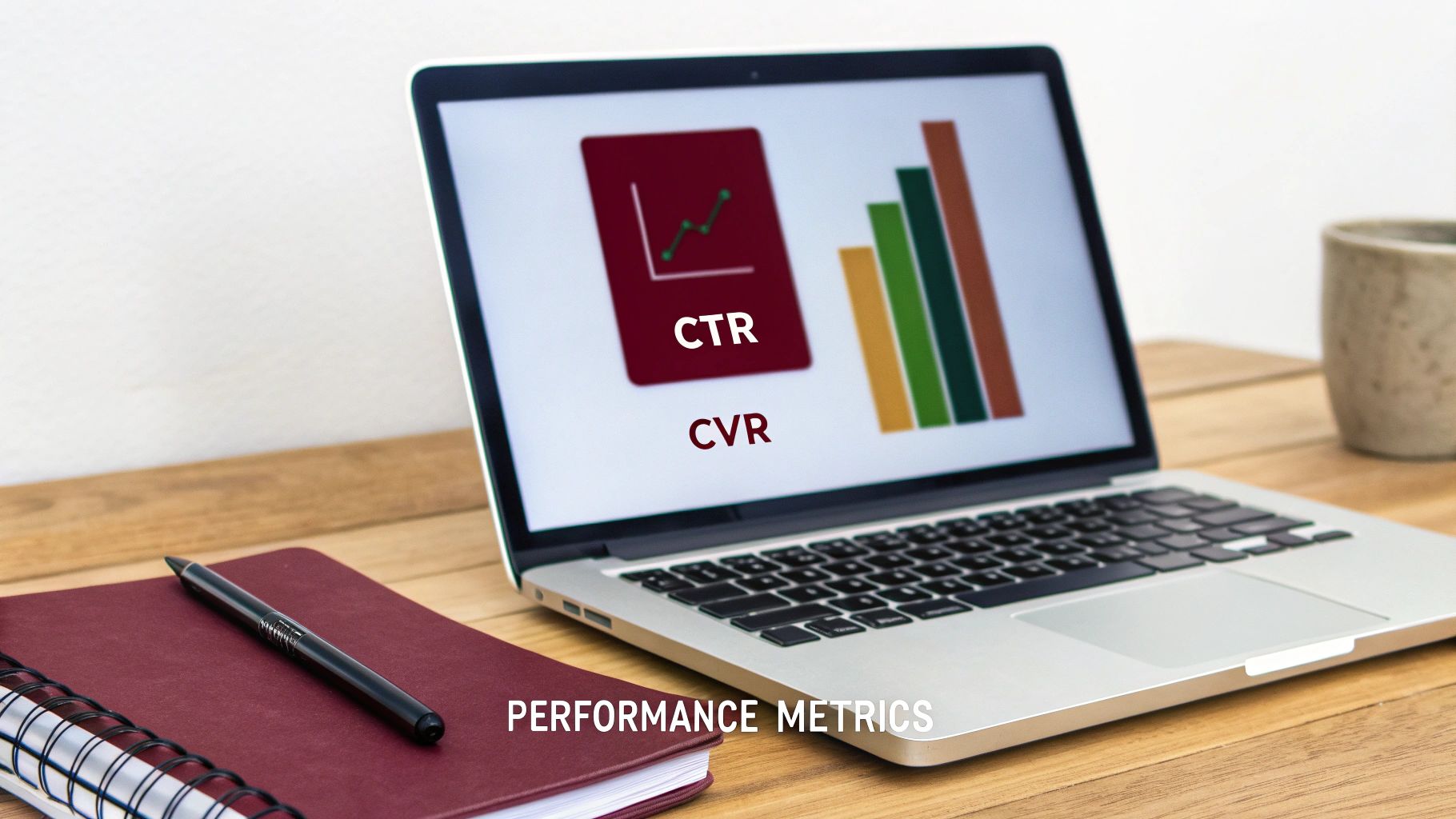
Analyzing performance metrics for branded versus non-branded keywords is essential for the financial management of your PPC strategy. The data reveals shopper behavior and the actual impact of your advertising budget. These two keyword types perform differently across all major metrics, and failing to account for these variances will lead to unrealistic campaign goals.
Branded searches consistently outperform on efficiency metrics. Shoppers searching your brand name are pre-qualified, which results in higher Click-Through Rates (CTR) and Conversion Rates (CVR). This high intent directly lowers the Advertising Cost of Sale (ACOS) because fewer clicks are needed to secure a sale.
Non-branded keywords, however, are the drivers of business growth. These campaigns will have a higher Cost Per Click (CPC) due to broad market competition. Conversion rates are also naturally lower, as these shoppers are still in the consideration phase, comparing multiple products and brands.
1. Click-Through Rate (CTR)
CTR measures the relevance of your ad to a search query. For branded terms, a high CTR is a baseline expectation. A shopper searching for “Osprey hiking backpack” expects to see an ad for that exact product.
- Branded CTR: Typically falls between 0.75% and 2.5%, and can be higher. Lower figures may indicate issues with your main image, pricing, or review score.
- Non-Branded CTR: Generally ranges from 0.3% to 0.6%. These shoppers are browsing, and your ad is one of many options in the search results.
2. Conversion Rate (CVR)
CVR is the definitive measure of purchase intent and shows the most significant contrast between the two keyword types.
- Branded CVR: Rates often exceed 20%. For established brands, 30-40% is achievable. The trust has been established; the shopper simply needs to complete the transaction.
- Non-Branded CVR: Expect rates between 5% and 15%. Convincing these shoppers requires more effort, as your product is being evaluated against numerous competitors.
3. Cost Per Click (CPC)
CPC is driven by competition. Since nearly all sellers in a category bid on high-volume, non-branded keywords, the costs are inherently higher.
- Branded CPC: These are typically lower, often between $0.30 and $1.00. Competition is limited to your brand and a few opportunistic rivals.
- Non-Branded CPC: Costs can easily range from $1.00 to $5.00+. In highly competitive categories like supplements or electronics, CPCs can be substantially higher.
Expecting the same ACOS from a discovery campaign and a brand defense campaign is a common and costly error. You must establish different performance targets for each to accurately measure success and avoid prematurely cutting off your growth channels.
4. Advertising Cost of Sale (ACOS)
ACOS synthesizes all other metrics, showing the direct relationship between ad spend and resulting sales. To get a detailed view of performance, you should regularly leverage the data inside Amazon Brand Analytics.
- Branded ACOS: A well-managed branded campaign should operate at an ACOS of 5% to 15%. Its function is to efficiently capture existing demand, not generate new demand.
- Non-Branded ACOS: An acceptable ACOS is significantly higher, typically between 30% and 60%. During a product launch, it may be even higher. This is an investment in new customer acquisition and organic rank improvement.
Structuring Your PPC Campaigns
Campaign structure is a critical determinant of success. The most important rule in Amazon PPC is to create separate campaigns for branded and non-branded keywords. This separation is the foundation of an effective advertising strategy.
Combining these two keyword types contaminates your performance data, making it impossible to discern what is truly effective. You risk evaluating a customer acquisition campaign using the same ACOS target as a brand defense campaign. This approach often leads to cutting spend on campaigns that are fueling long-term growth.
1. Brand Defense Campaign
A branded campaign is a defensive tactic. Its purpose is to protect your digital real estate from competitors who bid on your brand name to divert traffic. You’ve invested in building brand recognition; this campaign protects that investment.
This campaign must only contain keywords that include your brand name.
- Keyword Examples: “YourBrand,” “YourBrand product name,” “YourBrand for men.”
- Match Types: Use a combination of exact, phrase, and broad match to capture all variations of brand-related searches, including common misspellings.
- Bidding Strategy: The objective is to achieve 100% impression share at the top of search results. Bids must be aggressive enough to maintain this position. The goal is control, not immediate profit.
A properly executed brand defense campaign functions as an inexpensive insurance policy. The ACOS is typically very low, and it prevents competitors from capturing customers who are specifically searching for your brand.
For a more detailed analysis, our article on Amazon PPC brand defense provides further insights.
2. Non-Branded Campaigns
Non-branded campaigns are your offensive growth drivers. They are used to discover new customers, improve organic ranking for high-value generic keywords, and increase market share.
These campaigns should target broad, descriptive keywords related to your product’s category, function, or benefits.
- Keyword Examples: “portable power bank,” “stainless steel water bottle,” “winter hiking boots.”
- Match Types: Start with automatic campaigns and broad match ad groups to allow Amazon’s algorithm to identify relevant search terms. Once converting terms are identified, move them into dedicated exact match campaigns for greater control.
- Bidding Strategy: Concentrate bids on securing top-of-search placements for your most important keywords. Since over 80% of clicks occur on page one, visibility is critical. The ACOS will be higher, but the objective is new customer acquisition and organic rank improvement, not immediate profitability.
3. Campaign Segmentation
For established brands, separating branded and non-branded keywords is only the first step. Advanced sellers implement further segmentation for more granular control over ad spend.
Consider these additional layers for your non-branded strategy:
- Category Campaigns: Group keywords by product categories, such as separate campaigns for “running shoes” and “trail shoes.”
- Competitor Campaigns: Target competitors directly by bidding on their brand names and ASINs to appear on their product detail pages and in relevant search results.
- Top Performers Campaign: Isolate your best-performing non-branded keywords, those with high search volume and strong conversion rates. Place them in a dedicated campaign with a significant budget and bid to dominate those search results.
This structured approach allows you to allocate budget precisely where it will have the greatest impact. You can fund high-ACOS growth campaigns without compromising the efficiency of your defensive branded campaigns.
Allocating Bids and Budgets
The allocation of your ad budget between branded and non-branded campaigns is a strategic decision influenced by your brand’s maturity, market competition, and overall business objectives. A proper allocation balances customer acquisition with brand protection. An improper one will either stifle growth or result in overspending on defense.
The fundamental principle is that branded campaigns focus on defense and efficiency, while non-branded campaigns drive growth and discovery. Their bidding strategies and budget requirements are distinct, and applying a uniform approach is a common mistake.
1. Bidding Strategies
Your bids must align with the value of each click. For branded terms, you are capturing the attention of a shopper already seeking you out. For non-branded terms, you are paying for an introduction to a new potential customer.
Branded Keyword Bids: The sole objective is to achieve 100% top-of-search impression share. You must own this space. Your bids need to be high enough to consistently block competitors from capturing your traffic. This creates a “brand tax,” making it cost-prohibitive for others to bid on your name. While your CPC will likely be low, your bid itself must be aggressive.
Non-Branded Keyword Bids: This is where you must invest, especially for keywords driving sales. The majority of clicks occur on the first page of search results, so your bids must be sufficient to secure these top placements. For more detailed targeting information, our guide on Amazon Ads match types offers a complete breakdown.
2. Budget Allocation
Your budget division is not a static decision. It should evolve with your brand’s development. A startup has different needs than a well-known brand.
An effective budget split must be dynamic. Review your allocation quarterly to ensure it aligns with your current market position and strategic goals.
A new brand might implement a 20/80 split, investing most of its budget in discovery. As the brand gains momentum and its branded search volume increases, that ratio could shift to a more balanced 40/60 or even 50/50.
3. Budget Split Frameworks
Here are three practical frameworks for allocating your ad spend:
New or Emerging Brands: Allocate 70-80% of your budget to non-branded campaigns. Your priority is reaching new customers and building awareness. The remaining 20-30% should fund a defensive branded campaign to capture anyone searching for you by name.
Established Brands: A more balanced 50/50 or 60/40 split (favoring non-branded) is often optimal. At this stage, you have significant brand equity to protect while still needing to fuel growth and fend off competitors in the broader category.
Market Leaders: You might shift to a 40/60 split, dedicating 40% to a robust brand defense strategy while using 60% to target competitors and maintain dominance on high-volume generic terms. Your branded search volume is now a significant asset that requires substantial protection.
Advanced Optimization and Measurement
Once your campaigns are structured and running, ongoing management is required. This involves continuously refining targeting, eliminating wasted spend, and understanding the synergistic impact of your advertising efforts. This moves beyond ACOS analysis to see how your campaigns collectively grow your brand.
Mastering negative keywords is a critical first step for maintaining clean and actionable campaign data.
1. Negative Keywords for Purity
To obtain an accurate measure of performance, you must prevent your branded and non-branded campaigns from overlapping. The most effective method is to add your brand name as a negative exact match in all non-branded campaigns.
This simple action achieves two critical objectives:
- It directs all branded search traffic to your brand defense campaign, enabling accurate performance measurement.
- It preserves the integrity of your non-branded campaign data. Without this separation, low-cost, high-converting branded terms can inflate performance metrics, masking underperforming generic keywords.
Without this enforcement, you cannot make informed decisions about bidding and budgets. You might scale a non-branded ad group that appears successful only because it is capturing branded searches.
2. Mining Search Term Reports
The Search Term Report provides direct insight into customer search behavior. It reveals the exact phrases shoppers use before clicking your ads. A weekly review of this report is essential for identifying new keyword opportunities and eliminating inefficient spending.
Look for high-performing, non-branded search terms within your automatic and broad match campaigns. When you identify a keyword that has driven multiple sales at an acceptable ACOS, graduate it. Move that exact term into its own manual campaign where you can apply a precise bid and dedicated budget. For a more detailed look at this process, our guide on Amazon PPC bid optimization covers more advanced techniques.
Your non-branded campaigns should continuously feed your high-performance exact match campaigns. This systematic process of harvesting and graduating keywords is how you scale ad spend effectively.
3. Measuring Brand Growth
The ultimate indicator of your non-branded ad spend’s success is an increase in your branded search volume. As you invest in discovery campaigns, you should observe a corresponding rise in the number of shoppers searching for you by name. This validates that your strategy is effective.
Amazon’s enhanced branded search identification provides a clearer picture. The branded search rate, calculated as branded searches divided by impressions, directly measures this ad-driven awareness. A campaign achieving a 5-10% branded search rate indicates that your ads are successfully prompting shoppers to seek out your brand. These searches often result in conversion rates over 40% higher than average due to pre-existing purchase intent.
By consistently analyzing your Search Term Reports, using negative keywords precisely, and tracking the growth in your branded search volume, you can build a data-driven engine that drives sales today while building a more valuable brand for the future.
Creating a Keyword Flywheel Effect
Branded and non-branded keywords are not separate strategies; they are interconnected components of a growth loop. This “flywheel effect” distinguishes brands that simply advertise from those that strategically build a dominant presence on Amazon. The process begins with a single, well-targeted non-branded ad.
The strategy is based on a straightforward customer journey. A shopper searching a generic term like “noise cancelling earbuds” clicks your non-branded ad, purchases your product, and has a positive experience. The next time they need a similar item, they search for your brand directly.
1. Fuelling the Flywheel
Your non-branded campaigns provide the initial momentum for the flywheel. They are your top-of-funnel customer acquisition tool, introducing your brand to new audiences. Each sale from a non-branded keyword is an investment in a future branded search.
On Amazon, 81% of clicks go to listings on the first search results page, with 64% concentrated in the top three positions. This underscores the importance of aggressive bidding on high-value non-branded terms. Securing this initial visibility is the only way to earn the click that introduces a new customer to your brand.
2. Capturing Demand
As your non-branded efforts succeed, you will see a measurable increase in your branded search volume. This is where your defensive branded campaigns become crucial. Their role is to efficiently capture this high-intent demand you’ve created, converting shoppers who are now actively seeking you out by name.
This cycle creates a positive feedback loop for Amazon’s A10 algorithm:
- Increased Sales Velocity: More branded searches lead to more sales, boosting your overall sales velocity.
- Higher Conversion Rate: Branded terms convert at a higher rate, signaling to Amazon that your product is highly relevant for those searches.
- Improved Organic Rank: The combination of high sales velocity and conversion rate for both branded and related non-branded terms improves your organic ranking across the board.
The ultimate objective of your non-branded spend is not just the initial transaction. It’s to convert a generic searcher into a brand loyalist who returns and searches for you by name.
3. Measuring Momentum
The flywheel’s success can be tracked with specific metrics. Monitor your branded search volume in Brand Analytics over time. As you increase investment in non-branded campaigns, you should see a corresponding lift in searches for your brand name, proving that your top-of-funnel ad spend is effectively building brand equity.
Beyond Amazon’s internal tools, broader market trend analysis can provide additional insights. Understanding how to apply different data sources can help optimize campaigns by leveraging web data for advanced optimization. This integrated approach, where non-branded spend creates branded loyalists, is the foundation for sustainable, long-term growth on the marketplace.
Common Questions We Get Asked
When managing Amazon PPC, the distinction between branded and non-branded keywords often raises several questions. Here are answers to the most common queries we receive from sellers refining their advertising strategy.
1. Should I Bid On My Brand Name?
Yes, absolutely. It is a necessary defensive tactic. If you do not occupy the top ad spot for your own brand name, a competitor will.
This strategy, known as “brand defense,” is about controlling the narrative and preventing rivals from capturing high-intent shoppers who are already looking for you. The ACOS on these campaigns is almost always extremely low, making it a cost-effective form of brand protection.
2. What Is a Good ACOS?
This depends entirely on your objective. There is no single correct answer.
- For profitability: Your target ACOS must be below your product’s break-even profit margin. If your margin is 35%, a 25% ACOS is profitable.
- For growth or launch: A higher ACOS of 40% to 70% or more is often a strategic investment. You are purchasing market visibility, data, and improved organic ranking, not immediate profit.
Never apply a single ACOS target to all campaigns. A brand defense campaign might run at a 10% ACOS, while a new product launch campaign might strategically operate at a 60% ACOS. Both can be correct for their specific purpose.
3. How to Keep Branded Searches Out?
Negative keywords are the tool for this. It is a simple but critical administrative task.
Add your brand name, including common misspellings and variations, as negative exact match keywords to all of your non-branded campaigns. This includes automatic, broad, and phrase match campaigns. This action prevents data contamination, providing a clear view of performance and enabling smarter budget allocation.
4. When to Shift Budget?
Your budget allocation should evolve with your brand. A new brand is in discovery mode and might allocate 80% of its budget to non-branded keywords to attract new customers.
As your brand gains traction, indicated by rising branded search volume in Brand Analytics, it is time to rebalance. A mature brand might move to a 50/50 split. This reflects a shift from a pure customer acquisition strategy to a dual approach of attracting new shoppers while actively defending an existing customer base.