
Amazon customer retention is the percentage of buyers who return to purchase from your brand again after their first order. On a platform where Amazon controls the inbox, hides customer email addresses, and places a competitor one click away from every listing, keeping a customer is harder than on any other channel.
The average repeat purchase rate for third-party sellers sits between 20% and 40% depending on category. Amazon Prime members renew at a 93% rate after year one and 98% after year two. That gap exists because Amazon invests in retention infrastructure at a scale most individual brands never replicate. The gap is also where most seller revenue quietly disappears.
Repeat customers spend 67% more per order than first-time buyers. Acquiring a new customer costs between 5 and 25 times more than keeping an existing one. A 5% improvement in retention can increase profits by 25% to 95%. This explains why the most profitable Amazon brands shift their attention toward retention once their acquisition channel is established. Every customer who does not return is a customer you paid to acquire and never fully monetized.
Why Amazon Retention Works Differently
Most retention strategies work for direct-to-consumer brands with email lists, owned websites, and full CRM access. Amazon retention operates under different rules. You do not own the customer relationship. You cannot build a points-based loyalty program. Amazon controls which products appear in reorder suggestions, and it controls what communication reaches the customer after purchase.
That constraint is also the opportunity. Amazon’s tools reach the customer exactly where they already buy. You are not pulling them to a new platform. You are meeting them at the moment of intent, using tools Amazon built specifically to help brand-registered sellers drive repeat purchases.
The three platform-specific challenges every Amazon seller faces:
- You cannot directly email customers after purchase
- You cannot run traditional loyalty programs with points or tiers
- Amazon controls reorder recommendations, not you
How to Measure Retention in Amazon Brand Analytics
You cannot improve what you do not measure. Amazon provides precise retention data. The problem is that most sellers never look at it.
1. Repeat Purchase Behavior Report
Under Seller Central → Brands → Brand Analytics → Consumer Behavior Analytics → Repeat Purchase Behavior report provides detailed retention data per ASIN and brand.
Vendor Central users find the same report under Reports → Analytics → Consumer Behavior Dashboards → Repeat Purchase Behavior.
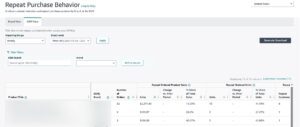
Once inside, switch from Brand View to ASIN View using the toggle at the top. Brand View gives you a brand-level picture. ASIN View shows exactly which products generate loyal buyers and which generate one-time purchases. These are very different problems requiring very different responses.
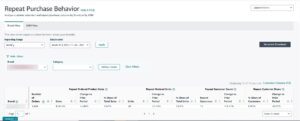
The Time Between Orders column is the most actionable figure in the report. It shows the average number of days between a customer’s first and second purchase per ASIN. This number sets the timing for every retargeting and re-engagement campaign you run. Pull this report every Monday. If repeat purchase percentage on a key ASIN drops two weeks in a row, something changed and it needs investigation before it compounds.
Consumable and replenishment categories should sit at 30% to 40% repeat purchase rate. Durable goods are healthy at 15% to 20%. Any consumable ASIN below 10% has a product quality or listing optimization problem.
2. Customer Loyalty Analytics Dashboard
Under Seller Central → Brands → Brand Analytics → Customer Loyalty Analytics, the dashboard segments your entire customer base into four behavioral tiers based on purchase recency, frequency, and spend.
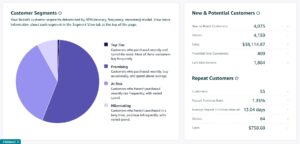
Top Tier: High-frequency, high-spend buyers who purchase without needing incentives. Protect this segment with exclusive new product access. Do not discount them reflexively.
Promising: Buyers who have purchased more than once but have not yet reached consistent frequency. One well-timed promotion or a Subscribe & Save nudge moves a Promising buyer into Top Tier.
At-Risk: Previously active buyers whose frequency is declining. This segment is time-sensitive. The window to recover an At-Risk customer is short, and a targeted discount at the right moment is the most reliable recovery lever.
Hibernating: Buyers who have gone completely inactive. Recovery is harder but remains possible for consumable products. A compelling re-engagement offer paired with a new product announcement produces the best response rates in this group.
Pull this report every Monday. If the At-Risk count on any ASIN has grown since last week, check inventory levels first since stockouts are the most common cause of involuntary churn, then check recent ratings for product quality, and then act with a re-engagement campaign before the window closes.
3. Numbers You Should Track First
Before building any retention campaign, establish these three figures for each top ASIN:
Repeat Purchase Rate: What percentage of customers who bought this ASIN once came back within 90 or 180 days.
Customer Lifetime Value: Average order value multiplied by average order frequency multiplied by average customer lifespan in months. This tells you exactly what each retained customer is worth and how much you can justify spending to keep them.
Time Between Orders: The average days between first and second purchase, available in the Repeat Purchase Behavior report. This is your remarketing trigger. If Time Between Orders on a supplement is 47 days, your re-engagement campaign goes out on day 40, not day 90.
Amazon Customer Retention Strategies 2026
Measuring retention tells you where the gaps are. The retention strategies below close them. Each one uses a tool Amazon already provides to brand-registered sellers. What they require is consistent execution and an understanding of which tool fits which stage of the customer journey.
Strategy 1: Subscribe and Save
Subscribe & Save converts one-time buyers into customers with automatic recurring orders. No other tool on Amazon creates the same level of purchase predictability.
Subscribers carry 3x the lifetime value of regular customers and purchase 2.5x more frequently. A 5% seller-funded discount is enough to double Subscribe & Save conversion rates. The economics are more favorable than most sellers expect before they test it.
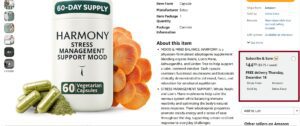
Customers who subscribe receive free shipping and a 5% discount. In health, baby care, grocery, and beauty categories, customers with five or more active subscriptions qualify for a 15% discount on eligible items. All other categories are capped at 10%.
Subscribe & Save works best for replenishment products with a natural reorder cycle: supplements, vitamins, coffee, food, baby care, beauty and personal care, pet food, and household cleaning supplies. If your catalog includes any product a customer uses up and replaces, it belongs in this program.
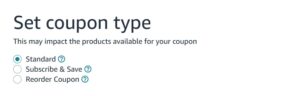
For enrolment, go to Seller Central → Advertising → Coupons → Set coupon type to “Subscribe & Save” → Select products → Define discount. Here you can monitor active subscriber shipped units, and shipped revenue.
Strategy 2: Brand Tailored Promotions
This is the most direct method for increasing customer retention because it allows you to move away from “spray and pray” coupons and instead offer exclusive discounts to specific shoppers based on their history with your brand.
Under Seller Central → Advertising → Brand Tailored Promotions, you can access and create promotions.
When you create a promotion in Seller Central, you will be asked to select a specific goal. Each goal has different audience segments tailored to that objective.
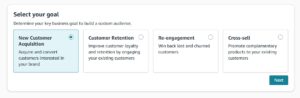
Goal 1: New Customer Acquisition
While this sounds like an acquisition tool, it plays a vital role in the retention lifecycle by capturing high-intent shoppers before they drift to competitors.
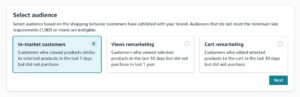
- In-Market Customers: Audiences actively researching products in your specific category in last 7 days but who have not bought yet.
- Views Remarketing: Shoppers who have clicked on your brand or products recently but have not purchased in the last 12 months.
- Brand Cart Abandoners: Customers who added your product to their cart in the last 30 days but haven’t purchased yet.
Goal 2: Customer Retention
This is the core of your loyalty strategy. These options allow you to reward your best customers to keep them coming back.
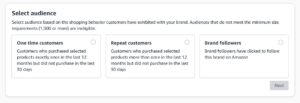
- One Time Customer: Customers who purchased selected products exactly once in the last 12 months but did not purchase in the last 30 days.
- Repeat Customers: Customers who purchased selected products more than once in the last 12 months but did not purchase in the last 30 days
- Brand Followers: Brand followers have clicked to follow this brand on Amazon.
Goal 3: Re-engagement
Use this to win back customers who are showing signs of churn or have stopped buying from you entirely.
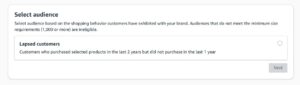
- Lapsed Customers: Customers who previously purchased from you but have not bought anything in the last 12 months.
Goal 4: Cross-sell
This strategy increases Customer Lifetime Value (CLV) by introducing your existing buyers to other products in your catalog.
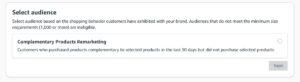
Complementary Product Remarketing: Targets customers who viewed or purchased products that frequently sell alongside your items (e.g., targeting a customer who bought your shampoo with a discount for your conditioner).
For instance, looking back at the example in the previous section where we identified 1,864 cart abandoners: this is a “hot” audience. Because these shoppers are already familiar with your brand and showed high intent, you should target them by selecting the New Customer Acquisition goal. This is often the quickest win for generating immediate orders.
Conversely, if your data reveals a low repeat purchase rate, you should focus on the Customer Retention goal. Specifically, target the Repeat Customers audience (shoppers who ordered more than once in the last 12 months but not in the last 30 days). This tactic is highly effective for consumables such as toiletries, supplements, or pet food that require regular replenishment.
While Amazon requires a minimum discount of 10% for these promotions, a standard offer may not be enough to win back lost sales. To effectively convert Cart Abandoners, we recommend applying a discount of at least 20% to provide the necessary nudge to finalize the purchase.
Strategy 3: Sponsored Display Retargeting
Sponsored Display reaches previous customers and high-intent audiences across Amazon, Amazon-owned properties, and third-party websites. For retention, it is the paid channel that keeps your brand visible during the natural reorder window, reaching customers not just when they are searching, but when they are browsing between purchase decisions.
Under Seller Central → Advertising → Campaign Manager → Create Campaign → Sponsored Display → Audiences → Remarketing audiences and target customers who previously viewed or bought products from your brand.
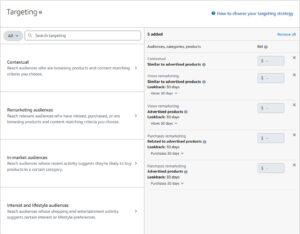
The most common Sponsored Display retention mistake is using a default 30-day window for a product with a 60-day reorder cycle. The ads stop running before the customer is ready to buy again. Match every retargeting window to the Time Between Orders figure from Brand Analytics:
- Time Between Orders of 30 days: Start serving ads from day 20
- Time Between Orders of 45 to 60 days: Start serving ads from day 40
- Time Between Orders of 90 days or more: Start serving ads from day 75
Prime Day and other major sales events bring a surge of new buyers who will not return without structured follow-up. In the first 7 days after the event, run Sponsored Display Purchase Remarketing on all event buyers.
From day 7 to day 30, layer a BTP Recent Customers campaign to cross-sell a complementary product at 10%. From day 30 to day 60, if no second purchase, shift those buyers into a BTP One-Time Customers campaign at 15%.
After day 60 with no conversion, move non-responding buyers into DSP lapsed audience retargeting if you have access to Amazon DSP.
Strategy 4: A+ Content and Brand Store
Most sellers treat A+ Content as a first-purchase conversion tool. It is also a retention tool. Every time a loyal customer returns to reorder and lands on your product page, the quality of that experience either reinforces or quietly erodes their loyalty.
Returning customers are not reading your listing for the first time. They are confirming their decision. A+ Content should remind them why your product is worth continuing to buy. Include usage instructions, before and after comparisons where relevant, dosage reminders for supplements, and care instructions for applicable products. Customers who fully understand and use your product correctly have lower return rates and higher reorder rates.
Use comparison chart modules within A+ Content to map your product variations against real customer use cases. This cross-sells your catalog naturally and helps returning customers discover products they did not know you made.
Under Seller Central → Advertising → A+ Content Manager, you can build and update your Brand Store pages.
Your Amazon Brand Store is the one page on the platform you control completely. Organize it for repeat visits. Structure it with a Best Sellers section for your highest-repeat ASINs, a New Arrivals section for recent launches, and a Bundle Deals section designed to cross-sell existing customers into higher order value purchases. Update the store at minimum once per month. A store that never changes gives returning customers no reason to come back.
Under Seller Central → Stores → Manage Stores, you can build and update your Brand Store pages.
Strategy 5: Cross-Selling and Upselling
Retention does not always mean the same product in the next order. It means the same brand. Cross-selling and upselling within your catalog increase the number of your ASINs a customer buys regularly, which makes them exponentially harder to lose. A customer who buys three of your products has invested in your brand rather than in a single item. A competitor would have to displace all three products simultaneously to win that customer back.
Brand Story as a Cross-Selling Medium
Amazon Brand Story is an A+ Content module that appears on every product detail page across your catalog. It is one of the most underused cross-selling tools available.

A well-built Brand Story does not just tell customers who you are. It shows them the full range of problems your brand solves. When a customer reads about the founding reason behind your brand and sees that your values align with what they care about, they become more likely to explore your other products. Brand affinity converts browsers into catalog buyers.
Structure your Brand Story around the customer’s need, not your company history. Lead with the problem your brand was built to solve. Show how your product range addresses that problem at different stages or use cases. Include a clickable link to your Brand Store so customers who engage with the story can immediately explore the full catalog. Customers who click through a Brand Story to the Brand Store convert at a higher rate on second and third product purchases than those who arrive through search alone.
A Brand Story that communicates a clear, credible, and consistent identity also reduces price sensitivity among repeat buyers. Customers who feel connected to a brand are less likely to leave for a cheaper alternative.
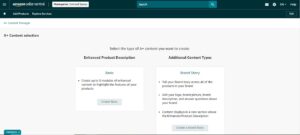
Under Seller Central → Advertising → A+ Content Manager → select Brand Story from the content type options. Once published, the Brand Story module appears on every ASIN you apply it to automatically.
Virtual Bundles
Virtual Bundles let brand-registered sellers group two to five complementary ASINs into a single bundle listing without physically packaging them together. Amazon ships the items separately from existing FBA inventory. Bundles appear on product detail pages as “Explore related collections” and are discoverable in search.

Pair your highest-repeat ASIN with the complementary product a customer would naturally buy next. Set the bundle price below the combined individual prices. A 5% to 15% bundle discount is standard. The visual comparison of individual prices versus the bundle price is the conversion mechanism.
Under Seller Central → Brands → Virtual Bundles, you can access and create Virtual bundles.
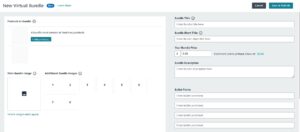
Inside the builder, search for and add 2 to 5 complementary ASINs, set the bundle price below the combined individual prices, write a bundle title that describes the combined use case rather than just listing the products, add a main bundle image, and submit for review.
Variation Pages for Natural Upsell
Organize ASIN variations strategically. If you sell a product in a standard size and a larger size, the variation page creates a natural upsell at the moment of reorder. Display the per-unit price clearly for each variation. Customers who see that the 90-count option costs 30% less per unit than the 30-count will often upgrade on their second purchase. Customers who migrate to the larger size have higher lifetime value than those who stay on the smallest option indefinitely.
Strategy 6: Package Inserts
The physical package is the only communication channel you control completely on Amazon. It arrives in the customer’s hands, branded with your imagery, and it forms the final impression that determines whether they come back.
Amazon’s packaging insert policy prohibits external website URLs, review requests, and any contact information that routes customers off Amazon. Everything you include must stay within Amazon’s ecosystem and deliver genuine value.
Compliant inserts that drive repeat purchases include a reorder card with your ASIN and a QR code linking to your Amazon listing with a note pointing customers to Subscribe & Save, a product usage guide that increases perceived value and reduces the likelihood of returns, a printed card featuring two or three other products from your catalog with their ASINs, and a Subscribe & Save reminder that shows the discount percentage clearly.
Do not include requests for 5-star reviews, incentives for feedback of any kind, negative review suppression language, or external website URLs. Amazon’s enforcement on packaging inserts has been increasingly active since 2025, and any insert that tries to manipulate the review process or redirect traffic off Amazon carries real account risk.
Strategy 7: Pricing Consistency and the Retention Effect
Price volatility is an invisible churn driver. When customers see your product at $29.99 one week and $24.99 the next, they stop buying at full price. They wait for the discount. Time Between Orders extends artificially, Subscribe & Save churn rises as subscribers pause for better pricing, and lifetime value per customer falls.
Consistent everyday pricing with predictable, time-limited promotional events trains customers to buy when they need the product.
How To Reduce Churn Rate on Amazon
A customer who has a problem resolved quickly is often more loyal than one who never had a problem at all. The post-purchase exception is a retention opportunity when you handle it well.
Amazon’s A-to-Z Guarantee protects buyers on third-party orders covering late or missing deliveries and items not matching their description. Claim ratios affect account health and Buy Box percentage directly. Sellers with lower claim rates and faster response times hold better Buy Box percentages and better organic rankings.
1. Messaging Response Time
Respond to customer messages within 4 hours during business hours. Amazon requires responses within 24 hours. Set up mobile notifications for Seller Central messages. Every additional hour of delay after a customer sends a complaint increases the probability of a claim.
2. Proactive Shipping Communication
For FBM orders, send tracking confirmation within your stated handling time. If a shipment is delayed, contact the customer before they contact you. Proactive communication about a delay is one of the most reliable ways to prevent both a claim and a negative review at the same time.
3. Return Policy Clarity in Your Listing
State your return policy clearly in the product description. Customers uncertain about returns are less likely to buy. Customers who discover an unexpected return restriction after purchase are unlikely to return to your brand. A clear, fair return policy reduces purchase hesitation and post-purchase anxiety in the same sentence.
Frequently Asked Questions
What is Amazon customer retention?
Amazon customer retention is the practice of keeping buyers who have purchased from your brand returning for repeat orders. It uses Amazon’s native tools including Brand Analytics, Subscribe & Save, Brand Tailored Promotions, Sponsored Display, and the Manage Your Customer Engagement tool to reduce churn and increase customer lifetime value over time.
How do I check my repeat purchase rate on Amazon?
Under Seller Central → Brands → Brand Analytics → Consumer Behavior Analytics → Repeat Purchase Behavior, the report shows your repeat order percentages by brand and ASIN. Switch to ASIN View to see the figures for individual products. The data refreshes within 72 hours and can be exported for further analysis.
What is a good repeat purchase rate on Amazon?
For consumable categories including supplements, food, beauty, and household products, 30% to 40% is strong. For durable goods, 15% to 20% is healthy. Consumable ASINs below 10% have a product or listing quality issue, not a marketing problem.
What is the best Amazon tool for customer retention?
Subscribe & Save produces the strongest documented results, with subscribers carrying 3x the lifetime value and 2.5x the purchase frequency of non-subscribers. Brand Tailored Promotions is the most targeted active tool for reaching specific customer segments with precision discounts.
How do Brand Tailored Promotions work?
Brand Tailored Promotions let brand-registered sellers offer 10% to 50% discounts to specific customer segments based on actual purchase and engagement history. The discount appears as a green badge on the product page and in search results, visible only to customers in the targeted audience. There is no platform fee. You pay only the cost of the discount when redeemed.
What are ASIN-level BTP audiences?
Added in Amazon’s October 2024 update, ASIN-level BTP audiences allow you to target customers based on their behavior with a specific product rather than your entire brand. The four ASIN-level audiences are Views Remarketing, Cart Remarketing, One-Time Customers, and Lapsed Customers.
How do I grow my follower count for MYCE?
Post 3 to 5 times per week using Amazon Posts. Ensure your Brand Store homepage has a visible Follow button. Run Amazon Live sessions for product demonstrations. Every engagement with your brand content creates a path to a new follower.