
Amazon’s advertising business has exploded into a multi‐billion dollar segment. In 2024 Amazon Ads generated about $56.2 billion in revenue (up ~18% from 2023), making it the third‐largest ad network after Google and Meta.
For Amazon sellers, this rapid growth suggests tremendous potential: Amazon shoppers are already in a buying mindset, so putting a product in front of them can yield high returns. To turn this massive potential into stable monthly revenue is not an automatic process; it requires precise Amazon ads management to filter out window shoppers and target the customers who are actually ready to buy.”
We’ll go deep into the data, case examples, and best practices that show how advertising on Amazon drives ranking, clicks, and sales and how it stacks up against other channels.
Why Buyer Intent on Amazon Matters
Amazon shoppers exhibit exceptionally high purchase intent, making ads unusually effective. Unlike browsing on Google or social media, people on Amazon know what they want to buy.
Amazon search ads often catch customers “further down the sales funnel,” meaning they’re ready to purchase. In fact, Amazon shoppers convert at much higher rates than on other e‑commerce sites.
Average Amazon PPC conversion rate is around 9–10% (even reaching 10.33% in 2025 data), compared to only about 1–2% for typical e‑commerce advertising. This 7–10x higher conversion reflects the platform’s intent‐driven audience.
A report by Analytic Partners found Amazon ads deliver roughly 20% higher ROI than a brand’s average marketing spend. In practice, this means dollars spent on Amazon often turn into proportionally more sales than the same budget on broader channels.
1. Multiple Amazon Ad Types
Multiple ad types let sellers reach those ready‐to‐buy shoppers. Sponsored Products (keyword‐ targeted product ads) are the backbone of Amazon PPC, appearing in search results and on product pages to boost organic ranking.
Sponsored Brands display your logo and multiple products at the top of search results, building brand awareness. Sponsored Display ads enable retargeting off and on Amazon, reaching customers who viewed your (or similar) products.
Together, these tools exploit Amazon’s unique advantage: first‐party data on user behavior. When a shopper searches for “wireless headphones” and sees your Sponsored Product, that click is extraordinarily valuable, it’s a user with immediate purchase intent.
Even Amazon’s streaming/video platform has joined in (ads on Prime Video), further extending the high-intent reach. In short, Amazon Ads target real shoppers in a shopping mindset, not just window‐shoppers.
2. Amazon PPC vs Other E-commerce Ads
The table below shows why advertising on Amazon is so effective for direct sales.
| Metric | Amazon PPC (Average) | Typical E-commerce Ads (Average) |
|---|---|---|
| Conversion Rate | 9-10.5% | 1.3% |
| Shopper Intent | High (Ready to Buy) | Low to Medium (Browsing) |
| Environment | Marketplace | Social Media, Search Engines |
| Primary Goal | Direct Sales | Brand Awareness, Lead Gen |
According to 2025 benchmarks, for every 1,000 clicks, a typical Amazon PPC campaign could generate around 100 sales. An off-site e-commerce ad might get 13. This performance gap is why a well-managed campaign can deliver strong returns. You can check the latest Amazon advertising benchmarks for more details.
Ultimately, whether Amazon PPC works for you depends on three key factors:
Retail Readiness: A great ad campaign can’t fix a weak product page. You need quality images, compelling copy, and good reviews before spending money on ads.
Understanding Margins: You must know your break-even ACoS (Advertising Cost of Sale) to determine if your campaigns are profitable. Without knowing your numbers, you’re flying blind.
A Clear Objective: Your goal, whether it’s launching a new product, defending market share, or clearing out inventory, will dictate your entire advertising strategy.
How to Measure If Your PPC Is Working
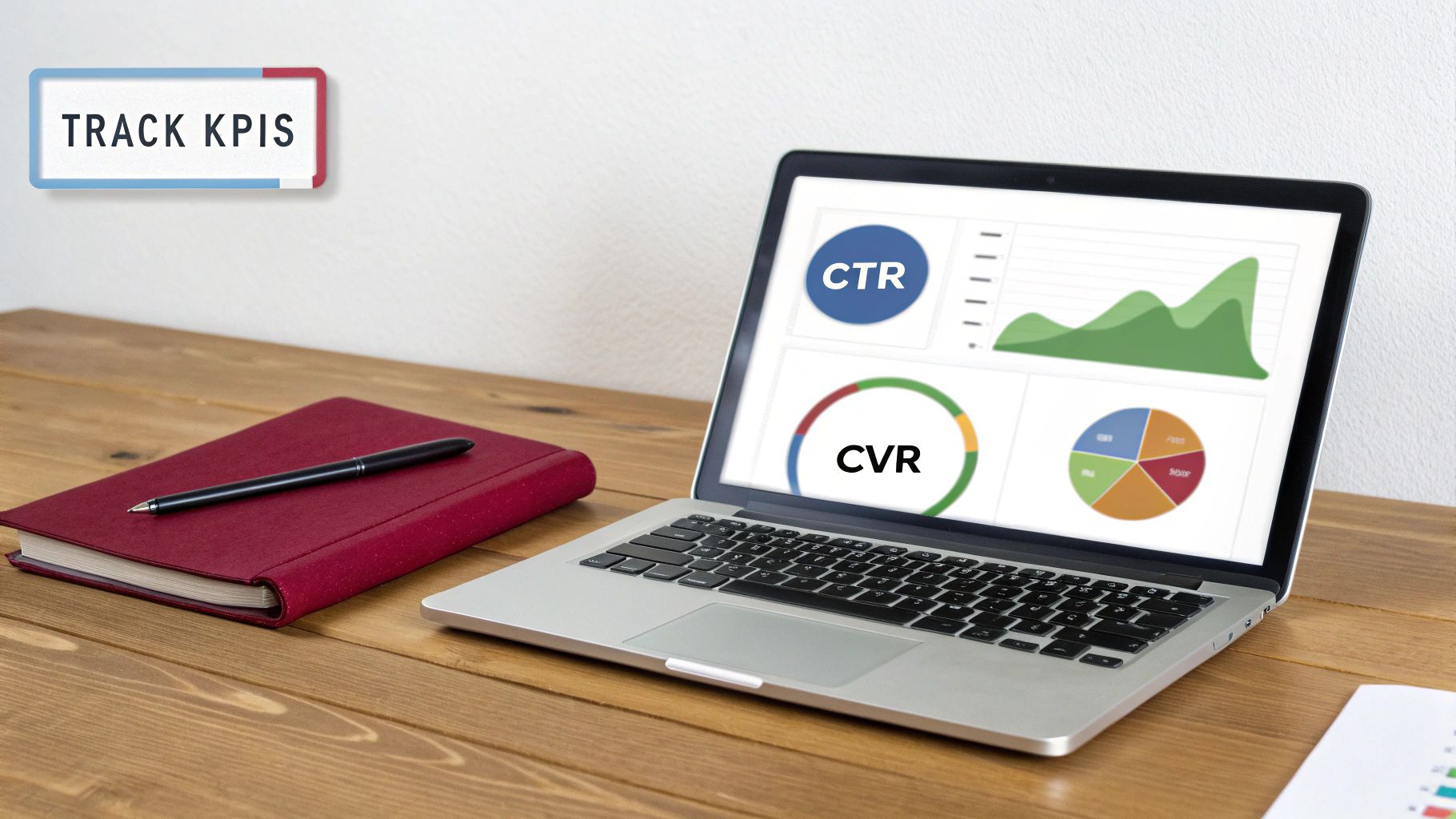
Success with Amazon PPC is about what the data tells you. To find out if your ads are making money, you have to track the right Key Performance Indicators (KPIs).
To track Amazon PPC performance, sellers use a key KPI called ACoS (Advertising Cost of Sales). ACoS is calculated as Ad Spend ÷ Ad Sales × 100 and shows the percentage of revenue spent on advertising. It directly indicates whether ad-driven sales are profitable or operating at a loss.
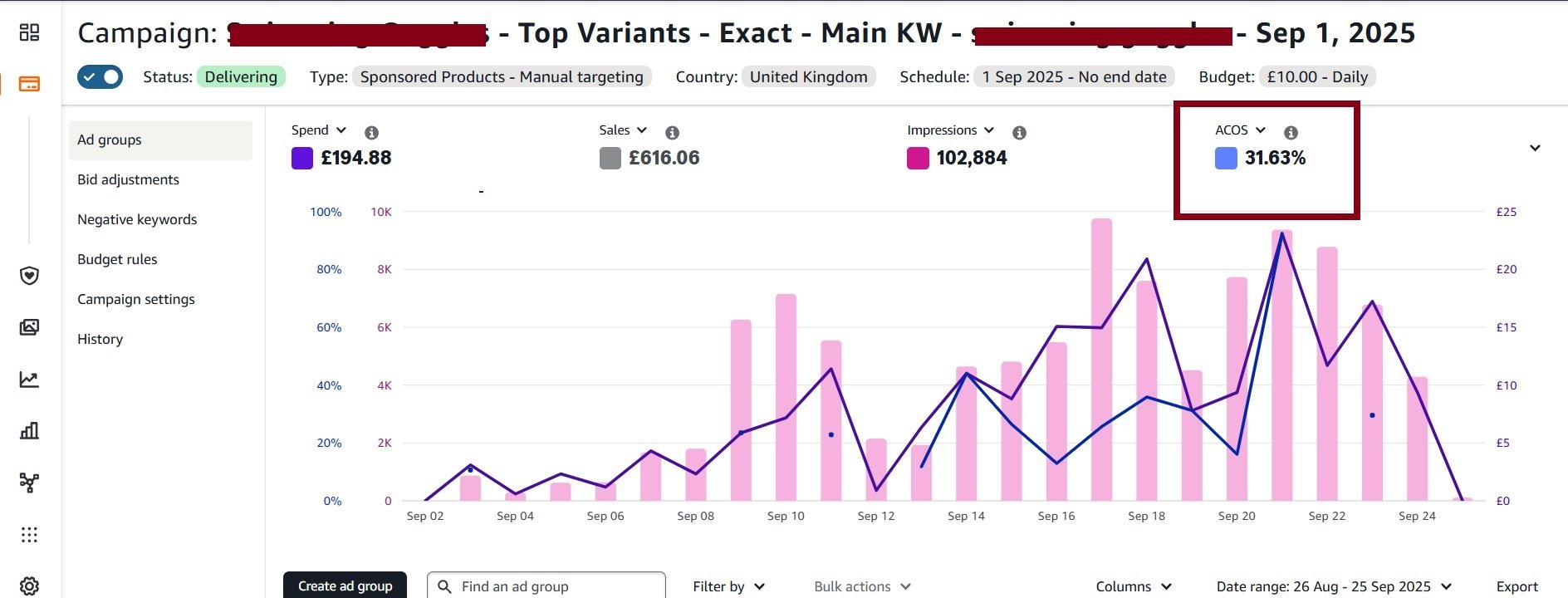
The first step is to calculate your break-even Advertising Cost of Sales (ACoS). This is the maximum you can spend on ads before you start losing money on a sale. For example, if your product has a 30% profit margin before ad spend, your break-even ACoS is 30%. Any ACoS below that number means you’re profitable on ad-driven sales.
1. The Most Important PPC Metrics
While break-even ACoS is the starting point, a few other metrics provide a complete picture of your campaign’s health. You can’t just look at one number in isolation.
Total Advertising Cost of Sales (TACoS): This metric measures your total ad spend against your total sales, both organic and ad-driven. A falling TACoS over time is a positive sign, indicating your ads are boosting your organic rank and increasing overall sales.
Conversion Rate (CVR): This is the percentage of clicks that result in a sale. A high CTR but a low CVR usually points to an issue with your product page, such as a high price, poor reviews, or unconvincing bullet points.
Click-Through Rate (CTR): This shows the percentage of people who see your ad and click it. A low CTR could mean your main image isn’t grabbing attention or your ad copy doesn’t match what shoppers are searching for.
These metrics work together. If your ACoS is too high, looking at CVR and CTR can tell you why. Are not enough people clicking (low CTR), or are they clicking but not buying (low CVR)? This framework helps you make smart decisions. For more details, our guide on ACoS vs. ROAS offers a deeper look.
To truly know if your campaigns are delivering value, you have to understand how to calculate marketing ROI. This gives you a broader view, ensuring your ad spend contributes to your business’s overall growth. Stick to these core KPIs, and you’ll know exactly where your money is going.
True Cost of Running Amazon Ads
To determine if Amazon PPC will work for you, you need a clear picture of the costs. it’s about knowing what you’re paying for with each click and how that fits into your finances.
The most direct cost is your Cost-Per-Click (CPC), the fee you pay Amazon each time a shopper clicks your ad. The CPC is always changing based on your product category, the keywords you target, and how many other sellers are competing for the same audience.
1. Cost Per Click
With competition on Amazon increasing, the average CPC has risen to a point where every click must count. Industry data for 2025 shows the average Amazon CPC is between $0.91 and $1.04. With sellers investing billions in Amazon ads, you’re advertising in a crowded market. You can find more 2025 PPC statistics and benchmarks to get a better idea.
If your product converts at a typical 10% rate, you could spend around $10 in ad fees to get one sale. The critical question is: can your profit margins handle that cost?
2. Budgeting for Data
A common mistake is thinking your initial ad budget is all about immediate sales. It’s not. For the first few weeks, you’re buying data. You have to spend money to discover which keywords are effective, which audiences buy, and where you’re wasting money.
This initial stage requires a “testing budget.” Think of it as an investment in intelligence. Be prepared to spend this money, possibly at a loss, to gain the insights needed for future profitable campaigns. A good way to start is by setting small, separate budgets for different campaign types:
- Automatic Campaigns: Let Amazon find new, high-converting search terms you might not have considered.
- Manual Keyword Targeting: Target specific, high-intent keywords you’ve already researched.
- Product Targeting (ASIN) Campaigns: Place your ads on competitors’ product pages to attract their customers.
Starting with a small, controlled budget for each allows you to see what’s working without taking a large financial risk. Once the data comes in, you can shift your ad spend toward the strategies that are making you money. For more information, our guide to understanding Amazon CPC explains what goes into the per-click cost. This methodical approach helps you build a profitable advertising machine.
Why Some PPC Campaigns Succeed and Others Fail
I’ve seen this scenario many times: two sellers launch similar products, both start PPC campaigns, and get completely different results. One sees a sales increase and makes money, while the other burns their budget with little to show for it.
The difference is rarely a secret bidding trick. It’s about having a solid foundation before you spend on ads.
The best campaigns are built on retail readiness. Driving paid traffic to a poorly designed product detail page is a waste of money. A great listing is essential.
Before launching an Amazon advertising campaign, your listing should have:
- High-Quality Visuals: At least seven professional photos and a video showing the product in use.
- Compelling Copy: A keyword-rich title, benefit-focused bullet points, and A+ Content that answers customer questions.
- Positive Social Proof: A base of at least 15-20 reviews with an average rating above 4.3 stars.
If these elements are missing, your ads are being asked to do a job they weren’t designed for. PPC is an amplifier; it enhances what’s already there. It can’t fix a flawed offer.
1. Timing and Context
Beyond the listing, the timing and strategy behind your campaign are important. A profitable PPC approach must adapt to your goals and market conditions.
For a new product launch, it’s a good time to be aggressive. You might need to run ads at a higher ACoS to get those first sales and reviews, which helps your organic ranking. The goal isn’t immediate profit; it’s building long-term momentum.
During peak seasons like Prime Day or Q4, the strategy needs to shift. Ad performance can be unpredictable during these events. During a July 2025 event, one analysis found that while total ad sales increased 27-28% year-over-year, conversion rates and CPCs varied daily. Sellers who actively managed their bids saw significant gains, while those who didn’t risked wasting their budget on clicks that didn’t convert.
Successful campaigns are an extension of a smart business strategy. They support a great product with a high-converting listing and are timed to achieve specific goals, whether launching a new item or capitalizing on seasonal demand.
Common Reasons Your Amazon Ads Aren’t Working
I’ve heard many sellers say, “Amazon PPC just doesn’t work.” They give up, convinced they’ve wasted money. But in most cases, it’s not the platform that’s broken; it’s the strategy.
Their campaigns are often losing money because of a few common, fixable mistakes.
The main issue is the “set it and forget it” mindset. Amazon ads need constant optimization. If you ignore your campaigns for weeks, you’re likely wasting your budget on clicks that lead nowhere.
Another common error is targeting keywords that are too broad. Bidding on a term like “shoes” is a mistake that will cost you. You’ll get thousands of clicks from people searching for everything from men’s loafers to toddler sandals, none of whom are looking for your specific product. On Amazon, specificity is key.
1. What to Avoid for a Profitable Campaign
If your ads are underperforming, one of these issues is likely the cause. Use this checklist to diagnose what’s wrong with your campaigns.
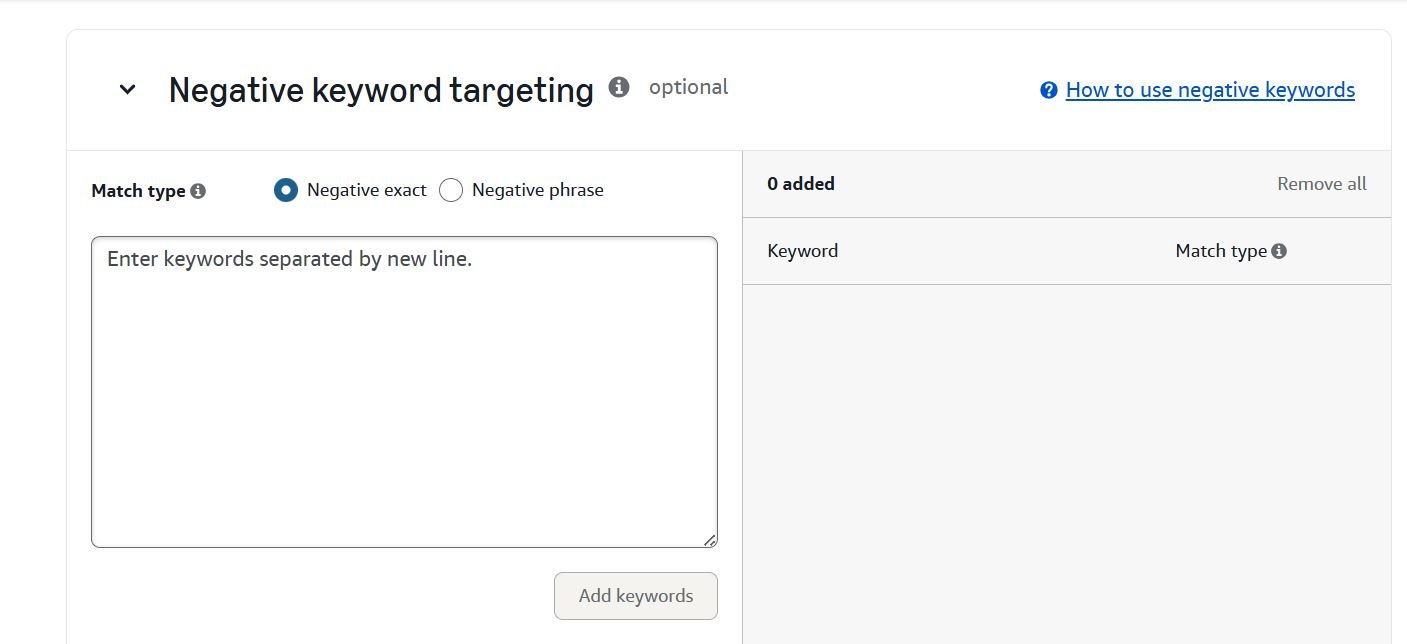
Neglecting Negative Keywords: This is as important as choosing the right keywords. If you sell leather dog collars, you must add terms like “cat,” “choke,” and “chain” as negatives. This stops you from paying for irrelevant traffic. The only way to find these budget-draining terms is by regularly reviewing your Amazon search term report.
Having Unrealistic Expectations: Expecting profitability in the first week leads to disappointment. The first 2-4 weeks are for data collection. You’re paying Amazon for market research to see what works. Patience is necessary.
Blaming Ads for a Product Problem: This is a hard truth. If your click-through rate is high but your conversion rate is low, the ad is doing its job. The problem is on your product page. Ad traffic can’t fix a non-competitive price, bad reviews, or poor product photos.
Ignoring Organic Ranking Campaigns: Amazon ads are not only for generating immediate sales but also for improving keyword rankings. Ranking-focused campaigns help your keywords gain organic positions, leading to consistent organic sales over time. As rankings improve, reliance on PPC decreases, and sales can continue even when ad spend is reduced or paused.
By avoiding these common mistakes, you can diagnose what’s wrong and steer your campaigns toward profitability. Successful PPC is about methodical testing, learning, and refining your approach.
Case Studies & Success Stories
Multiple case studies illustrate Amazon Ads’ impact on real businesses. Here are few of the case studies of Amazon ads.
1. Outdoor Furniture Brand Case Study
For example, for a outdoor-furniture retailer (“Ultra”) a disciplined Amazon PPC approach was applied to achieve over $1,000,000 in monthly sales with a single-digit ACoS of ~7.14%.
In other words, 93 cents of every sale went to organic costs, not ads. This level of performance came from tactics like tight campaign organization and aggressive keyword optimization.
2. Beauty Brand Case Study
Another case study of our agency showed that by adding defensive campaigns (bidding on the brand’s own keywords and ASINs), monthly Amazon PPC revenue jumped by $8,000–$15,000 while maintaining an ACoS below 10%.
In plain terms, a relatively small additional ad spend delivered thousands more in sales at an extremely efficient cost. This underscores how Amazon’s intent-driven traffic and rich customer data can improve sales.
Amazon’s search ads not only drove sales on Amazon but even lifts off-Amazon sales: paid search ads on Amazon had the highest in-Amazon conversion, suggesting customers clicked and bought directly.
Amazon’s ad system continues to improve (better targeting, more ad space), sellers are seeing steady ROI gains. In fact, one industry report found that ad-driven Amazon sales often allow for ROAS of 3–5× or more, far above many other digital channels.
Real-world evidence shows Amazon Advertising does work. Sellers routinely report double- and triple-digit percentage increases in sales after scaling PPC properly. When done right, Amazon ads can transform a “dead” listing into a top seller or turn a niche product into a 6-figure business.
Best Practices for Amazon Ads
Amazon Ads are powerful, but they aren’t automatic money-makers. Success requires ongoing optimization. Here are some important tips:
1. Set Clear Goals (And Metrics)
Decide if you’re chasing sales volume, profitability, or both. Target a sustainable ACOS (e.g. 20–30%) based on your product margins. Monitor RoAS daily and adjust bids to balance spend vs. return.
2. Keyword Strategy
Use a mix of broad, phrase, and exact match keywords. Seed automatic
campaigns to discover high-intent terms, then move the best-performing search terms into tightly‐bidded exact-match campaigns. Add irrelevant terms as negative keywords to prevent waste.
3. Ad Type Mix
Don’t rely on one ad format. Sponsored Products should form the core of every campaign (they generate the most sales ).
Use Sponsored Brands to boost awareness for your brand portfolio and to defend against competitor ads on your keywords.
Implement Sponsored Display retargeting to re-engage shoppers who viewed your product but didn’t buy; this can significantly raise your overall conversion rate.
3. Optimize Listings for Conversion
Ads bring clicks; your listing must close the deal. Enhance product titles, images, bullet points, and A+ content so that traffic converts at a high rate (e.g. 10–15% is a reasonable target ). Collect reviews and use competitive pricing. Even with great ads, a poorly written listing will squander your CPC.
4. Bid Management
Amazon CPC can change (notably it rose to ~$1.04 in 2025 ). Increase bids on keywords and placements that convert better, and decrease bids (or pause) on those that bleed spend with no sales or high ACOS.
Use dynamic bidding strategies or dayparting to lower ACOS. For example, reducing bids off-hours or on days with lower conversion rates.
5. Continuous Testing & Analytics
Treat Amazon PPC as a lab. Constantly A/B test ad copy (for Sponsored Brands) and new keyword ideas. Use the search term report and Brand Analytics to spot rising trends or problems.
The Advertising Console’s reports on impressions, clicks, CTR, and conversions are gold and analyze them weekly to spot unproductive spend.
Remember that an ad-click is only one step; track your TACoS (total ACoS including organic lift) to make sure paid efforts are building your long-term business, not just short-term sales.
Frequently Asked Questions
How Long Does It Take for Amazon PPC to Become Profitable?
You shouldn’t expect Amazon PPC to be profitable immediately. The first two to four weeks are a data-gathering phase. You’ll likely run campaigns at a loss during this period, which is normal. The goal is to identify which keywords and targeting methods generate sales.
Once you have this initial data, you can start optimizing. With consistent adjustments, most sellers can achieve profitability within one to three months. This timeline can vary depending on your product’s price, profit margin, competition in your category, and how quickly you act on the data.
Can I Succeed on Amazon Without Using PPC?
Technically, yes, but it is much more difficult. Succeeding on Amazon today without PPC is challenging, especially when launching a new product. Without ads, you rely solely on organic ranking, which is a slow and unpredictable process. PPC provides immediate visibility.
It’s the fastest way to get the initial sales and reviews that Amazon’s algorithm needs to start showing your product to more shoppers organically. PPC helps get the sales flywheel spinning and provides valuable keyword data you can use to optimize your listing for better organic search performance.
What Is a Good ACoS for an Amazon PPC Campaign?
There’s no single “good” ACoS because it depends on your profit margins and campaign goals.
The most important number to know is your break-even ACoS, which is your profit margin before ad spend. If your product has a 30% profit margin, your break-even ACoS is 30%. Anything below that is profit.
- For a new product launch, a higher ACoS (e.g., 40-50%) might be acceptable. The goal isn’t immediate profit; it’s gaining sales velocity and social proof.
- For an established product, you’ll want to aim for an ACoS well below your margin (e.g., 15-25%) to maximize your net profit.
If you’re looking for more on these concepts, our guide on what PPC is on Amazon breaks it down further.
Should I Hire an Agency to Manage My Amazon PPC?
This depends on your budget, time, and expertise. If you have a smaller budget and the time to learn, managing your own campaigns is a great way to understand what drives your business.
However, once your ad spend grows (often over $5,000 per month), or if you don’t have time for daily management, hiring an agency or a freelancer can provide a significant return. Their expertise can often pay for itself. For sellers interested in expanding their e-commerce knowledge, Branditok’s marketing blog offers useful perspectives on different strategies.