
For seasoned Amazon brand owners, the advertising game has evolved. Relying only on Sponsored Products is no longer a winning strategy. With rising CPCs and intensified competition, a bottom-funnel-only approach isn't sustainable for growth. It captures existing demand but fails to create new customers, leading to stalled progress.
The necessary evolution is a full-funnel Amazon advertising strategy. It involves building a resilient sales engine by engaging shoppers at every stage of their journey, from initial discovery to the final purchase. This approach moves beyond simply capturing demand to actively creating it, ensuring long-term, scalable growth.
Moving Beyond Bottom-Funnel

It's a comfortable but dangerous pattern for established brands to pour their entire ad budget into Sponsored Products campaigns, focusing on high-intent keywords at the very bottom of the funnel. For a while, this method works, driving sales and delivering a measurable ACOS.
The problem is you're only fishing from a small, overcrowded pond. You are competing with every other seller for the same small group of "ready-to-buy" shoppers. As the cost-per-click continues to climb, this strategy becomes a game of diminishing returns. You end up spending more for the same customer, shrinking your profit margins.
1. The Strategic Shift
A full-funnel Amazon advertising framework systematically guides shoppers from the first moment of brand discovery (Awareness), through their active evaluation (Consideration), and to the final purchase (Conversion). This represents a significant shift from simply capturing demand to actively creating it.
When you ignore the top and middle of the funnel, you're invisible to potential customers until they're ready to buy. By then, you're often left competing on price alone against rivals who have already built brand recognition and trust.
2. Why This Matters in 2026
Winning on Amazon requires thinking bigger. It involves deploying broader strategies designed to increase Amazon sales that extend beyond a narrow, bottom-funnel focus. This approach builds long-term brand equity and makes your business more resilient to aggressive competitors and rising ad costs.
By 2026, brands that don't invest in top-of-funnel awareness will find their customer acquisition costs unsustainable. The marketplace rewards sellers who bring new shoppers to the platform, not just those who convert existing traffic.
This article provides actionable blueprints for structuring, funding, and measuring a sophisticated full-funnel strategy. It is written for sellers who have mastered the basics and are ready for the next level of growth.
Understanding how a dedicated Amazon ads management services provider operates can also provide valuable context for expert implementation. Our goal here is to help you build a predictable, scalable sales engine.
Full-Funnel Campaign Architecture
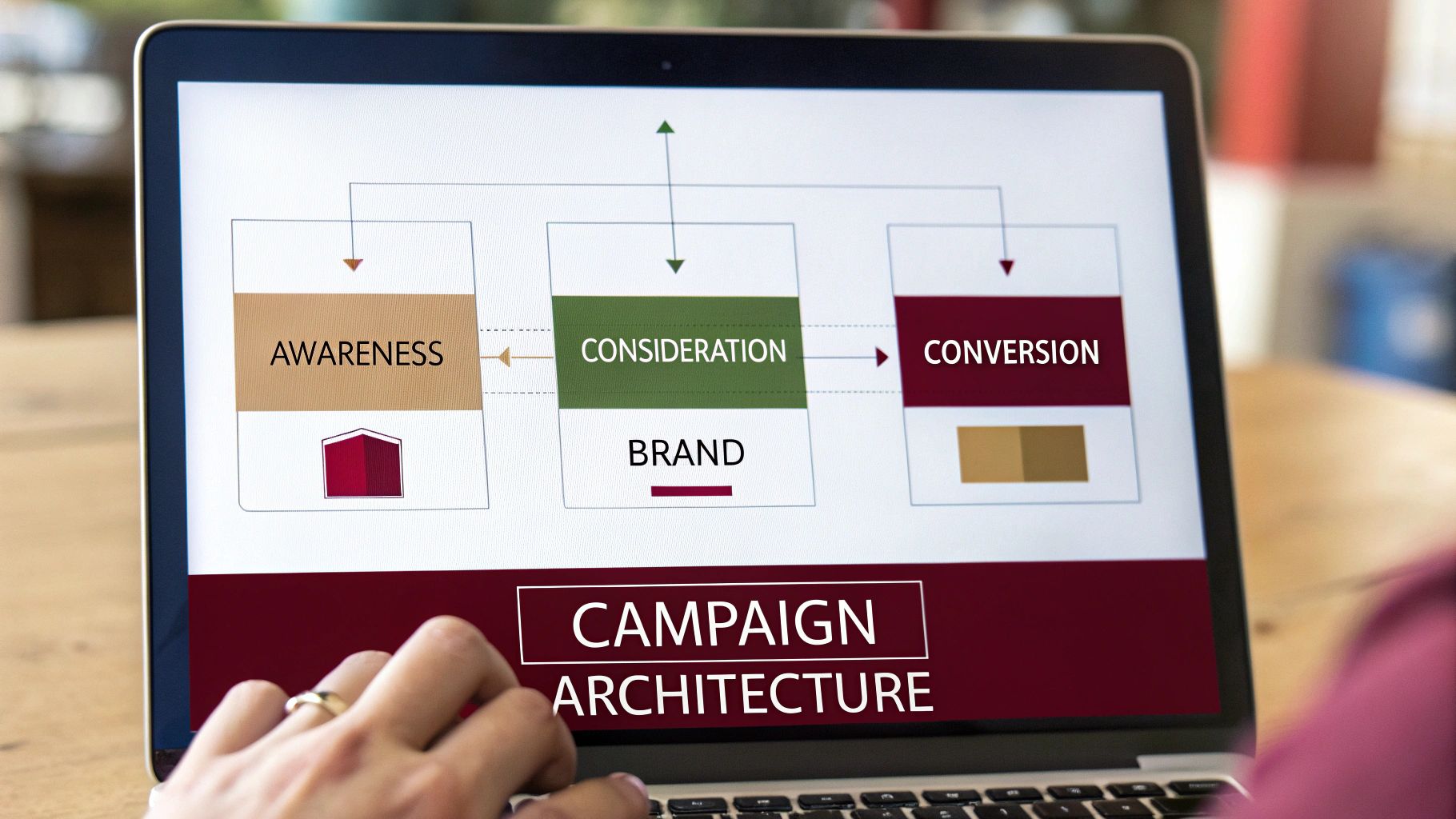
A successful full-funnel Amazon advertising strategy requires a deliberate architecture that mirrors how people shop on the platform. Random campaigns won't work.
This means you need distinct campaigns designed for each stage of the funnel, each with its own specific goal, ad type, and targeting. Every ad dollar should have a job: to move a shopper from one stage to the next.
If these stages aren't kept separate, you'll send mixed signals to shoppers, and your performance data will be a mess. You won't know what's working. The point is to build a system where awareness feeds consideration, and consideration feeds conversion, creating a predictable pipeline of new customers.
1. Top of Funnel
The goal here is simple: discovery. You're introducing your brand to a cold audience, shoppers who aren't looking for your products yet. Think of it as planting a seed and building brand recall for when they are ready to buy.
Your go-to ad types for this stage are Sponsored Brands Video and Sponsored Display.
- Sponsored Brands Video: These are absolute scroll-stoppers in search results. Use them to tell a quick problem-solution story. A short, impactful video showing your product in action communicates value better than text. Target broad, high-volume, non-branded keywords related to the problem your product solves.
- Sponsored Display (Audiences): Target in-market and lifestyle audiences that fit your ideal customer profile. Selling high-end kitchen gadgets? Target audiences interested in "Gourmet Cooking" or shoppers who've recently browsed the home & kitchen category.
Think of this stage as an investment in future demand. You aren't chasing a 25% ACOS here; you are building an audience that will convert at a lower cost later. Success is measured in impressions, video completion rates, and new-to-brand metrics.
2. Middle of Funnel
A shopper now knows they have a need and they've heard of your brand. They're in the consideration phase, actively comparing options and reviews. Your job shifts from broad discovery to targeted education, showing why you're better than the competition.
Here, you'll lean heavily on Sponsored Brands (Product Collection) and Sponsored Display (Product Targeting).
- Sponsored Brands (Product Collection): Start targeting competitor brand names and specific category keywords. Your creative needs to highlight your unique selling proposition (USP). Use custom imagery to showcase a feature your competitor lacks or a superior material. Critically, link these ads to your Amazon Storefront to pull them into a branded, educational experience away from competitor ads.
- Sponsored Display (Product Targeting): It's time to be aggressive. Target the product detail pages of your direct competitors. Your ad appears right on their listing, giving you an opportunity to intercept their traffic. Include a coupon in your ad creative to make switching to your product an easy decision.
You want to answer the question, "Why should I choose you?" before the shopper thinks to ask it.
3. Bottom of Funnel
This is the finish line. You're targeting high-intent shoppers who are ready to buy. Your campaigns here need to be focused on closing the deal as efficiently and profitably as possible. This stage is all about Sponsored Products, with a healthy dose of brand defense.
- Sponsored Products (High-Intent Keywords): Bid aggressively on long-tail, high-conversion keywords, such as "[product name] for [specific use case]" or "[brand name] [model number]." These searches show the user has done their research and is ready to buy.
- Sponsored Products (ASIN Targeting): Target your own complementary products. If a customer is looking at your main product, show them an ad for an accessory. It’s a simple way to increase your average order value.
- Brand Defense: Protecting your front gate means running search ads for brand keywords. Bid on your own brand name to ensure competitors can’t siphon off traffic actively looking for you.
Amazon Ad Types and Funnel Stages
Here's a quick-reference table that maps the primary ad types and targeting methods to each funnel stage. Think of it as a cheat sheet for building your campaign architecture.
| Funnel Stage | Primary Ad Types | Core Objective | Example Targeting |
|---|---|---|---|
| Awareness (Top) | Sponsored Brands Video, Sponsored Display | Drive discovery & build brand recall | Broad category keywords, in-market audiences |
| Consideration (Middle) | Sponsored Brands, Sponsored Display | Educate & differentiate from competitors | Competitor brand keywords, competitor ASINs |
| Conversion (Bottom) | Sponsored Products | Capture high-intent sales & defend brand | Long-tail keywords, branded keywords, own ASINs |
Using this framework ensures that each ad type plays to its strengths, guiding shoppers smoothly from first impression to final sale.
Amazon’s ad platform is expected to reach $56.2 billion globally in 2025. Sponsored Products still represent the largest share, but rising costs make a full-funnel strategy essential. With the average CPC hitting $1.12 in 2025, you can't afford to focus only on the bottom of the funnel.
By structuring your campaigns this way, you create a complete system. It's a machine that not only captures existing demand but actively creates new demand, paving a sustainable path to real growth.
Budgeting and Bids Across the Funnel

There is no one-size-fits-all formula for setting your full-funnel Amazon advertising budget. It's a living model that must reflect your current business goals. Forget an even 33% split across each stage. Your budget needs to be intentionally allocated to achieve your objectives.
For a new product launch, you have to be aggressive at the top of the funnel to build awareness. In that scenario, a split like 60% for Awareness, 25% for Consideration, and 15% for Conversion is a solid starting point. You're front-loading your spend to fill the funnel with new shoppers.
Now, consider a mature product in a competitive category. Your priority shifts to defending market share and maximizing profit from high-intent buyers. The budget inverts. You might allocate 10% for Awareness, 20% for Consideration, and 70% for Conversion. It’s all about protecting your position and capturing sales.
1. Bidding Strategies
Your bidding strategy must adapt to the goal of each funnel stage. Using one bid strategy for everything is the wrong approach.
Here’s how to align your bidding with your objectives:
Top of Funnel (Awareness): The goal here is exposure. You want to get in front of as many relevant people as possible. Your key metric is impressions. For this, vCPM (cost per thousand viewable impressions) bidding on Sponsored Display is ideal. You're paying for views, which is what you need.
Middle of Funnel (Consideration): Now you're trying to get shoppers to click and learn more. The game is about traffic and engagement, so you optimize for clicks. Use Cost-Per-Click (CPC) bidding for Sponsored Brands and Sponsored Display campaigns targeting competitor ASINs.
Bottom of Funnel (Conversion): Profitability is the priority. You’re targeting shoppers ready to buy. Your bidding should focus on maximizing your return. For your Sponsored Products campaigns, Target ACOS (Advertising Cost of Sale) is the perfect fit. You're telling Amazon to hit a specific profitability target, and it will adjust bids to achieve it.
2. Dynamic Budgeting
Your initial budget is just a starting point. A sophisticated full-funnel Amazon advertising approach involves setting up rules to shift money automatically based on performance. You can't wait for a monthly report to discover you've been overspending on a non-performing campaign.
Set up automated rules, either in your ad software or using Amazon's portfolio settings. For example, if a consideration campaign's click-through rate (CTR) drops below your benchmark, a rule can automatically reduce its budget and reallocate those funds to a high-converting bottom-funnel campaign. This agility separates a static strategy from a dynamic, self-optimizing machine. For brands building these complex systems, working with specialized Amazon ads management services can provide the necessary expert guidance.
Key Takeaway: Treat your budget like a fluid asset. Set baseline allocations based on your goals, but have a system to reallocate spend weekly based on real-time data like CTR, detail page views, and conversion rates. This ensures every dollar is working as efficiently as possible.
The data supports this. In 2025, optimized full-funnel campaigns on Amazon saw average conversion rates hit 10-15%. This is driven by high-intent shoppers who convert at a rate of 9-11% across the platform. While the average CPC has increased to $1.12, a well-managed strategy can still keep ACoS in a healthy 25-36% range. With daily ad spend topping $47 billion across major categories, a strategic, full-funnel approach is the proven path to profitable growth. You can see more details in these Amazon advertising statistics for 2025 on luzern.co.
Creative and Landing Pages at Every Stage

An effective full-funnel Amazon advertising strategy is about more than keywords and bids. Your creative assets, including images, videos, and landing pages, must resonate with the shopper's stage in their journey. This is where many brands fail.
Showing a feature-heavy ad to a cold audience is as ineffective as showing a lifestyle ad to someone ready to buy. You're just wasting money.
Your creative needs to evolve as the customer moves from awareness to consideration to conversion. Each asset has a specific job that changes from the top of the funnel to the bottom.
1. Top of Funnel Creative
At the top of the funnel, you're talking to a cold audience. They aren't looking for your brand and may not even realize they have the problem your product solves. Your creative has one job: stop the scroll and plant a seed.
- Sponsored Brands Video: Lead with the problem, not the product. In the first three seconds, show a relatable pain point, then introduce your product as the solution. Think less like a polished commercial and more like a quick, helpful social media video.
- Sponsored Display Imagery: Lifestyle photos are your best tool here. Show your product in action, used by your ideal customer in a setting that feels aspirational or relatable. This lets shoppers understand the "why" without reading any text.
The goal isn't an immediate sale. It's about making a strong first impression so they remember you later.
2. Mid Funnel Creative
Shoppers in the middle of the funnel are in research mode. They know they need a solution and are comparing you against the competition. Your creative needs to shift from introducing an idea to proving your value.
This is the perfect time to send traffic to your Amazon Storefront. Think of it as your branded home base on Amazon, where you can pull shoppers away from chaotic search results into a controlled environment. Use your Storefront to tell your brand story, showcase your entire product line, and explain what makes you the best choice.
Driving mid-funnel traffic from Sponsored Brands to a well-designed Storefront can increase conversion rates by up to 20% compared to sending them to a standard product page. You get to make your case without competitor ads nearby.
In your ad creative, use custom images that draw direct comparisons or highlight your unique selling proposition (USP). If your product is tougher, show a side-by-side comparison. If it has a key ingredient, make that the focus.
3. Bottom of Funnel Assets
Once a shopper lands on your product detail page (PDP), they're at the bottom of the funnel. This is your final sales pitch. Your PDP is your most critical conversion asset and needs to be a fortress of trust and persuasion. For a deep dive, check out how comprehensive Amazon SEO services play a role here.
Your PDP must include these elements:
- Top-Notch Imagery and Video: You need at least seven high-resolution images. Show the product from all angles, in use, and use infographics to call out key benefits. A product video on the listing is essential to demonstrate value.
- A+ Content: Use this space to address any final purchase hesitations. Use comparison charts against your own products or competitor types, answer common questions, and reinforce your brand story. It’s your last chance to answer the "what ifs."
- Benefit-Driven Copy: Ensure your title, bullets, and description do more than just include keywords. They need to sell. Lead with what the customer gets, not just what the product is.
By tailoring every asset to its specific job in the funnel, you build a seamless and convincing path that guides shoppers from their first glance to the final click.
Measuring Full-Funnel Success
Relying only on last-click sales metrics like ACOS to judge your full-funnel performance is like rating a restaurant based only on the final bill. It misses the story of how the customer got there. To justify your investment in a full-funnel Amazon advertising strategy, you must measure performance with a nuanced set of KPIs that match the goal of each stage.
Each part of your funnel has a different job. Awareness campaigns aren't meant to drive immediate sales. Their job is to introduce your brand to new audiences. If you judge them by the same ACOS target as your bottom-funnel campaigns, you'll shut them off prematurely, starving your funnel.
1. KPIs for Awareness
At the top of the funnel, it's all about reach and making a great first impression. You're trying to get in front of as many new, relevant shoppers as possible.
The metrics that matter most here are:
- Impressions: This is your baseline for reach. Are your ads being seen by enough people?
- Video Completion Rate (VCR): For Sponsored Brands Video, this tells you if your creative is holding a cold audience's attention. A high VCR is a clear sign your message is effective.
- New-to-Brand (NTB) Metrics: This is the ultimate proof that your top-of-funnel efforts are working. A high percentage of NTB orders confirms you're acquiring new customers, not just retargeting existing ones.
2. KPIs for Consideration
You've captured a shopper's attention. Now, the goal is to drive engagement and pull them deeper into your world. You want them to click, browse, and seriously consider your products over the competition.
Keep an eye on these engagement metrics:
- Click-Through Rate (CTR): A strong CTR indicates your ad creative and targeting are compelling enough to make a shopper want to learn more.
- Detail Page View Rate (DPVR): This metric, available for Sponsored Display, shows how many impressions led directly to a visit to your product page. It’s a great measure of how well your ad is driving traffic to your most important conversion asset.
Understanding attribution windows (e.g., 7-day vs. 14-day) is also critical. A shopper might see a Sponsored Display ad, not click, but then search for your brand a week later. A longer attribution window helps connect upper-funnel touchpoints to the eventual sale.
3. KPIs for Conversion
At the bottom of the funnel, the focus shifts to profitability and efficiency. These are the metrics most sellers are familiar with, but they represent the final payoff for the entire journey.
The core metrics here remain the same:
- Advertising Cost of Sale (ACOS): Measures the direct efficiency of your ad spend against sales.
- Return on Ad Spend (ROAS): Shows total revenue generated for every dollar spent.
- Total Sales Volume: The ultimate measure of whether the entire system is driving top-line growth.
Amazon's advertising ecosystem is growing, making a full-funnel view essential. Forecasts show Amazon’s retail media ad revenues climbing to nearly $70 billion in 2026. This growth is fueled by top-funnel assets like Prime Video ads, where U.S. viewing hours have surged 37%. With Amazon's Q3 2025 ad revenue hitting $17.7 billion, a 24% year-over-year increase, the scale for advertisers who master the full funnel is massive. You can explore more about these trends in this eMarketer forecast on Amazon's ad revenues.
For a complete view of the customer journey, sophisticated sellers are turning to Amazon Marketing Cloud (AMC). AMC allows you to connect the dots and see how upper-funnel touchpoints, like a video view, contribute to a sale days or weeks later. This is how you prove the value of your awareness and consideration spend, providing the data needed to justify and scale your full-funnel strategy with confidence.
These insights also have a significant impact on your organic performance. The more effectively you advertise, the better your products will rank naturally. You can learn more about how advertising directly influences your Amazon product ranking service strategy.
Full-Funnel KPI Matrix
Here's a simple matrix outlining the key performance indicators for each stage of the funnel. Think of this as your scorecard for measuring what matters at every step.
| Funnel Stage | Primary KPIs | Secondary KPIs | Business Goal |
|---|---|---|---|
| Awareness (TOFU) | Impressions, New-to-Brand (NTB) Metrics | Video Completion Rate (VCR), Reach | Introduce the brand to new audiences and maximize visibility. |
| Consideration (MOFU) | Click-Through Rate (CTR), Detail Page View Rate (DPVR) | Ad-attributed Store Visits, Add to Carts | Drive engagement, educate shoppers, and pull them into your product ecosystem. |
| Conversion (BOFU) | ACOS, ROAS, Total Sales | Conversion Rate (CVR), Cost Per Acquisition (CPA) | Drive profitable sales, maximize efficiency, and increase market share. |
By tracking these specific KPIs, you move beyond a one-dimensional view of performance. You can accurately diagnose what's working and make smarter decisions to fuel sustainable growth across your entire Amazon business.
Common Questions About Full-Funnel Advertising
Shifting to a full-funnel model often brings up practical questions. Brand owners frequently get stuck on timelines, budgets, and whether they have the right tools for the job.
Let’s tackle some of the most common questions with direct, real-world advice.
1. "How Long Until I See Results?"
This question requires a shift in how you think about advertising.
You'll see sales from your bottom-funnel Sponsored Products campaigns within days. That’s the instant gratification part of Amazon Ads.
But the compounding impact from your top and mid-funnel efforts is measured over a longer horizon, typically 60 to 90 days. Don't look for immediate ACOS improvements from a new Sponsored Brands Video campaign. Instead, watch for the leading indicators that show the strategy is working.
Check your branded search volume in Brand Analytics. Are more people searching for your brand name directly? That’s a significant win. Also, monitor your organic rank for top non-branded keywords. If you see those start to climb, it’s a powerful sign that your awareness campaigns are building authority.
The full return on your investment comes later as you build a loyal customer base and can reduce expensive, aggressive conquesting ads.
2. "What's a Good Starting Budget Split?"
There’s no single magic number, but there are smart starting points based on your brand's stage.
- For an established brand: A 15-25-60 split (Awareness-Consideration-Conversion) is a balanced approach. Most of your budget goes toward converting existing demand, but you’re still investing enough to keep your funnel full of new shoppers.
- For a new product launch: Flip that model completely. You’ll want something closer to 50-30-20. You have to invest in brand discovery and education. Your goal is building momentum, not immediate profitability.
This isn't a "set it and forget it" rule. You must be in your ad account weekly, ready to reallocate your budget. If a mid-funnel competitor targeting campaign is performing well with a high click-through rate, allocate more funds to it. Agility is key.
3. "Can I Do This Without Amazon DSP?"
Yes, absolutely. You can build an effective full-funnel Amazon advertising strategy entirely within the standard Amazon Ads console. You don't need the complexity or minimum spend requirements of Amazon DSP to get started.
You can create a robust funnel using a smart combination of Sponsored Products, Sponsored Brands, and Sponsored Display. In fact, Sponsored Display has excellent audience-building and retargeting features perfect for the top and middle of the funnel. You can target in-market audiences to build awareness and then retarget everyone who viewed your detail page to drive consideration.
Amazon DSP is a great tool for brands looking to scale aggressively with its advanced off-Amazon reach, but it's not a prerequisite. Master the tools you already have first.
4. "How Do I Measure New-to-Brand Metrics?"
New-to-brand (NTB) metrics prove that top-of-funnel spending is working. These metrics track orders from customers who haven't bought from your brand in the past 12 months. This is a critical KPI for your awareness and consideration campaigns.
You can find this data right inside the advertising console. You can add columns for NTB orders, NTB sales, and the percentage of NTB sales for your Sponsored Brands and Sponsored Display campaigns.
Use this data to justify your awareness spend. A campaign might have a higher ACOS than your bottom-funnel campaigns, but if it has a high percentage of new-to-brand sales, it's doing its job perfectly by acquiring new customers and growing your audience.