
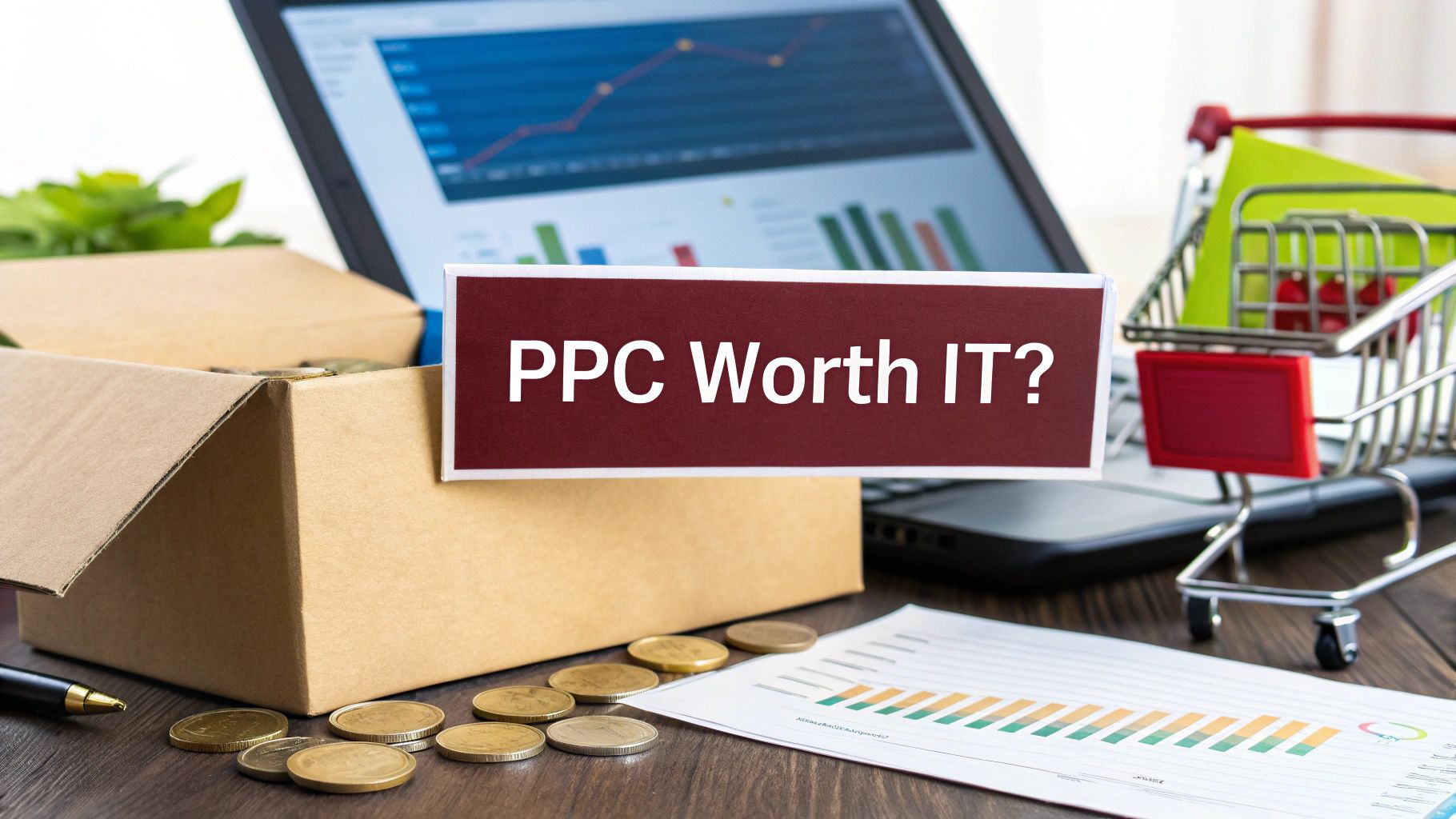
The short answer is YES. Amazon PPC acts as fulcrum for your business: it generates the sales velocity that directly builds your organic rankings. Think of ad spend as the investment that buys you long-term visibility.
However, the sales velocity is strongly connected with one metric: Conversion Rate (CVR). In 2026, visibility without conversion is wasted budget: it is a negative signal to Amazon. Your ad spend buys the traffic, but optimized listing is accountable for conversion. This dynamic is non-negotiable. The understanding that traffic has zero value without a high conversion rate is the financial reality of PPC for amazon sellers.
Is Amazon PPC a Smart Investment?
Amazon Pay-Per-Click (PPC) puts your products in front of shoppers who are actively searching for what you sell. This isn’t like social media advertising, where you interrupt someone’s feed. On Amazon, you’re targeting customers with high purchase intent. They’re on the site, often with a credit card saved, ready to buy. That makes it one of the most effective advertising platforms available to e-commerce sellers.
The real question isn’t whether PPC works, but whether your product’s finances can support it. Success comes down to a simple formula: your profit margin has to be larger than your advertising cost. This is where understanding a few key metrics is a must.
1. The Metrics That Matter
Your success in the PPC world depends on your numbers. Specifically, you need to track your Advertising Cost of Sales (ACoS) and Return on Ad Spend (ROAS) closely.
ACoS tells you, as a percentage, how much of your ad-generated revenue you spent to get it. A lower ACoS is usually the goal, but the “right” number depends on your profit margins and campaign objectives. For a full explanation of how these two metrics work together, check out our deep dive on ACoS vs. ROAS.
2. A Quick Decision Framework
Deciding when to use PPC often comes down to a few common situations. This table breaks them down to help you see where your business fits.
| Scenario | Is PPC Worth It? | Key Action |
|---|---|---|
| New Product Launch | Almost always, yes. | Get initial sales, gather keyword data, and start organic ranking. |
| Defending Top Rankings | Essential. | Run defensive campaigns to block competitors from stealing your spot. |
| Boosting a Slow Seller | Yes, with a plan. | Target precise keywords to find what works and improve sales velocity. |
| Low-Margin Products | It’s tricky, but possible. | Be extremely precise with targeting and monitor your ad spend daily. |
| Seasonal or High-Demand Items | Yes, to maximize visibility. | Capture peak traffic and dominate search results during key periods. |
| Already Dominating Organically | Yes, for brand defense. | Protect your brand name and key terms from being poached by rivals. |
PPC isn’t just for one type of seller. It’s a versatile tool that can be adapted whether you’re launching, defending, or scaling. The key is aligning your strategy with your business goals and, most importantly, your budget.
Key Amazon PPC Costs and Metrics
Before you can decide if running Amazon PPC ads is a smart move, you have to understand the metrics that reveal the true performance of your campaigns.
Getting a handle on these numbers is the difference between blindly spending money and strategically investing it. They show you what’s working, what’s not, and where your actual profit is coming from.

Think of these as the vital signs for your Amazon business. Ignoring them is like flying blind, you’ll just burn through your budget with no idea why.
1. ACoS (Advertising Cost of Sales)
This is the most talked-about metric in the Amazon world. ACoS measures your ad spend as a percentage of the revenue you made directly from those ads.
The formula is simple:
ACoS = (Ad Spend ÷ Ad Revenue) x 100
So, if you spend $25 on ads and that generates $100 in sales, your ACoS is 25%. A lower ACoS means your campaigns are more efficient.
But what’s a “good” ACoS? It depends on your profit margin. If your product has a 40% profit margin, a 25% ACoS is great. It means you’re still pocketing a 15% profit on every ad-driven sale.
2. ROAS (Return on Ad Spend)
ROAS is the flip side of ACoS and is often more intuitive. It tells you exactly how many dollars you get back for every dollar you spend on ads.
- ROAS = Ad Revenue ÷ Ad Spend
Using our same example, that $100 in sales from a $25 ad spend gives you a ROAS of 4 (or 4x). For every $1 you put in, you got $4 back. A high ROAS is a clear sign your ads are performing well.
3. TACoS (Total Advertising Cost of Sales)
This is where you see the bigger picture. While ACoS only looks at ad-driven sales, TACoS measures your ad spend against your total sales, both organic and paid.
Why does this matter? TACoS helps you understand if your ads are boosting your organic sales.
If your TACoS is going down while your ACoS holds steady, that’s a fantastic sign. It means your ads are creating a “halo effect,” improving your organic ranking and driving more free sales. You can pull the necessary data for this by digging into your Amazon advertising reports.
4. Other Key Performance Indicators
Beyond the big three, a few other metrics give you important insight into your campaign health:
- CTR (Click-Through Rate): What percentage of shoppers who see your ad click on it? A low CTR could mean your main image or title isn’t compelling enough.
- CVR (Conversion Rate): Of the people who clicked your ad, what percentage bought the product? A low CVR might signal problems with your product page, like a high price, bad reviews, or confusing bullet points.
- CPA (Cost Per Acquisition): Your Cost Per Acquisition (CPA) tells you how much you’re spending to get a new customer through your ads.
Industry-wide, the average ACoS on Amazon tends to fall between 25% and 36%. Many experienced sellers aim for a 30% ACoS as a solid balance between aggressive growth and profitability. This performance is possible because you’re advertising where people are ready to buy.
Why Amazon PPC Converts Better
The single biggest reason Amazon PPC is so effective comes down to one word: intent.
People don’t go on Amazon to see what their friends are doing. They go there with a credit card in hand and a problem they need to solve now.
This is a completely different environment from other ad platforms. An ad on Facebook or Instagram is an interruption. With Google Ads, you might catch someone in the research phase, but they could be weeks away from buying.
Amazon, on the other hand, is the final destination. It’s where the purchase happens.
1. The Power of “Ready-to-Buy” Traffic
When a shopper types “noise-canceling headphones for travel” into Amazon’s search bar, they’re not just browsing. They are actively looking to buy a product. Putting your ad in front of them at that moment is incredibly powerful.
This ready-to-buy mindset shortens the sales cycle. You don’t have to spend weeks warming up a lead. They already know the problem and have come to the place they trust to find the solution. The result? Higher conversion rates and a smarter use of your ad budget.
2. The Numbers Don’t Lie
The data confirms it. Amazon Ads have an average conversion rate of 9.96%. That’s about seven times more effective at turning clicks into sales than the average e-commerce rate of just 1.33%.
That gap shows why ad dollars on Amazon often work much harder than on a brand’s own website. If you want to dive deeper into the data, check out our complete guide to Amazon’s conversion rate.
Your ads are hitting a pre-qualified audience that has already decided to make a purchase. For any brand, but especially direct-to-consumer ones, this is a massive shortcut to sales. You’re sending traffic that’s ready to convert straight to your product page, which is why agencies can deliver measurable growth so quickly. You can find more insights on how purchase intent drives Amazon conversions on sarasanalytics.com.
Advertising on Amazon gives you a direct line to the largest pool of active, high-intent buyers on the planet. While other platforms are great for building awareness, Amazon is where you close the deal.
When Is Amazon PPC a Waste of Money?
Amazon PPC isn’t a magic wand for a struggling product. Think of it as a megaphone. It amplifies what’s already there. If you have a great product, it will broadcast its benefits. If you have a weak one, it will just tell everyone faster why they shouldn’t buy it.
Pouring ad money onto a weak foundation is one of the quickest ways to burn your budget with nothing to show for it.
Before you spend a single cent, you must ensure your product is retail-ready. Sending paid traffic to a listing that isn’t optimized to convert is like paying for billboards to advertise a store that’s still under construction.

Without a retail-ready listing, your campaigns will fail, no matter how clever your keyword strategy is.
1. Your Listing Isn’t Retail-Ready
A retail-ready listing is the first step. Put yourself in a shopper’s shoes. They click your ad and land on a page with blurry photos, a confusing title, and zero reviews. They won’t buy it.
Here’s a quick checklist for what “retail-ready” looks like:
- High-Quality Images: You need at least five to seven professional shots. This includes infographics that explain features and lifestyle photos that show your product in use. Your main image must stand out on a pure white background.
- Optimized Title: Your title should include your most important keywords while remaining readable. It must tell the shopper what your product is and why they should care.
- Compelling Bullet Points: This is your sales pitch. Use your bullet points to sell the benefits, not just list features. Answer customer questions and address objections before they arise.
- A+ Content: If you’re brand registered, A+ Content is a must. It builds trust and gives you a large space to tell your brand story and showcase your product.
- Positive Reviews: Launching ads for a product with zero reviews is a bad idea. Aim for at least a handful of positive reviews to build social proof first.
2. Bidding on the Wrong Keywords
The next big money pit is a sloppy keyword strategy. This usually goes wrong in one of two ways.
First, sellers bid on super broad, competitive keywords. Trying to win the bid for a term like “water bottle” is expensive, and the traffic you get is unfocused. The shopper’s intent is too vague to convert well.
Second, they forget about negative keywords. If you sell premium leather dog collars, you don’t want to waste money on clicks from people searching for “cheap nylon dog collars.” Adding “cheap” and “nylon” as negative keywords prevents your ad from showing up to the wrong audience, saving you money.
A poorly structured campaign with mismatched keywords will sink your budget fast. A great trick is to run an automatic campaign for a week or two first. It lets Amazon tell you what customers are actually searching for before you go all-in on a manual campaign.
3. Running Campaigns Without Clear Goals
Running ads without a specific objective is like driving without a destination. You’re just burning gas. You have to know what you’re trying to achieve.
Are you launching a new product? Your goal might be getting those first few sales and collecting data. In that case, you can accept a much higher ACoS.
Or are you trying to maximize profit from an established product? Then your target ACoS needs to be comfortably below your profit margin. Without a clear goal, you can’t measure success and will end up making decisions based on gut feelings instead of data.
How to Test Amazon PPC Without Burning Cash
Starting with Amazon PPC doesn’t have to be a huge financial risk. The smartest way to begin is with a small, controlled test to gather your own data and see if ads will work for your products. This approach keeps the risk low and lets Amazon’s algorithm show you what’s working.
The goal here isn’t immediate profit; it’s data collection. This is your foundation for building larger, more profitable campaigns later.
1. Pick Your Best Product
Don’t try to advertise your entire catalog at once. That’s a recipe for confusion.
Instead, pick one or two of your best-selling products. You want the ones with solid reviews and a healthy profit margin. These products already convert shoppers, which gives your test campaign the best chance to succeed and produce clean data. Starting with a product that struggles to sell will only confuse the results.
2. Launch a Low-Budget “Discovery” Campaign
Your first move is to create a Sponsored Products automatic campaign. This is the easiest way to start because you let Amazon do the initial work. The platform will automatically show your ad to shoppers based on keywords and products it deems relevant.
Here’s the simple setup:
- Daily Budget: Start small. A budget of $15-$25 per day is enough to gather data without high risk.
- Bidding Strategy: Choose “Dynamic bids – down only.” This setting tells Amazon to lower your bid in real-time for clicks that are less likely to convert, which helps protect your budget.
- Duration: Let it run for at least one to two weeks. You have to give the algorithm enough time to experiment and collect meaningful data.
The whole point of this initial automatic campaign is research. You are paying Amazon a small fee to tell you exactly which customer search terms lead to clicks and, more importantly, sales.
3. Find Winning Keywords in Your Search Term Report
After your campaign has been running for a couple of weeks, it’s time to analyze the results. Go to your advertising reports and pull the Search Term Report for your new automatic campaign.
This report is a goldmine. It shows you the exact search terms customers typed into Amazon before clicking on your ad. You’ll quickly see which terms are driving sales at a good ACoS and which ones are just wasting money.
4. Build a Smarter Manual Campaign
Now you can take what you’ve learned and build a more targeted and profitable manual campaign. With a manual campaign, you get precise control over which keywords you bid on and how much you’re willing to pay. For a deeper dive, you can learn more about automatic vs. manual campaign targeting in our article.
Create a new manual campaign and add your top-performing search terms from the automatic campaign as exact match keywords. These are your proven winners.
At the same time, take all those irrelevant terms that got clicks but zero sales and add them as negative keywords to both your automatic and new manual campaigns. This step is critical. It tells Amazon to stop showing your ad for those money-wasting searches.
This two-step process, finding what works and cutting what doesn’t, is the most reliable way to answer the question, “Is Amazon PPC worth it?” with your own data.
Managing PPC Yourself vs. Hiring an Agency
You’re at a crossroads. Do you keep managing Amazon PPC campaigns yourself, or is it time to hire professionals? It’s a big decision for any growing brand, and there’s no single right answer. It comes down to a trade-off between your time, budget, and expertise.
The DIY route gives you total control and saves you management fees. This is a fine approach when you’re just starting, perhaps with a smaller budget and a few products. It’s a great way to learn Amazon advertising firsthand. The biggest drawback is the time commitment. Keeping up with keyword research, bid adjustments, and Amazon’s changing algorithm can easily become a full-time job.
1. The Case for In-House Management
You’re likely a good fit for managing PPC in-house if these points sound familiar:
- Your monthly ad spend is under $2,000-$3,000. At this level, an agency fee could take up a large portion of your advertising budget.
- You enjoy analyzing data and have the time to commit, at least 5-10 hours per week, to optimizing your campaigns.
- You have a small, straightforward product catalog, making it easier to track performance.
2. When to Hire an Agency
As your business grows, the complexity of managing PPC multiplies. The signs that you’re ready to hire an expert are usually hard to ignore.
You should seriously consider an agency when:
- Your ad spend is consistently above $5,000 per month. At this level, the money you could make from expert optimization often outweighs the agency fees.
- You’re spending more time on ads than on product development, sourcing, or other core parts of your business that need your attention.
- Your ACoS is slowly rising, and you’re struggling to stay profitable.
Understanding the costs is a big part of this decision. You can weigh the investment against your potential return by checking the typical pricing for PPC management services. If you’re hitting these numbers and feeling the pressure, it’s a good time to explore the top Amazon PPC agencies. Seeing what specialized expertise can do for your ROI might make the decision for you.
Top Amazon PPC Questions, Answered
Here are quick answers to the questions we hear most often from sellers trying to figure out if PPC is right for them.
1. How long does it take to see results?
You’ll start seeing data like impressions and clicks almost immediately, often within a few hours of launching a campaign.
However, real, meaningful results take longer. You’ll need about 2 to 4 weeks to gather enough performance data to make smart decisions. Profitable, stable campaigns are more of a 30 to 90-day journey as you refine keywords, adjust bids, and find what works. The first month is a learning phase, not a profit phase.
2. What’s a good starting budget?
There’s no magic number, as it depends on your product’s price and competition. A solid starting point for most new advertisers is between $20 and $50 per day.
This budget is usually enough to get the data you need to learn which keywords and ads are converting without a large financial risk. The initial goal isn’t profit, it’s to learn what works so you can scale your spending intelligently.
3. Can I succeed on Amazon without ads?
Technically, yes, it’s possible. Realistically, in today’s competitive marketplace, it’s incredibly difficult. PPC is one of the fastest ways to generate sales velocity, which is a massive signal to Amazon’s organic ranking algorithm.
Without ads, you’re waiting for shoppers to discover you organically, which can take a long time. Meanwhile, your competitors use PPC to stay at the top of search results, taking your potential customers. Think of PPC less as an expense and more as a necessary investment for growth.