
Amazon Marketing Cloud (AMC) is a cloud-based data that lets advertisers analyze detailed shopping and ad interactions across Amazon.
AMC ingests pseudonymized signals from Amazon’s trillion+ shopping, browsing, and streaming data and advertisers’ own inputs and lets you query them with SQL to uncover insights and build custom audience segments.
Launched in 2019, AMC has evolved into a powerful audience-segmentation and analytics suite for Amazon Ads. By “connecting SKU to Consumer ID” through purchase and behavioral data, AMC faciliates PPC experts to visualize who is buying what and why, enabling much more precise targeting than traditional keyword-only campaigns.
Starting September 16, 2025, AMC is now directly accessible through the Ads Console for every seller and you’ll no longer need a dedicated partner or deep technical skills, thanks to pre-built templates and AI assistance that make advanced analytics available to everyone.
Why Use AMC for Amazon Ads
AMC’s real value is its ability to answer tricky questions that simple attribution models can’t. Here is why you should use AMC.
1. Rich & Granular Data
AMC taps into multi-channel Amazon data. You can segment audiences by transaction data (e.g. past purchases, purchase frequency, basket size, product categories), browsing behavior (e.g. product page views, searches, add-to-cart events), and ad engagement (ad impressions, video views, clicks).
You can even incorporate your own first party lists (CRM, loyalty members, etc.) into AMC . This lets you create audiences like “users who bought Product A in the last 30 days” or “viewed PDP 3+ times without purchasing,” which traditional Amazon reporting cannot easily produce .
2. Privacy-Safe Clean Room
All data in AMC is anonymized and aggregated under Amazon’s strict privacy policies. Audiences follow the same minimum-size and policy rules as DSP audiences.
Advertisers can analyze cross-channel journeys and build audiences in Amazon advertising console. In effect, AMC uncovers “who” is converting by stitching together signals, rather than guessing from placements.
3. Actionable Insights and Cross-Channel Analytics
Beyond audiences, AMC can measure media impact, incremental reach, and attribution (e.g. how streaming TV ads influence DSP conversions).
But the new custom-audience features are especially powerful for targeting. By analyzing “which audiences frequently lead to the highest purchase rate,” you can inform bidding and creative strategies.
For example, AMC can identify loyal customers, high-CLV buyers, or segments over- or under-exposed to ads, letting you define “Awareness,” “Consideration,” “Conversion,” or “Loyalty” audiences aligned to your goals.
Is AMC Right Fit for Your Brand?
Amazon Marketing Cloud is not a universal solution that every advertiser should adopt immediately. While AMC is extremely powerful, it is also data-dependent and strategy-driven.
Before investing effort into AMC setup and audience strategy, it is critical to evaluate whether your brand is actually in a position to benefit from it. The following scenarios will help you determine whether AMC is appropriate for your current stage.
1. Brands Actively Using Amazon DSP
If your brand is already running Amazon DSP at scale, AMC may already be part of your existing workflow. Amazon DSP users have historically relied on AMC for advanced audience creation, path-to-conversion analysis, and cross-channel measurement.
For DSP-heavy brands, AMC is less about “starting from scratch” and more about optimization and insight consolidation across all Amazon ad formats.
2. New Brands and Product Launches
If you are a new brand, launching your first products, or operating with minimal historical data, AMC is not the right starting point. AMC relies on statistically meaningful data such as impressions, clicks, page views, and purchases to build reliable audiences. Without that volume, any audience you create will either be too small to activate or too broad to be useful.
At this stage, your priority should be:
- Sponsored Products Exact and Phrase match campaigns
- Search term harvesting and relevance validation
- Establishing baseline conversion rates and ACoS benchmarks
Once your listings generate consistent traffic and conversions, AMC becomes far more valuable. Until then, focusing on fundamentals will produce faster and more predictable results than attempting advanced audience modeling with insufficient data.
3. Established and Profitable Brands (The Ideal Use Case)
Established brands with proven products and stable profitability represent the ideal use case for Amazon Marketing Cloud. If your listings convert reliably, your core PPC structure is sound, and you can allocate approximately 10 percent of your ad budget to controlled experimentation, AMC becomes a powerful growth lever rather than a reporting tool.
For these brands, AMC enables:
- Precision audience segmentation beyond keywords
- Identification of high-intent shoppers who are currently under-targeted
- Incremental growth through bid optimization and audience-based scaling
- Smarter budget allocation based on contribution margin rather than ACoS alone
This is where AMC delivers its true value. Instead of asking “which keyword converts,” you start answering more advanced questions such as:
- Which shoppers are most likely to repurchase?
- Which audience segments drive incremental revenue rather than cannibalized sales?
- Where should bids be increased or restricted based on shopper behavior, not just search intent?
For profitable, mature brands, AMC is not an experimental add-on. It is a strategic tool that allows you to move from keyword-driven PPC to audience-led growth.
Step-by-Step Process to Create an AMC Audience (No-Code)
Creating audiences in Amazon Marketing Cloud is not technically complex. The process below focuses specifically on no-code, rule-based audiences that can be reliably used for Sponsored Products, Sponsored Brands, and Sponsored Display campaigns.
Step 1: Access Amazon Marketing Cloud
Log in to your Amazon Advertising account and confirm you are inside the correct advertiser profile. From the main dashboard, open the left-hand navigation and move through Measurement & Reporting → Amazon Marketing Cloud. This opens the AMC workspace directly inside the Advertising Console.
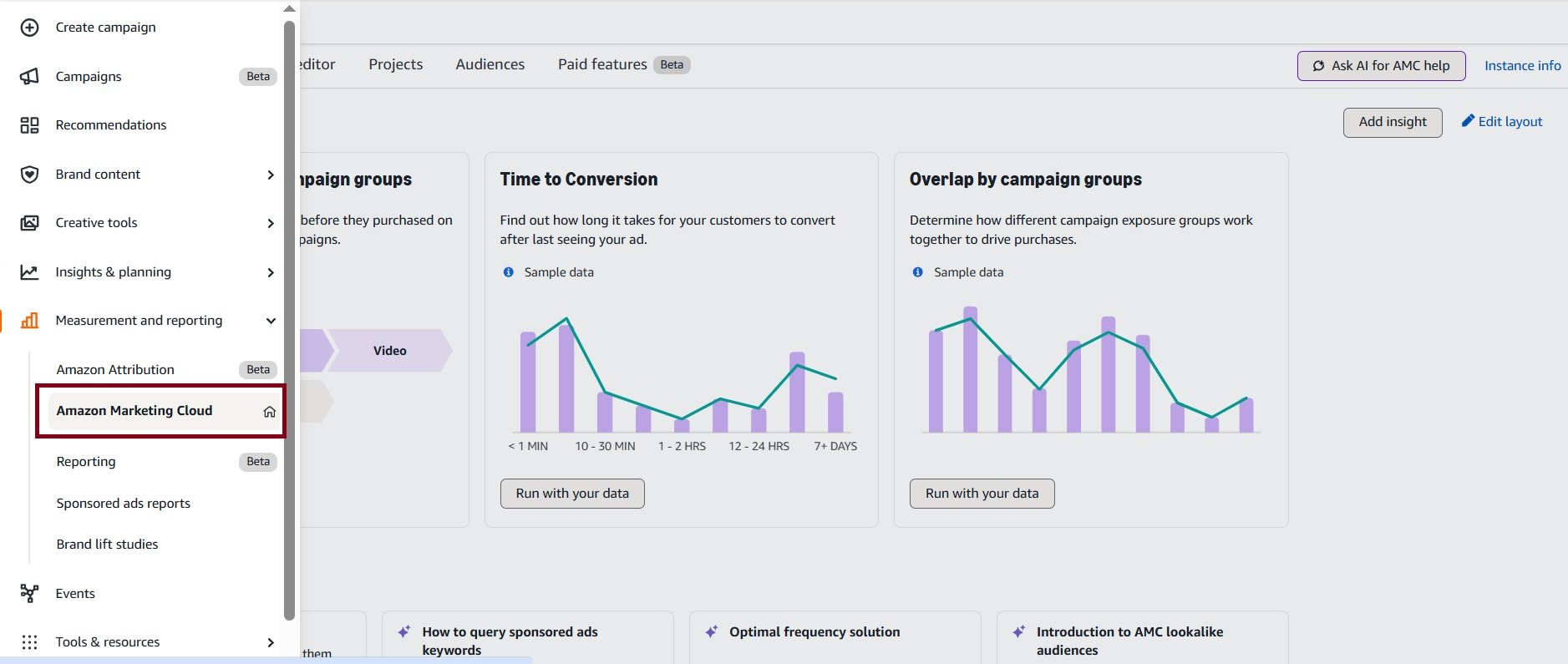
Step 2: Identify the Correct AMC Workspace
Once AMC loads, you will see multiple tabs across the interface. Audience creation begins by moving through Use Cases → Audiences, which contains Amazon’s predefined audience frameworks.
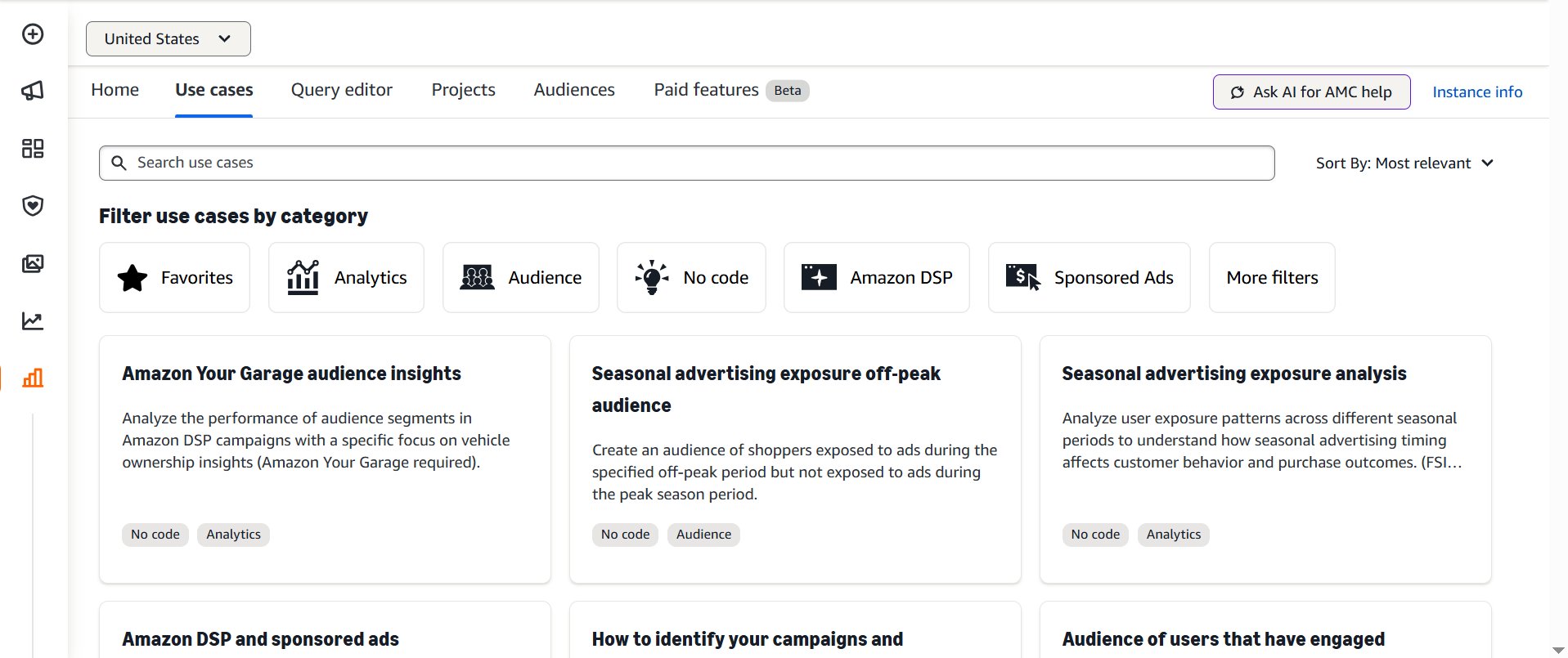
Step 3: Filter the Audience Templates to No-Code
Inside the Audiences library, apply the No-Code filter by moving through Use Cases → Audiences → Filters → No-Code. This removes all SQL-based options and ensures you are only working with audiences that can be created without technical configuration.
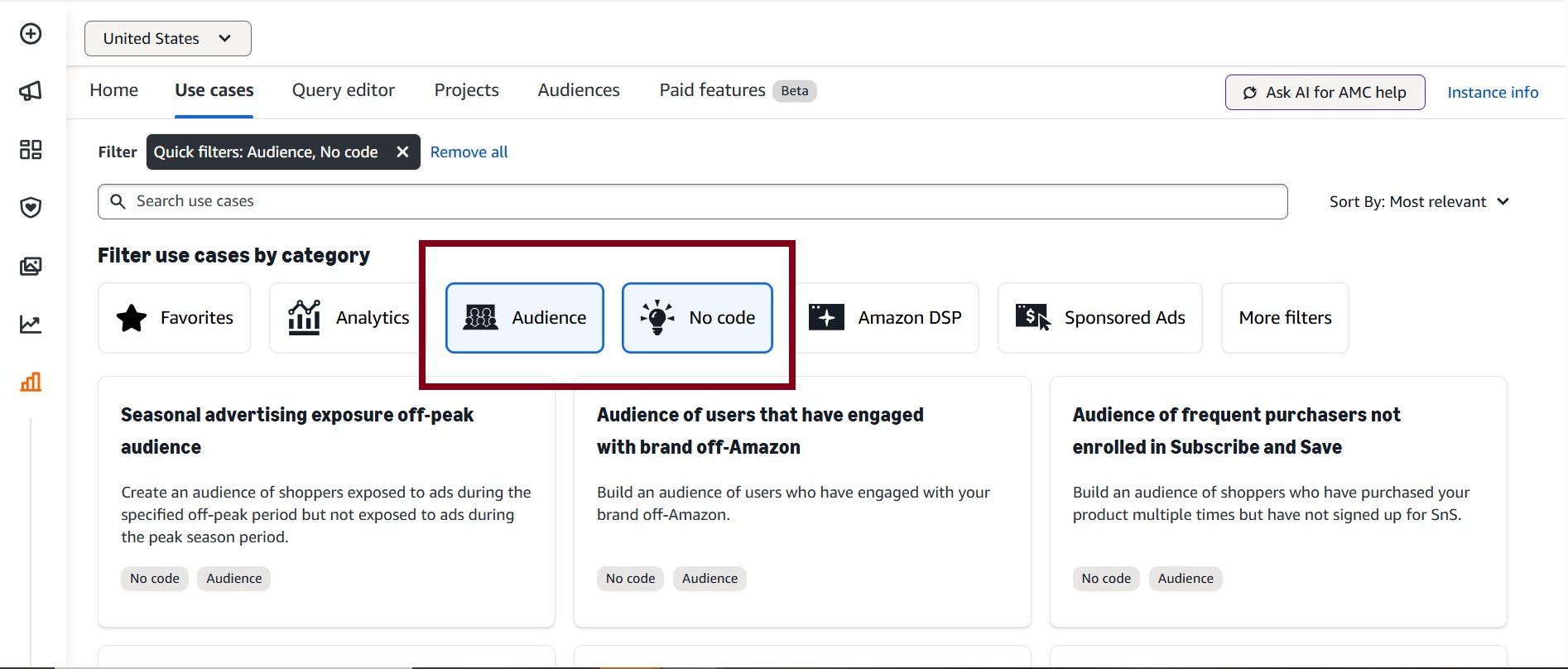
Step 4: Choose the Appropriate Audience Use Case
After filtering, the interface displays audience tiles grouped by funnel intent such as acquisition, conversion, and loyalty.
For Sponsored Ads, begin by selecting one of the following proven templates directly from the grid:
- High-Value New-to-Brand Customers
- Added to Cart but Did Not Purchase
- High Total Purchase Customers.
Clicking any audience moves you forward into the audience overview.
Step 5: Review the Audience Overview Screen
After selecting an audience, AMC opens an overview page explaining how the audience is built, which shopper behaviors qualify users, and what the intended use case is. This page confirms whether the audience is meant for acquisition, retargeting, or retention. Once confirmed, continue by clicking Audience Overview → Create Audience.
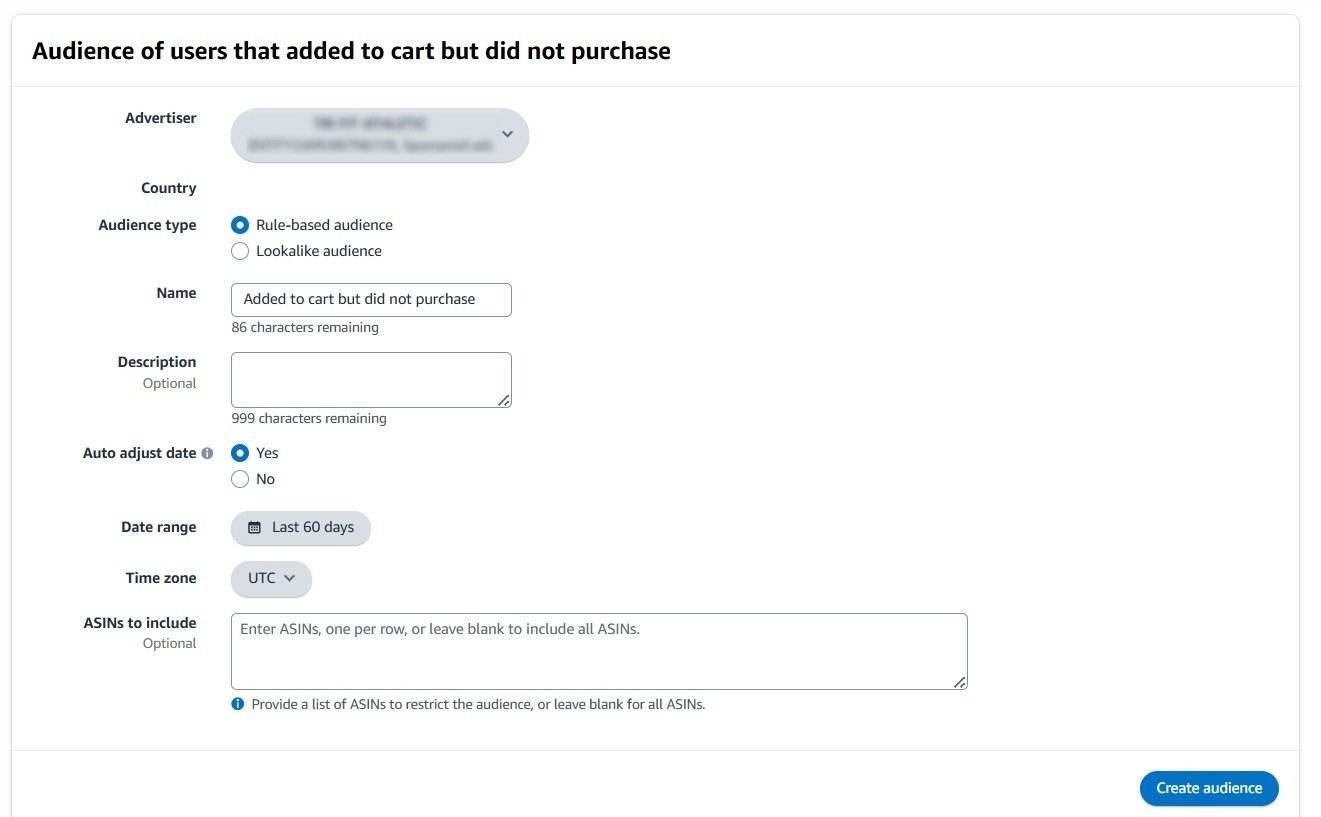
Now select the following options
- Enter a clear audience name that includes both intent and lookback window.
- In audience type select ‘Rule-Based Audience’. Lookalike audiences should not be used at this stage because they expand reach beyond strict behavioral logic.
- In Date Range select 30 days for high-volume brands. If your account has limited traffic or fewer conversions, extend this window to 90 days or up to one year to ensure the audience can populate.
- Include any ASIN in ‘ASINs to include‘ field to restrict audience to any specific product line.
- Complete the setup by clicking Audience Configuration → Create Audience → Confirm. AMC will now begin processing the audience.
Step 13: Monitor Audience Processing
Track audience status by navigating through Audiences → Your Audiences. The status will progress from Pending to Processing and finally to Ready. Processing can take up to 24 hours depending on data volume.
Step 14: Verify Audience Size
Once the audience is marked Ready, review the estimated audience size shown in Audiences → Your Audiences → Audience Details. If the size is too small to activate, return to configuration and extend the lookback window.
Standard Amazon Reports vs. Amazon Marketing Cloud Insights
Standard Amazon reports tell you what happened inside individual campaigns. They report clicks, spend, sales, and attribution in isolation.
This section breaks down how standard reporting limits decision-making compared to AMC audience.
| Metric or Question | Standard Amazon Reports | Amazon Marketing Cloud (AMC) |
|---|---|---|
| Cross-Channel Impact | Shows performance for each ad type (SP, SB, DSP) separately. | Reveals how exposure to a DSP ad influenced a later Sponsored Products conversion. |
| Ad Frequency | No visibility into how many times a unique user saw an ad. | Can calculate the optimal number of ad impressions needed before a purchase. |
| New-to-Brand Source | Identifies NTB sales per campaign. | Shows the specific sequence of ads that first introduced a new customer to your brand. |
| Audience Overlap | Can’t show if different campaigns reached the same shoppers. | Quantifies the percentage of your audience reached by both SB and DSP campaigns. |
| Full Purchase Path | Last-touch attribution only (which ad got the final click). | Maps out every ad touchpoint—video views, display impressions, clicks—over weeks or months. |
It’s the difference between seeing a single snapshot and watching the entire movie of your customer’s journey.
Getting these insights almost instantly is a massive advantage, which is why mastering real-time data analytics is now a necessity for brands that want to stay ahead.
Activating AMC Audiences in Campaigns
Once audiences are built in AMC, the next step is using them in Amazon Ads campaigns. Importantly, how you use an audience depends on the ad type:
1. Amazon Sponsored Display
Sponsored Display campaigns allow you to directly target custom audiences. When setting up a Sponsored Display ad.
For example, you can select your AMC-built audience as a targeting option. This means you tell Amazon “only show these display ads to people in this audience. This is the most precise way to reach your segment.
Use SD for bottom-of funnel retargeting (cart abandoners, PDP viewers) or even prospecting (audiences based on similar behaviors). SD also reaches users off-Amazon, so AMC audiences here extend your reach beyond Amazon search pages. Only Sponsored Display currently supports direct audience targeting.
2. Sponsored Products & Sponsored Brands
Unlike Display, SP and SB campaigns are keyword-based. You cannot directly choose an audience to target. Instead, Amazon lets you boost bids for users in your audience.
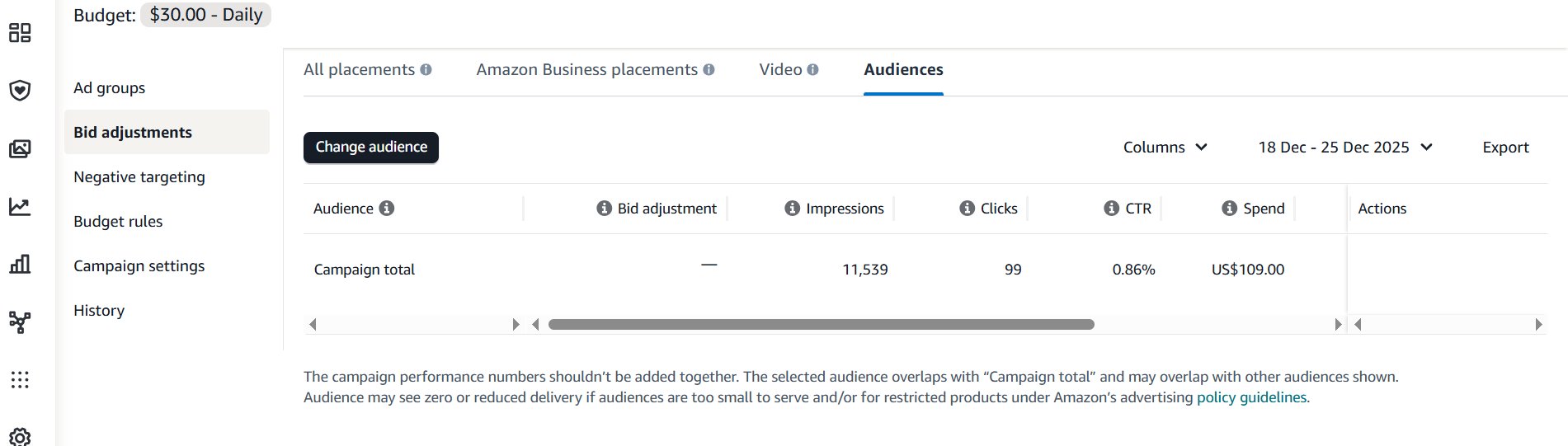
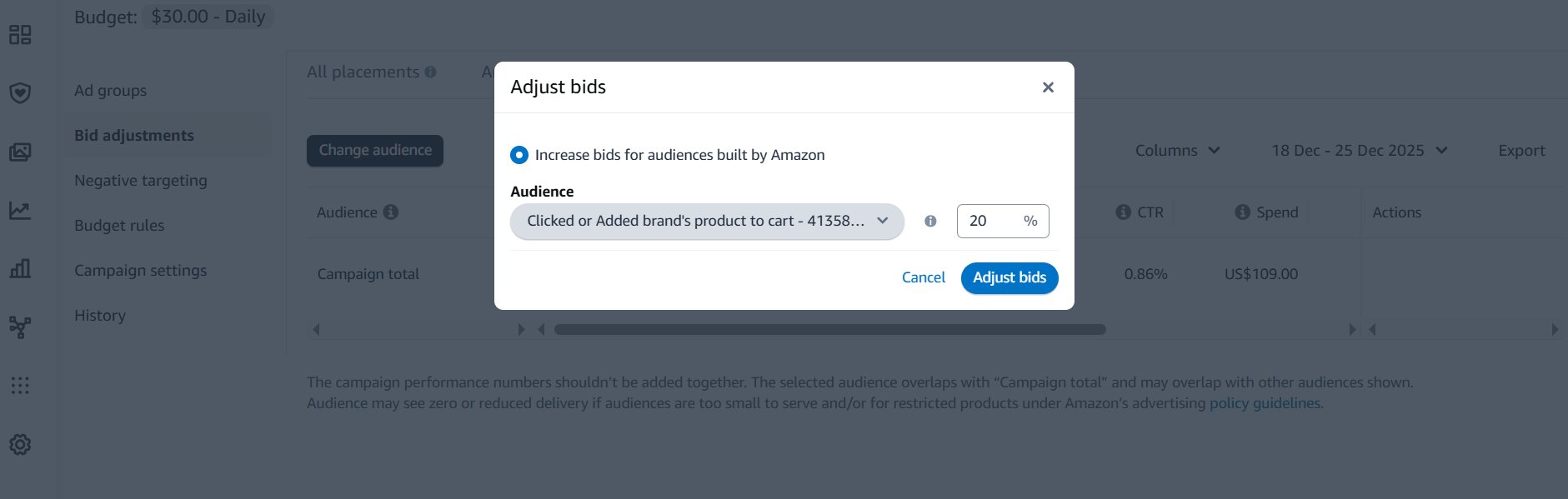
In practice, you assign AMC audiences in the campaign’s “Audiences” in “Bid adjustment” section. For example, you might say “if the auction user is in Audience X, increase my bid by 20%.” This “audience bid boost” feature was launched in late 2024 and gives unprecedented control over PPC campaigns.
Three Best Campaign Campaign Strategies to Launch with AMC Audiences
One of the most common mistakes advertisers make with Amazon Marketing Cloud audiences is simply layering them onto existing campaigns and expecting immediate results. In practice, this rarely works.
AMC audiences change who you bid on, which means your campaign structure must also change. Without intentional setup, you risk muted performance or misleading results.
Through controlled experimentation across multiple accounts, three campaign structures consistently outperform all others when launching AMC audiences. Each strategy is designed to solve a specific PPC limitation while minimizing wasted spend.
1. Strategy 1: Sponsored Products Exact Match
This strategy is designed for highly competitive keywords where relevance exists, but profitability has historically been impossible using standard PPC tactics. Here is when to use this strategy:
- Keywords with strong relevance but inflated CPCs
- Terms where broad traffic destroys efficiency
- Search terms dominated by large brands or category leaders
For example, you sell a product called a “cat tunnel.” The keyword “cat bed” is relevant from a shopper intent perspective, but normally too broad and expensive to convert profitably. Here is how your campaign structure would be
- Campaign Type: Sponsored Products
- Match Type: Exact
- Keyword Selection: Competitive but relevant keywords
- Base Bid: Intentionally low, well below your normal winning bid
Now apply a high bid adjustment to a high-intent AMC audience, such as:
- Likelihood to Purchase
- In-Market or High-Consideration audiences
This works because you are no longer competing for every search of “cat bed.” You only enter the auction aggressively when the shopper searching that term belongs to an audience with demonstrated buying behavior. This allows you to access expensive keywords selectively, instead of funding irrelevant traffic.
You will see reduced waste spent, improved conversion rates on historically unprofitable terms and access to new keyword opportunities without broad exposure
This is one of the most reliable ways to expand keyword coverage while maintaining control.
2. Strategy 2: Auto Campaigns with Audience Filters
Auto campaigns are often considered risky due to uncontrolled spend and inconsistent traffic quality. When managed traditionally, they require constant intervention and heavy negation to remain profitable. Amazon Marketing Cloud audiences fundamentally change how auto campaigns should be used.
The main issues with traditional auto campaigns include:
- Heavy and ongoing negative keyword management
- High exposure to low-intent shoppers
- Poor scalability once primary search terms are identified
Instead of running a single auto campaign, create three separate auto campaigns, each paired with a different AMC audience. This allows you to control traffic quality at the audience level rather than relying entirely on negation.
Your campaign structure should be:
- Campaign Type: Sponsored Products Auto
- Base Bids: Low and conservative
- Negation: Minimal initial negatives
Create one auto campaign for each of the following audiences:
- New-to-Brand
- Likelihood to Purchase
- Abandoned Cart or Viewed but Not Purchased
Each campaign should run independently with its own budget and performance metrics. This separation allows you to identify which audience produces the most efficient discovery traffic and where incremental spend should be allocated.
This setup gives Amazon’s algorithm more freedom to explore placements and search behavior across the platform, while still filtering traffic quality through audience qualification. You are no longer depending solely on keyword negation to protect efficiency.
When executed correctly, this approach results in cheaper discovery clicks, cleaner and more actionable search term data, and far better scalability than traditional auto campaigns. It is particularly effective for expanding long-tail coverage without losing control over spend.
3. Strategy 3: Broad Match for High-Value Shoppers
Broad match keywords and single-word terms are typically avoided because they attract low-intent traffic and inflate spend without producing consistent returns. With AMC audiences layered correctly, these keyword types become viable and scalable.
This strategy is most effective when:
- You want to increase reach without sacrificing efficiency
- Exact and phrase match coverage is already stable and optimized
- You have clearly defined high-value audiences available
Your campaign structure should be:
- Campaign Type: Sponsored Products or Sponsored Brands
- Match Type: Broad or single-word keywords
- Base Bid: Conservative and controlled
Next, apply a high bid adjustment exclusively to high-value AMC audiences, such as:
- Repeat purchasers
- Shoppers with high predicted conversion probability
- High lifetime value segments
This works because broad match provides reach, while the audience layer functions as a quality filter. You effectively recreate intent control that keywords alone cannot provide, allowing you to scale without opening the floodgates to irrelevant traffic.
When implemented properly, this strategy delivers expanded reach with controlled efficiency, higher click-through rates compared to traditional broad match execution, and access to new and previously unreachable search behavior patterns.
This approach should only be deployed once your foundational keyword campaigns are stable and profitable. Used too early, it can mask structural issues. Used at the right stage, it becomes a powerful scaling mechanism.
4. How to Analyze Performance Correctly
AMC audience campaigns must be evaluated differently than traditional PPC campaigns.
In the Amazon Ads Console, filter campaign performance by Audience to isolate results from audience-enabled campaigns.
Higher CPC Is Expected
Audience-qualified traffic is more competitive. Paying a higher CPC is acceptable if conversion quality improves. High CPC not a problem if revenue scales proportionally.
Click-Through Rate Should Increase
Because the audience is pre-qualified, CTR should rise. If CTR does not improve, the audience definition may be too broad or misaligned with the keyword set.
Focus on Total Sales Lift, Not ACoS Alone
A low ACoS on an audience campaign does not automatically indicate success. In many cases, especially with Sponsored Display or aggressive retargeting, you may simply be capturing demand that would have converted organically. Ask the right question:
- Did total account-level sales increase?
- Did contribution margin improve?
- Did new-to-brand sales grow?
If audience campaigns show strong efficiency but overall revenue remains flat, you are likely cannibalizing existing demand rather than creating incremental growth.
As you drive more qualified traffic, that growth can be amplified with strategies like AI content optimization for e-commerce to ensure your listings are primed to convert.
FAQs About Amazon Marketing Cloud
1. Is Amazon Marketing Cloud Free To Use?
Accessing the AMC platform itself doesn’t cost anything. There’s no subscription fee you have to pay Amazon Ads.
However, AMC is built on top of Amazon Web Services (AWS), and you are responsible for the AWS costs you incur while using it. Think of it like this: Amazon gives you a free key to a workshop (AMC), but you have to pay for the electricity (AWS) you use to run the machines. The more data you store and the bigger the queries you run, the more “electricity” you use. For most brands, these costs are minor compared to the value of the insights you can get.
2. Do I Need To Be a Data Scientist To Use AMC?
Not anymore. A few years ago, the answer would have been “yes.” You needed someone who could write complex SQL (Structured Query Language) from scratch. That’s no longer the reality.
Amazon has put a lot of effort into making the platform more approachable for marketers, brand managers, and founders.
The introduction of pre-built query templates and AI-powered tools that help you generate queries has been a major change. You can now answer detailed questions about your customer’s journey without writing a single line of SQL yourself. While having an analyst on your team is still a huge advantage for deep-dive analysis, it’s not a requirement to get started.
3. How Is AMC Different From Amazon Attribution?
On the surface, both tools seem to be about measurement. The real difference is the level of depth and the scope of what you can see.
- Amazon Attribution is a tool for one specific job: measuring how your off-Amazon marketing (like Google ads, Facebook campaigns, or email newsletters) drives traffic and sales on Amazon. It’s your go-to for proving the value of your external channels.
- Amazon Marketing Cloud is a full analytics environment. It allows you to connect data from all your Amazon advertising—Sponsored Products, Sponsored Brands, DSP—and even bring in your own first-party data. It’s built to answer complex questions about the entire customer journey that a tool like Attribution isn’t designed to handle.
In short, Amazon Attribution tells you what happened. AMC helps you understand the how and why.
4. What Is the Minimum Ad Spend Required for AMC?
Amazon doesn’t publish a hard number for a “minimum spend” to get into AMC. Historically, access was reserved for big spenders, particularly those heavily invested in the Amazon DSP, or for brands working with an agency with a strong relationship with Amazon.
But that’s changing. Amazon is working to make AMC more accessible, and the spending thresholds are becoming less of a barrier.
The more practical “minimum” is about data volume. If you’re only spending a few hundred dollars a month on ads, you won’t have enough data to work with. Your datasets will be too small, and AMC’s privacy thresholds will prevent any real analysis. As a general rule, if you’re spending consistently across a few different ad types, you’ll likely have enough data to make AMC a powerful addition to your toolkit.