
Every week, a new ad promises $10,000 per month in passive income through a fully automated Amazon store. A company builds your store, sources products, handles logistics, and deposits profits into your account. You do nothing.
That pitch has created an entire industry around Amazon FBA automation. Some investors have genuinely built profitable, hands-off stores through managed services. Many others have lost $25,000 to $75,000 with absolutely nothing to show for it.
The difference almost always comes down to understanding exactly what you are buying, who you are buying it from, and what realistic outcomes actually look like. This guide breaks down everything about Amazon automation in 2026. Costs, profit margins, scam detection, Amazon’s own policies, and the honest math that most automation companies never show you.
Why Amazon Automation Services Exist
Before exploring automation itself, it helps to understand why this model attracts so much interest. Amazon’s third-party marketplace has grown into one of the largest e-commerce ecosystems on the planet, and the sheer scale of money flowing through it makes it irresistible to investors.
Figures below illustrate the size and potential of Amazon’s seller ecosystem.
| Metric | Figure | Source |
|---|---|---|
| Global Amazon sellers | ~9.7 million | Marketplace Pulse, 2024 |
| Active US sellers | ~2 million | Marketplace Pulse, 2024 |
| 3P seller share of units sold | ~60% | Amazon Annual Report, 2023 |
| 3P seller services revenue | $140.1 billion | Amazon 10-K Filing, 2023 |
| US sellers exceeding $100K/year in sales | 200,000+ | Marketplace Pulse, 2024 |
| Average new seller startup cost | $2,500 to $5,000 | Jungle Scout, 2024 |
| Sellers reporting profit margins above 10% | ~65% | Jungle Scout State of the Seller, 2024 |
A marketplace where over 200,000 US sellers generate six figures annually is naturally attractive to people who want exposure without doing the daily work themselves. That gap between opportunity and effort is exactly where Amazon automation companies have positioned their services.
Amazon Automation Explained
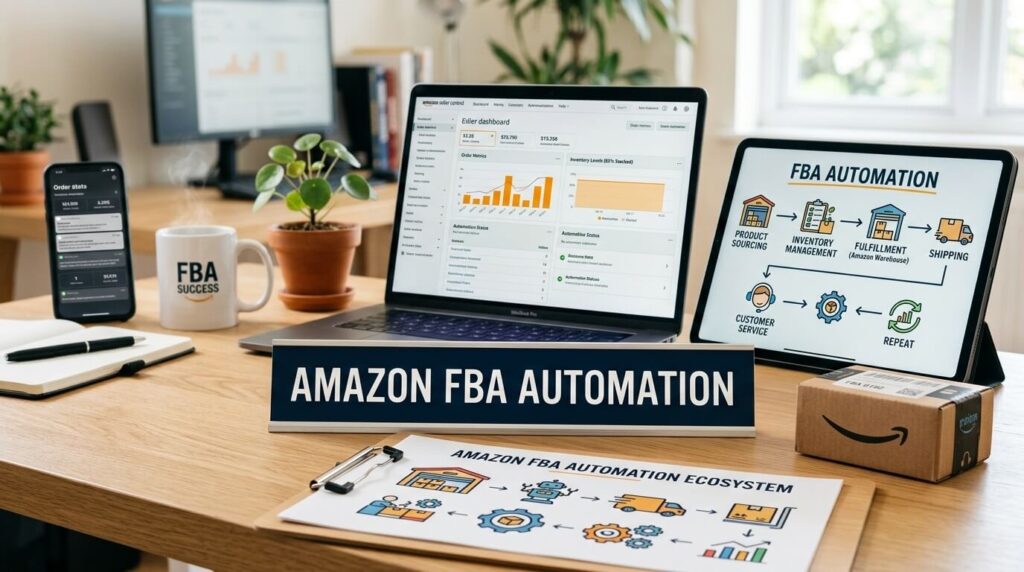
Amazon automation is not a single business model. The term covers several distinct approaches to running an Amazon seller account with reduced hands-on involvement from the account owner. Understanding the differences matters because costs, risks, and profit potential shift dramatically depending on which model you choose.
Done-for-You Store Management
This is what most people mean when they search for Amazon automation. A company creates an Amazon seller account in your name (or takes over your existing account), then manages everything. Product sourcing, listing creation, inventory management, customer service, and advertising all fall on their side.
Here is what this model typically involves:
- You provide the capital investment, usually $15,000 to $50,000 or more
- The automation company makes all operational decisions
- Revenue splits are standard, typically 70/30 or 75/25 in your favor
- You own the Amazon seller account legally
- The company handles every aspect of daily operations
Software-Based Automation
This approach uses tools to automate specific tasks within your Amazon business. You still run the operation yourself, but repetitive processes are handled by software instead of manual effort.
Sellers commonly automate these tasks through software:
- Repricing products based on competitor activity and Buy Box rotation
- Automated Amazon PPC campaign management including bid adjustments and keyword targeting
- Inventory restocking alerts and purchase order generation
- Customer communication sequences and review request timing
- Listing optimization, keyword tracking, and A/B testing
Hybrid Models
Some companies offer a middle ground combining software platforms with account management support, coaching, or partial operational help. These tend to cost less than full done-for-you services but require more involvement from the account owner. Monthly fees for hybrid models generally range from $500 to $3,000.
How a Fully Managed Amazon Automation Store Works
For investors considering the done-for-you route, the process follows a predictable sequence. Knowing each phase helps you ask the right questions and identify companies that cut corners.
Phase 1: Onboarding and Account Setup (Weeks 1 through 4)
- The company guides you through registering an Amazon Professional Seller account at $39.99 per month
- Business entity formation is typically recommended, usually an LLC
- Tax information is submitted to Amazon through Seller Central
- Your bank account and payment method are connected for disbursements
Phase 2: Product Research and Sourcing (Weeks 2 through 8)
- The team identifies products using wholesale or retail arbitrage models
- Supplier relationships and distributor accounts are established
- Initial inventory is purchased using your investment capital
- Products are prepped according to Amazon’s packaging requirements and shipped to FBA fulfillment centers
Phase 3: Listing and Launch (Weeks 4 through 12)
- Product listings are created or existing ASINs are used in the wholesale model
- Pricing strategies are implemented, often with automated repricing tools
- PPC advertising campaigns are launched to generate initial sales velocity
- First orders start flowing, though volume is typically low during this phase
Phase 4: Ongoing Management
- Daily repricing and inventory replenishment
- Continuous PPC optimization and budget allocation
- Customer service including buyer messages and returns processing
- Monthly reporting to the account owner covering revenue, costs, and profit
- Reinvestment of early profits into additional inventory to grow the catalog
Most legitimate operations take 3 to 6 months before generating consistent, meaningful revenue. Any company promising significant returns within the first 30 days is not being straightforward about how Amazon FBA actually works.
Cost of Amazon FBA Automation in 2026
Cost is where most investors either underestimate or get misled. The upfront service fee is only one piece of the total investment. Amazon charges its own set of fees, your business needs working capital for inventory, and advertising adds another ongoing expense.
What Automation Companies Charge
Below is a breakdown of what you will typically pay to the automation service provider itself.
| Cost Component | Typical Range | Notes |
|---|---|---|
| Upfront setup and management fee | $2,000 to $5,000 | One-time payment to the automation company |
| Monthly management fee (if applicable) | $500 to $2,000 per month | Some charge ongoing fees on top of or instead of setup fees |
| Revenue share to automation company | 2% to 5% of revenue | Deducted from your monthly earnings |
| Initial inventory capital | $5,000 to $20,000 | Your money used to purchase actual products |
| Ongoing inventory reinvestment | Varies | Usually 50% to 70% of early revenue gets reinvested |
Amazon’s Own Fee Structure
Amazon charges every FBA seller the following fees regardless of whether an automation company is involved. These are not optional and directly affect your profitability.
| Amazon Fee Type | Amount | Details |
|---|---|---|
| Professional seller subscription | $39.99 per month | Required for any seller processing volume |
| Referral fee | 6% to 15% | Percentage of sale price, most categories at 15% |
| FBA fulfillment fee | $3.22 to $10.48+ per unit | Based on product size and weight tier |
| Monthly storage fee (January through September) | $0.87 per cubic foot | Standard-size items |
| Monthly storage fee (October through December) | $2.40 per cubic foot | Peak season rates |
| Inbound placement service fee | $0.21 to $1.58 per unit | Charged when shipping to a single fulfillment center |
| Aged inventory surcharge | Applies after 181+ days | Penalty for slow-moving stock sitting in warehouses |
Total First-Year Investment Across Three Scenarios
Below is a realistic projection of first-year total investment at three different entry points, combining automation fees, inventory capital, and estimated Amazon costs.
| Scenario | Automation Fee | Inventory Capital | Amazon Fees (Est.) | PPC Spend (Est.) | Total Year 1 |
|---|---|---|---|---|---|
| Budget entry | $2,000 | $5,000 | $3,000 to $5,000 | $3,000 to $6,000 | $13,000 to $24,000 |
| Mid-range | $3,000 | $15,000 | $7,000 to $12,000 | $6,000 to $12,000 | $31,000 to $55,000 |
| Aggressive growth | $5,000 | $30,000+ | $15,000 to $25,000 | $12,000 to $24,000 | $60,000 to $1,0000+ |
Revenue and Profit Expectations
Profit projections are where automation companies most often stretch the truth. Monthly revenue of $50,000 sounds impressive until you subtract product costs, Amazon fees, PPC spend, and the automation company’s cut. What remains is often far smaller than the headline number.
Monthly Profit and Loss for an Automated Amazon Store
The following projection reflects a store using the wholesale model that has been operating for 6 or more months with stabilized sales volume.
| Line Item | Amount |
|---|---|
| Monthly gross revenue | $30,000 |
| Cost of goods sold (approximately 50%) | -$15,000 |
| Amazon referral fees (15%) | -$4,500 |
| FBA fulfillment fees | -$3,000 |
| PPC advertising spend | -$2,000 |
| Storage and miscellaneous Amazon fees | -$500 |
| Gross profit before automation company share | $5,000 |
| Automation company revenue share (rough estimate) | -$1,500 |
| Net profit to account owner | $3,500 |
That is roughly an 11.7% net margin on $30,000 in monthly revenue. On a $40,000 total first-year investment, it would take approximately 11 to 12 months of consistent $3,500 monthly profit just to reach break-even.
Several factors make these numbers fluctuate significantly in practice:
- Wholesale margins are inherently tighter than private label margins, leaving less room for error
- Amazon PPC costs have increased year over year as competition on the platform has intensified
- Product returns and damaged inventory typically reduce profits by 2% to 5%
- Seasonal demand swings can move monthly revenue up or down by 30% to 50%
- Early-stage stores rarely hit these numbers consistently until months 8 to 12
- Reinvesting early profits into inventory growth delays your personal payback timeline further
The critical takeaway is this: anyone presenting revenue as profit is either uninformed or deliberately misleading you.
What Amazon’s Policies Actually Say About Third-Party Account Management
This is a section most automation company websites conveniently avoid. Amazon has specific policies about who can access and operate your seller account, and violating them can result in permanent suspension with no appeal.
Every investor needs to understand these policy realities:
- Amazon’s Terms of Service hold the account owner fully responsible for all activity on the account, regardless of who performs the actions
- Amazon allows third-party access through “user permissions” in Seller Central, where you can grant varying levels of access to outside parties
- Selling, transferring, or assigning seller accounts to other parties is explicitly prohibited by Amazon
- If Amazon detects policy violations committed by your automation company (listing restricted products, review manipulation, pricing violations), your account gets suspended, not theirs
- Account reinstatement after a suspension is difficult, often requiring a detailed Plan of Action, and is sometimes impossible
Amazon does not endorse, regulate, or oversee automation services. There is no Amazon-approved list of automation providers. If your automation company makes a mistake, you carry 100% of the consequences.
The Fraud Problem That Has Damaged the Entire Industry
The Amazon automation space has been plagued by scams since at least 2019. The Federal Trade Commission has taken enforcement action against multiple companies that collected large upfront fees and either delivered minimal results or disappeared entirely.
Common fraud patterns that have been documented across FTC complaints, BBB filings, and consumer protection investigations include:
- Collecting $20,000 to $50,000 in upfront fees, making minimal or no product purchases, and then becoming unresponsive
- Creating fake dashboards or doctored screenshots showing fabricated sales data to keep investors paying additional fees
- Recycling the same small inventory across dozens of client accounts, creating the illusion of a working business
- Pressuring investors to “scale up” with additional capital before the store has proven any real traction
- Using influencer partnerships and paid testimonials to manufacture social proof
Identifying Fraud vs. Legitimate Operations
Below is a comparison of warning signs against indicators of a potentially legitimate service.
| Warning Signs (Potential Fraud) | Positive Indicators (Potentially Legitimate) |
|---|---|
| Guaranteed income promises of $5K to $10K monthly | Clear disclaimers that results vary and are not guaranteed |
| No verifiable company history or leadership | Registered business with identifiable founders and track record |
| High-pressure tactics with “limited spots” or “price increases tomorrow” | Transparent pricing with no manufactured urgency |
| Only shows revenue screenshots, never actual profit | Shares detailed P&L breakdowns including all fees and costs |
| No formal contract or extremely vague terms | Detailed contract with performance terms, exit clauses, and refund provisions |
| Claims zero Amazon experience is needed and there is no risk | Explains risks honestly and outlines investor responsibilities |
| Refuses to provide current client references | Willingly connects you with existing clients for direct conversations |
How to Properly Vet an Amazon Automation Company
If you are seriously considering an automation service in 2026, a thorough vetting process can protect you from losing your entire investment. Treat this like any five-figure business decision, because that is exactly what it is.
Complete these verification steps before signing anything or sending money:
- Business registration verification. Look up the company on your state’s Secretary of State website. Confirm the LLC or corporation filing, formation date, registered agent, and whether it is in good standing.
- FTC and consumer complaint search. Visit ftc.gov and search the company name. Also check the Better Business Bureau, Trustpilot, and your state attorney general’s consumer complaint portal.
- Client reference calls. Ask for contact information for 3 to 5 current clients. Speak with them directly. Ask about timeline to profitability, communication quality, and whether initial projections matched reality.
- Contract review. Look for exit clauses, refund policies, performance benchmarks (and what actually happens if they are not met), fee structures, and who retains intellectual property like supplier relationships.
- Amazon compliance questions. Ask specifically how they access your account, what user permission levels they request, and how they handle restricted product categories and brand gating.
- Leadership background checks. Search the founders and key operators on LinkedIn. Look for verifiable Amazon selling experience, not just marketing or coaching backgrounds.
- Request a sample P&L. A legitimate company should be able to show a realistic profit and loss statement from an existing managed store with identifying information redacted.
- Consult a business attorney. Before signing any contract involving $10,000 or more, have an attorney review the terms. This typically costs $300 to $800 and can save you from devastating contractual traps.
Software Tools for Sellers Who Want to Automate Without Outsourcing
Not everyone needs a full done-for-you service. Many successful Amazon sellers automate the most time-consuming parts of their operation using software tools, keeping full control of their account and avoiding the fees and risks of third-party management.
Using a strategic combination of these tools, a seller can automate 60% to 80% of daily operational tasks while keeping full ownership of their business, data, and profits.
Repricing Software
Repricing is one of the most impactful areas to automate because Buy Box rotation directly affects sales volume, and manual repricing is nearly impossible at scale.
| Tool | Starting Price | Primary Strength |
|---|---|---|
| Repricer (formerly RepricerExpress) | $85 per month | AI-driven repricing with Buy Box targeting |
| Informed.co | $149 per month | Machine learning price optimization |
| Seller Snap | $250 per month | Game theory-based algorithmic repricing |
| BQool | $25 per month | Budget-friendly with customizable rule sets |
PPC Advertising Automation
Amazon advertising costs have risen significantly over the past three years. Automated PPC management helps control spend while maintaining visibility.
| Tool | Starting Price | Primary Strength |
|---|---|---|
| Perpetua | $250 per month | AI-powered bid optimization across campaigns |
| Pacvue | Custom pricing | Enterprise-level campaign management |
| AdBadger | $275 per month | Automated bid adjustments and negative keyword mining |
| Scale Insights | $78 per month | Budget-friendly PPC automation with algorithmic bidding |
Inventory Management and Forecasting
Running out of stock kills your search ranking. Overstocking eats into margins through storage fees. Automation here directly protects profitability.
| Tool | Starting Price | Primary Strength |
|---|---|---|
| SoStocked (by Carbon6) | $158 per month | Demand forecasting with seasonal adjustment |
| RestockPro (by eComEngine) | $59 per month | FBA inventory planning and shipment tracking |
| InventoryLab | $69 per month | Combined accounting and inventory management |
| Sellerboard | $19 per month | Profit tracking with inventory monitoring |
All-in-One Research and Management Platforms
For sellers who prefer a single ecosystem over multiple specialized tools, these platforms cover broad functionality.
| Tool | Starting Price | Primary Strength |
|---|---|---|
| Helium 10 | $29 per month | Full suite including keyword research, listing optimization, refund management |
| Jungle Scout | $29 per month | Product research, sales analytics, keyword tracking |
| Seller.Tools | $37 per month | Keyword automation and listing management |
| SmartScout | $29 per month | Brand and category-level market research |
Emerging Trends Shaping Amazon Automation in 2026
The automation landscape is shifting. Several developments are changing what these services look like and how sellers approach hands-off Amazon selling.
Key developments worth tracking in 2026:
- AI-powered product research and sourcing. Newer tools use machine learning to identify profitable wholesale opportunities faster than manual research, reducing the value proposition of some automation companies.
- Amazon’s crackdown on policy violations. Amazon has become increasingly aggressive about suspending accounts for catalog quality issues, restricted product violations, and IP complaints. This raises the stakes for anyone letting a third party make sourcing decisions.
- Increased FBA fee complexity. Amazon has layered more fees in recent years, including inbound placement fees and low-inventory-level fees. These squeeze margins tighter and make profitable automation harder to achieve.
- Rise of AI listing and PPC tools. Tools like ChatGPT integrations and Amazon’s own AI features are making it easier for individual sellers to handle tasks that previously justified paying an automation company.
- Growing regulatory attention. Following FTC enforcement actions, state-level investigations into automation companies have increased, potentially improving consumer protection but also signaling how widespread the problem has become.
Who Should and Who Should Not Consider Amazon Automation
Amazon FBA automation is not inherently a scam. Legitimate companies do exist, and some investors have built genuinely profitable stores through managed services. But it is absolutely not the right path for everyone, and being honest about that is more useful than a sales pitch.
This model may make sense if you meet all of these criteria:
- You have $25,000 or more in capital that you can afford to lose entirely without financial hardship
- You lack the time to learn and operate an Amazon business yourself due to a full-time career or other active businesses
- You have thoroughly vetted the automation company using the verification steps outlined above
- You understand and accept timelines of 12 months or longer to reach break-even
- You treat this as a speculative business investment with real risk, not as guaranteed passive income
This model is likely not right for you if any of these apply:
- You are investing money you cannot afford to lose, including savings, retirement funds, or borrowed capital
- You expect guaranteed returns or fast profits within the first few months
- You have not done independent research on how Amazon FBA actually works
- You feel pressured by a sales pitch involving limited spots, countdown timers, or price increases
- You cannot independently verify the legitimacy and track record of the company you are evaluating
Steps to Take Before Sending Money to Any Automation Provider
If after thorough research you decide to proceed, these concrete actions protect your investment and your Amazon account before a single dollar changes hands.
Follow this sequence to reduce your exposure to risk:
- Form your own LLC before engaging with any automation company. This separates your personal assets from business liabilities.
- Open a dedicated business bank account. Never provide an automation company access to personal finances.
- Register your own Amazon seller account directly through Amazon Seller Central. You should own and control the account from day one.
- Enable two-factor authentication on your Amazon account, your email, and any linked financial accounts.
- Use Amazon’s built-in user permissions to grant the automation company access at the appropriate level. This allows you to monitor activity and revoke access at any time.
- Require monthly financial reports that include all revenue, cost of goods sold, Amazon fees, PPC spend, and net profit calculations.
- Log into your own Seller Central account weekly to independently verify reported sales data against actual account performance.
- Keep organized records of all contracts, email communications, and financial transactions.
- Set a clear performance evaluation timeline. If the company has not delivered measurable progress within 6 months, execute your exit plan.
- Never grant full administrative access or share your primary login credentials with the automation company.
Frequently Asked Questions
Is Amazon FBA automation legitimate?
Amazon automation as a business model is legal. Companies can manage Amazon seller accounts on behalf of account owners using Amazon’s user permissions feature. However, the industry has an unusually high rate of fraud and deceptive practices. Whether your experience is positive depends entirely on the specific company you choose and how thoroughly you vet them before investing.
How much does Amazon automation cost in total?
Total first-year costs typically range from $26,000 to over $100,000 depending on the service provider, inventory investment, and advertising spend. This includes the automation service fee ($15,000 to $50,000), initial inventory capital ($5,000 to $30,000), Amazon seller fees, and monthly PPC advertising costs.
How long does it take to see profit from an automated Amazon store?
Legitimate automation services typically take 3 to 6 months to generate consistent revenue and 9 to 18 months to reach break-even on your total investment. Companies promising meaningful profit within 30 to 60 days are misrepresenting the reality of how Amazon FBA businesses grow.
Can Amazon suspend my account because of an automation service?
Yes. Amazon holds the account owner responsible for all activity regardless of who performs the actions. If the automation company lists restricted products, engages in review manipulation, or violates pricing policies, your account faces suspension. The automation company faces no consequences from Amazon directly.
What is the difference between Amazon automation and Amazon FBA?
Amazon FBA is a fulfillment service provided by Amazon where they store, pack, and ship your products from their warehouses. Amazon automation refers to outsourcing the entire management of your Amazon selling business to an outside company. FBA is a logistics service from Amazon. Automation is a business arrangement with a third-party operator.
What profit margins should I realistically expect?
Net profit margins for automated stores running wholesale models typically fall between 8% and 15% of gross revenue after subtracting product costs, all Amazon fees, PPC advertising spend, and the automation company’s revenue share. Private label automation can produce higher margins but adds complexity, longer timelines, and greater upfront investment.
What should I do if my automation company stops communicating?
Immediately log into your Amazon Seller Central account and revoke all third-party user permissions. Change your account password and review recent account activity for any unauthorized changes. Document all communications and financial transactions. File complaints with the FTC at reportfraud.ftc.gov, your state attorney general’s consumer protection division, and the Better Business Bureau. Consult a business attorney about potential legal remedies based on your contract terms.