
Amazon PPC brand defense strategy involves bidding on your own branded keywords to secure the top ad spots. It acts as a proactive shield, stopping competitors from placing their ads in front of customers who are specifically searching for your products. This approach protects your sales and helps maintain customer loyalty.
The primary reason to run these campaigns is that competitors are actively and aggressively bidding on your brand name. They place their sponsored ads directly above your organic listings to intercept your customers. Ignoring this is a significant risk, as these rivals can poach your most valuable, highest-intent customers at the moment they are ready to buy. Every click they get is a potential lost sale and a customer who may not return.
Why Brand Defence Is No Longer Optional

The first question most brand owners ask is, “Why should I pay for clicks from shoppers who are already searching for me?” It can feel like paying for traffic you should get for free.
That thinking, however, overlooks the competitive reality of the Amazon marketplace. Your competitors are likely bidding on your brand name right now, placing their sponsored ads above your organic listings to capture your traffic.
This is a direct attempt to steal your highest-intent customers right when they’re about to make a purchase. Each click a competitor wins is a lost sale and potentially a lost customer for good.
1. The Real Cost of Inaction
Leaving your brand undefended creates a domino effect of problems beyond just a few lost sales. When rivals start siphoning off your branded traffic, it can cause significant damage to your business.
To put this into perspective, here’s a rundown of the major risks you take by not having a brand defense strategy in place.
The High Cost of an Undefended Brand
| Risk Area | Impact on Your Business | Typical Metric Affected |
|---|---|---|
| Traffic Hijacking | Competitors capture your high-intent traffic, directly stealing potential sales. | Click-Through Rate (CTR), Sales Volume |
| Lowered Organic Rank | Amazon’s A10 algorithm sees lower conversions from branded searches, hurting your rankings. | Organic Keyword Rank, Best Seller Rank (BSR) |
| Customer Confusion | Shoppers looking for you find competitors first, leading to frustration and lost trust. | Conversion Rate (CVR), Customer Reviews |
| Brand Equity Erosion | Competitors chip away at your market share and customer loyalty over time. | Customer Lifetime Value (CLV), Repeat Purchase Rate |
| Increased Ad Costs | Competitors drive up the cost of your own branded keywords, making it more expensive to advertise later. | Cost-Per-Click (CPC), ACoS |
The consequences are far-reaching. Data shows that in undefended branded searches, competitors can achieve up to 25% higher click shares on average. This sends a negative signal to Amazon’s A10 algorithm, which rewards consistent conversions from branded traffic.
The fight for branded search terms is a fight for market share. If you aren’t there, a competitor will be. The cost of a brand defense campaign is minimal compared to the long-term cost of customer erosion and lost brand equity.
Plus, it creates a poor customer experience. A shopper searching for “Brand X” expects to find “Brand X,” not a cheaper alternative from “Brand Y” at the top of the page. This confusion leads to frustration, misguided purchases, and a slow erosion of trust.
2. Shifting Your Mindset
Protecting your brand on Amazon isn’t just another marketing tactic; it’s a fundamental cost of doing business on the platform.
Think of it as digital real estate. Your branded search results page is your storefront. Allowing competitors to set up shop there rent-free is a critical business error. The money you invest in an Amazon PPC brand defense campaign protects that storefront.
Many of the most effective defensive tools are available only to sellers enrolled in Amazon’s Brand Registry. The program is essential for maintaining control over your listings and ads. If you haven’t already, take the time to explore the benefits of Amazon Brand Registry. It’s the first step toward building a true protective shield around your products and customers.
Building Defensive Campaign Structure
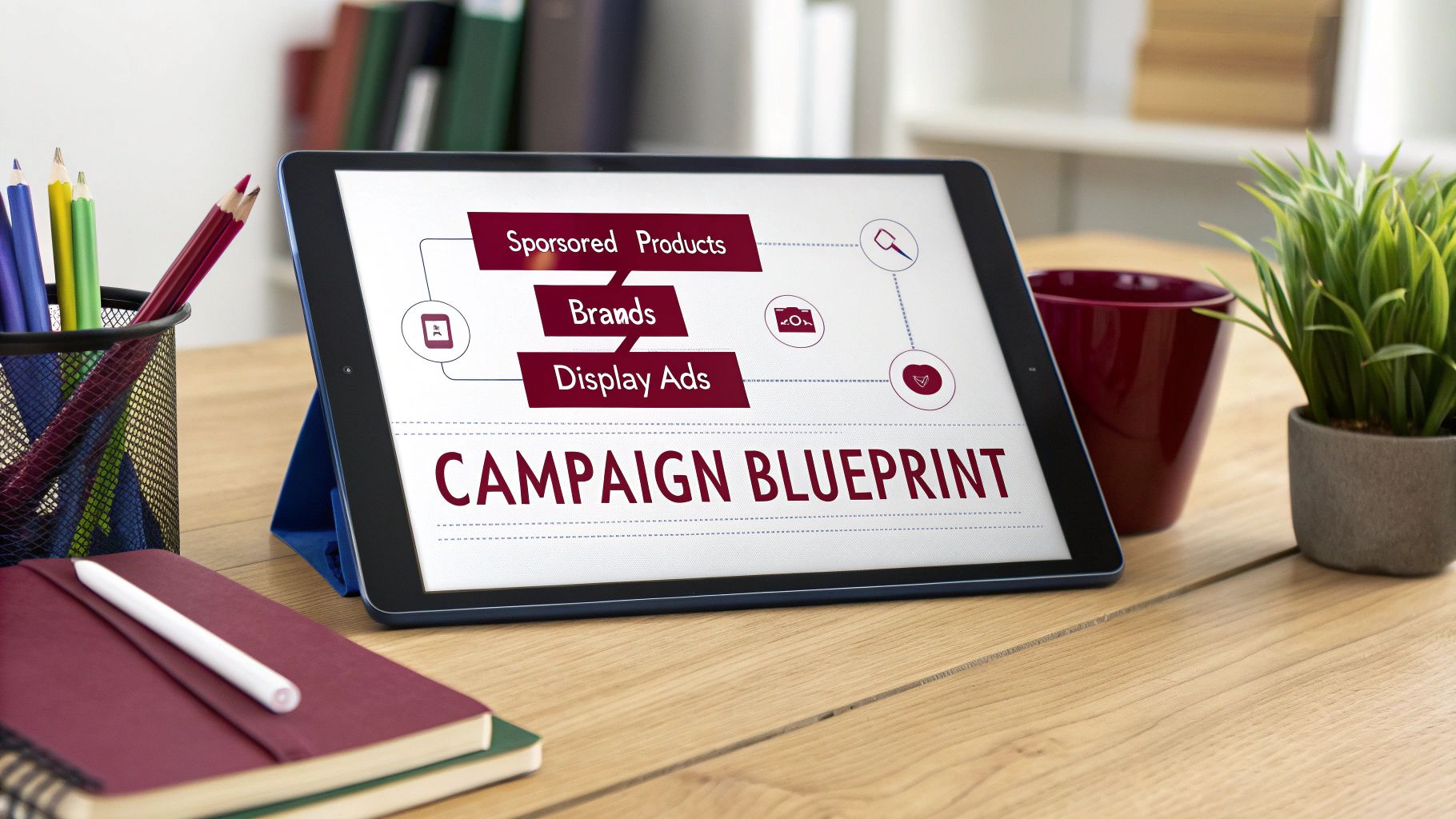
A solid defense starts with an organized campaign structure built to shield your brand from every angle. Simply spending money on your brand name isn’t a strategy; you need a segmented, multi-layered approach using Amazon’s full suite of advertising tools.
The goal is to build a fortress around your branded search terms and product detail pages. This is done by setting up dedicated campaigns for each ad type: Sponsored Products, Sponsored Brands, and Sponsored Display. Each serves a unique defensive purpose, giving you maximum control over bids, budgets, and messaging, ensuring no cracks for competitors to slip through.
1. Isolate Branded Keywords
First, you must isolate all branded keyword traffic into its own set of campaigns. If your branded terms are mixed with your general, non-branded campaigns, controlling your defensive posture becomes nearly impossible. The aggressive, high-bid strategy required for defense will negatively impact the ACoS of your other campaigns and distort your performance data.
A clean way to organize this is by creating a separate “Brand Defense” portfolio in the advertising console. Inside this portfolio, you’ll build out the specific campaigns we’re about to cover. And remember, a good defense also means knowing what the offense is up to; learning how to spy on your competitors’ strategy can give you a serious edge.
2. Sponsored Products
Your Sponsored Products (SP) campaigns are the foundation of your Amazon PPC brand defense. Their main job is to secure the top-of-search ad slots for anyone typing in your brand name or a close variation.
Here’s how to structure your SP Brand Defense campaign:
- Create a New SP Campaign: Give it a clear name you can’t misinterpret, like “[Brand Name] – SP – Brand Defense – Exact.”
- Use Manual Targeting: This is essential for brand defense. You need precise control. You can learn more about the differences in our article covering automatic vs. manual campaign targeting.
- Build Specific Ad Groups:
- Brand Name Exact: Target your exact brand name (e.g., “EcoFresh Soap”). This is your highest-priority ad group.
- Brand Name Phrase: Target your brand name in phrase match to catch longer-tail searches (e.g., “EcoFresh Soap for sensitive skin”).
- Misspellings & Variations: Target common typos and variations of your brand name (e.g., “EkoFresh Soap” or “Eco Fresh Soap”). Competitors often bid on these because they’re cheaper and sellers sometimes forget them.
For these campaigns, you need to bid aggressively from the start. The goal here is not a low ACoS; it’s 100% impression share at the top of the search results.
3. Sponsored Brands
While Sponsored Products ads are your frontline defense, a Sponsored Brands (SB) ad is your unmissable billboard. It occupies the large, premium space at the very top of the search results, allowing you to showcase multiple products and a custom headline.
For brand defense, your Sponsored Brands ad should be an undeniable statement of ownership. Use a headline like “The Official Store for [Your Brand Name]” to instantly signal authenticity to shoppers and physically push competitors further down the page.
Your SB campaign should also target your exact and phrase match branded keywords. Link this ad directly to your brand store. It’s a powerful way to pull the customer into your brand’s world, making it much harder for them to get distracted by a competitor’s offer. You own the entire customer experience from the moment they search for you.
4. Sponsored Display
Finally, Sponsored Display (SD) ads are your gatekeepers, positioned on your own product detail pages. If you’ve ever scrolled down one of your own listings and seen the carousel of “Products related to this item” filled with competitor ads, that’s your traffic being siphoned off. Sponsored Display is how you prevent it.
Set up an SD campaign using Product Targeting and target your own ASINs. It sounds counterintuitive, but placing your own ads on your own product pages allows you to:
- Block Competitors: You’re buying up the ad inventory on your own real estate, preventing rivals from diverting your traffic at the point of decision.
- Cross-Sell Your Catalog: Promote complementary products. If a customer is looking at your shampoo, show them an ad for your conditioner.
- Upsell to Premium Products: Use the ad space to advertise a larger size or a premium version of the product the customer is already viewing.
This defensive trifecta—Sponsored Products, Sponsored Brands, and Sponsored Display—creates a comprehensive shield. Each campaign type works together to protect your traffic, control your brand messaging, and keep customers within your product family.
Keyword and ASIN Targeting for Maximum Protection
An effective Amazon PPC brand defense relies on precision targeting. While your campaign structure provides the fortress walls, your keywords and ASIN targets are the guards on patrol. The goal is to cast a defensive net so tight that competitors can’t find a way in.
To achieve this, you need to understand both your loyal customers and your most aggressive rivals. This isn’t just about bidding on your brand name; it’s about anticipating every possible search variation someone might use. Any branded term you overlook is a backdoor left open for a competitor.
1. Branded Keyword Targeting
Your first step is to build a complete library of your branded keywords. This is the core of your defensive strategy, so be thorough. You must account for every way a shopper could search for your products.
Start with the obvious, then expand. Segment your keywords into dedicated ad groups for tighter control over bids and cleaner reporting.
- Core Brand Terms (Exact Match): Target your brand name exactly as people know it, like “AuraGlow” or “KitchenPro.” This ad group will likely see the most traffic, so be prepared to bid aggressively.
- Brand Variations (Phrase Match): This catches searches where your brand is part of a longer query. Using phrase match on terms like “AuraGlow whitening strips” or “KitchenPro blender” ensures you appear whenever your brand is included in a product search.
- Common Misspellings (Exact Match): Competitors often bid on typos of brand names because they’re cheaper and easy to miss. Create a list of every misspelling you can think of. For “AuraGlow,” that could be “Aura Glow,” “Auraglo,” or even “OraGlow.”
- Brand + Product Identifiers (Exact Match): Target your brand name paired with specific model numbers or product lines, such as “KitchenPro X500” or “AuraGlow Radiant Serum.” This is crucial for protecting your individual hero products.
Building this keyword list is an ongoing task. Regularly review your Search Term Reports to uncover new misspellings and search variations people are actually using. Add these as new exact match keywords to keep your defense airtight.
2. Defensive ASIN Targeting
Keywords protect you in search results, but ASIN targeting defends your home turf: the product detail page (PDP). Your PDP is some of the most valuable real estate on Amazon. Leaving it undefended is like letting competitors hand out flyers next to your “Add to Cart” button.
This is where Sponsored Products and Sponsored Display campaigns become your gatekeepers. When you target your own ASINs, you effectively block competitors from appearing in the “Sponsored products related to this item” carousels.
Let’s break down the different ways you can use this targeting in your broader strategy.
Defensive Targeting Types and Use Cases
| Targeting Type | Primary Goal | Example Implementation |
|---|---|---|
| Keyword Targeting | Dominate search results for all branded queries, preventing competitors from appearing above your organic listings. | Bidding on “BrandX,” “Brand X,” “BranX,” and “BrandX coffee maker” in Sponsored Products and Brands campaigns. |
| Defensive ASIN Targeting | Block competitor ads from appearing on your own product detail pages, keeping shoppers in your ecosystem. | Using Sponsored Display to place your own ads on the detail pages of your top-selling ASINs. |
| Offensive ASIN Targeting | Place your ads on competitor product detail pages to capture their traffic and introduce your brand to new customers. | Targeting the ASINs of direct competitors who sell similar products, often with weaker reviews or higher prices. |
The execution is straightforward. Create a new Sponsored Display or Sponsored Products campaign, and in the targeting section, choose Product Targeting. From there, enter your own ASINs.
Done right, this means that when a shopper is on your product page, the ads they see are for your other products. It’s a fantastic opportunity to cross-sell or upsell. For example, if they’re looking at your standard coffee maker, show them an ad for your high-end espresso machine. You can find more advanced plays in our complete guide to Amazon product targeting.
By combining a robust keyword strategy with disciplined ASIN targeting, you’re building a two-layer defense. You’re protecting your brand from the initial search through to the final purchase decision, stopping sales leakage while reinforcing your brand’s authority.
Bids and Budgets for Brand Dominance
When running brand defense campaigns, the standard PPC playbook doesn’t apply. Your main goal isn’t a low ACoS; it’s total dominance. Think of this as a strategic investment to protect your market share, which requires a more aggressive approach with your bids and budgets.
You must shift your mindset from short-term profitability to ensuring complete, unwavering visibility. Every time a competitor gets an ad spot above you for your own brand name, it’s a weakness in your defense. The mission is to make it an unprofitable and frustrating experience for anyone else trying to bid on your terms by maintaining an unbreakable presence.
1. Setting Aggressive Bids
For brand defense, your default position must be the very top of the search results page. To secure this spot consistently, you have to set bids high enough to win nearly every auction for your branded keywords. You’re aiming for a near 100% Top of Search impression share.
This often means bidding higher than Amazon’s suggestions. A good starting point is to set your bid 25-30% above the high end of Amazon’s suggested range. Then, monitor your impression share daily. If it drops below 95%, increase your bids until you’re back on top.
2. Using Placement Modifiers
Placement modifiers, or placement bid adjustments, are your tool for reinforcing top-of-page dominance. They let you increase your base bid by up to 900% specifically for those valuable top-of-search placements.
Here’s how to use them:
- Go to the “Placements” tab inside your brand defense campaign.
- Find the “Top of search (first page)” option and set a positive bid adjustment.
- Start with an adjustment of 50-100% and watch your placement reports closely.
This tells Amazon you’re willing to pay a premium to secure that first ad slot, which is a critical lever for pushing competitors out of view. For a deeper dive, see our guide on Amazon PPC bid optimization.
3. Allocating Budgets
A solid Amazon PPC brand defense campaign never stops. If your daily budget runs out at 8 PM, you’re inviting competitors to swoop in overnight. Your budget must be high enough to keep your ads running 24/7.
Here’s a practical approach: let your campaign run for a full week and monitor its daily spend. Identify the day with the highest spend, then set your daily budget 20-30% higher than that peak amount. This buffer handles unexpected traffic surges without your campaigns going dark.
Your budget isn’t just a cost; it’s an insurance policy. The small amount you might “over-budget” is insignificant compared to the potential sales lost when your ads are offline.
Managing bids for brand dominance is less about daily financial returns and more about long-term asset protection. While it’s helpful to know what constitutes a good Cost Per Click (CPC), the success metrics here are different.
Separating branded from non-branded campaigns is key to preventing overspending. Brand defense campaigns often run at a very low ACoS, frequently under 10%. In fact, these campaigns can achieve a Return on Ad Spend (ROAS) up to 5x higher by focusing exclusively on high-intent, own-brand terms. This efficiency makes aggressive bidding a smart, sustainable investment.
How Brand Defense Supercharges Your Organic Rank

It’s easy to view an Amazon PPC brand defense as just a business cost. But that’s only part of the picture. A solid brand defense strategy is a direct investment in your organic growth, creating a positive feedback loop that continues to deliver value.
This works because you’re feeding Amazon’s A10 algorithm exactly what it values: relevance and sales velocity. By consistently owning the ad placements for your branded keywords, you ensure that every high-intent shopper finds you, clicks, and converts.
That steady stream of conversions sends a powerful signal to Amazon that your product is the authority for those searches. The algorithm rewards this authority by improving your organic placement. This creates a powerful cycle where paid success directly boosts your organic rank.
1. The Paid-to-Organic Connection
Your branded search terms are a direct line to your most valuable customers. When they type in your brand name, they expect to see you at the top.
By securing that top ad spot, you remove friction from their path to purchase. This leads to higher conversion rates, which is a major signal for the A10 algorithm.
A high conversion rate on branded searches tells Amazon, “When a shopper looks for this brand, this is the product they want.” That validation is a huge factor in how Amazon determines top organic spots.
Additionally, the consistent sales velocity from these branded searches helps stabilize and improve your Best Seller Rank (BSR). As your BSR improves, so does your overall search visibility. Over time, you’ll start ranking higher organically not just for your brand name, but for related non-branded terms as well. Amazon begins to see your product as a trusted, high-performing item.
For more details, check out our full guide on improving your Amazon organic ranking.
2. Turning Ad Spend into an Organic Asset
The data supports this connection. Bidding on your own branded keywords consistently yields 15-25% higher conversion rates compared to non-branded terms. All of that high-conversion traffic feeds the A10 algorithm and improves your unpaid visibility.
The opposite is also true. Research indicates that brands ignoring brand defense can see their organic share of voice drop by 20% when competitors start bidding on their brand name.
This reframes your brand defense budget. You aren’t just paying to block competitors; you’re paying to fuel the flywheel that builds your organic foundation. The low ACoS typical of these campaigns makes it one of the most efficient ways to generate the sales history Amazon needs to trust your product. It’s a smart investment that locks in today’s sales while building the organic authority that will drive tomorrow’s growth.
Common Questions About Brand Defense Campaigns
Even experienced sellers can be hesitant when setting up their first dedicated Amazon PPC brand defense campaign. It can feel counterintuitive to spend money advertising to shoppers who are already looking for you.
Let’s address the most common questions.
Am I Just Paying for Sales I Would Get Anyway?
This is a fair question. You would still get some of those sales organically, but you wouldn’t get all of them.
Your competitors are actively bidding on your brand name. They are trying to pull away your most valuable customers just before they buy. Think of your brand defense campaign as an insurance policy that guarantees you capture the maximum possible sales from your own branded traffic.
Plus, the Advertising Cost of Sale (ACoS) on these campaigns is usually so low it becomes an easy decision. It’s a small investment to prevent sales leakage.
How Much Should I Budget for Brand Defense?
There’s no single answer, but the guiding principle is that your budget must be high enough to keep your ads running 24/7. Your brand defense cannot take a break.
A practical way to set it is to let your new campaigns run for a full week and observe the daily spend. Find the day with the highest spend, and then set your daily budget about 20-30% higher than that number. This buffer is crucial as it keeps your ads live during unexpected traffic surges, leaving no gaps for a competitor to exploit.
What ACoS Should I Expect for These Campaigns?
Brand defense campaigns are known for their efficiency. Since you’re targeting people who already know and want your brand, conversion rates are very high.
This results in a very low ACoS, almost always in the single digits—somewhere between 2% and 10% is typical.
Remember, ACoS isn’t the primary goal here; protection is. The strategic value of preventing a competitor from stealing a customer is worth far more than the ad spend, even if your ACoS is slightly higher than desired.
Should I Use Sponsored Display for Brand Defense?
Yes, absolutely. Sponsored Display is a critical component of a complete defensive strategy. Its main job is to act as a gatekeeper on your own product detail pages.
Set up a Sponsored Display campaign using product targeting and aim it directly at your own ASINs. This simple move accomplishes two powerful things:
- It physically blocks competitor ads from appearing in the sponsored carousels on your listings.
- It provides a perfect opportunity to cross-sell or upsell your own related products, keeping shoppers engaged with your brand.