
Amazon’s ranking algorithm is the proprietary system that determines the order of product listings in search results. It evaluates hundreds of data points in real time to predict which product a customer is most likely to purchase based on their specific search query.
Unlike Google, which optimizes for information relevance, Amazon optimizes for purchase probability. Every ranking decision is rooted in one question: “Which product will generate the most revenue?”
Behavioural Differences Between A9 and A10
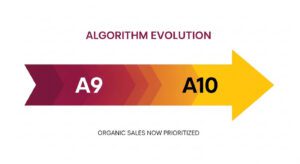
A9 asked one question: what is selling? A10 asks a harder one: why is it selling, and is that demand real? Two products with identical monthly sales volumes can sit ten pages apart in search results. Here is how A9 and A10 differ from each other.
1. What A9 Rewarded
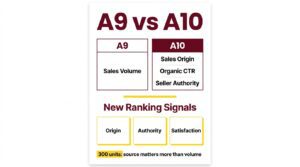
A9 had one important logic: products that sell more must be more relevant. That made sales velocity the single most powerful ranking signal, and it made the system easy to game. Run aggressive PPC, flood a launch with giveaways or rebate-driven purchases, generate enough velocity in a short window, and organic ranking followed. The source of those sales did not matter. Amazon saw units moving and ranked the product accordingly.
That dynamic created a marketplace where ad spend essentially purchased organic position. The quality of actual customer demand was irrelevant. Volume was everything.
2. What Changed Under A10
The current system broke that equation by adding one critical variable: where did this sale come from?
Not all sales carry the same ranking weight anymore. The algorithm now reads the origin of each conversion and scores it differently:
Organic sales carry the highest ranking weight. A customer searched a keyword, saw your listing without a sponsored label, and bought it. That tells the algorithm your product earned the click on its own merit.
PPC-attributed sales still contribute but at a lower weight than before. They remain valuable for generating keyword-level data and launch velocity, but heavy reliance on them no longer produces the same organic lift.
Click Through Rate (CTR) is a standalone ranking signal. If your listing consistently wins clicks in the search results for a keyword, Amazon consider it plus point for organic ranking.
Giveaway or rebate-driven sales carry the least sustained weight. They may temporarily move BSR but produce minimal lasting ranking benefit once the promotion ends.
External traffic that converts is now treated as cross-platform market validation, carrying strong ranking weight because Amazon did not drive that discovery itself.
A product doing 300 units monthly, with 200 organic and 100 PPC-attributed, will consistently outrank a product doing the same 300 units with 250 coming from paid campaigns and 50 from organic search.
3. The Three New Signals A10 Added
Beyond reweighting sale sources, A10 introduced three signals A9 largely ignored:
CTR as an independent ranking input. A9 measured whether clicks converted. A10 also measures whether your listing wins clicks against competitors without the aid of sponsored placement. Organic CTR, at the keyword level, now contributes to impression share, which feeds the ranking loop directly.
Seller authority at the catalog level. A9 evaluated individual ASINs almost exclusively. A10 assigns an authority score to the seller behind them. Feedback ratings, return rates relative to category average, account tenure, order defect rate trajectory, and Brand Registry status all influence how the algorithm handles ranking decisions across every product in your catalog.
Customer satisfaction as a post-purchase signal. A9 treated reviews as a secondary trust marker. A10 integrates return rates, customer service ticket volume, and review sentiment into its product quality assessment. A product with a 4.8-star rating but a 15 percent return rate may rank below a 4.3-star product with a 3 percent return rate, because the algorithm reads returns as product-reality mismatches.
| Ranking Signal | A9 Behavior | A10 Behavior |
|---|---|---|
| Keyword Matching | Exact and phrase priority | Semantic and intent-based |
| PPC-Driven Sales | Very High ranking weight | Moderate ranking weight |
| Organic Sales | Moderate ranking weight | Highest ranking weight |
| Giveaway or Rebate Sales | Accepted velocity input | Minimal sustained ranking benefit |
| External Traffic | No meaningful signal | Strong signal when converting |
| Organic CTR | Moderate weighting | High weighting, feeds impression share |
| Seller Authority | ASIN-level only | Catalog-level authority score |
| Conversion Rate | Primary signal | Primary signal, broader data inputs |
| Customer Satisfaction | Secondary signal | Direct ranking factor with return rate data |
| Review Quality | Volume-based | Recency, helpfulness, and sentiment weighted |
The 9 Critical Amazon A10 Ranking Factors
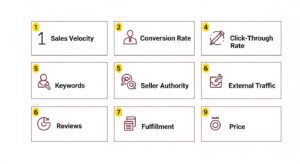
The A10 algorithm evaluates 9 key factors to rank products on Amazon. Based on analysis, here are the 9 core ranking factors that matter most in 2026:
Factor #1: Sales Velocity & Performance
The speed and consistency of sales is a major factor. New products with a high launch velocity (steady flow of sales in the first weeks) usually rank faster. If sales stall, rankings fall.

Sales Velocity Benchmarks:
| Performance Level | Monthly Sales Needed | Ranking Impact |
| Low | 1-5 units | Difficult to rank |
| Moderate | 10-50 units | Can reach page 2-3 |
| Good | 50-100 units | Page 1 potential |
| Excellent | 100+ units | Top 10 positions |
A10 heavily favors recent performance. A product that sold well last quarter but stalls today will slide. A product that suddenly converts well, even at lower total volume, can climb quickly.
How to improve sales velocity:
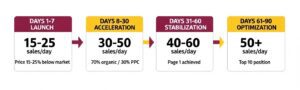
- Launch with aggressive pricing (20-25% below competitors)
- Enroll in Amazon Vine to get 15-30 reviews for best conversion rate.
- Use Amazon coupons to increase conversion during launch
- Run Sponsored Products campaigns targeting exact-match keywords
- Aim for 70% organic sales and 30% PPC sales for stable organic rankings
- Build external traffic to accelerate organic signals
Factor #2: Conversion Rate (CVR)
Conversion is one of the strongest ranking signals in the A10 algorithm. If shoppers click but don’t buy, Amazon thinks your product isn’t a good fit for the keyword.
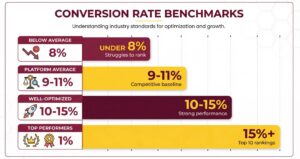
Below are the Amazon conversion rate benchmarks by category in 2026.
| Category | Average CVR | Good CVR | Excellent CVR |
| Electronics | 3-8% | 9-12% | 13%+ |
| Home & Kitchen | 10-14% | 15-18% | 19%+ |
| Beauty & Personal Care | 12-18% | 19-22% | 23%+ |
| Grocery | 15-25% | 26-30% | 31%+ |
| Supplements | 8-12% | 13-16% | 17%+ |
| Pet Supplies | 12-15% | 16-19% | 20%+ |
| Toys & Games | 10-14% | 15-18% | 19%+ |
The average conversion rate on Amazon varies from 10% to 15% for well-optimized listings with strong reviews. The average Amazon conversion rate for all product types across the platform tends to hover around 9-11% as of November 2025.
Products converting above 15% typically rank in the top 10 positions, while those below 8% struggle to maintain first-page visibility.
How to improve conversion rate:
Below are some strategies you can implement to improve your conversion rate.
- Optimize main image to stop the scroll
- Add lifestyle images showing product in use
- Use Premium A+ Content with comparison charts
- Price competitively (within 10% of top competitors)
- Display a coupon badge for psychological urgency
- Enrol the products in Amazon FBA to get prime badge
- Adding a “Coupon” badge (e.g., Save 5%) increases Click-Through Rate (CTR) and often Conversion Rate because shoppers feel they are getting a deal
Factor #3: Click-Through Rate (CTR)
A10 closely monitors how often users click on your product when it appears in search results. A high CTR indicates that your product is appealing and relevant to shoppers, which positively influences your ranking.
| CTR Range | Performance Level | Action Needed |
| Below 0.3% | Poor | Urgent optimization needed |
| 0.3-0.5% | Average | Improve main image, title |
| 0.5-0.8% | Good | Fine-tune pricing, badges |
| Above 1.0% | Excellent | Maintain and scale |
According to statistics from Amazon, on average 35% of Amazon shoppers click on the search result and up to 64% of clicks from the Amazon search results page target the first three search results.
Below are some strategies you can implement to improve your CTR.
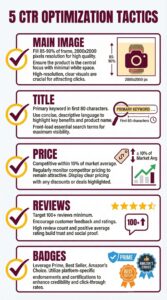
- Main image optimization: Fill 85-90% of frame, pure white background, show product clearly
- Title structure: Lead with main keyword, include key benefit
- Price positioning: Be competitive or show clear value
- Review count: Products with 100+ reviews get significantly more clicks
- Badges: Prime, Best Seller, Amazon’s Choice dramatically improve CTR
The main image is one of the key factors that influence CTR. The A10 algorithm places even more weight on CTR compared to A9.
Factor #4: Keyword Relevance & Indexing
Amazon won’t rank you for a keyword unless you’re indexed for it. Indexing means Amazon’s system recognizes your product as relevant to that keyword. If your product isn’t indexed, it will never show up in search.
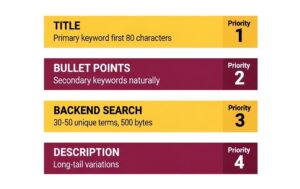
Below is the exact framework for where to place keywords in a listing for maximum ranking impact.
| Location | Indexing Weight | Character Limit |
| Product Title | Highest | 200 characters (80 chars visible on mobile in search results) |
| Bullet Points | High | 1,000 characters total |
| Backend Search Terms | High | 249 bytes |
| Product Description | Medium | 2,000 characters |
| A+ Content | low | 8-10 high search volume keywords |
A well-optimized listing should focus on 20 to 30 core, highly relevant keywords. Then you’ve got your backend search terms field. It gives you 500-bytes of space, which is the perfect spot to add another 30 to 50 unique keywords. Think synonyms, common misspellings, and those long-tail variations.
Below are some strategies you can implement to improve keyword indexing.
- 2 Primary keyword in first 80 characters of title
- Secondary keywords in bullet points (2-3 keywords per bullet)
- No keyword repetition in backend search terms
- Include common misspellings and foreign keywords in backend
Factor #5: Seller Authority
A seller’s authority plays a crucial role in the A10 algorithm. Factors like positive feedback, the length of time you’ve been selling on Amazon, a low return rate, and effective inventory management all contribute to higher rankings.
Below are the seller authority metrics that impact rankings.
| Metric | Target | Impact Level |
| Order Defect Rate (ODR) | Below 1% | Critical |
| Late Shipment Rate | Below 4% | High |
| Pre-fulfillment Cancel Rate | Below 2.5% | High |
| Seller Feedback Rating | 95%+ positive | High |
| Return Rate | Below category average | Medium |
| Account Age | 12+ months | Medium |
A10 places great weight on your feedback ratings, sales history, and return rates. Long-standing solid sellers get ranking perks.
Below are some strategies you can implement to build seller authority.
- Respond to all customer messages within 24 hours
- Maintain inventory to avoid stockouts
- Use FBA to leverage Amazon’s logistics reputation
- Monitor and address negative feedback immediately
- Reducing returns from 12% to 8% (category average) provides a ranking boost equivalent to 200-300 incremental monthly sales
Factor #6: External Traffic
A10 values external traffic more than its predecessor. When users are directed to Amazon from external sources like social media, blogs, or websites, it signals to the algorithm that your product is in demand, boosting its ranking.
A10 rewards sellers who bring shoppers from outside Amazon because this expands Amazon’s reach at zero marketing cost to them.
| Traffic Source | Ranking Impact | Conversion Potential |
| Google Ads | High | Medium-High |
| Social Media (TikTok, Instagram) | High | Medium |
| YouTube Reviews/Influencers | Very High | High |
| Blog Content/SEO | Medium | High |
| Email Marketing | Medium | Very High |
| Affiliate Marketing | High | Medium |
YouTube, Facebook, Instagram, X (Formerly Twitter), and Reddit are the top social media traffic referrers to Amazon. YouTube leads by a huge margin with almost 6 out of 10 social media visitors coming from the video-sharing platform.
Below are the best external traffic strategies in 2026.
- Use Amazon Attribution to track external campaigns
- Partner with micro-influencers in your niche
- Create product-focused content on YouTube
- Build an email list for launches
- Run Google Shopping ads pointing to Amazon listings
Factor #7: Customer Reviews & Ratings
Never underestimate the weight of good reviews. A10 identifies products with good reviews and ranks them higher. Moreover, reviews not only actively affect your seller rating, they are often the second touchpoint in the customer journey of your buyers.
Reviews, ratings, return rates, and customer complaints all influence how Amazon views your product. A 4.8-star product with 500 reviews will almost always outrank a 3.9-star product with 20 reviews, even if both have keywords placed correctly.
Here is how to build reviews ethically on Amazon in 2026.
- Enroll new products in Amazon Vine to get early, credible reviews
- Use Amazon’s “Request a Review” button
- Automate review requests with tools like Helium 10 Follow-Up
- Address negative reviews by improving product quality
Factor #8: Fulfillment Method (FBA vs FBM)
Prime eligibility shows Amazon that a seller meets strict fulfillment standards. Sellers using Fulfillment by Amazon (FBA) automatically benefit from this status. FBA inventory often ranks higher because it aligns with Amazon’s customer experience goals.
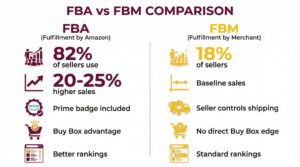
FBA vs FBM Ranking Impact:
| Factor | FBA | FBM |
| Buy Box Eligibility | Highly favored | Must meet strict metrics |
| Prime Badge | Automatic | Requires Seller Fulfilled Prime |
| Conversion Rate | 20-25% higher | Baseline |
| Search Ranking | Boosted | Neutral |
| Customer Trust | High (Amazon-backed) | Varies |
| Return Handling | Amazon manages | Seller manages |
Approximately 82% of active Amazon marketplace sellers use Fulfillment by Amazon (FBA). This means the vast majority of sellers rely on Amazon’s warehousing and Prime network, with the remaining 18% using FBM or a hybrid model.
FBA sellers see average sales increases of 20-25% compared to merchant-fulfilled operations.
Factor #9: Price Competitiveness
Price influences conversion, Buy Box ownership, and ranking simultaneously.
Price isn’t just a number; it’s a signal to both customers and Amazon’s algorithm. Amazon wants to offer its customers the best deals. Competitive price gets more sales velocity that helps you get indexed on more related keywords.
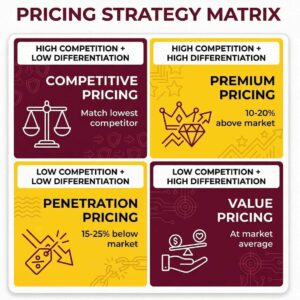
Pricing Strategy Matrix:
| Scenario | Recommended Approach |
| New Product Launch | 15-25% below competitors |
| Building Reviews | 10-15% below market |
| Established Product | Within 5% of competitors |
| Premium Positioning | Must justify with A+ Content |
| Winning Buy Box | Match or beat lowest FBA price |
Pricing tactics:
- Use automated repricing tools to stay competitive
- Add coupons rather than lowering list price
- Monitor competitor pricing weekly
- Factor in all costs (FBA fees, PPC, returns) for profitability
The COSMO and Rufus Impact on Product Discovery
Most ranking losses sellers are experiencing, trace back to COSMO and Rufus. These two systems changed how Amazon interprets listings and how customers interact with search results.
1. How COSMO Rewrites Keyword Strategy
The keyword strategy that worked under A9 was accumulation: more terms, more fields, more matches. COSMO changes the optimal strategy to coverage: fewer repetitions, more intent dimensions.
COSMO evaluates listings against approximately 15 commonsense relationship types. These include who the product is for, what it does, where it is used, when it is used, what problem it addresses, what it pairs with, what it replaces, and what category of need it serves. A listing that covers 10 of these dimensions with one mention each will surface for more queries than a listing that covers 3 dimensions with 5 mentions each.
The practical audit is: read your A+ Content, title, bullet points, and product description and check how many of these dimensions your listing actually addresses. If your listing explains what the product is but not who it is for, where they use it, or what problem it solves, COSMO has insufficient data to surface it for intent-matched queries where your product is objectively the right answer.
2. Optimizing for Rufus
Rufus processed over 274 million daily queries by Q4 2025. Amazon integrated Sponsored Ads into the Rufus interface at the start of 2025, meaning paid placements can now appear inside conversational shopping sessions.
Rufus processes natural language. A customer asking “what should I use to clean a cast iron skillet without stripping the seasoning” is not typing keywords. They are describing a problem and expecting Rufus to match it to the right product. Listings that answer this question in their copy, through title, description, bullet points, or A+ Content are the listings Rufus surfaces.
On any live listing on Amazon, scroll down past the images and the buy box. Amazon now displays suggested Rufus questions specific to that product category. These questions are not randomly generated. They reflect the actual queries customers in that category are asking. Answering every one of those questions somewhere in the listing content is the most direct way to Rufus recommendation eligibility.
3. The Enhance My Listing Tool
Amazon launched its AI-powered “Enhance My Listing” tool in May 2025. The tool uses generative AI to analyze a listing’s current content, identify gaps against category standards, and suggest updates to title structure, attribute completeness, missing feature callouts, and seasonal relevance.
The tool surfaces gaps accurately but generates suggestions with inconsistent brand alignment across categories. Accepting suggestions wholesale without reviewing them has resulted in title replacements that inaccurately represent the product or strip out brand positioning language. Use it for gap identification. Write the corrections yourself.
Amazon PPC in Context of Ranking
PPC and organic ranking are not separate disciplines. They share performance data infrastructure and produce compounding outcomes when managed together.
1. How PPC Contributes to Organic Position
Amazon’s ad conversion data feeds the same performance scoring system as organic conversion data. A PPC campaign generating strong CTR and high conversion rates on a target keyword teaches the algorithm that your listing is a relevant, high-performing result for that keyword.
As that sales performance signal accumulates, organic ranking on the same keyword typically improves. This is the keyword cycling strategy that you can use to efficiently expand your organic keyword ranking: run aggressive PPC on a target keyword, generate enough conversion data to earn an organic position, then reduce ad spend on that keyword as organic traffic absorbs it.
The relationship works in reverse too. A PPC campaign generating poor conversion rates tells the algorithm that your listing does not satisfy the intent behind that keyword that results into lower organic ranks on target keyword.
2. TACoS as the Ranking Indicator
TACoS, Total Advertising Cost of Sales, measures ad spend as a percentage of total revenue including both organic and ad-attributed sales. It is the most accurate single indicator of whether your PPC spent is building organic position or not.
When TACoS declines over time while ACoS remains stable or improves, your advertising is successfully generating organic ranks. When TACoS stays flat or increases despite consistent ad spend, your organic position is not improving, and the ad budget is being wasted. A declining TACoS trend is the outcome you should be working toward.
3. The PPC Cliff Problem
A common structural error occurs when sellers accelerate ranking gains through aggressive PPC, achieve the target position, and then sharply reduce ad spend to recover margins. The sudden velocity drop that follows sends a negative performance signal to the algorithm. Ranking begins to decline. The seller re-increases ad spend to recover position. The cycle repeats.
When reducing PPC spend from a position-building campaign, scale back gradually over three to four weeks. Allow organic sales velocity to absorb the budget reduction before reducing further. A 20 to 25 percent weekly reduction in PPC spend for a well-ranked ASIN gives the algorithm enough continued performance data to maintain organic position while spending efficiency improves.
Frequently Asked Questions
What is the Amazon A10 algorithm?
The Amazon A10 algorithm is the updated version of Amazon’s product search ranking system, succeeding the A9 algorithm. It places greater emphasis on organic sales, external traffic, seller authority, and buyer behavior diversity. While Amazon has not officially named it A10, the ranking behavior changes have been widely documented by sellers and industry analysts since 2020.
Does Amazon PPC still help organic rankings?
Yes, but less than before. Under A10, PPC-driven sales still contribute to total sales velocity and help with keyword indexing. However, the algorithm now gives more weight to organic sales. PPC is most effective for ranking during product launches and for maintaining visibility, not as a permanent ranking crutch.
How long does it take to rank on Amazon page 1?
Timeline varies by category competitiveness. In low-competition niches, optimized listings can reach page 1 within 2-4 weeks. In competitive categories, it typically takes 2-6 months of consistent sales, optimization, and review accumulation. Products in ultra-competitive spaces may require 6-12 months and significant marketing investment.
Do customer reviews directly affect Amazon search rankings?
Reviews influence rankings indirectly rather than directly. Higher ratings and more reviews increase click-through rate and conversion rate from search results. These performance metrics are what the algorithm uses for ranking decisions. A product with 500 reviews and a 4.5-star rating will typically convert better than a product with 10 reviews and a 5-star rating.
Is Amazon FBA required for good rankings?
FBA is not technically required, but it provides significant indirect advantages. The Prime badge increases conversion rates by 20-30%, and FBA sellers win the Buy Box more frequently. Sellers using FBM can compete, but they need to match FBA-level shipping speeds and maintain excellent seller metrics.
How often does Amazon’s ranking algorithm update?
Amazon’s search rankings update in near real-time. Your position for a given keyword can shift multiple times per day based on sales velocity, competitor activity, and inventory status. BSR updates approximately every hour. Major algorithm updates (like the A9-to-A10 shift) happen less frequently and are not publicly announced.
What tools should I use to track Amazon keyword rankings?
The most widely used Amazon keyword tracking tools include Helium 10 (Keyword Tracker), Jungle Scout (Rank Tracker), Sellics, DataDive, and AMZScout. Each provides daily ranking updates for tracked keywords and can monitor competitor rankings simultaneously. Free options exist but lack accuracy and update frequency.
Does external traffic really help Amazon rankings?
Yes. Under the A10 algorithm, external traffic that converts on Amazon sends strong positive signals. Amazon rewards sellers who bring new customers to the platform. Use Amazon Attribution links to track external traffic performance and earn the Brand Referral Bonus (averaging 10% back on qualifying sales).
What is the difference between BSR and keyword ranking?
BSR (Best Sellers Rank) measures your sales performance relative to other products in your category. Keyword ranking measures where your product appears in search results for a specific search term. A product can have a great BSR but poor keyword ranking for certain terms if the listing is not optimized for those keywords.
How do I find the best keywords for my Amazon listing?
Start with Amazon’s own search bar auto-suggest to find real shopper queries. Use tools like Helium 10 Cerebro or Magnet, Jungle Scout Keyword Scout, or Amazon’s Brand Analytics (for Brand Registered sellers) to identify high-volume, relevant keywords. Also mine your PPC Search Term Reports for converting keywords you may not have included in your listing.