
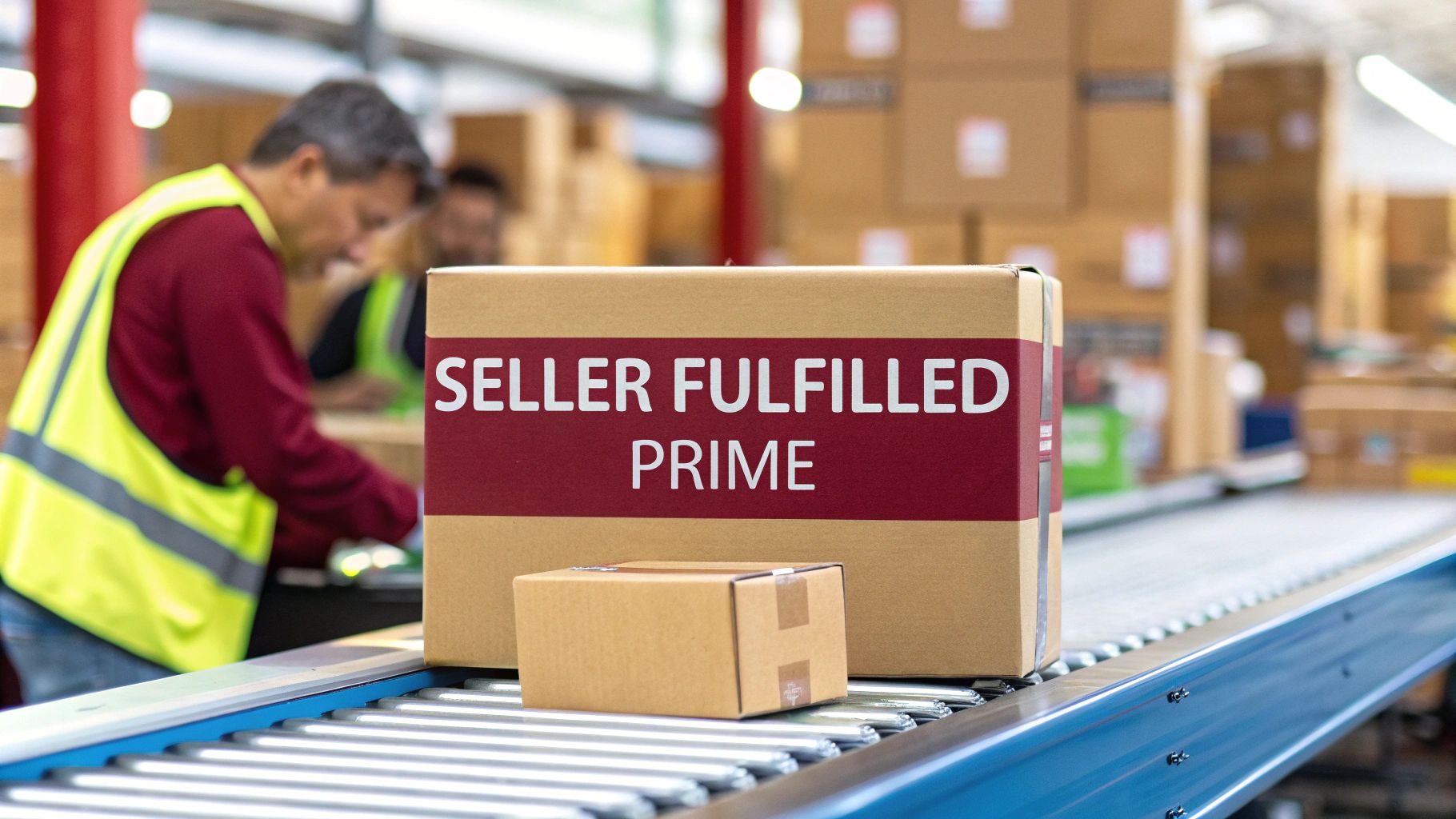
Amazon Seller Fulfilled Prime (SFP) is a program that lets qualified third-party sellers display the Prime badge on their listings while shipping orders directly from their own warehouse or through a third-party logistics provider. You fulfill Prime orders from your own facility while displaying the Prime badge on your listings. You ship the products directly to customers, but Amazon handles all post-order customer service, returns, and refunds.
History Behind SFP
Amazon first launched Seller Fulfilled Prime as an alternative to its Fulfillment by Amazon program in 2015 as a way to increase the availability of products to Prime members while allowing sellers to take over control of the fulfillment process.
Seller Fulfilled Prime originally launched with the goal of offering fast Prime delivery services for sellers independently managing their fulfillment. However, due to challenges with the program, Amazon closed enrollment and did not accept any additional sellers from 2019 onward.
Amazon released an updated set of guidelines for Seller Fulfilled Prime in 2023, and the program officially reopened enrollment in October 2023. Since reopening, Amazon has continued tightening requirements based on real performance data, with the most significant changes rolling out in 2025.
How SFP Differs from FBM
Many sellers confuse SFP with standard Fulfilled by Merchant (FBM). They are not the same.
FBM allows sellers to handle their own inventory storage, packaging, and shipping. However, FBM listings do not automatically receive the Prime badge, which is a significant advantage of SFP as many customers prioritize Prime-eligible products for their fast and free shipping benefits.
With FBM, you control fulfillment but lose access to Prime customers who filter search results exclusively for Prime-eligible products. SFP closes that gap. You keep the operational control of FBM while gaining access to the Prime badge that drives conversion.
Who SFP Works Best For
Amazon states the best products for Seller Fulfilled Prime include seasonal or unpredictable demand products, high-value products, items with variations, and inventory that is slow-moving or requires some type of special handling or preparation.
SFP is most effective for products that are difficult to manage under FBA, such as oversized items, restricted categories, high-value goods, or fragile merchandise that benefits from seller-controlled handling.
Most sellers do not have the operational capabilities to meet Seller Fulfilled Prime standards, and large brands and 3PLs benefit most from the program.
Benefits of the Prime Badge
The Prime badge does one thing well: it moves more units at the same price. Here is what that looks like in practice across the metrics that matter.
1. High Conversion Rate
The inclusion of the Prime badge can increase shopper conversion by an average of 20 to 25%, making it a strong tool for improving sales on the platform.
Non-Prime products convert at 10 to 13% on average, while Prime-eligible products jump to 18 to 25%. When Prime members view Prime products, conversion rates reach 74%.
2. Featured Offer Advantage
With the Prime badge, customers immediately recognize the trusted promise of fast, reliable delivery. Having the Prime badge increases the likelihood of becoming the Featured Offer and gaining product exposure that can lead to higher sales.
Products with the Prime badge are more likely to win the Buy Box, increasing sales opportunities. For competitive categories where multiple sellers compete on the same ASIN, the Prime badge is one of the strongest signals Amazon’s algorithm uses when deciding which offer to feature.
3. Access to Prime Members
Being part of the SFP program allows you to reach Amazon’s most loyal customer base: Prime members. These members are known to spend significantly more than other Amazon users, up to 3 times more by some figures, making them a high-value target audience for your products.
4. Inventory Control Without FBA Limits
SFP allows sellers to avoid the often high FBA fees and storage costs, a benefit that is especially relevant for large or heavy items.
SFP does not impose storage limits, unlike FBA which can restrict storage based on Inventory Performance Index scores. Sellers running high-volume or bulky-item operations are not subject to FBA’s seasonal storage caps or the quarterly IPI reviews that can cut off access to FBA space without warning.
5. Post-Order Amazon Support
Amazon handles post-order customer service on your behalf and automatically authorizes returns initiated within the return window. This is often overlooked in the SFP conversation. You ship the order, and Amazon takes over everything that happens after the package leaves your facility.
Amazon SFP Requirements in 2026
Every SFP requirement is tracked weekly, and Amazon does not negotiate misses.
1. Performance Thresholds
For SFP, the required performance thresholds are a 93.5% On-Time Delivery Rate (OTDR), a 0.5% cancellation rate, and a 99% Valid Tracking Rate (VTR).
Eligibility requirements include an On-Time Delivery Rate greater than 93.5%, a Pre-Fulfillment Cancel Rate below 0.5%, and a Valid Tracking Rate of 99%.
Sellers must maintain zero-day handling for same, one, and two-day orders, set cutoff times no earlier than 2pm on weekdays and 10:30am on weekends, operate on one weekend day, and offer free standard shipping for all Prime customers across the contiguous US.
2. Weekly Performance Review Cycle
Performance requirements are reviewed on a weekly basis from Sunday through Saturday. Sellers receive email notices for any requirements not met. Ongoing failure to meet requirements may lead to Prime offers being disabled and disenrollment from the program.
The On-Time Delivery Rate previously held at a stringent 97% has now been adjusted to 93.5%. This appears beneficial, offering a 3.5% margin of error. However, alongside this relaxed standard, Amazon introduced a significant operational challenge: moving performance evaluations from a monthly to a weekly cycle.
3. Minimum Monthly Volume
If you have not shipped at least 100 Seller Fulfilled Prime packages per month, or if you have not shipped Seller Fulfilled Prime packages consistently throughout the month, Amazon will limit your maximum daily Prime order volume until you resume shipping Prime packages consistently and reach at least 100 Seller Fulfilled Prime packages in a month.
Lock down 100+ Prime shipments per month by automating SFP orders to spread volume evenly across weeks. Bunching all your Prime volume into one week and going quiet for three weeks will trigger the volume cap even if your OTDR and cancellation rates are perfect.
4. Size Tier Separation (November 2025 Update)
Amazon now evaluates SFP eligibility separately by size tier: standard, oversize, and extra-large. Performance in one tier does not affect others, so a late oversized shipment will not jeopardize standard-size Prime eligibility.
Sellers can enroll in multiple tiers based on warehouse and carrier capabilities, with trial periods aligned to weekly tracking from Sunday through Saturday for clearer feedback.
This is a meaningful operational change for brands selling across multiple product sizes. An oversize freight delay no longer puts your standard item Prime eligibility at risk.
5. Misclassified Products
Amazon can block SFP orders, pause Prime eligibility, or revoke Prime status if you are repeatedly misclassifying products.
Audit listings for correct size tiers and package profiles. Misclassification is one of the most avoidable reasons sellers lose SFP status. A product listed in the wrong size tier will violate carrier routing, inflate handling complexity, and trigger compliance flags. Run a full ASIN-level audit before enrollment and quarterly after that.
Pre-Qualification: What You Need Before Trial
To prequalify for Seller Fulfilled Prime, you must have a domestic US address as your default shipping address and a Professional selling account. You also need to have met prequalification performance requirements.
You will need 100 or more seller-fulfilled packages shipped in the past 90 days, a cancellation rate under 2.5%, a valid tracking rate above 95%, a late shipment rate under 4%, a domestic US shipping address, and a professional selling account.
If you are not prequalified, you can monitor your performance using your business reports and Account Health dashboard, checking back periodically to see if you have met the requirements.
Pre-qualification thresholds are lower than the thresholds required during and after the trial. Do not mistake passing pre-qualification for being ready to maintain SFP status long-term. The gap between those two standards is where most trial failures happen.
The SFP Trial: How It Works in 2026
The trial is a required period prior to enrollment where you demonstrate you can meet the eligibility requirements. During the trial, you have access to a new shipping template with options for one and two-day delivery speeds. You will not receive Prime branding for products until you have passed the trial and are enrolled in Seller Fulfilled Prime.
1. Trial Duration and Completion
To enroll in Seller Fulfilled Prime, you need to prequalify for the program by meeting performance requirements, then successfully complete a 30-day trial. Once enrolled, you have access to Prime branding.
Only after you ship at least 100 Prime packages while meeting the Seller Fulfilled Prime requirements will you be enrolled into the program and Prime branding will be displayed on your offers.
2. Trial Attempt Limits (June 2025 Rule Change)
There is now a maximum limit of three attempts to pass the Seller Fulfilled Prime trial per calendar year. If you do not pass the trial, you may restart it as long as you pre-qualify for the program’s 30-day trial period.
Any attempt before the effective date of the policy changes starting June 29, 2025 will not count toward this limit.
3. Trial Blackout Periods
If your 30-day trial spans the 30 days leading up to Prime Day, Black Friday through Christmas, and similar major events, you cannot graduate. This is to confirm sellers are tested before the busiest season.
This uses one of your three attempts regardless of your performance figures. Plan your trial for January through early June or August through mid-October to avoid these blackout periods.
If you pass the Seller Fulfilled Prime trial within this restricted graduation period or during the event itself, your Prime offers will be eligible to display the Prime badge after the event has ended.
The best trial windows in 2026 are January through early June and August through mid-October. Late Q3 and all of Q4 are high-risk windows that either block graduation or consume attempts during a period when operational pressure is highest.
4. What Happens After You Pass
Successful trial completion automatically enrolls you in SFP with full Prime badge privileges.
To confirm you are able to successfully maintain on-time delivery for Prime orders, use the Control Prime order volume option to set daily limits for how many same, one, and two-day delivery orders customers can place. This limit should reflect the number of orders you can reliably ship each day.
Setting your daily order cap too high to maximize sales volume and then failing on OTDR is one of the most common post-enrollment mistakes. The daily cap should reflect your verified operational capacity, not your aspirational one.
OTDR Protection
One of the most operationally important changes Amazon introduced in 2025 is OTDR protection for SFP sellers.
SFP and Premium Shipping offers receive OTDR protection from late deliveries if Shipping Settings Automation is enabled on your shipping template, you have purchased shipping labels marked as “OTDR Protected” when using Amazon Buy Shipping or Veeqo, and you have shipped on time.
Even if a seller does not use these tools, delivery disruptions caused by Amazon-recognized major events such as weather emergencies or carrier outages that affect specific regions will not count against the seller’s OTDR.
Enable Shipping Automation and Protected Labels in Seller Central under Fulfillment Settings, and turn on SFP templates with default OTDR-protected labels. Monitor weekly OTDR by investing in an operations dashboard that can track your OTDR by week for both SFP and Premium orders.
The protection is not automatic if you are using standard labels. You must explicitly purchase “OTDR Protected” labels through Amazon Buy Shipping or Veeqo for the shield to apply.
SFP vs FBA: A Direct Comparison
Both programs deliver the Prime badge. The difference is in who controls what, and what that control costs.
| Factor | SFP | FBA |
|---|---|---|
| Prime Badge | Yes | Yes |
| Inventory Control | Full control | Amazon’s warehouses |
| Handling Fees | Your cost + carrier | Amazon picks, packs, ships |
| Storage Limits | None | IPI-dependent caps |
| OTDR Responsibility | Seller-owned | Amazon-managed |
| Custom Packaging | Yes | No (Amazon packaging) |
| Weekend Operations | Required | Not applicable |
| Post-Order Service | Amazon handles | Amazon handles |
SFP offers more control over inventory compared to FBA, allowing sellers to manage their fulfillment process directly. FBA fees cover storage, packing, and shipping, which can be higher for large or heavy items.
SFP can save 30 to 40% on fulfillment costs compared to FBA fees, with no seasonal storage charges. That saving is real for heavy or large-item sellers. It is less applicable to lightweight standard-size products where FBA’s per-unit fee structure is highly optimized.
Prime members spend more per order and shop more frequently than regular customers. The badge signals fast, free shipping and reliable service, which increases conversion rates and can improve your Buy Box chances.
Approved Carriers for SFP
The approved carrier list is available to SFP applicants and members of the Amazon fulfillment network. It includes major US carriers like USPS, UPS, FedEx, DHL, and many others.
Amazon requires UPS, FedEx, DHL, USPS, or Amazon Shipping.
The Valid Tracking Rate metric was expanded in January 2025 to cover all shipping carriers, not just Amazon-integrated ones. If you use a regional carrier without proper tracking, every shipment counts against you.
Regional carriers without Amazon system integration count against your VTR even if the carrier legitimately delivers on time. Verify that every carrier in your SFP stack is Amazon-integrated and returns scan events that feed into Seller Central. If it does not show tracking in Seller Central, it counts as no tracking.
How to Maintain SFP Status
Monitor your ongoing performance using your Seller Fulfilled Prime performance dashboard.
You will receive up to 3 email alerts if any requirements are missed before being revoked from the program.
Even though Amazon’s OTDR standard is 93.5%, smart sellers should maintain operational targets closer to the previous 97% threshold. This approach creates a performance buffer and a margin of safety against unforeseen logistical disruptions.
Running at 93.5% is the floor, not the target. A single bad weather week, a carrier failure, or an unexpected order surge can push you below the floor before you have time to file a disruption appeal. Sellers maintaining 97% or above have a real buffer. Sellers running at 94% are always one bad week away from receiving an email notice.
1. Weekly Monitoring Checklist
- Check the SFP performance dashboard every Monday for the prior Sunday through Saturday window
- Verify all orders from the prior week have valid tracking scans in Seller Central
- Confirm no OTDR-flagged shipments before the 14-day appeal window closes
- Review any new ASIN size tier classifications added during the week
- Track OTDR by week for both SFP and Premium orders using a dedicated operations dashboard
2. Handling Regional Disruptions
If a regional snowstorm hits, notify Amazon proactively to be considered for exemption from performance defects before the disruption impacts deliveries.
If there is a major disruption event impacting all sellers shipping to a specific region as determined by Amazon, late deliveries to that area will not impact your OTDR, regardless of whether you are using the OTDR protection tools.
Proactive notification before a disruption is substantially easier to act on than an appeal filed after failed deliveries have already hit your performance data. If a named weather event is affecting your primary fulfillment region, open a case in Seller Central before the delivery deadline, not after.
The SFP and Premium Shipping Connection
Premium Shipping (1 to 3 business day promised delivery) and SFP share performance infrastructure but are assessed separately.
Starting June 29, 2025, Amazon rolled out tighter performance guardrails for two of its shipping programs: Seller Fulfilled Prime and Premium Shipping.
Amazon updated performance requirements for Premium Shipping, reducing the minimum OTDR requirement to 93.5% from 97%. Performance monitoring now runs over 7 days instead of the previous 30.
Under the new weekly cadence, a single bad week can put you on notice, and three such weeks in a month spells immediate removal from Premium Shipping. Consistent performance throughout each month matters far more than a healthy 30-day aggregate.
Sellers running both programs on the same fulfillment operation need to track both dashboards independently. A carrier failure that affects your SFP tier will likely affect your Premium Shipping eligibility at the same time.
Frequently Asked Questions
Can I apply for SFP if I am currently FBM only?
Yes. SFP is open to all Professional sellers who meet pre-qualification thresholds. You do not need to be an FBA seller to apply. You need 100 or more seller-fulfilled packages in the prior 90 days, a cancellation rate below 2.5%, and a valid tracking rate above 95%.
How many times can I attempt the SFP trial?
There is a maximum limit of three attempts to pass the Seller Fulfilled Prime trial per calendar year. If you do not pass the trial, you may restart it as long as you pre-qualify for the program’s 30-day trial period.
What happens if I miss the OTDR requirement one week?
You will receive email notices for any requirements not met. Ongoing failure to meet requirements may lead to Prime offers being disabled and disenrollment from the program. A single missed week triggers a notice, not immediate removal. Act on it within 14 days if an appeal is warranted.
Q: Does the Prime badge display during the trial period?
No. You will not receive Prime branding for products until you have passed the trial and are enrolled in Seller Fulfilled Prime.
Can I use a 3PL instead of my own warehouse for SFP?
Yes, provided the 3PL meets Amazon’s carrier integration, same-day handling, and OTDR requirements. You can use third-party fulfillment centers as long as they meet Amazon’s shipping and performance standards.
Is SFP available for international sellers?
To prequalify for Seller Fulfilled Prime, you must have a domestic US address as your default shipping address and a Professional selling account. International sellers operating in the US marketplace must have a US-based fulfillment operation to qualify.
What carriers are accepted for SFP?
The approved carrier list includes major US carriers like USPS, UPS, FedEx, DHL, and many others. All carriers used must be Amazon-integrated with tracking that feeds into Seller Central.
What is the minimum OTDR for SFP in 2026?
The minimum On-Time Delivery Rate for Seller Fulfilled Prime is greater than 93.5%. Running near the minimum leaves no buffer. Experienced SFP sellers maintain internal targets at 97% or above.
Does SFP help with Buy Box eligibility?
Products with the Prime badge are more likely to win the Buy Box, increasing sales opportunities. Amazon uses OTDR to measure seller reliability and Buy Box eligibility. Strong OTDR and SFP status are both positive signals in Amazon’s Featured Offer algorithm.