
If your Amazon strategy is solely focused on acquiring new customers, you're fighting an expensive, uphill battle. Advertising costs are constantly rising, and the brands that achieve sustainable growth have mastered long-term profitability, not just temporary sales spikes.
Customer lifetime value (CLV) is the most critical metric for this endeavor. It distinguishes brands that are sustainably scaling from those caught in a cycle of increasing ad spend and diminishing margins. By shifting focus from a single transaction to the entire customer relationship, you can build a more resilient and profitable business on the Amazon platform.
The Most Important Metric on Your Dashboard
Chasing the next new customer is a constant grind. You invest in PPC, compete for organic ranking, and hope for a conversion. The real financial opportunity, however, lies in what happens after that initial sale.
Acquiring a new customer can cost five times more than retaining an existing one. Increasing customer retention by just 5% can lead to a profit increase ranging from 25% to 95%. For Amazon sellers, this insight should fundamentally alter your approach. The goal shifts from achieving the lowest ACoS on a single purchase to acquiring customers with a high probability of returning.
This requires a strategic shift toward building a brand that earns trust within the competitive Amazon marketplace. A successful strategy creates a powerful financial flywheel for your business:
A higher CLV allows for a greater customer acquisition cost (CAC) while maintaining profitability.
Repeat buyers contribute to organic ranking and sales velocity without additional ad spend.
Loyal customers form a ready audience for future product launches.
This approach is the solution to margin compression and inefficient ad spend. For a deeper look at the tactics, there are excellent resources on how to increase customer lifetime value. Ultimately, a focus on CLV transforms your operation from just selling products to building a durable, profitable asset.
Calculating Your Amazon CLV
You cannot improve what you don't measure. Many sellers get lost in daily metrics like ACoS and sales velocity, which provide an incomplete picture. Customer Lifetime Value (CLV) offers the strategic clarity needed to build a brand for the long term.
The calculation itself is straightforward and doesn't require advanced data science skills. The core formula is simple.
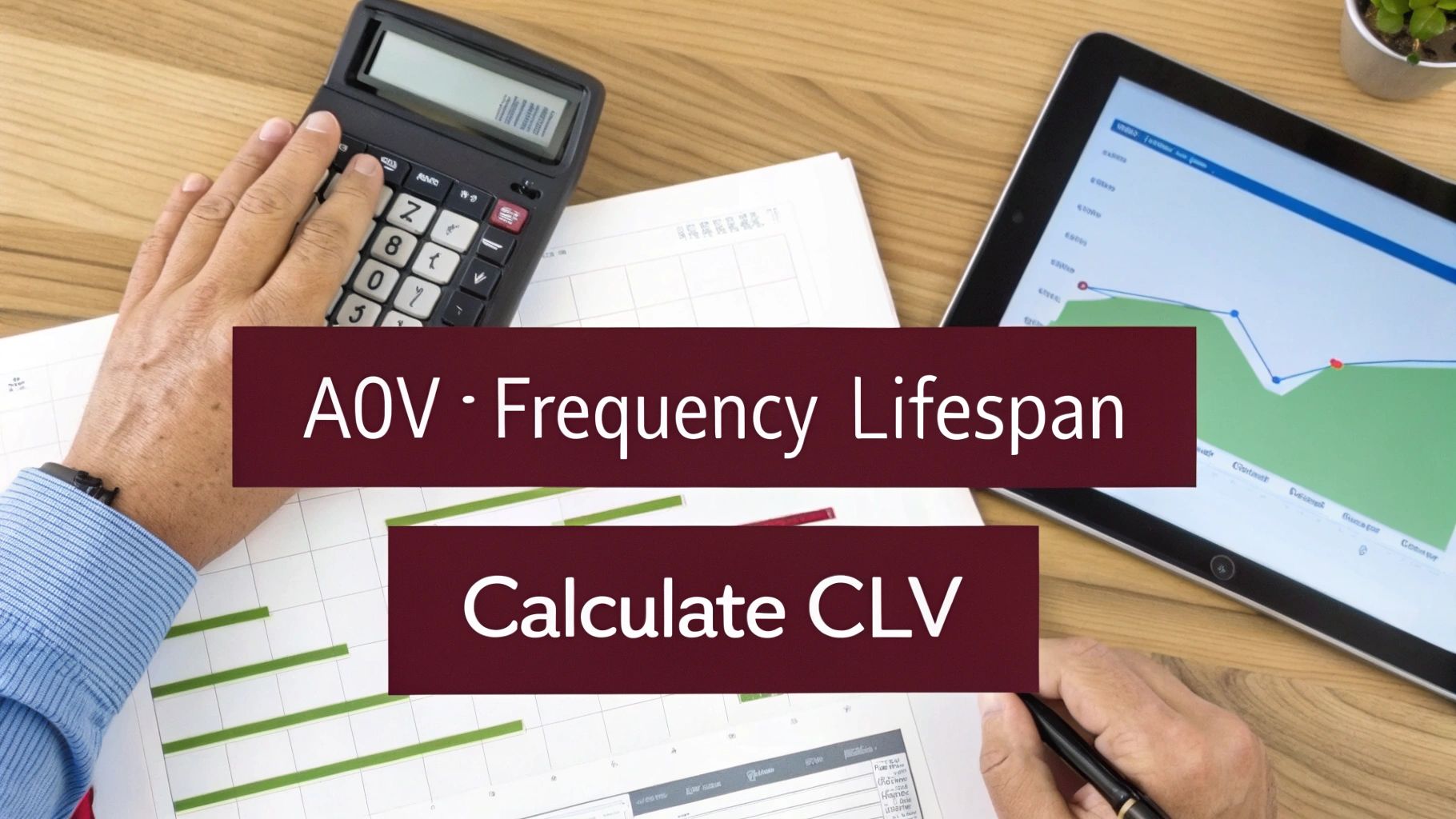
CLV = Average Order Value (AOV) x Purchase Frequency x Customer Lifespan
To find these figures, you'll need to navigate Seller Central reports. Understanding the nuances of each component is important. For a more detailed guide on the methodology, this article on how to calculate CLTV for your business is a valuable resource.
1. Finding AOV
Average Order Value (AOV) is the average amount a customer spends per transaction. This is the simplest component to calculate.
Navigate to Seller Central > Reports > Business Reports. Pull your total sales and total order count for a specific period, such as the last 12 months.
AOV = Total Sales / Total Orders
A higher AOV directly contributes to a higher CLV. A customer spending $45 per order is inherently more valuable than one spending $25, assuming similar profit margins. Of course, you must also understand your profit on those orders. If you need a refresher, review our guide on how to calculate profit margins.
2. Determining Frequency
Purchase Frequency indicates how often an average customer buys from you within a year. It's a strong indicator of customer loyalty and product satisfaction.
To obtain this data, access the Amazon Brand Analytics dashboard and locate the Repeat Purchase Behavior report. This report provides the total number of orders and unique customers for your brand.
Purchase Frequency = Total Orders / Unique Customers
A frequency of 1.0 indicates a "one and done" customer base. A figure like 1.8 suggests a healthy segment of repeat buyers. Consumable products, like coffee or supplements, should have a much higher frequency than durable goods like kitchen appliances.
3. Estimating Lifespan
Customer Lifespan is the average duration a customer continues to purchase from you. This is the most challenging metric to determine on Amazon due to data limitations.
A solid estimate can be derived by analyzing Brand Analytics data over a longer period (e.g., 2-3 years) to observe when the repeat purchase curve flattens. A more practical method is to use the inverse of your churn rate.
Calculate your annual churn rate by determining the percentage of last year's customers who did not make a purchase this year. If 40% of your customers did not return, your churn rate is 40%, and your retention rate is 60%. Your estimated customer lifespan would be 1 / 0.40 = 2.5 years.
4. Benchmarking Results
After calculating your CLV, the next step is to determine its effectiveness. This depends entirely on your product category. A brand selling high-ticket electronics will have a different CLV profile than one selling dog treats.
Sample CLV Calculations
This table illustrates how these variables function across different product categories, helping you contextualize your own figures.
| Product Category | Avg. Order Value (AOV) | Annual Purchase Frequency | Customer Lifespan (Years) | Calculated CLV |
|---|---|---|---|---|
| Coffee Pods (Consumable) | $35 | 6.0 | 2.5 | $525.00 |
| Skincare (Consumable) | $50 | 4.0 | 3.0 | $600.00 |
| Pet Toys (Durable) | $25 | 1.5 | 2.0 | $75.00 |
| Kitchen Gadgets (Durable) | $80 | 1.1 | 4.0 | $352.00 |
Consumable brands depend on high purchase frequency. In contrast, durable goods brands must maximize AOV on the initial sale and build strong brand loyalty to remain top-of-mind for future purchases. Use these benchmarks to identify opportunities for improving customer lifetime value.
Core Strategies to Increase Repeat Purchases
Once you have established your CLV, the objective is to increase it. This involves building a system that encourages customer loyalty, a challenge within Amazon's transactional ecosystem.
A mere 5% increase in customer retention can boost profits by 25% to 95%. This demonstrates the need to optimize the entire customer journey, not just the initial conversion.
1. Master Subscribe And Save
For consumable products, Subscribe & Save (S&S) is the most effective tool for increasing CLV. It secures recurring revenue and removes your product from competitive search results for future purchases. A subscription is a significant win.
Make the S&S offer compelling, typically by offering the maximum discount (10% or 15%, depending on the category). While this reduces the margin on a single order, the long-term value of a guaranteed repeat customer far outweighs the initial discount.
Actionable Steps:
Showcase S&S in A+ Content: Visually highlight the savings and convenience of the "set it and forget it" benefit.
Target "subscribe" keywords in PPC: Bid on high-intent terms like "[your product] subscription" or "[your brand] auto-delivery."
Analyze S&S churn data: Use the S&S dashboard to understand why customers cancel. If the reason is "switched to another product," you have a competitive threat to address.
Mistakes to Avoid:
Passive management: Actively monitor your subscriber count and churn rate. A sudden drop is a critical warning sign.
Stockouts: A stockout is the quickest way to lose a subscriber, as it forces them to find a competitor's product.
2. Leverage Virtual Bundles
Virtual Product Bundles are an underused tool for increasing both Average Order Value (AOV) and exposing customers to more of your products. They allow you to sell complementary items together from individual product pages without creating new physical packaging.
For example, if you sell a premium shampoo, you can create a virtual bundle with your conditioner. This introduces customers to another product and increases the value of the initial sale. A well-designed bundle introduces a customer to your brand's ecosystem, making them more likely to return for individual items later.
This strategy directly works to improve customer lifetime value by converting one-time buyers into multi-product loyalists.
3. Use Amazon Posts And Follow
Amazon Posts function as your brand's social media feed on the platform. It is a free tool for creating lifestyle content that appears on your product pages, storefront, and competitors' carousels.
The key is to encourage shoppers to "Follow" your brand. When they do, your Posts content can appear in their personalized shopping feed on the Amazon app, creating a direct, free communication channel. Use Posts in conjunction with your Amazon Storefront to build a comprehensive brand hub that tells your story and showcases your entire product line.
4. Re-engage With Brand Tailored Promotions
Brand Tailored Promotions offer a compliant method for driving repeat business. This feature allows you to send custom discount codes to specific audiences, including past purchasers.
You can segment your audience based on their history with your brand:
Repeat Customers: Those who have ordered more than once in the past year.
Recent Customers: Buyers from the last 90 days.
High-Spend Customers: The top 5% of customers by spending over the last 12 months.
Sending a 15% off coupon exclusively to your "High-Spend Customers" rewards your best customers and keeps your brand top-of-mind, directly increasing your CLV.
Advanced PPC Tactics for CLV
Standard PPC campaigns are designed for initial conversions. A low ACoS is a short-sighted metric if it doesn't contribute to long-term profitability. To start improving customer lifetime value, your advertising strategy requires a complete overhaul. The objective must shift from merely acquiring new customers to strategically re-engaging existing ones.
This means analyzing your ad spend through a CLV lens. The critical question is not "Which campaign had the lowest ACoS?" but "Which campaigns attract customers who make repeat purchases?" This perspective is what enables brands to scale effectively.
1. Embrace New-to-Brand Metrics
Focusing solely on ACoS can be misleading. A campaign with a high ACoS might be highly effective at bringing in first-time buyers who later become loyal subscribers. Amazon's New-to-Brand (NTB) metrics are essential for uncovering this.
NTB data helps identify which keywords and ad types are driving customer acquisition. You might find that a broad-match keyword has a poor ACoS but an excellent NTB rate. This insight justifies a higher ad spend on that keyword, as you are filling your funnel with high-potential shoppers.
Treat your campaigns like a portfolio. Some are optimized for immediate profitability (low ACoS) with branded terms, while others are optimized for growth (high NTB rate), even at a higher initial acquisition cost. This balanced approach ensures you are not just harvesting existing demand but actively creating future revenue.
2. Use Sponsored Display And DSP Retargeting
Once a customer makes a purchase, the effort to secure a second one begins. This is where Amazon's more advanced advertising tools are most effective.
Sponsored Display and Amazon DSP (Demand-Side Platform) are designed for re-engagement. They allow you to serve ads to specific audiences both on and off Amazon.
Here is how to use them to increase your CLV:
Retarget Past Purchasers: Create audiences of customers who bought from you in the last 30, 60, or 90 days. Serve them ads for complementary products or new launches.
Create Lookalike Audiences: With Amazon DSP, you can build audiences that resemble your best customers, such as your highest spenders or most frequent buyers. This helps you find new people who are more likely to become high-CLV customers.
Segment Your Ad Creatives: For new customers, your creative should introduce the brand. For past purchasers, you can focus on cross-sells or "complete the set" messaging.
These tactics keep your brand top-of-mind and guide customers through your product catalog. Loyal customers spend 67% more than new ones, making this nurturing process a direct path to increased revenue.
3. Analyze PPC Data Through A CLV Filter
To integrate these strategies, you must connect your advertising data to your CLV calculations. Export your campaign data and cross-reference it with the repeat purchase reports in Brand Analytics.
This analysis helps you answer important questions:
Do customers from Campaign A have a higher repeat purchase rate than those from Campaign B?
Which keywords attract customers who enroll in Subscribe & Save?
What is the average time between the first and second purchase for customers re-engaged with Sponsored Display?
Answering these questions allows you to allocate your budget with precision. You can confidently increase spending on campaigns that, despite a higher ACoS, consistently deliver customers with a superior lifetime value. For brand owners seeking deeper insights, platforms like Amazon Marketing Cloud can provide the granular data needed to connect ad exposure directly to long-term customer behavior.
Optimizing the Post-Purchase Experience
The sale is not the finish line; it is the starting point for building a higher CLV. Since Amazon controls most of the customer relationship, the post-purchase experience is one of the few opportunities for your brand to differentiate itself. A well-planned strategy here can turn a simple delivery into a memorable brand interaction.
The objective is to forge a genuine connection, transforming a positive product experience into true brand loyalty. Make customers feel they have purchased from a brand, not just a listing on Amazon.
The Power Of Compliant Inserts
Product inserts are your brand's direct communication with the customer, but you must adhere to Amazon's terms of service. Soliciting five-star reviews or offering discounts for feedback is a violation that can lead to account suspension. Modern inserts must be smarter.
The key is to add value. Your insert should reinforce the customer's purchase decision.
Offer warranty registration. This is a compliant way to capture a customer's email and open a direct line of communication.
Provide helpful usage tips. Include a QR code that links to a video tutorial or a guide on your brand website.
Share your brand story. A concise, authentic message about your company's origins can create an emotional connection.
A well-executed insert drives customers to your off-Amazon assets, helping you build an audience you own.
Turning Customer Service Into A Retention Tool
Negative experiences, such as a damaged product or a shipping delay, are inevitable. How you handle these situations defines your brand. Excellent customer service is not just damage control; it's a powerful retention tool.
A customer whose problem you resolve quickly and professionally is often more loyal than one who never had an issue. They have seen that your brand stands behind its products.
Responding to negative reviews publicly and professionally helps the unhappy customer and shows all potential buyers that you are responsive and trustworthy. This turns a potential liability into a marketing asset. Proactively encouraging customers to contact you directly for support can prevent negative feedback from being posted.
Make Your Storefront A Brand Hub
Your Amazon Storefront is your brand's home on the platform, yet many sellers treat it as a simple product catalog. It should be a curated brand destination that tells your story and showcases your full product line.
A well-designed storefront is crucial for improving customer lifetime value because it facilitates cross-selling and introduces customers to other products you offer.
Use your storefront to:
Create dedicated pages for product categories. Simplify navigation of your entire product ecosystem.
Use high-quality lifestyle images and videos. Show your products in use and build an aspirational brand image. Learn more in our guide to Amazon Enhanced Brand Content.
Feature your brand's mission and values. Connect with customers beyond just price and specifications.
By driving traffic from Posts, ads, and product inserts to your Storefront, you create a cohesive brand experience that encourages subsequent purchases.
Frequently Asked Questions
1. How often should I measure my Amazon CLV?
For most Amazon brands, a quarterly review of your CLV is ideal. It is frequent enough to identify shifts in customer behavior without being overly reactive to daily data fluctuations. If you sell products with a rapid repurchase cycle, such as supplements, a monthly analysis is more appropriate. A comprehensive, deep-dive analysis at least once a year is essential for shaping long-term strategy and setting growth targets.
2. Can I improve CLV with a single product?
Yes. While you cannot cross-sell, you can focus on the other two CLV levers: purchase frequency and customer lifespan. Your goal is to become the definitive choice for that specific product.
Prioritize these areas:
Maximize Subscribe & Save: This should be your top priority. A subscription secures recurring revenue and removes your product from competitive search for that customer's future purchases.
Create an exceptional post-purchase experience: Deliver more than just a product. High-quality packaging and responsive customer service build loyalty that encourages repeat orders.
Retarget past buyers: Use Sponsored Display to run promotions targeting previous customers. A timely ad can serve as a reminder to restock.
3. What is a good CLV to CAC ratio for PPC?
For Amazon PPC, a healthy CLV to Customer Acquisition Cost (CAC) ratio is 3:1 or higher. This means that for every dollar spent to acquire a customer, you should generate at least three dollars in revenue from them over their lifetime. A 1:1 ratio means you are breaking even on each new customer, while a ratio below 1:1 indicates you are losing money on your ad spend. Achieving a strong ratio provides the confidence to justify a higher ACoS on campaigns that are proven to attract high-value, long-term customers.