
Every brand selling through Amazon faces the same frustrating reality. You set a Minimum Advertised Price. You communicate it to every distributor and retailer. And within weeks, unauthorized or rogue sellers list your products at rock-bottom prices on Amazon, dragging your brand value down with them.
Here is what makes this problem worse: Amazon will not enforce your MAP policy. Not now, not ever. Amazon has stated repeatedly through its seller policies and support channels that pricing between brands and their resellers is a private commercial matter. Amazon considers itself a marketplace, not a pricing regulator.
That leaves enforcement entirely in your hands. And most brands either don’t know how to approach it, or they take the wrong steps and end up wasting thousands of dollars with nothing to show for it.
MAP stands for Minimum Advertised Price. It is the lowest price at which a retailer or reseller is allowed to advertise a product for sale. Brands set MAP policies to protect pricing consistency across all sales channels, including Amazon.
A few critical distinctions matter here because many brands confuse MAP with other pricing concepts.
Key differences between MAP and related pricing terms include the following.
- MAP (Minimum Advertised Price): The lowest price a reseller can publicly display in ads, listings, or product pages. It does not restrict the actual transaction price in all cases, though most brands treat it as a floor.
- MSRP (Manufacturer’s Suggested Retail Price): A recommended price, not a mandated one. Retailers can sell above or below MSRP without consequence.
- RPM (Resale Price Maintenance): An agreement where the manufacturer sets the actual resale price, not just the advertised price. RPM carries more antitrust scrutiny than MAP.
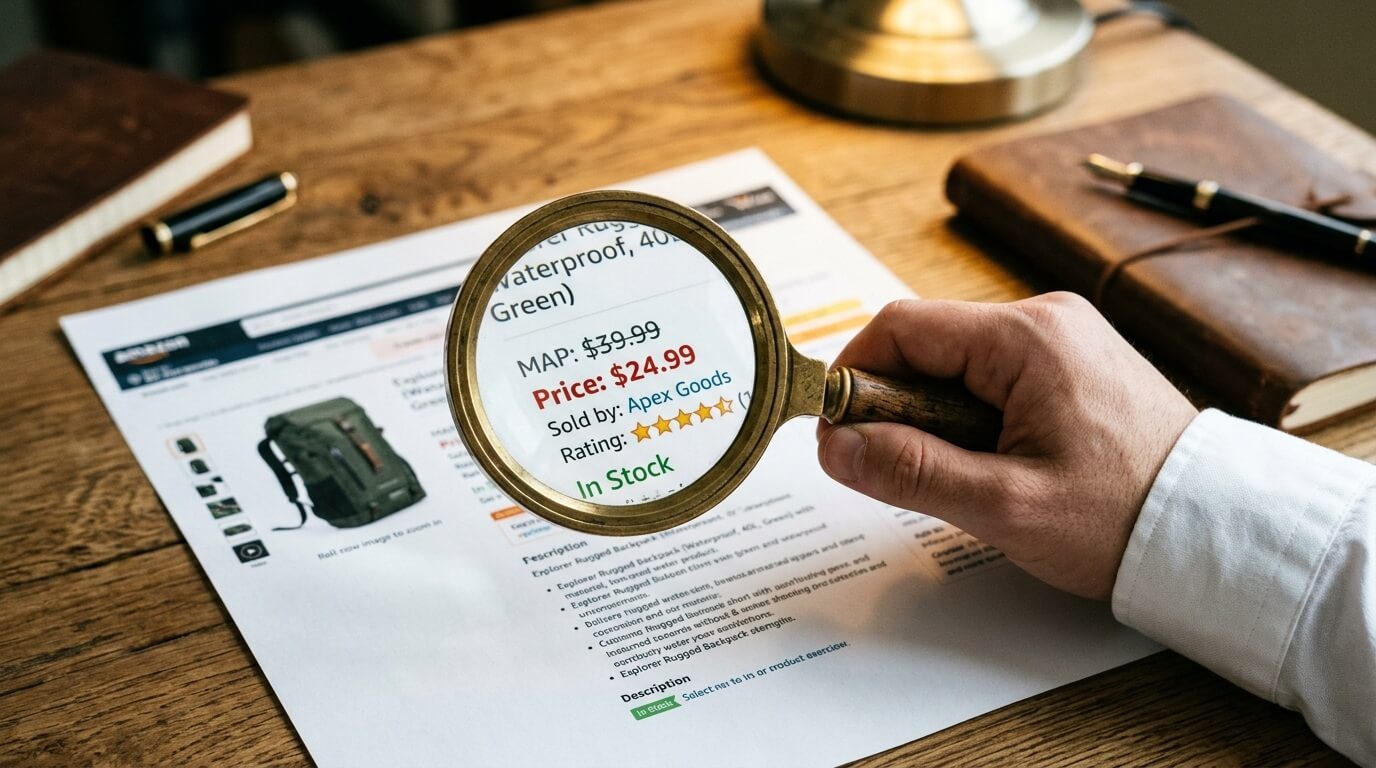
On Amazon, the “advertised price” is effectively the listing price. When a seller posts a product at $29.99 and your MAP is $39.99, that is a clear violation. Amazon treats this listing price as the advertised price, making it visible to every shopper who searches for your product.
Why Amazon Refuses to Enforce Your MAP Policy
This is the part most brand owners struggle to accept. Amazon’s position is unambiguous, and it has not changed in over a decade.
Amazon does not enforce MAP policies because Amazon views pricing as a competitive element of its marketplace. In Amazon’s framework, lower prices benefit consumers, and consumer benefit drives Amazon’s business model. Asking Amazon to force sellers to raise prices runs directly against that philosophy.
Specifically, here is what Amazon will not do regarding MAP enforcement.
- Amazon will not remove listings solely because a seller violates your MAP
- Amazon will not share seller identity or contact information with you
- Amazon will not intervene in pricing disputes between brands and third-party sellers
- Amazon will not add MAP price floors to your product listings
- Amazon’s own retail arm (1P) sometimes prices below MAP, and Amazon considers that within its rights as a retailer
What Amazon will help with is a narrower set of issues. Amazon will act on intellectual property violations, counterfeit claims, trademark infringement, and certain brand misrepresentation issues through Brand Registry. But price alone is never grounds for removal.
This distinction is critical. Your enforcement strategy must work around Amazon’s rules, not against them.
Legal Foundation That Makes MAP Enforcement Possible
MAP enforcement is legal in the United States, but it rests on specific legal principles that brands need to understand. Getting the legal basis wrong can expose you to antitrust claims.
The Colgate Doctrine (1919)
The foundation of all MAP enforcement in the U.S. comes from the Supreme Court’s ruling in United States v. Colgate & Co. (250 U.S. 300, 1919). The court held that a manufacturer has the right to unilaterally announce the prices at which it is willing to sell its products and to refuse to deal with anyone who does not comply.
The key word is “unilaterally.” Your MAP policy cannot be negotiated or agreed upon with resellers. It must be a one-way announcement from the brand. The moment it becomes a mutual agreement, it risks crossing into price-fixing territory.
Leegin Creative Leather Products v. PSKS (2007)
This Supreme Court decision changed how vertical price agreements are evaluated. Before Leegin, any agreement between a manufacturer and retailer on resale prices was automatically (per se) illegal. After Leegin, these arrangements are evaluated under the “rule of reason,” meaning courts consider whether the agreement promotes or harms competition.
This ruling made MAP policies significantly easier to defend legally, as long as they serve legitimate business purposes like maintaining brand quality and supporting retailer services.
What This Means for Your Amazon MAP Policy
The practical requirements for a legally sound MAP policy are outlined below.
- Your MAP policy must be unilateral, meaning you announce it and retailers either comply or face consequences, with no negotiation
- Consequences for violations must be pre-defined and consistently applied across all resellers
- You cannot collude with one retailer to enforce MAP against another retailer
- You cannot threaten retailers who lower prices below MAP with anything beyond your stated policy consequences (such as suspension of supply)
- Documentation of every enforcement action protects you if your policy is ever legally challenged
Brands that enforce MAP selectively, punishing some violators while ignoring others, create legal vulnerability. Consistency is not optional.
Building a MAP Policy That Holds Up on Amazon
A MAP policy is only as strong as its documentation. Vague language, missing definitions, or unclear consequences give violators room to argue and make enforcement nearly impossible.
Every effective MAP policy for Amazon sellers needs to address the specific challenges of marketplace selling. Traditional MAP policies written for brick-and-mortar retail often miss key issues unique to Amazon.
Components of an Amazon-Ready MAP Policy
Your policy document should include each of the following elements.
- Covered products: List specific SKUs or product lines covered by the policy, not just “all products”
- MAP prices: Include a current price list with effective dates. Update it whenever prices change.
- Definition of “advertised price”: Explicitly state that the listing price on Amazon, including any displayed discounts, coupons, or promotional prices, counts as the advertised price
- Coupon and promotion rules: Clarify whether Amazon coupons, Lightning Deals, Prime Exclusive Discounts, or Subscribe & Save pricing must also comply with MAP
- Violation consequences: Spell out the exact penalty structure (first warning, second warning, suspension of supply, account termination)
- Enforcement timeline: Define how long a seller has to correct a violation (24 hours, 48 hours, etc.)
- Free shipping clause: Specify whether free shipping combined with a lower price constitutes a violation
- Bundle and kit policies: State whether bundled products with effective per-unit prices below MAP are considered violations
- Holiday and sale exceptions: If you allow MAP exceptions during Black Friday, Prime Day, or other events, specify exact dates and approved discount levels
MAP Policy Gaps That Create Problems on Amazon
The table below highlights gaps that frequently appear in MAP policies and the Amazon-specific issues they cause.
| Policy Gap | Amazon-Specific Problem |
|---|---|
| No mention of Amazon coupons | Sellers list at MAP but attach a 15% coupon, effectively selling below MAP while technically listing at MAP |
| No bundle or kit language | Sellers create multi-packs at prices that work out to below MAP per unit |
| No definition of “advertised price” for marketplaces | Sellers argue that the Amazon listing is not an “advertisement” in the traditional sense |
| No coverage of Subscribe & Save | Subscribe & Save discounts of 5% to 15% push the effective price below MAP |
| No mention of Amazon Warehouse Deals | Open-box or returned items get relisted at deep discounts under your ASIN |
| Vague penalty timelines | Sellers stall, claiming they “didn’t receive notice” or “need time to update systems” |
Addressing these gaps before you start enforcement saves enormous time and legal headaches later.
Amazon’s Brand Protection Tools Worth Using
Amazon does not enforce MAP, but it provides several tools that indirectly support your enforcement efforts. These tools help you control who sells your products, verify product authenticity, and remove certain types of unauthorized listings.
Amazon Brand Registry
Brand Registry is the foundation of any brand protection strategy on Amazon. Enrollment requires an active registered trademark in the country where you want to enroll. As of 2024, Amazon reported that more than 700,000 brands had enrolled in Brand Registry globally.
Brand Registry gives you access to these enforcement-related features.
- Report a Violation tool: Allows you to report trademark, copyright, and patent violations directly, with faster response times than standard Seller Support
- Automated brand protections: Amazon’s machine learning scans listings for potential infringement and proactively removes suspected violations
- Brand Analytics: Provides search term data and market basket analysis to identify sellers and pricing patterns
- A+ Content and Brand Store: Gives you control over your brand’s presentation, making it harder for unauthorized sellers to misrepresent your products
Amazon Transparency Program
Transparency assigns a unique, scannable code to every individual unit of your product. Every unit must have a valid Transparency code to be sold on Amazon under your ASIN. This is one of the most effective tools for blocking unauthorized sellers because they simply cannot obtain valid codes without buying directly from you.
Important details about Transparency include the following.
- You must apply Transparency codes to every unit you manufacture, not just units sold on Amazon
- The per-unit cost ranges from $0.01 to $0.05 depending on volume
- Consumers can scan codes with the Amazon Shopping app to verify authenticity
- Sellers without valid codes cannot list against your ASIN, which removes most unauthorized resellers
Amazon Project Zero
Project Zero combines automated protections with the ability for enrolled brands to directly remove counterfeit listings without filing a report. You get a self-service counterfeit removal tool, which lets you take down listings in minutes instead of days.
The requirement is that you must maintain a high accuracy rate in your removals. If Amazon determines you are using Project Zero to remove legitimate sellers (not actual counterfeits), you risk losing access to the tool. This means Project Zero works for counterfeit removal, not for MAP enforcement specifically.
How to Enforce MAP Pricing on Amazon
Enforcement is not a single action. It is a repeatable process that you run continuously. Brands that treat it as a one-time cleanup always end up back where they started within a few months.
Step 1: Identify Every Seller Listing Your Products
Start by cataloging every seller on every ASIN you own. On any product detail page, click “New & Used” to see all active offers. For brands with dozens or hundreds of ASINs, manual tracking is not realistic. You will need either a monitoring tool or a dedicated team member.
Key data points to capture for each seller include the following.
- Seller name and Amazon storefront link
- Current listing price vs. your MAP price
- Number of ASINs they are listing from your catalog
- Whether they are an authorized reseller or unauthorized
- How long they have been active on the listing
- Seller feedback rating and volume (helps assess if they are a serious business or a fly-by-night operation)
Step 2: Classify Violators by Type
Not all MAP violators are the same. How you respond depends on who the violator is and where they got your product. The most common violator categories are outlined below.
- Authorized retailers who knowingly violate MAP: These sellers have a direct relationship with you. They know the policy and are choosing to ignore it. They are the easiest to address because you can cut off their supply.
- Unauthorized sellers who obtained product through distribution leaks: These sellers bought your product through a distributor, liquidator, or retail arbitrage. They have no direct agreement with you, making them harder to control.
- Amazon 1P (Amazon Retail): Amazon’s own retail arm may price your product below MAP. This is one of the hardest situations to address because Amazon sets its own prices based on competitive data.
- Counterfeiters and gray market sellers: These sellers may be offering fake or internationally sourced versions of your product. Enforcement here involves IP claims, not MAP policy.
Step 3: Contact Authorized Violators Directly
For sellers who have a direct relationship with your brand, enforcement is straightforward. Send a formal MAP violation notice referencing your policy, the specific ASIN, the listed price, and the MAP price. Give them a defined correction window, typically 24 to 48 hours.
Your MAP policy should already outline the consequences. A standard penalty escalation looks like this.
- First violation: Written warning with 24-hour correction window
- Second violation within 90 days: Supply suspension for 30 days
- Third violation within 12 months: Permanent termination of authorized reseller status and supply cutoff
Document every communication. Use email, not phone calls, so you have a written record. Consistency matters both for legal protection and for sending a clear signal to your reseller network.
Step 4: Address Unauthorized Sellers
Unauthorized sellers present a bigger challenge because you have no supply agreement to enforce. Your options are more limited but still viable.
Effective approaches for handling unauthorized sellers include the following.
- Trace the supply chain: Use test buys to determine where the seller obtained your product. Purchase a unit from the Amazon listing, examine packaging, batch codes, and distributor markings to identify the supply leak.
- Tighten distribution agreements: Once you identify the leaking distributor, enforce your distribution agreement’s resale restrictions. If your distribution agreement does not prohibit resale to unauthorized parties, update it immediately.
- Use Amazon Transparency: Enroll your products in Transparency. Once active, only sellers with valid Transparency-coded units can list your product. This removes unauthorized sellers without requiring you to identify or contact them individually.
- File IP complaints where applicable: If the unauthorized seller is using your trademark, copyrighted images, or patented technology without authorization in a way that violates your IP rights, file a report through Brand Registry.
- Send cease-and-desist letters: A formal legal letter from your attorney does not carry the force of law by itself, but many small sellers will remove listings rather than risk legal action. Response rates to attorney-sent C&D letters range from 40% to 60% for first-time recipients.
Step 5: Handle Amazon 1P Pricing
When Amazon itself is the seller (listed as “Ships from and sold by Amazon.com”), MAP enforcement gets complicated. Amazon buys your product wholesale and sets its own retail price. Amazon’s vendor agreements explicitly state that Amazon determines the retail price.
Strategies brands use to address Amazon 1P pricing are listed below.
- Raise wholesale cost: If your wholesale price to Amazon leaves enough margin for Amazon to price below MAP, consider adjusting wholesale pricing so MAP compliance makes financial sense for Amazon
- Shift to 3P (Seller Central): Some brands have moved from Vendor Central to Seller Central to maintain direct pricing control. This is a major operational decision with trade-offs.
- Negotiate with your Amazon vendor manager: While Amazon is not obligated to follow MAP, some vendor managers will work with brands on pricing if the brand demonstrates that price erosion damages long-term demand
- Accept it strategically: Some brands factor Amazon 1P pricing into their channel strategy, accepting that Amazon will be the low-price leader and structuring other channel benefits accordingly
Step 6: Monitor, Repeat, and Escalate
MAP enforcement is ongoing. New sellers appear constantly on Amazon, and existing sellers test boundaries regularly. Brands that maintain consistent monitoring and fast response times see the best long-term compliance.
| Enforcement Phase | Expected Timeline |
|---|---|
| Initial seller audit and ASIN mapping | 1 to 2 weeks |
| First round of violation notices | 2 to 4 weeks |
| Compliance improvement from authorized sellers | 60 to 75 days |
| Unauthorized seller reduction (with Transparency) | 90 to 120 days |
| Measurable pricing recovery | 4 to 6 months |
| Stabilized pricing across catalog | 6 to 12 months |
Results are not instant. Any service or tool that promises overnight MAP compliance on Amazon is overpromising.
MAP Monitoring Tools
Manual monitoring works when you have fewer than 10 ASINs. Beyond that, you need software. The MAP monitoring tool market has grown significantly, with options ranging from basic price trackers to full-service enforcement platforms.
The comparison below covers the most widely used MAP monitoring tools as of 2025, based on publicly available pricing and feature information.
| Tool | Starting Price (Monthly) | Key Features | Best For |
|---|---|---|---|
| TrackStreet | Custom pricing (est. $500+/mo) | Automated violation detection, seller identification, enforcement workflow, reporting dashboards | Mid-size to enterprise brands with 50+ SKUs |
| MAPP Trap | Custom pricing (est. $300+/mo) | MAP monitoring, violation alerts, compliance scoring, reseller management | Brands focused purely on MAP with lean teams |
| Brandlox | Starting around $29/mo per ASIN group | ASIN monitoring, unauthorized seller alerts, hijacker detection | Small brands with fewer SKUs and tight budgets |
| Price Spider (Qi) | Custom enterprise pricing | Omnichannel pricing intelligence, MAP monitoring, where-to-buy solutions | Large brands needing cross-channel visibility |
| ChannelAdvisor | Custom pricing (typically $1,000+/mo) | Marketplace management with MAP monitoring built in, multi-channel listing tools | Brands selling across multiple marketplaces |
| Helium 10 (Market Tracker) | Starting at $79/mo (part of suite) | Competitive market tracking, pricing alerts, keyword and listing tools | Amazon-focused sellers who want monitoring bundled with other tools |
When evaluating tools, focus on these features because they make the biggest practical difference.
- Automated violation alerts: You need real-time or near-real-time notifications when a seller drops below MAP
- Seller identification: Some tools pull seller details that help you trace supply chain leaks
- Enforcement workflow integration: Tools that let you send violation notices directly through the platform save significant time
- Historical pricing data: Seeing pricing trends over time helps you identify repeat offenders and seasonal patterns
- Multi-marketplace coverage: If you sell on Amazon US, Amazon UK, Amazon EU, and other marketplaces, you need a tool that monitors all of them
The Authorized Seller Program
Technology and legal action address symptoms. An Authorized Seller Program addresses the root cause. If you control who can sell your product and where they can get it, unauthorized sellers lose their supply.
How an Authorized Seller Program Works
You formally designate which retailers and resellers are authorized to sell your products on Amazon. Every authorized seller signs an agreement that includes MAP compliance, territory restrictions, and platform-specific rules.
Your program should include these components.
- Written authorization agreement: Clearly states the seller is authorized to sell specified products on Amazon, subject to MAP compliance and other terms
- Approved seller list: Maintained internally and updated whenever you add or remove authorized sellers
- Distribution restrictions: Your wholesale and distribution agreements explicitly prohibit resale to unauthorized parties, including Amazon resellers who are not on your approved list
- Annual review: Evaluate each authorized seller’s compliance annually and revoke authorization for persistent violators
- Limited distribution: Reducing the number of authorized Amazon sellers to a controlled group (often 3 to 5 sellers) gives you better visibility and faster enforcement
Authorized Seller Programs Combined With Amazon Tools
The most effective enforcement setup combines an Authorized Seller Program with Amazon’s Transparency program. The combination works like this.
- Only authorized sellers receive product with valid Transparency codes
- Unauthorized sellers cannot source properly coded inventory
- Any unauthorized seller who attempts to list your product gets blocked at the fulfillment stage because their units lack valid codes
- Your authorized sellers know that non-compliant behavior results in losing authorization (and access to Transparency-coded inventory)
Brands running this combination report the highest MAP compliance rates, often above 90% sustained compliance within 6 to 9 months.
DIY Enforcement vs. Outsourced Services
Every brand reaches a point where they need to decide whether to handle enforcement in-house or hire a third-party service. Both approaches work. The right choice depends on catalog size, budget, and internal resources.
The cost comparison below reflects typical expenses for each approach based on a brand with 50 to 100 active ASINs on Amazon.
| Cost Category | DIY Enforcement | Outsourced Service |
|---|---|---|
| MAP monitoring software | $300 to $1,000/month | Usually included in service fee |
| Staff time (dedicated or partial) | 15 to 25 hours/week of a brand manager’s time | 2 to 5 hours/week for oversight |
| Legal fees (C&D letters, policy review) | $2,000 to $10,000/year depending on volume | Often included or discounted through service partnerships |
| Test buys for supply chain tracing | $500 to $2,000/year | Usually included |
| Transparency program costs | $0.01 to $0.05 per unit (same either way) | $0.01 to $0.05 per unit (same either way) |
| Total estimated annual cost | $8,000 to $25,000/year | $15,000 to $60,000/year |
Outsourced services cost more in direct dollars but free up significant internal time. For brands where a single team member handles marketing, Amazon management, and MAP enforcement, outsourcing often pays for itself through faster response times and higher compliance rates.
For smaller brands with 10 or fewer ASINs, DIY enforcement using a basic monitoring tool and a template-based notification process is usually sufficient.
Mistakes That Make MAP Enforcement Fail on Amazon
After working through the enforcement process, certain errors come up repeatedly. Avoiding them from the start saves months of frustration.
Here are the most common mistakes brands make when enforcing MAP on Amazon.
- Inconsistent enforcement: Penalizing small sellers while ignoring large accounts that violate MAP destroys credibility and creates legal risk. Every violator must face the same consequences.
- No documentation: Without written records of every violation notice and response, you have no evidence if a situation escalates legally. Keep everything in writing.
- Relying on Amazon to act: Submitting pricing complaints to Amazon Seller Support accomplishes nothing. Amazon will not take action on price-only complaints. Do not waste time on this path.
- Weak distribution agreements: If your wholesale contracts do not restrict resale to unauthorized parties, distributors will happily sell to anyone, and your product ends up in the hands of Amazon arbitrage sellers.
- Threatening sellers without a policy: Sending angry emails to Amazon sellers demanding they raise prices, without a formal MAP policy in place, has zero legal backing and can actually backfire.
- Ignoring Amazon coupons and promotions: A seller listing at MAP but running a 20% coupon is effectively selling below MAP. Your policy must explicitly address this.
- Forgetting about international gray market goods: Products manufactured for sale in other countries at lower price points can end up on Amazon US. Your distribution agreements should address international resale restrictions.
- Not doing test buys: You cannot trace a supply chain leak if you do not buy the product and examine it. Test buys cost $20 to $100 per purchase but reveal exactly where unauthorized inventory originates.
Frequently Asked Questions
Does Amazon enforce MAP pricing?
No. Amazon does not enforce MAP policies for any brand. Amazon considers pricing a matter between brands and their resellers. You must enforce your own MAP policy using the tools and strategies available outside of Amazon’s direct intervention.
Can I report a seller to Amazon for violating my MAP policy?
You can report sellers for intellectual property violations through Brand Registry, but Amazon will not take action based solely on a pricing complaint. Your report must involve a trademark, copyright, or patent issue for Amazon to act.
Is a MAP policy legally enforceable?
Yes, in the United States. Under the Colgate Doctrine, brands can unilaterally set pricing policies and refuse to supply retailers who violate them. The policy must be unilateral (not a negotiated agreement) to remain legally sound.
What is the fastest way to remove unauthorized sellers from my Amazon listings?
The Amazon Transparency program is the most effective method. Once your products require Transparency codes, sellers without valid codes cannot fulfill orders. This blocks unauthorized sellers without requiring individual removal requests.
How much does MAP enforcement cost for a small brand?
For a brand with 10 to 20 ASINs, expect to spend $5,000 to $15,000 per year on a combination of monitoring software, test buys, and occasional legal fees. Transparency program costs add $0.01 to $0.05 per unit produced.
Can Amazon price my product below MAP when they are the seller?
Yes. When Amazon purchases your product wholesale through Vendor Central, Amazon sets the retail price. Amazon is not bound by your MAP policy in this scenario. Brands address this by adjusting wholesale pricing or transitioning to Seller Central.
How long does it take to see results from MAP enforcement?
Most brands see measurable pricing improvement within 4 to 6 months of consistent enforcement. Full stabilization across a catalog of 50+ ASINs typically takes 6 to 12 months.
What should I do if a seller ignores my cease-and-desist letter?
If a C&D letter is ignored, your next options include cutting off their supply chain (by enforcing distributor agreements), enrolling in Transparency to block their future sales, or pursuing legal action if the violation involves IP infringement.
Do I need a lawyer to enforce MAP on Amazon?
Not for basic enforcement. You can monitor, notify, and penalize violators internally. However, having an attorney review your MAP policy document and handle C&D letters adds legal weight and protects you against antitrust claims. Budget $2,000 to $5,000 for initial legal review.
Can I use Brand Registry to enforce MAP?
Brand Registry does not directly address pricing. However, it gives you access to tools like the Report a Violation portal, which helps with trademark and listing accuracy complaints. When unauthorized sellers use your brand name or images without permission, Brand Registry helps you remove those listings, which indirectly reduces MAP violations from those sellers.