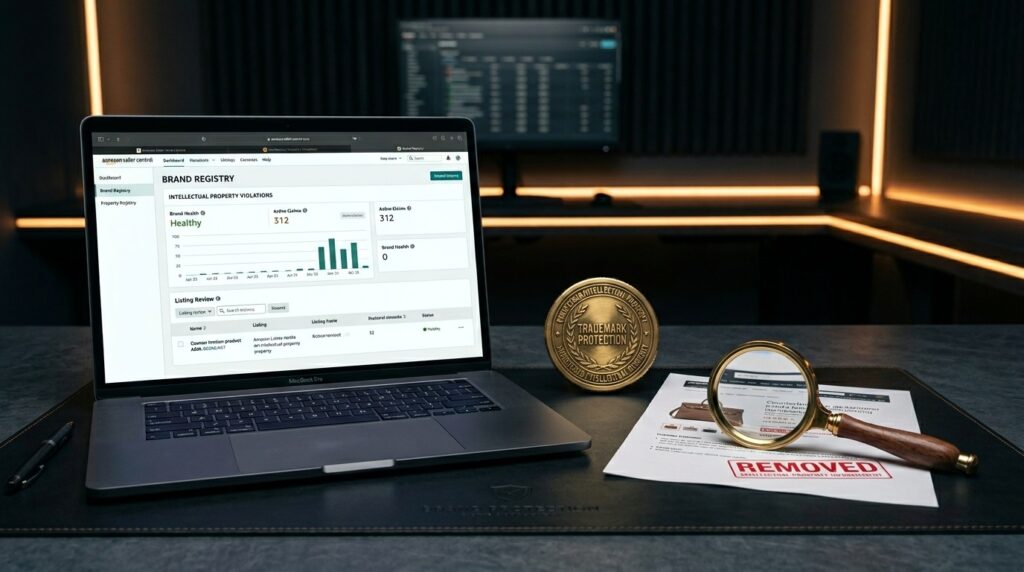

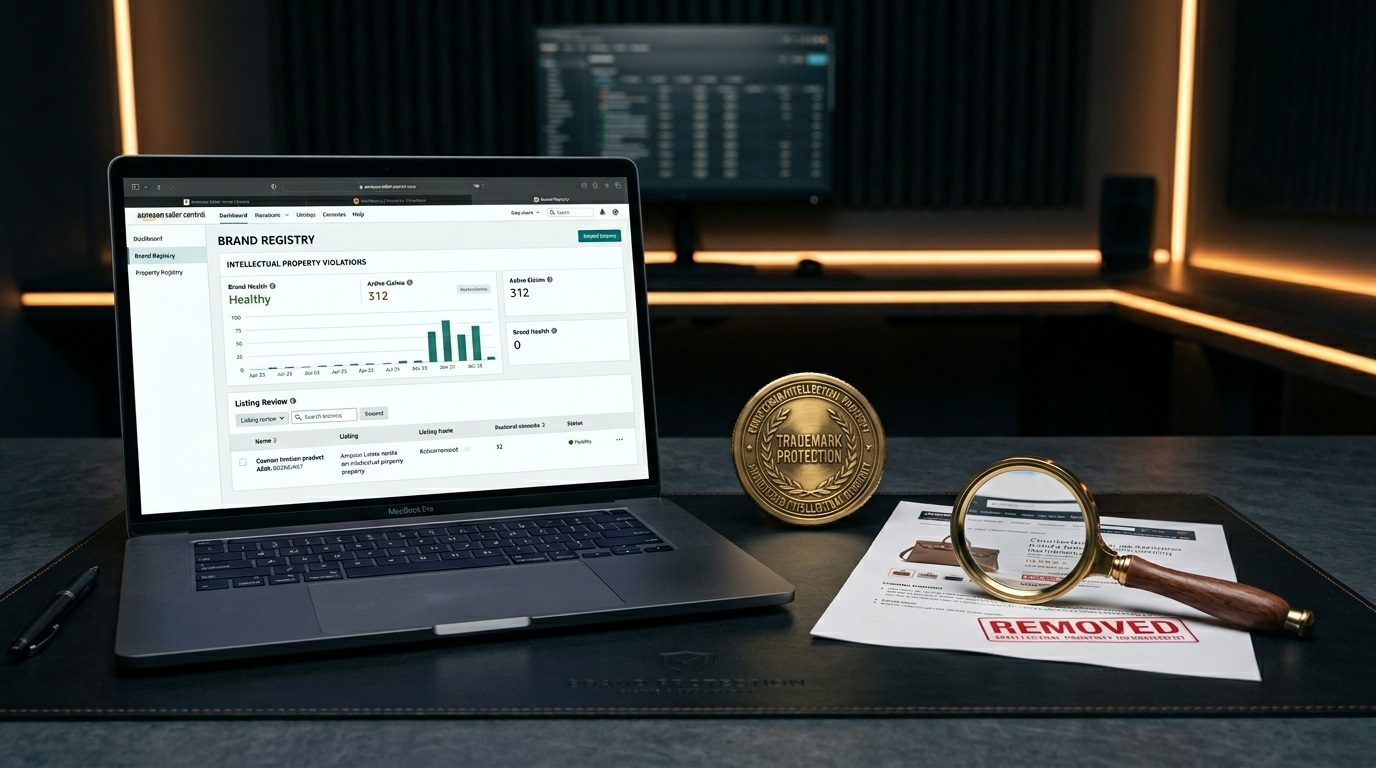
Amazon removed over 700 million suspected counterfeit listings and stopped over 800,000 bad actor accounts from selling a single product in 2023. Despite that, counterfeiting on the platform grew by an estimated 15% year over year. The tools exist. The problem is that most sellers either don’t know about them or use them in isolation.
This guide covers 15 distinct protection strategies across Amazon’s internal tools, legal frameworks, operational defenses, customs enforcement, and gray market controls. Each section includes the specific steps, costs, and conditions under which each strategy works best.
Strategy 1: Trademark Registration
Everything starts here. Without a registered trademark, you cannot access Brand Registry, Project Zero, Transparency, or any of Amazon’s enforcement tools.
At minimum, register your brand name as a word mark. If your logo is distinctive, register that separately as a design mark. Word marks provide broader protection because they cover the name in any font, style, or color.
File in every country where you sell on Amazon. A U.S. trademark (USPTO) covers Amazon.com. It does not cover Amazon.co.uk, Amazon.de, or Amazon.co.jp. Each marketplace requires a trademark from the corresponding jurisdiction or a qualifying international registration.
| Filing Route | Government Fee | Attorney Fee | Total | Timeline |
|---|---|---|---|---|
| USPTO (TEAS Plus) | $250/class | $350 to $1,000 | $600 to $1,250 | 8 to 12 months |
| USPTO (TEAS Standard) | $350/class | $350 to $1,000 | $700 to $1,350 | 8 to 12 months |
| IP Accelerator (through Amazon partner firm) | Included | $600 to $2,000 total | $600 to $2,000 | Brand Registry access in days |
| Madrid Protocol (international) | $653 base + per country | $1,000 to $3,000 | $2,000 to $6,000+ | 12 to 18 months |
Strategy 2: Brand Registry Enrollment
Brand Registry is the gateway to every other Amazon protection tool. It’s free, but the enrollment process has specific requirements that trip up sellers.
Current requirements:
- Active registered trademark (or pending trademark filed through IP Accelerator)
- Trademark must be text-based (word mark) or image-based (design mark)
- Issued by a recognized trademark office (USPTO, EUIPO, UKIPO, CIPO, JPO, INPI, or equivalent)
- Brand name or logo must appear on products or packaging
Enrollment steps (updated for 2026):
- Go to brandregistry.amazon.com
- Sign in with your Seller Central or Vendor Central credentials
- Select “Enroll a new brand”
- Enter your brand name exactly as it appears on your trademark certificate
- Provide the trademark registration number and issuing office
- Select product categories
- Upload photos showing the brand name/logo on products and packaging
- Submit and respond to the verification code Amazon sends to the trademark correspondent
The verification code goes to the email or mailing address listed on your trademark registration as the correspondent. If this is your attorney’s address, alert them in advance. Delayed verification is the number one reason enrollments stall.
What you unlock with brand registry:
- Report a Violation tool for manual IP complaints
- Automated Brand Protections (machine learning scans that blocked 99%+ of infringing content before brands even reported it, per Amazon’s 2023 report)
- A+ Content, Brand Stores, Sponsored Brands, and Brand Analytics
- Eligibility for Project Zero, Transparency, and Brand Gating
- Listing content authority (your edits take priority over other sellers on your listings)
What Brand Registry does NOT do:
- It does not prevent other sellers from listing against your ASINs
- It does not block authorized resellers selling genuine products
- It does not automatically remove all counterfeits
- It does not grant exclusivity over your listings
This distinction matters. Sellers who enroll in Brand Registry and expect it to solve all problems are the ones who get burned when a hijacker appears three months later. Brand Registry gives you tools. You still need to use them and layer additional strategies on top.
Strategy 3: Project Zero
Project Zero is the most powerful enforcement tool Amazon offers to brand owners. It combines three capabilities that no other program matches.
Component 1: Self-service counterfeit removal. You can take down counterfeit listings instantly without waiting for Amazon’s investigation team. No 3 to 7 business day review period. Click, confirm, removed.
Component 2: Automated protections. Amazon feeds your brand data into its machine learning models, which scan over 8 billion listing updates daily. This makes the automated detection significantly more accurate for your specific products.
Component 3: Product serialization. Amazon provides unique codes for each unit. When scanned at fulfillment centers or by customers, these codes verify the product is genuine.
Eligibility requirements:
- Active Brand Registry enrollment
- Demonstrated history of accurate violation reports (Amazon evaluates your submission accuracy rate)
- Evidence of a genuine counterfeiting problem
How to apply:
- Sign in to Brand Registry
- Navigate to Protect in the top menu
- Look for the Project Zero enrollment option
- Complete the application with details about your counterfeiting issues
- Amazon reviews and approves based on your reporting history and the severity of your problem
Amazon monitors your self-service removal accuracy. Removing legitimate sellers, authorized resellers, or competitors will get your access revoked. The threshold is widely reported to be around 90% accuracy. Only use self-service removal when you are certain the listing is counterfeit.
When Project Zero outperforms Report a Violation:
- You’re dealing with counterfeit sellers who spin up new accounts weekly
- Speed matters because every hour a counterfeit holds your Buy Box costs sales
- You need to remove multiple listings simultaneously during a coordinated counterfeit attack
Strategy 4: Transparency Program
Transparency is fundamentally different from every other tool on this list. Instead of detecting and removing counterfeits after they appear, it prevents counterfeit units from shipping in the first place.
How it works:
- Amazon generates unique 2D Transparency codes for your products
- You apply these codes to every unit during manufacturing or packaging
- When inventory arrives at Amazon’s fulfillment center, every unit is scanned
- Units without a valid Transparency code are rejected and never ship
- Customers can also verify authenticity by scanning the code with the Amazon app
Cost structure:
Transparency pricing is volume-based. Amazon doesn’t publish a fixed rate card, but seller-reported costs consistently fall in this range:
| Annual Unit Volume | Estimated Cost Per Unit |
|---|---|
| Under 10,000 | $0.05 |
| 10,000 to 50,000 | $0.03 to $0.04 |
| 50,000 to 200,000 | $0.015 to $0.025 |
| 200,000 to 1,000,000 | $0.01 to $0.015 |
| Over 1,000,000 | Negotiated |
If your product sells for $30 and you move 100 units per day, a single week of Buy Box hijacking costs you roughly $21,000 in lost revenue. At 36,500 annual units and $0.03 per code, your annual Transparency cost is $1,095. The math isn’t close.
Plan for 4 to 8 weeks from enrollment to first shipment with codes applied. The main bottleneck is integrating code application into your manufacturing or packaging line. Amazon provides technical specifications for code format, placement, and print quality.
Where Transparency works best:
- Health and personal care products
- Supplements and vitamins
- Electronics and accessories
- Automotive parts
- Any product where counterfeits pose safety risks
- High-value items with strong resale demand
Where it may not justify the cost:
- Products with razor-thin margins under $10
- Very low volume items (under 500 units per year)
- Products with no history of counterfeiting
Strategy 5: Brand Gating
Amazon Brand Gating (also called brand restriction or brand approval) is one of the least understood but most effective tools for controlling who sells your products on Amazon.
When your brand is gated, any new seller who wants to list your products must provide documentation proving they are authorized to sell them. This can include invoices from the brand or authorized distributor, authorization letters, or other proof of a legitimate supply chain.
Amazon does not have a public application for brand gating. Historically, gating was reserved for high-profile brands or brands in restricted categories. However, Brand Registry enrollment significantly increases your chances. Some brands receive gating automatically after enrolling and meeting certain criteria (typically a combination of brand recognition, sales volume, and counterfeiting complaints).
Steps to request brand gating:
- Enroll in Brand Registry and maintain an active, clean account
- File consistent, accurate reports through Report a Violation
- Contact Brand Registry support and request brand gating
- Provide evidence of counterfeiting problems (test buy documentation, Report a Violation history, customer complaints)
- Amazon evaluates and may approve gating for your brand
Not every brand gets approved. Amazon considers factors including brand recognition, category risk, and the volume of legitimate third-party sellers. Brands in categories like beauty, health, grocery, and baby products are more likely to qualify because these categories have higher safety and authenticity concerns.
While Brand Registry and Project Zero remove bad listings after they appear, gating prevents unauthorized sellers from creating those listings in the first place. It’s the proactive version of what other tools do reactively.
Gating doesn’t help if counterfeit sellers provide fraudulent invoices. Some sophisticated counterfeiters forge invoices or use straw-man companies. For this reason, gating works best when combined with Transparency (which verifies individual product units regardless of seller credentials).
Strategy 6: GS1 UPC Ownership and Catalog Integrity
This is the strategy that almost nobody writes about, but it prevents one of the most common forms of listing hijacking: catalog abuse.
Every Amazon product listing is tied to a UPC, EAN, or other Global Trade Item Number (GTIN). If you purchased your UPCs from a third-party reseller rather than directly from GS1, you have a problem. Those UPC codes may not be permanently tied to your company, and another seller could potentially claim ownership of the same code.
Why this matters for brand protection:
- If another seller claims the same UPC, they can potentially merge into your listing or create competing listings with catalog confusion
- Amazon’s catalog system uses GTINs as a primary product identifier. Owning your GTINs through GS1 gives you stronger standing in catalog disputes
- When you register GTINs through GS1 and link them to your Brand Registry account, Amazon can verify that you are the legitimate brand owner
GS1 costs:
| Company Revenue | Annual GS1 Membership Fee | Initial License Fee | Capacity |
|---|---|---|---|
| Under $1M | $150/year | $250 | 10 UPCs |
| $1M to $10M | $150/year | $750 | 100 UPCs |
| $10M to $100M | $150/year | $2,500 | 1,000 UPCs |
Action steps:
- Purchase a GS1 Company Prefix at gs1us.org (or your country’s GS1 organization)
- Assign GTINs to each product through the GS1 Data Hub
- Connect your GS1 account to Amazon Brand Registry through the GTIN verification process
- Use the “Report incorrect product information” tool in Seller Central for any listings using your GTINs without authorization
Strategy 7: FNSKU Labeling to Prevent Commingled Inventory Fraud
This is an operational fix, not a tool you sign up for, and it prevents a specific type of counterfeiting that Amazon’s IP tools can’t catch.
When you use manufacturer barcodes (UPC) for FBA shipments instead of Amazon’s FNSKU labels, Amazon stores your inventory in a shared pool with identical products from other sellers. If another seller ships counterfeit units with the same UPC, Amazon may ship those counterfeit units to your customers under your seller account.
You get the negative review. You get the A-to-Z claim. Your product quality metrics take the hit. And you had no control over it.
The fix:
- Go to Seller Central > Settings > Fulfillment by Amazon
- Change the FBA product barcode preference to “Amazon barcode” (FNSKU)
- Apply unique FNSKU labels to every unit you ship to Amazon
- Your inventory is now stored and shipped separately from other sellers’ inventory
There is no extra cost for FNSKU labeling beyond the label printing itself (a few cents per unit). If you prefer, Amazon will apply labels for you at $0.55 per unit through the FBA Label Service.
Strategy 8: A+ Content and Brand Story as Defensive Tools
Most guides position A+ Content and Brand Story as marketing features. They are also brand protection tools.
How A+ Content protects your brand:
- Custom images, comparison charts, and branded layouts make your listing look professional and difficult to replicate
- Counterfeiters rarely invest in A+ Content, so its presence signals legitimacy to customers
- Amazon gives Brand Registered sellers content authority, meaning your A+ Content is harder for other sellers to overwrite
- Rich content reduces buyer confusion between your genuine product and lookalike counterfeits
How Brand Story protects your brand:
The Brand Story module appears above the A+ Content section on your listing. It tells your brand’s origin, values, and product philosophy. This is real estate that no other seller can fill, and it creates a visual trust signal that counterfeit sellers simply can’t match.
Strategy 9: Design Patents and Utility Patents
If someone is creating a knockoff product that looks like yours but uses a different brand name, trademark law won’t help you. That’s where patents come in.
Design patents protect the ornamental appearance of your product. If your product has a unique shape, surface pattern, or visual design, a design patent prevents others from selling products that look substantially similar.
- Cost: $1,500 to $3,500 for filing through a patent attorney
- Timeline: 12 to 18 months for approval
- Duration: 15 years from grant date (no maintenance fees)
- Enforcement on Amazon: Submit design patent through Report a Violation; Amazon may remove infringing listings
Utility patents protect how your product works. If your product has a novel function, mechanism, or process, a utility patent prevents others from making, using, or selling products that perform the same function in the same way.
- Cost: $7,000 to $15,000+ for filing through a patent attorney
- Timeline: 2 to 4 years for approval
- Duration: 20 years from filing date (maintenance fees required)
- Enforcement on Amazon: More complex; Amazon may require a court order for contested claims
Which one should you file?
For Amazon brand protection specifically, design patents often deliver better ROI because they’re cheaper, faster, and easier to enforce on the platform. Amazon’s team can visually compare a product to your design patent. Utility patent disputes usually require legal proceedings that go beyond Amazon’s internal process.
File a design patent for your top-selling products before they become popular enough to attract copycats. The 12 to 18 month approval timeline means you need to file early.
Strategy 10: MAP Policies and Authorized Reseller Programs
Amazon’s IP tools are built for counterfeiting. They are not built for controlling authorized resellers who sell your genuine products at prices you don’t approve.
This is the gray market problem, and it requires legal and contractual solutions rather than Amazon tools.
A MAP policy sets the lowest price at which authorized resellers can advertise your products. It does not set the final sale price (that would raise antitrust concerns under U.S. law). It controls the advertised price.
How to implement a MAP policy:
- Draft a unilateral MAP policy with an attorney experienced in antitrust and distribution law (cost: $2,000 to $5,000)
- Communicate the policy to all distributors and retailers
- Monitor compliance on Amazon and other channels
- Enforce consequences for violations (typically suspension of supply)
Authorized Reseller Agreements
These contracts specify exactly who is permitted to sell your products, where they can sell them, and under what conditions.
Key clauses to include:
- Territory restrictions. Limit where the reseller can sell (online vs. brick-and-mortar, specific marketplaces)
- Anti-diversion clauses. Prohibit resellers from selling to unauthorized parties
- Quality control requirements. Require specific storage, handling, and shipping standards
- Marketplace restrictions. Specify which online platforms are approved for resale
- Termination provisions. Clear consequences for violation, including immediate supply cutoff
This is a legal concept that Amazon sellers should understand. Under U.S. trademark law, if a product sold by a reseller is “materially different” from the product the brand owner sells, the resale can be considered trademark infringement even though the product itself is genuine. Material differences can include: missing warranty, different packaging, removed serial numbers, absence of quality control, or excluded accessories.
If your authorized reseller agreements create material differences between your authorized channel and unauthorized resellers (for example, only authorized buyers receive your full warranty), you may have a legal basis for enforcing takedowns against unauthorized sellers even when they sell genuine products.
This requires an attorney. It is not something you can enforce through Amazon’s standard tools alone.
Strategy 11: U.S. Customs and Border Protection Recordation
If counterfeit versions of your products are manufactured overseas (and most are), registering your trademarks with U.S. Customs and Border Protection (CBP) adds a layer of protection that works before products even reach Amazon’s warehouses.
When you record your trademark with CBP, customs officers at U.S. ports of entry are authorized to inspect, detain, and seize imported goods that bear your trademark without authorization.
It costs $190 per trademark class, per recordation. The registration lasts 20 years.
How to file:
- Go to the CBP Intellectual Property Rights e-Recordation system (iprr.cbp.gov)
- Create an account
- Submit your trademark registration details
- Provide product descriptions, images, and information about authorized importers
- Pay the $190 fee
- CBP reviews and approves (typically within 30 to 60 days)
Many counterfeit products that end up on Amazon arrive through ocean freight shipments. If CBP seizes a shipment of counterfeits bearing your trademark, those products never make it to an FBA warehouse. This is upstream protection that no Amazon tool can replicate.
CBP seized over 25,000 shipments of counterfeit goods valued at $2.76 billion in retail value in fiscal year 2023. Having your trademark recorded with CBP puts your brand on their radar.
BP stops counterfeits at the border. Transparency stops them at the fulfillment center. Together, these two strategies create a two-gate system that makes it extremely difficult for counterfeit units to reach customers.
Strategy 12: Monitoring and Test Buys
Protection tools are only as good as your ability to detect threats quickly. Monitoring should be a daily practice, not an occasional check.
What to monitor daily:
- Buy Box ownership on every active ASIN
- Number of sellers on each listing
- Listing content changes (title, images, bullets, description)
- Pricing anomalies (sudden drops may signal unauthorized sellers)
- Review sentiment shifts (sudden negative reviews mentioning quality issues can indicate counterfeits)
- Brand Analytics search term reports (watch for your brand name appearing with terms like “fake,” “authentic,” or “original”)
Manual monitoring is feasible if you have fewer than 20 ASINs. Check each listing daily for new sellers, content changes, and Buy Box status.
Use Automated monitoring tools if you have more than 20 ASINs or sell in multiple marketplaces.
| Tool | Focus | Starting Price | Best For |
|---|---|---|---|
| Brandlox | ASIN monitoring, hijacker alerts | $99/month | Small to mid-size brands |
| Gray Falkon | AI-powered enforcement automation | Custom pricing | Mid-size to enterprise |
| Red Points | Multi-platform brand protection | Custom pricing | Brands selling beyond Amazon |
| Helium 10 (Alerts) | Listing change and hijacker alerts | $29/month (included in suite) | Budget-conscious sellers |
| SellerPulse (by Jungle Scout) | Listing alerts and monitoring | Included in Jungle Scout plans | Existing Jungle Scout users |
When you detect a suspicious seller on your listing, place an order from them. When the product arrives:
- Photograph the shipping label, packaging, and product before opening
- Compare the product to your genuine item (weight, materials, print quality, packaging details)
- Document every difference
- Save the order confirmation and seller information
This evidence makes your Report a Violation submission nearly impossible to deny. It also provides documentation for legal action if needed.
Strategy 13: Responding to Listing Hijacking
When a hijacker hits your listing, speed matters. Here is the step-by-step response playbook:
In the first hour:
- Screenshot the listing showing the unauthorized seller, their price, and their seller name
- Check if the seller has taken the Buy Box
- Verify whether the listing content has been altered
- If you have Project Zero access, remove the counterfeit listing immediately
Within 24 hours:
- If you don’t have Project Zero, file a Report a Violation through Brand Registry with your trademark registration number and evidence
- Order a test buy from the suspicious seller
- Check your other ASINs for the same seller (hijackers often target multiple listings simultaneously)
- If the seller is using your brand name in their seller name, report it as a separate trademark violation
Within 48 to 72 hours:
- Follow up on the Report a Violation if no action has been taken
- If the test buy arrives and confirms a counterfeit, submit the evidence to strengthen your report
- Contact Brand Registry support directly if the standard report isn’t resolved
For persistent hijackers who return after removal:
- Send a cease and desist letter (your attorney can provide a template, or you can use one of several reputable cease-and-desist services)
- Escalate to Amazon through Brand Registry support and request evaluation for the Counterfeit Crimes Unit
- Consider filing in small claims court or pursuing trademark infringement litigation
- Document every incident, this pattern of behavior strengthens any future legal action
Well-documented reports with clear evidence typically resolve in 3 to 7 business days. Reports without supporting evidence can take 2 to 4 weeks or may be rejected.
Strategy 14: International Brand Protection
If you sell on Amazon in multiple countries, your U.S. brand protection strategy is only protecting one marketplace. Counterfeiting operations frequently target less-monitored international Amazon sites first.
| Marketplace | Required Trademark Office | Brand Registry Enrollment |
|---|---|---|
| Amazon.com (US) | USPTO | Separate enrollment |
| Amazon.co.uk (UK) | UKIPO or EUIPO | Separate enrollment |
| Amazon.de (Germany) | DPMA or EUIPO | Separate enrollment |
| Amazon.co.jp (Japan) | JPO | Separate enrollment |
| Amazon.ca (Canada) | CIPO | Separate enrollment |
| Amazon.in (India) | Indian Trademark Registry | Separate enrollment |
| Amazon.com.au (Australia) | IP Australia | Separate enrollment |
Instead of filing separate trademark applications in each country, the Madrid Protocol lets you file a single international application through WIPO that designates multiple countries.
Base fee: $653 (black and white mark) or $903 (color mark), plus per-country designation fees ranging from $70 to $350 each. Total cost for a 5-country international filing typically runs $2,000 to $4,000 through the Madrid system, compared to $5,000 to $15,000 for separate filings through local attorneys in each country.
If you can’t protect every marketplace at once, prioritize based on:
- Revenue (protect your highest-revenue marketplaces first)
- Counterfeiting risk (categories like supplements and electronics face more counterfeiting in European and Asian markets)
- Growth plans (file trademarks 12 to 18 months before you plan to launch in a new market)
Frequently Asked Questions
Can Amazon Brand Registry stop someone from selling my product?
No. Brand Registry cannot prevent other sellers from listing against your ASINs if they sell genuine products. It provides tools to report and remove counterfeit listings and IP infringements. To control who sells your genuine products, you need authorized reseller agreements, MAP policies, and potentially Brand Gating.
What is the difference between Transparency and Project Zero?
Transparency is a physical serialization system. You apply unique codes to every unit, and Amazon scans them at fulfillment centers to verify authenticity. Counterfeits without valid codes are rejected before shipping. Project Zero is a digital enforcement system that lets you remove counterfeit listings instantly and enhances Amazon’s automated scanning. Transparency prevents counterfeit units from reaching customers. Project Zero prevents counterfeit listings from staying active. They solve different parts of the same problem.
How do I get Brand Gating on Amazon?
Brand Gating is not open enrollment. You need an active Brand Registry account and typically a documented history of counterfeiting problems. Contact Brand Registry support with evidence of counterfeit issues and request gating. Approval depends on your category, brand recognition, and the severity of the counterfeiting problem.
Does a U.S. trademark protect my brand on Amazon UK or Amazon Germany?
No. Each Amazon marketplace requires a trademark from the corresponding country or region. A U.S. trademark covers Amazon.com only. For Amazon UK, you need a UKIPO or EUIPO trademark. For Amazon Germany, you need a DPMA or EUIPO trademark. The Madrid Protocol offers a cost-efficient way to file in multiple countries through a single application.
How long does it take to remove a counterfeit listing from Amazon?
With Project Zero self-service removal, counterfeits can be removed instantly. Through Report a Violation with strong evidence, expect 3 to 7 business days. Without clear evidence or for complex cases, it can take 2 to 4 weeks. Cases escalated to the Counterfeit Crimes Unit involve investigation timelines that vary depending on the scope of the counterfeiting operation.
How effective is recording my trademark with Customs and Border Protection?
CBP trademark recordation gives customs officers authority to inspect, detain, and seize imported counterfeits bearing your trademark at U.S. ports of entry. CBP seized over 25,000 shipments of counterfeit goods in fiscal year 2023. For brands facing counterfeits manufactured overseas and shipped to FBA warehouses, CBP recordation adds a critical upstream protection layer that Amazon’s tools can’t provide.
Is Amazon’s Counterfeit Crimes Unit free to use?
Yes. The Counterfeit Crimes Unit is funded entirely by Amazon. You cannot directly hire or engage them, but you can escalate serious, organized counterfeiting cases through Brand Registry support. Amazon evaluates cases based on severity, evidence, and pattern, and routes qualifying cases to the CCU for investigation and potential prosecution.