
Amazon Cost-Per-Click (CPC) is the price you pay each time a shopper clicks on one of your sponsored ads. Each click represents a potential customer visiting your product page, making CPC a direct measure of your ad budget’s effectiveness and a key factor in profitability.
What Amazon CPC Means for Your Business

Your Amazon CPC directly impacts your campaign’s bottom line. It’s a critical lever for controlling ad spend efficiency. A high CPC combined with a low conversion rate can quickly deplete your budget, while a well-managed CPC supports a healthy Return on Ad Spend (RoAS). Managing this metric allows you to bid more effectively, extend your budget, and grow sales without unnecessary spending. The team that provides Amazon PPC services will calculate your break-even point with reference to Cost of Goods (COGs), so you never pay more for a click than the product is actually worth.
1. Amazon CPC At a Glance
To understand how CPC fits into your Amazon ad strategy, it’s helpful to see all the components together. This table breaks down the core elements and their business implications.
| Metric | What It Means for Your Business |
|---|---|
| CPC | The direct cost of a single ad click. A fundamental measure of ad spend efficiency. |
| Bid | The maximum you’re willing to pay for a click. This is your primary tool for controlling CPC. |
| Competition | The number of sellers bidding on the same keywords. More competition usually means a higher CPC. |
| Relevance | How well your ad and product match a shopper’s search. Higher relevance can lead to a lower CPC. |
| RoAS | Return on Ad Spend. CPC is a key input; lower CPCs help improve RoAS if sales remain stable. |
| Conversion Rate | The percentage of clicks that result in a sale. A strong conversion rate can justify a higher CPC. |
These metrics are interconnected. Your goal is to find the right balance to drive profitable growth.
2. The Financial Impact of Each Click
Every click has a cost that reduces your profit margin on any ad-driven sale. A lower CPC provides more room for profit, while a higher one narrows it. This is why monitoring your CPC is so important.
The cost is not static; it fluctuates with competition, seasonality, and keyword relevance. For example, the average Amazon advertising CPC in 2024 ranged from a low of $0.82 in February to a peak of $1.14 in July, aligning with major shopping events like Prime Day.
3. Why CPC is a Core Advertising Lever
Managing your CPC is one of the most direct ways to influence campaign results. When you adjust your bids, you tell Amazon what a click is worth to you, which creates a ripple effect:
- Ad Visibility: Higher bids often secure more prominent ad placements.
- Budget Pacing: Lower CPCs allow your daily budget to go further, meaning more clicks for the same cost.
- Profitability: Keeping your CPC below your break-even point is essential for ensuring your ads are profitable.
The objective is to find a CPC low enough for profitability but high enough to secure necessary clicks. It’s a continuous balancing act. To learn more about converting clicks into revenue, see our guide on how to improve your Amazon conversion rate.
How Amazon Calculates Your Actual CPC
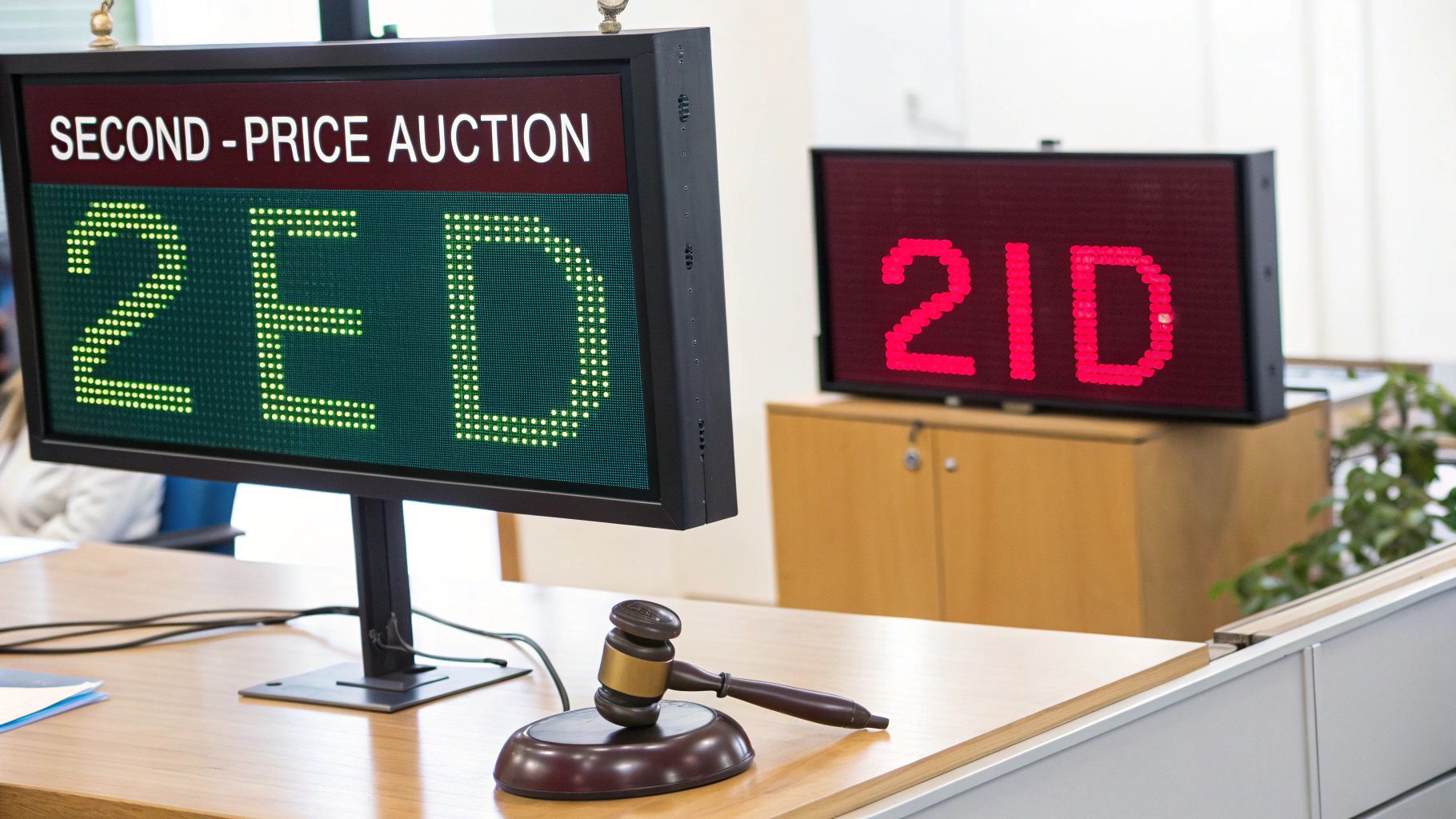
Your maximum bid isn’t what you pay per click. Amazon’s ad platform uses a second-price auction model. When you win an ad placement, you don’t pay your full bid. Instead, you pay just $0.01 more than the next-highest bidder’s offer.
This system promotes a fair and competitive marketplace. It encourages you to bid what a click is truly worth without the fear of overpaying. You can set your maximum bid confidently, knowing you’ll almost always pay less. To maximize this system, it’s helpful to understand the fundamental difference between impressions and clicks.
1. It’s Not Just About the Highest Bid
Winning an ad auction involves more than just bidding the most money. Amazon’s algorithm considers two main factors:
- Your Maximum Bid: The absolute most you’re willing to pay for a single click.
- Ad Relevance (Quality Score): Amazon’s internal assessment of how well your product listing and ad match a shopper’s search. A higher score indicates your ad is a good fit.
A highly relevant ad can beat a competitor with a higher bid because Amazon prioritizes a positive customer experience by showing shoppers what they’re looking for.
2. A Practical Auction Example
Imagine two sellers competing for the keyword “organic dog treats.”
- Seller A bids $2.50. Their product listing is decent but not perfectly optimized, giving their ad a moderate relevance score.
- Seller B bids $2.10, a lower amount. However, their ad’s relevance score is very high. Their product title, bullets, and backend keywords are focused on “organic dog treats,” and they have a strong sales history for that search.
In this case, Seller B will likely win the auction despite bidding less. Amazon’s algorithm views their ad as the better choice. Seller B will only pay $2.11, just a penny more than Seller A’s bid. This shows that optimizing your listings and ads provides a significant advantage in controlling your Amazon CPC. You can learn more about this system in our guide to what PPC is on Amazon.
Key Factors That Influence Your Amazon CPC
Your Amazon CPC isn’t a fixed number. It’s a dynamic metric influenced by several market forces. Understanding these variables is the first step toward predicting cost changes. The biggest factor is market competition. If you sell a popular item like an air fryer, you’re bidding against hundreds of other brands, which naturally drives up the auction price.
1. Keyword Selection and Match Types
The keywords you target directly impact your CPC. While cheap, broad keywords seem appealing, they often lead to wasted spend.
- Broad Match: A term like “running shoes” may have a lower CPC but can attract unqualified clicks from shoppers looking for different styles or sizes.
- Phrase Match: A more specific phrase like “men’s trail running shoes” has a slightly higher CPC but attracts more relevant traffic.
- Exact Match: A highly specific term like “[new balance men’s trail running shoes size 10]” will have the highest CPC, but the shopper’s intent is clear, often leading to a better conversion rate.
The data of a Amazon advertising campaign below show the same keyword placed in Exact, Phrase, and Broad, and Amazon assigns different bids to each version.
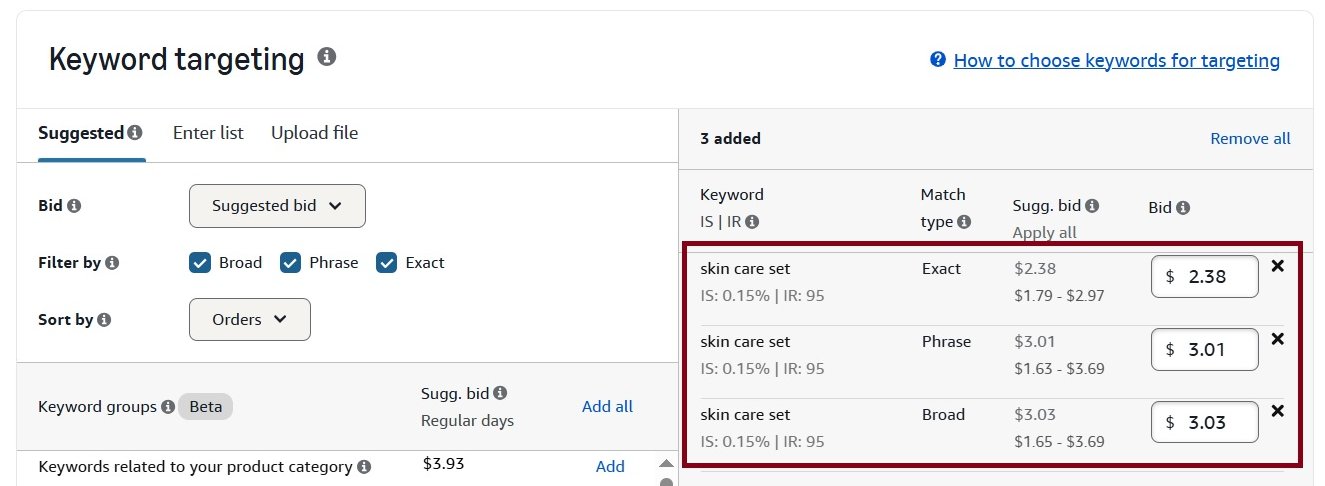
That bid difference pushes different CPC outcomes. Exact sits at 2.38, Phrase moves to 3.01, and Broad reaches 3.03. When you target them, the keyword tied to the lower bid produces the lower CPC, and the keyword tied to the higher bid produces the higher CPC. That is the direct link between match type and CPC: the match type changes Amazon’s bid, and the bid sets the CPC.
2. Seasonality and Market Trends
Shopper demand varies, and your CPC will follow. The cost to advertise “winter coats” will increase in Q4 as demand and competition rise. That same keyword will have a much lower CPC in May.
Major shopping holidays like Prime Day, Black Friday, and Cyber Monday create intense bidding wars, causing CPCs to rise across most categories. Experienced sellers anticipate these shifts and adjust their budgets and bidding strategies accordingly.
3. Ad Placement
The location of your ad on the page also affects its price. A Top of Search placement is the most expensive because it receives the most visibility. In contrast, ads on a Product Page or lower in the Rest of Search are generally cheaper but get less traffic.
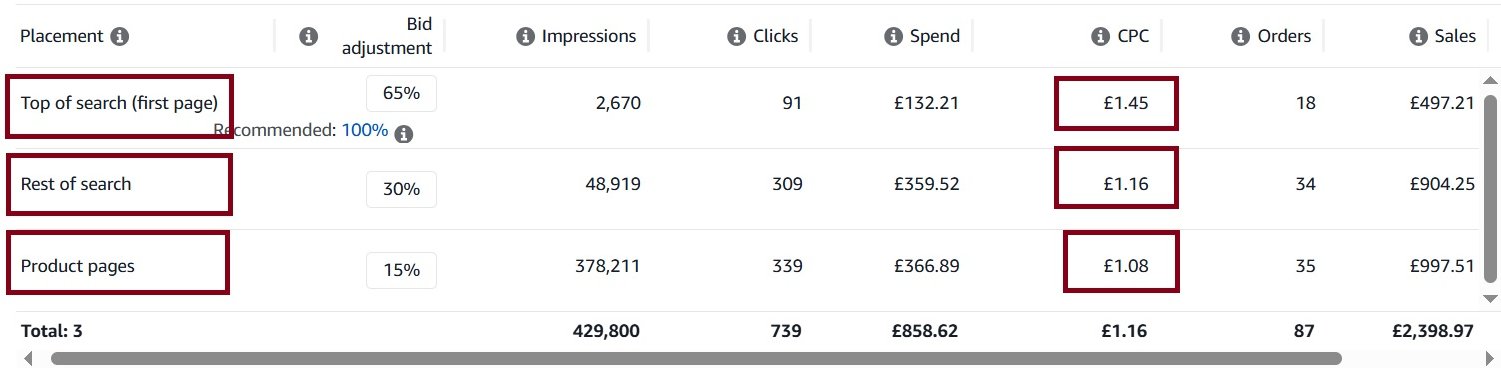
The data from Amazon advertising campaign above shows it clearly: Top of Search hits 1.45, Rest of Search drops to 1.16, and Product Pages falls further to 1.08. Same campaign, same keywords, different placements. CPC shifts based entirely on where the ad appears.
4. Ad Quality
Your ad’s “quality score,” Amazon’s internal relevance rating, is also important. A high quality score, earned through a strong click-through rate and conversion history, can help you win better placements at a lower CPC. To achieve this, you need to understand the components of a good Amazon CTR.
Data suggests the average CPC is projected to reach about $1.04 in 2025, up from the $0.95 average in late 2024. This trend highlights the importance of managing these factors. Sponsored Brands ads can command CPCs from $1.10 to $2.50. You can find more details about these rising Amazon ad CPCs on sellermetrics.app.’
5. Product Category
Amazon CPC isn’t uniform across the marketplace. Competitive categories drive higher costs per click. Health & Household and Beauty & Personal Care consistently sit among the highest average CPCs, with Health & Household around $1.46 per click. Typical platform-wide CPC averages fall in the $0.90–$1.10 range, but categories with intense competition and strong buyer intent push the average up.
Electronics often have higher CPCs around $1.12, while Fashion might average closer to $0.89. Some categories, like Baby products, have even seen significant year-over-year CPC increases, reflecting changing demand and advertiser pressure. This variation should inform how you allocate budget and set bids across your campaigns.
Strategies to Reduce Your Amazon CPC

Lowering your Amazon CPC requires a focus on efficiency, not just cutting bids, which can harm visibility and sales. The goal is to stop paying for clicks that don’t convert and pay less for those that do. This involves precise targeting, continuous optimization, and using Amazon’s tools effectively.
1. Negative Keyword Strategy
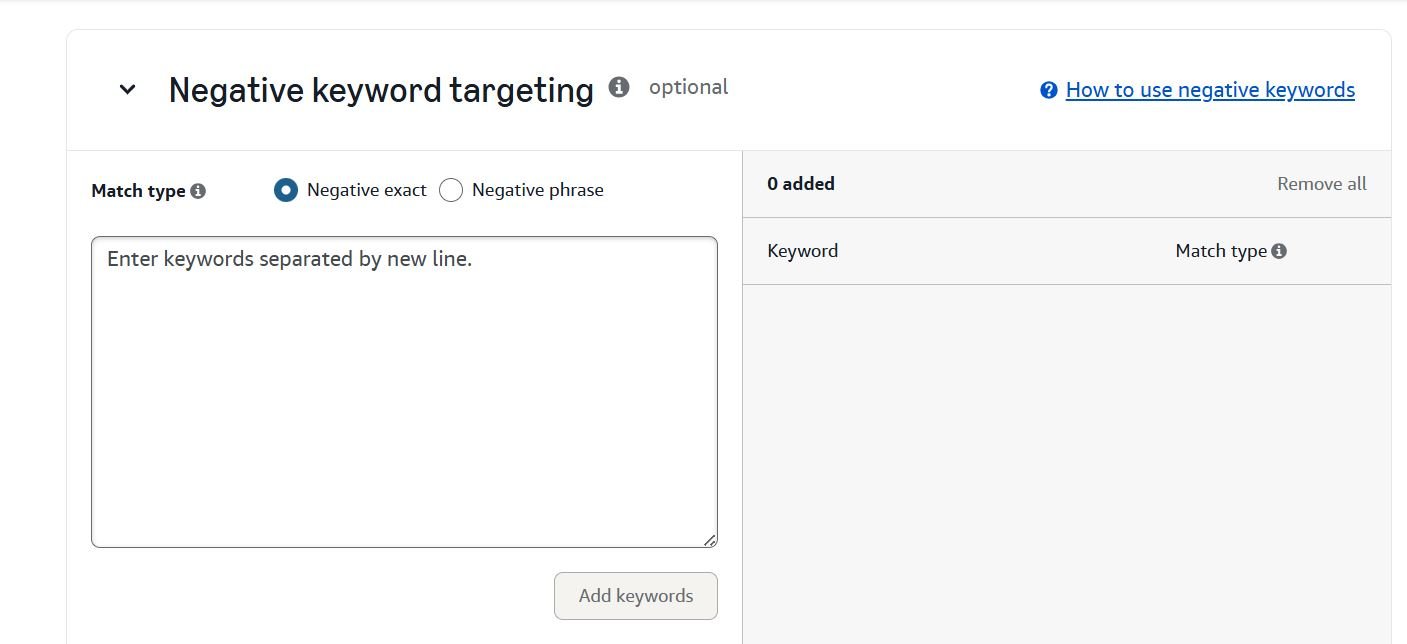
A quick way to lower your CPC is to stop spending on irrelevant search terms. A strong negative keyword list prevents your ads from appearing for searches that won’t convert.
For example, if you sell premium leather dog collars, you don’t want to pay for clicks from someone searching “cheap nylon dog collars.” Adding “cheap” and “nylon” as negative keywords stops this budget leak. Regularly review your Search Term Report to find and block these costly, irrelevant terms.
2. Focus on Long-Tail Keywords
Broad, single-word keywords are typically very competitive and expensive. Instead, focus on long-tail keywords, which are longer, more specific search phrases used by shoppers closer to making a purchase. These terms usually have less competition, resulting in a lower CPC.
Consider the difference in intent between a search for “shoes” versus “men’s waterproof hiking boots size 11 wide.” The second searcher knows exactly what they want. Targeting these specific phrases brings in higher-quality traffic for less money.
Focusing on these detailed phrases attracts shoppers further along in their buying journey, which often improves conversion rates along with lowering click costs.
3. Improve Your Ad’s Quality Score
Amazon rewards sellers who provide a good customer experience, and ad relevance (or quality score) is a key part of that. A higher score can directly lower your CPC because Amazon’s algorithm sees your ad as a better match for the search, giving you an advantage in the auction.
Improve your score by ensuring close alignment between your keywords, ad copy, and product detail page. If you’re bidding on “bamboo cutting board,” that phrase should be prominent in your product title and mentioned in your bullet points. This signals to Amazon that your product is an excellent fit for the search, which can help reduce your CPC. For more ideas, see these Amazon advertising tips.
4. Use Dynamic Bidding Strategies Wisely
Amazon offers dynamic bidding options that adjust your bids in real time based on the likelihood of a conversion. Using them correctly can prevent overpayment.
- Dynamic bids (Down only): This is the safest option. Amazon will lower your bid (up to 100%) if a click is less likely to result in a sale. It’s an effective way to control costs without risking over-bidding.
- Dynamic bids (Up and down): This is more aggressive. Amazon can increase your bid (up to 100%) for top-of-search placements. It can drive up your CPC if not monitored carefully.
- Fixed bids: Your bid remains exactly as you set it. You have full manual control but lose out on Amazon’s automated, cost-saving adjustments.
For sellers aiming to reduce their Amazon CPC, the “Down only” strategy is the most practical and effective choice. Many of these principles are also applicable to broader Search Engine Marketing strategies.
How to Analyze and Optimize Your CPC Performance
Managing your Amazon CPC is an ongoing cycle of analysis and adjustment. You need to regularly review performance to understand what’s working and what’s wasting money.
The best place to start is with Seller Central’s advertising reports. These reports provide valuable insights for cutting waste and improving performance.
1. Search Term Report Analysis
The Search Term Report is your most powerful tool for CPC optimization. It shows the exact search terms shoppers used before clicking your ad.
When reviewing this report, look for two things:
- High-Cost, Low-Conversion Keywords: Identify terms that receive many clicks but generate no sales. Add them to your negative keyword list immediately to stop wasting money.
- High-Performing Search Terms: Find unexpected customer search terms that are converting well. Move these to their own manual campaigns where you can give them more budget and attention.
Regularly analyzing this report is crucial. It reveals what customers are actually searching for. You can gain even more insights by cross-referencing this data with Amazon Brand Analytics reports.
2. Define What a “Good” CPC Really Is
There is no universal “good” CPC on Amazon. It’s entirely relative to your product’s price, profit margin, and conversion rate. A $3.00 CPC might be profitable for a $200 product but disastrous for a $20 item.
Instead of aiming for an arbitrary number, calculate your break-even ACoS. This is the highest Advertising Cost of Sale you can sustain before losing money on ad-driven sales. It’s your personalized benchmark.
The formula is simple: Break-Even ACoS = Pre-Ad Profit Margin (%)
For a product that sells for $50 with a $15 pre-ad profit, your profit margin is 30% ($15 / $50). Your break-even ACoS is 30%. Any CPC that helps keep your campaigns below this ACoS is a “good” CPC for your business.
3. Amazon CPC vs Other Ad Platforms
It’s helpful to compare Amazon’s ad costs with other major platforms for context.
| Platform | Average CPC (Approximate) |
|---|---|
| Google Display Ads | $0.63 |
| Amazon Ads | $0.98 |
| Facebook Ads | $1.72 |
As of 2025, the average CPC on Amazon is around $0.98. Compared to Google Display Ads at about $0.63 or Facebook Ads near $1.72, Amazon offers a competitive price for reaching shoppers with high purchase intent at the point of sale. For a broader comparison, you can find more insights about CPC statistics at amraandelma.com.
Got Questions About Amazon CPC? We’ve Got Answers.
Here are answers to some of the most common questions sellers have about Amazon CPC.
1. What Is a Good CPC on Amazon?
A “good” CPC depends on your product’s price, profit margin, and conversion rate. A profitable CPC for a $150 gadget would be unsustainable for a $20 phone case.
To determine what’s good for you, calculate your break-even ACoS (Advertising Cost of Sale) from your profit margin. If your pre-ad profit margin is 35%, your break-even ACoS is 35%.
Any CPC that keeps your campaigns below that 35% ACoS is a good CPC for you, as it ensures every ad-driven sale is profitable.
2. Why Is My Amazon CPC So High?
A high CPC is often due to a few common factors. The most significant is fierce competition. When more sellers bid on the same keywords, the auction price increases for everyone.
Seasonality also plays a major role. Costs typically rise during major shopping events like Q4 or Prime Day as brands increase their ad spend.
Another factor you can control is low ad relevance. If your product listing isn’t well-optimized for your target keywords, Amazon’s algorithm may charge you more to win an ad placement because it views your ad as a poor match for the search.
3. How Can I Lower My CPC Without Losing Sales?
The goal is efficiency, not just cutting bids, which can cause your ads and sales to decline.
- Use Negative Keywords: Regularly review your Search Term Report and add irrelevant queries as negative keywords. This prevents you from paying for clicks from shoppers who are not going to buy.
- Target Long-Tail Keywords: Instead of competing for broad, expensive terms like “yoga mat,” target more specific phrases like “eco-friendly non-slip purple yoga mat.” These have less competition, a lower CPC, and attract shoppers ready to buy.
- Boost Your Ad Relevance: Ensure your target keywords appear in your product title, bullet points, and description. A strong connection between your keywords and your product page signals relevance to Amazon, which can result in lower click costs.
- Use ‘Down Only’ Dynamic Bidding: This strategy allows Amazon’s algorithm to lower your bid for clicks it deems less likely to convert, helping you avoid overpaying.