

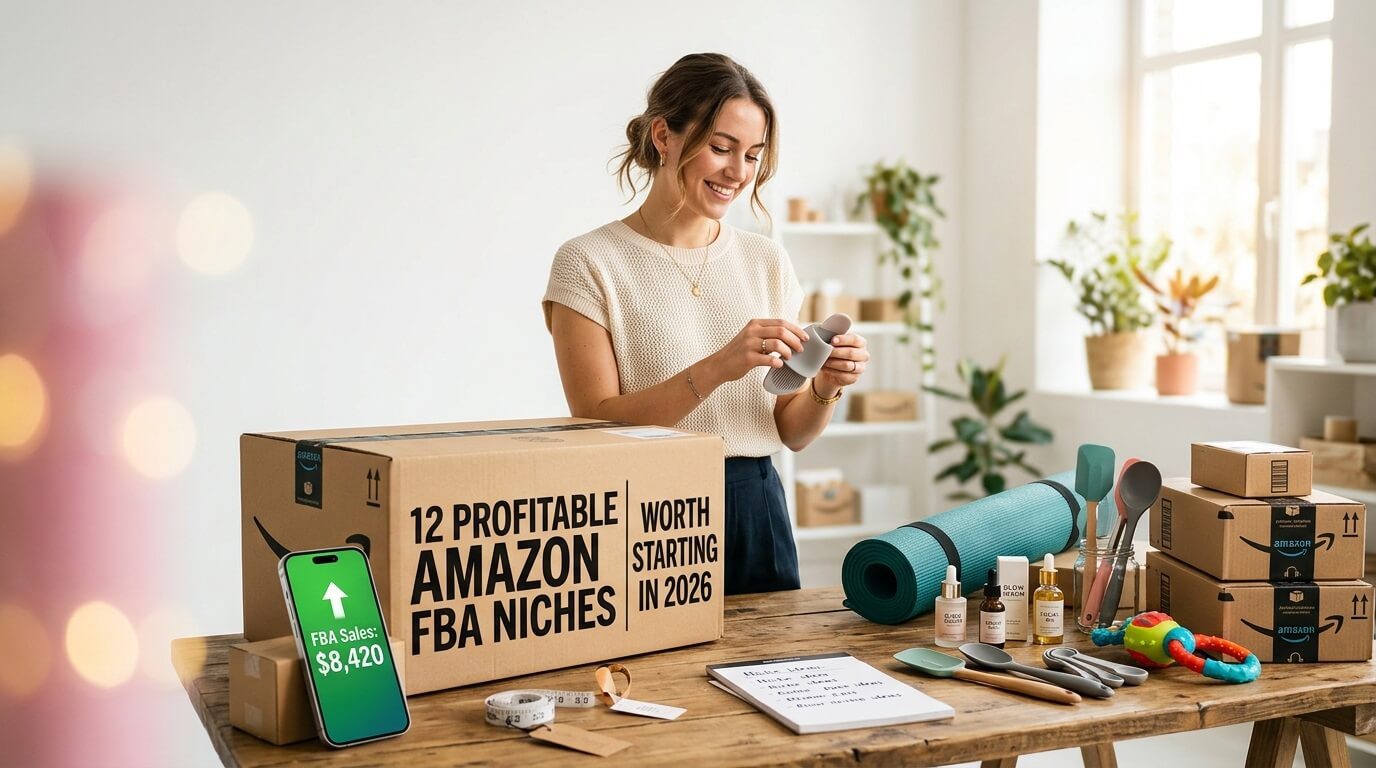
An Amazon FBA niche is a focused segment within Amazon’s product catalog where you concentrate your selling efforts. Instead of listing random products across unrelated categories, a niche seller builds a product line within a defined market, such as pet grooming tools, kitchen organization accessories, or home office desk products.
This focus matters because Amazon’s algorithm, customer behavior, and brand-building mechanics all reward specialization over randomness.
Niche selling gives you several compounding advantages over time.
- Brand recognition within a specific audience, which drives repeat purchases and organic word-of-mouth
- Cross-selling opportunities where one product listing drives traffic to your other related listings
- Supplier leverage because ordering multiple SKUs from the same factory or category lowers per-unit costs
- Listing optimization expertise since you learn what keywords, images, and A+ Content work for your specific buyers
- Higher Brand Registry value if you eventually want to sell your Amazon business (acquirers pay premium multiples for focused, well-branded stores)
The alternative, scattering products across random categories with no strategic connection, makes it nearly impossible to build the kind of defensible brand that generates sustainable profit on Amazon in 2026.
The data below shows the most important marketplace figures from Amazon’s public filings and verified industry sources.
| Metric | Figure | Source |
|---|---|---|
| Amazon Total Net Sales (2023) | $574.8 billion | Amazon 2023 10-K Filing |
| Third-Party Seller Services Revenue (2023) | $140.1 billion | Amazon 2023 10-K Filing |
| Share of Physical Product Sales from Third-Party Sellers | 60%+ | Amazon Public Statements |
| Active Customer Accounts Globally | 300+ million | Amazon Public Disclosures |
| Amazon Prime Members Worldwide | 200+ million | Amazon Shareholder Letter |
| Active Third-Party Selling Partners | ~2 million | Amazon Small Business Report |
| Amazon Advertising Revenue (2023) | $46.9 billion | Amazon 2023 10-K Filing |
| US E-Commerce Market Share Held by Amazon (2023) | ~37.6% | eMarketer / Insider Intelligence |
Six Factors That Make or Break an Amazon FBA Niche
Not all profitable-looking niches are actually profitable once you account for every cost, risk, and competitive reality. Experienced sellers evaluate every niche through a consistent framework before committing a single dollar.
Below are the six factors that consistently determine whether a niche generates sustainable profit or quietly drains your capital.
1. Demand Consistency
Products that sell steadily across all 12 months outperform seasonal products for most sellers, especially beginners. Seasonal niches like pool floats or Christmas decorations generate short revenue spikes followed by months of dead inventory and storage fees.
- Run your product idea through Google Trends and look for a flat or gently rising 12-month pattern
- Use Keepa to track BSR (Best Seller Rank) fluctuations on competitor listings over 6 to 12 months
- Prioritize niches where demand does not collapse after Q4
2. True Profit Margin After Every Fee
The fastest way to fail on Amazon FBA is to calculate margin as selling price minus product cost. That number is meaningless. Your real margin must account for every cost Amazon charges plus your own variable expenses.
A complete per-unit cost model includes the following line items.
- Product manufacturing or wholesale cost
- Shipping to Amazon’s fulfillment center (including inbound placement fees introduced in 2024)
- Amazon referral fee (category-specific, typically 15%)
- FBA fulfillment fee (based on size tier and weight)
- Monthly storage fees (higher during Q4)
- PPC advertising spend per unit sold
- Return and refund costs
- Product inspection and prep costs
If your margin after all of these falls below 25%, the niche leaves you very little room for error. Aim for 30% or higher when modeling a new product.
3. Competition Depth and Review Moats
A niche where every page-one listing has 5,000 to 50,000 reviews is extremely difficult for a new product to crack. Reviews function as a trust barrier, and shoppers overwhelmingly choose listings with more reviews when product quality and price look similar.
- Scan page one of your target keyword using Helium 10 Xray or Jungle Scout Extension
- Look for at least 3 to 5 listings on page one with fewer than 500 reviews
- Note how many page-one spots are Sponsored (more sponsored = higher PPC costs for that keyword)
- Check if any top listings have poor images, minimal bullet points, or no A+ Content (these signal beatable competition)
4. Product Size and Weight (Fee Impact)
Amazon’s FBA fulfillment fees increase sharply as products get larger and heavier. Keeping your product within the standard-size tiers has a measurable impact on unit economics, particularly for products priced below $30.
The following data below shows how FBA fulfillment fees scale across size tiers, based on Amazon’s 2024 published fee schedule.
| Size Tier | Weight Range | Approx. FBA Fee Per Unit |
|---|---|---|
| Small Standard | 4 oz or less | $3.22 |
| Small Standard | 12 to 16 oz | $3.77 |
| Large Standard | 4 oz or less | $3.86 |
| Large Standard | 1 to 2 lb | $5.90 |
| Large Standard | 2 to 3 lb | $6.29 |
| Small Oversize | Up to 70 lb | $9.73+ |
| Large Oversize | Up to 150 lb | $89.98+ |
The jump from standard to oversize tiers is dramatic. A product that fits in a small standard envelope costs roughly $3.22 to fulfill. A small oversize item costs $9.73 or more. That $6.50 difference comes directly out of your profit margin on every single unit sold.
5. Regulatory and Compliance Requirements
Some niches require product certifications, lab testing, FDA registration, CPSC testing (for children’s products), or category-specific safety documentation. These requirements add upfront cost, ongoing compliance overhead, and liability exposure.
A quick breakdown of regulatory complexity by niche type follows.
- Low complexity: Home organization, office supplies, non-electronic pet accessories, kitchen utensils, desk organizers
- Medium complexity: Beauty tools, fitness accessories, garden tools, automotive accessories
- High complexity: Dietary supplements, food products, children’s toys, skincare/cosmetics, electronics, anything applied to skin or ingested
Starting in a low-complexity niche and expanding later is a proven approach for first-time sellers who want to minimize risk while learning the platform.
6. Differentiation Opportunity
If every product on page one looks identical, your only way to compete is price, which is a margin-destroying race to the bottom. The best niches allow you to create products that are visibly or functionally different from existing options.
Practical ways to differentiate in any niche include the following.
- Improved packaging that looks premium in photos and unboxing
- Product bundles that combine complementary items competitors sell separately
- Color or material variations that do not exist in current top listings
- Solving a specific complaint found repeatedly in competitor reviews (read 1-star and 3-star reviews systematically)
- Superior A+ Content and lifestyle photography that competitors are not investing in
Amazon Referral Fees by Category
Amazon charges a referral fee on every sale, calculated as a percentage of the total price (including shipping if applicable). This is one of the largest per-unit costs you will face, and it varies meaningfully across categories.
| Product Category | Referral Fee Percentage |
|---|---|
| Pet Supplies | 15% (22% for veterinary diets) |
| Home (including Organization & Storage) | 15% |
| Kitchen | 15% |
| Baby Products | 8% for items $10 or less; 15% for items over $10 |
| Health & Personal Care | 8% for items $10 or less; 15% for items over $10 |
| Beauty | 8% for items $10 or less; 15% for items over $10 |
| Sports & Outdoors | 15% |
| Garden & Outdoor | 15% |
| Tools & Home Improvement | 15% |
| Arts, Crafts & Sewing | 15% |
| Automotive | 12% |
| Office Products | 15% |
| Clothing & Accessories | 17% |
| Grocery & Gourmet Food | 8% for items $15 or less; 15% for items over $15 |
| Electronics | 8% |
Baby, Health, and Beauty categories offer a reduced 8% referral fee on items at or below specific price thresholds. This creates a genuine margin advantage for lower-priced consumables and accessories in those categories. The Automotive category sits at 12%, making it one of the more fee-friendly categories for sellers who can navigate its moderate regulatory requirements.
12 Best Amazon FBA Niches for 2026
The following niches were selected based on a combination of sustained buyer demand, realistic margins after all Amazon fees, manageable competition for new entrants, practical sourcing options, and long-term brand-building potential. Each niche includes specific sub-categories worth exploring, a quick snapshot of key figures, and the honest considerations you need to weigh before committing.
1. Pet Supplies
The American Pet Products Association (APPA) reported that Americans spent $147 billion on their pets in 2023, with consistent year-over-year growth. Roughly 66% of US households (86.9 million homes) own a pet, according to the 2023-2024 APPA National Pet Owners Survey. This is not a trend. It is a structural market reality that shows no signs of reversing.
Pet owners buy emotionally and repeatedly. They do not comparison shop as aggressively as buyers in categories like electronics. They tend to stick with products that work for their pets, which means lower price sensitivity and higher lifetime customer value.
Sub-niches worth evaluating in 2026:
- Interactive and puzzle toys for dogs and cats
- Pet grooming tools (brushes, nail grinders, deshedding tools)
- Pet travel accessories (car seat covers, carriers, portable water bowls)
- Pet dental care products (toothbrushes, dental chews, water additives)
- Pet calming products (anxiety vests, pheromone collars)
Key considerations before entering this niche:
- The broader Pet Supplies category is competitive on high-volume keywords, but sub-niches like pet dental care or travel accessories still offer room for new entrants with strong listings
- Pet products often photograph well, which means good photography can be a real differentiator
- Consumable pet products (dental chews, grooming wipes) create repeat purchase opportunities
- Avoid anything that could be classified as a veterinary product, which carries the 22% referral fee and stricter regulatory oversight
2. Home Organization and Storage
People perpetually want to organize their closets, kitchens, garages, and bathrooms. This demand does not depend on trends, viral moments, or economic cycles. Organization products are functional purchases driven by the universal human desire for less clutter.
This niche also benefits from Amazon’s visual search behavior. Buyers browse images heavily when shopping for organizers, which means strong product photography and lifestyle images can differentiate an otherwise simple product.
Sub-niches worth evaluating in 2026:
- Drawer organizers (kitchen, bathroom, office)
- Closet storage systems and shelf dividers
- Under-sink organizers
- Garage wall-mount storage solutions
- Cable management and cord organizers
- Refrigerator and pantry storage bins
Key considerations before entering this niche:
- Products tend to be lightweight and compact, which keeps FBA fulfillment fees low
- Bamboo, clear acrylic, and stackable designs consistently perform well
- Bundles (such as a set of 6 drawer organizers) can increase average order value and reduce per-unit PPC cost
- Differentiation often comes from material quality, exact sizing for common drawers/cabinets, and better packaging
- This niche has one of the lowest return rates on Amazon because the products are simple and rarely malfunction
3. Kitchen Gadgets and Utensils
Kitchen is one of Amazon’s largest and most searched categories. The key to success here is going narrow. You will not compete against OXO and KitchenAid on broad terms, but you can build a profitable product line in specific sub-niches where the top listings are still beatable.
Kitchen products benefit from high purchase frequency. Buyers often purchase multiple gadgets in a single session or come back for complementary tools from the same brand.
Sub-niches worth evaluating in 2026:
- Silicone kitchen utensil sets
- Spice rack organizers and turntables
- Reusable food storage bags and wraps
- Specialty cutting boards (with juice grooves, built-in compartments)
- Kitchen timer and measurement tools
- Coffee accessories (filters, organizers, pour-over stands)
Key considerations before entering this niche:
- Food-contact products may require FDA-compliant materials (BPA-free, food-grade silicone). Verify with your supplier and secure material certifications
- Product bundling is particularly effective in this category. A silicone spatula alone is hard to differentiate, but a 12-piece color-coded utensil set with a holder creates a unique listing
- This category receives high organic search volume, which means well-optimized listings can generate sales without heavy PPC dependence
- Review competitor A+ Content. Many kitchen listings still use basic images and minimal brand storytelling, leaving an opening for sellers who invest in strong visual content
4. Baby Safety and Care Accessories
Parents spend more per child today than any previous generation, and they are willing to pay premium prices for products they believe are safer, better designed, or more convenient. The emotional intensity of buying for a baby creates a market where brand trust and product quality outweigh price sensitivity.
This niche carries higher barriers to entry due to safety testing requirements, which is actually a positive for sellers willing to invest in compliance. Those requirements keep out low-effort competitors who would otherwise flood the market.
Sub-niches worth evaluating in 2026:
- Cabinet and drawer locks / childproofing kits
- Baby bath accessories (thermometers, non-slip mats, bath seats)
- Stroller organizers and accessories
- Baby feeding accessories (bibs, suction plates, utensils)
- Baby travel gear (portable changing pads, diaper bag organizers)
- Nursery organization products
Key considerations before entering this niche:
- Products marketed toward children under 12 must comply with CPSIA (Consumer Product Safety Improvement Act). This means third-party lab testing, CPC (Children’s Product Certificate), and potentially lead/phthalate testing
- These compliance costs add $1,000 to $3,000+ upfront but create a meaningful barrier that deters casual sellers
- Baby products carry strong emotional purchase triggers, making premium branding and packaging unusually effective in this category
- The 8% referral fee on items priced at $10 or below creates strong margin opportunities for smaller accessories like cabinet locks and outlet covers
- Repeat purchasing is built in since parents continuously need new products as their child grows through different stages
5. Health and Wellness Accessories
Consumer interest in personal health, posture correction, pain relief, and wellness accessories continues to grow. This niche sits in a sweet spot: high demand and emotional buying behavior, but many sub-niches carry low regulatory burden as long as you avoid making medical claims or selling ingestible products.
The critical distinction here is between wellness accessories (which face minimal regulation) and health products like supplements or medical devices (which face extensive FDA oversight). Stick to accessories and tools.
Sub-niches worth evaluating in 2026:
- Posture correctors and back support braces
- Acupressure mats and massage tools
- Ice/heat therapy wraps and packs
- Blue light blocking glasses
- Ergonomic wrist rests and supports
- Sleep accessories (eye masks, earplugs, cooling pillows)
Key considerations before entering this niche:
- Never make medical claims in your listing (“cures,” “treats,” “heals”). Amazon enforces this strictly and violating FDA guidelines can get your listing removed or your account suspended
- Use language like “supports,” “helps with,” or “designed for comfort” instead
- Wellness products benefit heavily from social proof. External traffic from TikTok, Instagram, or YouTube reviews can accelerate launch velocity
- Posture correctors and massage tools are lightweight, ship easily, and have good margin profiles
- The reduced 8% referral fee on items at or below $10 creates opportunity for smaller accessories like wrist supports or acupressure rings
6. Beauty Tools and Grooming Devices
Beauty is one of the highest-margin categories on Amazon, and beauty tools (as opposed to consumable cosmetics) offer the advantage of not requiring FDA registration for most products. Hair styling tools, facial rollers, makeup organizers, and grooming kits can be sourced affordably and sold at strong markups.
This category is heavily influenced by social media trends, which can create fast demand spikes for specific products. Sellers who monitor platforms like TikTok and Instagram for emerging beauty tools can get ahead of trends before they saturate on Amazon.
Sub-niches worth evaluating in 2026:
- Jade/rose quartz facial rollers and gua sha tools
- Makeup brush sets with travel cases
- Hair styling tool organizers
- Dermaplaning and facial hair removal tools
- LED light therapy masks (higher price point, higher margin)
- Nail art kits and accessories
Key considerations before entering this niche:
- Beauty tools like rollers, brushes, and organizers rarely require FDA involvement. Products that contain chemicals or are applied to skin (serums, creams) do
- This niche rewards strong visual branding. Premium-looking packaging and aspirational lifestyle photography outperform generic white-background product shots
- Gifting potential is high, which means Q4 sales can significantly exceed the rest of the year
- Trend cycles can be short. The jade roller boom eventually cooled. Diversify your product line rather than betting everything on a single trendy item
- Beauty buyers leave more reviews than average, which helps new listings build social proof faster
7. Fitness and Recovery Equipment
Home fitness remains relevant well beyond the pandemic spike. Consumers who built home workout habits continue to invest in equipment, and the growing interest in recovery tools (massage guns, foam rollers, resistance bands) has created a robust secondary market alongside traditional fitness gear.
The fitness niche allows for both low-ticket items (resistance bands at $12) and premium products (massage guns at $80+), giving sellers flexibility in positioning and margin structure.
Sub-niches worth evaluating in 2026:
- Resistance band sets with door anchors
- Foam rollers and massage balls
- Yoga accessories (blocks, straps, wheel)
- Pull-up bars and push-up stands
- Jump ropes (weighted and speed)
- Muscle recovery tools (percussion massagers, compression sleeves)
Key considerations before entering this niche:
- Q1 (January through March) is the strongest quarter for fitness products due to New Year resolutions. Smart inventory planning is essential
- Resistance bands, yoga blocks, and foam rollers are lightweight and compact, keeping fulfillment fees low
- Higher-ticket items like percussion massage guns face more competition but also offer higher absolute margins per unit
- Product bundling is effective here. A resistance band set with an exercise guide, carrying bag, and door anchor creates more perceived value than bands alone
- Fitness products often benefit from video content in listings (demonstrating exercises or showing product use)
8. Garden and Outdoor Accessories
The garden and outdoor category saw accelerated growth during and after the pandemic, as more consumers invested in their outdoor living spaces. While the initial surge has stabilized, underlying demand for garden tools, planters, outdoor lighting, and landscaping accessories remains strong.
This category offers good margins and relatively low competition in smaller sub-niches that large brands tend to overlook.
Sub-niches worth evaluating in 2026:
- Self-watering planters and plant pots
- Garden tool organizer sets
- Raised garden bed kits
- Solar-powered outdoor lighting
- Seed starting kits and indoor growing accessories
- Bird feeders and wildlife accessories
Key considerations before entering this niche:
- Seasonality is the biggest risk factor. Spring and summer drive the majority of sales, so inventory management is critical to avoid carrying dead stock through fall and winter
- Indoor gardening products (grow lights, seed starting kits, self-watering planters for houseplants) provide year-round demand and partially offset seasonality
- Oversize products like large raised garden beds incur significantly higher fulfillment fees. Focus on standard-size items unless your price point can absorb the added costs
- Outdoor products must be durable. Negative reviews about products that break in weather conditions will destroy your listing’s performance
- This category has strong environmental and sustainability angles that can be leveraged in branding and A+ Content
9. Home Office and Desk Accessories
Remote and hybrid work arrangements continue to be a fixture of the professional landscape. Millions of people are still setting up, upgrading, or refining their home office setups, and the demand for desk accessories, ergonomic products, and workspace organization shows no signs of fading.
This niche benefits from practical, repeat-purchase behavior. Someone who buys a desk organizer often comes back for a monitor stand, cable management solution, or desk pad.
Sub-niches worth evaluating in 2026:
- Desk organizers and accessory trays
- Monitor stands and laptop risers
- Desk pads and mouse pads (extended, leather, felt)
- Cable management solutions
- Desk shelves and floating shelf organizers
- Whiteboard and planning accessories
Key considerations before entering this niche:
- This niche has one of the lowest return rates on Amazon, which directly protects your margins
- Premium materials (bamboo, walnut wood, genuine leather desk pads) can command significantly higher price points than plastic alternatives
- Desk accessories are among the easiest products to differentiate through design, color options, and material upgrades
- Work-from-home buyers value aesthetics. Clean, minimalist product photography performs especially well in this category
- Many products in this niche are compact and lightweight, resulting in low FBA fulfillment fees and favorable unit economics
10. Arts, Crafts, and Sewing Supplies
Hobbyist markets are uniquely attractive for Amazon sellers because the buyers are passionate, less price-sensitive than average, and purchase repeatedly within their chosen hobby. The arts, crafts, and sewing category is packed with consumable and semi-consumable products that drive recurring revenue.
This niche also tends to generate loyal customers. A crafter who loves your paint marker set is likely to try your canvas pads, brush sets, and storage solutions.
Sub-niches worth evaluating in 2026:
- Acrylic paint marker sets
- Embroidery and cross-stitch kits (beginner kits especially)
- Resin art supplies and mold kits
- Calligraphy and hand lettering sets
- Sewing organizers and storage
- Diamond painting kits
Key considerations before entering this niche:
- This niche has one of the lowest return rates across all Amazon categories, which is a significant margin advantage
- Beginner kits (“everything you need to start”) perform exceptionally well because they remove decision paralysis for new hobbyists
- The audience is active on Pinterest, YouTube, and Instagram. External traffic from tutorials or project showcases can drive strong launch momentum
- Product bundling adds disproportionate value here. A paint marker set with a practice pad, stencils, and a storage case outperforms markers sold alone
- This niche supports brand expansion naturally since hobbyists constantly need new supplies, tools, and project kits
11. Hand Tools and Workshop Organizers
The Tools and Home Improvement category is dominated by major brands on broad keywords, but dozens of smaller sub-niches remain accessible for private-label sellers. Workshop organizers, specialty hand tools, and tool storage solutions represent a practical, need-driven market with solid margins.
Buyers in this niche are primarily men aged 30 to 60 who value functionality, durability, and practical design over flashy branding. They read product specifications carefully and leave detailed reviews, which means product quality must be genuinely good.
Sub-niches worth evaluating in 2026:
- Tool organizer and storage solutions (pegboard accessories, magnetic strips)
- Specialty hand tool sets (precision screwdriver sets, hex key sets)
- Workbench accessories and clamps
- Measuring and marking tools
- Safety equipment (gloves, goggles, ear protection)
- Small power tool accessories (drill bit sets, sanding pads)
Key considerations before entering this niche:
- Durability is non-negotiable in this category. A hand tool that breaks or a storage solution that fails will generate negative reviews quickly and tank your listing
- Precision tools (screwdriver sets, hex keys) are lightweight, compact, and carry low fulfillment fees while allowing premium pricing
- Workshop organization products lend themselves to bundles and sets, which increase perceived value
- This audience tends to be less influenced by social media marketing and more influenced by detailed product descriptions, specifications, and review quality
- Competition from major brands is heavy on broad terms, so focus on long-tail keywords and specific-use products
12. Car Interior Accessories
The Automotive category is often overlooked by Amazon FBA sellers, which is exactly why it represents an opportunity. The 12% referral fee (lower than the standard 15% in most other categories) provides a built-in margin advantage, and many sub-niches within car interior accessories have moderate competition.
Car owners purchase accessories based on practical needs (organization, comfort, protection), and these products tend to have low return rates because buyers choose based on vehicle compatibility rather than subjective preferences.
Sub-niches worth evaluating in 2026:
- Car seat organizers and backseat organizers
- Trunk organizer and storage solutions
- Steering wheel covers
- Car phone mounts and holders
- Seat gap fillers and console organizers
- Windshield sun shades
Key considerations before entering this niche:
- Car interior accessories are practical, non-emotional purchases, meaning buyers are less likely to return products compared to fashion or beauty items
- Compatibility information matters. Clearly stating which car models your product fits reduces returns and improves customer satisfaction
- This category has fewer established private-label brands than Home, Kitchen, or Pet, which creates room for a well-branded new entrant
- Products like trunk organizers and backseat organizers are lightweight and collapsible, keeping fulfillment fees and inbound shipping costs manageable
Niches That Carry More Risk Than They Look Like
Some product categories look profitable on paper but come with hidden risks that new sellers often discover too late. The following niches are not necessarily impossible to sell in, but they require significantly more capital, expertise, and risk tolerance.
Below is a breakdown of high-risk niches and the specific reasons to approach them with caution.
| Niche | Key Risk Factors |
|---|---|
| Clothing and Apparel | Return rates of 20% to 30%, sizing inconsistencies, 17% referral fee, massive competition from established brands |
| Dietary Supplements | FDA regulations, required facility registration, GMP compliance, high liability, sophisticated competitors |
| Electronics | Rapid obsolescence, high return rates, FCC certification requirements, warranty expectations, razor-thin margins |
| Grocery and Food | Expiration date management, FDA requirements, temperature-sensitive storage, low price points, high competition |
| Toys (broad) | CPSIA and CPSC testing required, extreme Q4 seasonality (70%+ of sales in 2 months), major brand dominance |
None of these categories are off-limits forever, but they are poor choices for a first product launch. The compliance costs, return risks, and competitive intensity make them unsuitable for sellers still learning the fundamentals of Amazon FBA.
How to Validate Your Amazon FBA Niche B
Choosing a niche based on a guide alone is not enough. You need to validate your specific product idea within that niche before placing a manufacturing order. Below is a step-by-step process that experienced sellers use to confirm viability.
Step 1: Confirm Search Demand
Open Amazon and type your product idea into the search bar. If Amazon auto-suggests it, real buyers are actively searching for it. Then check the monthly search volume using Helium 10 Magnet or Jungle Scout Keyword Scout.
- Look for primary keywords with at least 3,000 to 5,000+ monthly searches
- Identify 5 to 10 supporting long-tail keywords with 500 to 2,000 searches each
- Confirm demand on Google Trends to ensure the product is not declining in interest
Step 2: Analyze Competition Quality
Examine the top 10 to 15 listings for your target keyword. You are looking for weaknesses you can exploit.
- Count reviews on page-one listings. Are there 3 to 5 listings with fewer than 500 reviews?
- Evaluate listing quality. Are photos professional? Is A+ Content present? Are bullet points detailed?
- Read the most critical reviews (1-star and 3-star). What are buyers complaining about?
If every listing on page one has 3,000+ reviews, professional photos, extensive A+ Content, and minimal negative feedback, the sub-niche may be too mature for a new entrant.
Step 3: Run the Numbers
Build a full cost model using the formula from the profit calculation section above. Do not estimate. Get actual quotes.
- Request supplier quotes from at least 3 manufacturers on Alibaba or through a sourcing agent
- Calculate exact Amazon fees using Amazon’s Revenue Calculator (available free on Seller Central)
- Estimate PPC costs by checking suggested bid ranges in Amazon’s keyword targeting tool
- Factor in a realistic return rate based on the category (use the figures in this guide)
Step 4: Order Samples
Before committing to a full production run, order samples from your top 2 to 3 supplier candidates. Evaluate them for quality, packaging, material accuracy, and durability. If the sample does not meet the standard you would expect as a buyer, find a different supplier.
Step 5: Check for Legal and Compliance Issues
Run a basic trademark search on the USPTO database to ensure your product name and brand concept do not infringe on existing trademarks. Verify that your product does not require certifications you are not prepared to obtain. Check Amazon’s restricted products list for any category-specific restrictions.
Frequently Asked Questions
What is the most profitable niche for Amazon FBA in 2026?
No single niche is universally “most profitable” because profitability depends on your specific product, sourcing costs, competition level, and advertising efficiency. However, Beauty Tools and Home Office Accessories consistently offer some of the highest margins (35% to 50% and 30% to 45% respectively) combined with low return rates and manageable competition.
How much money do I need to start Amazon FBA?
Most sellers can launch a first product in a low-complexity niche with $2,000 to $5,000. This covers initial inventory (typically 200 to 500 units), product samples, Amazon Professional Seller account ($39.99/month), product photography, and initial PPC budget. Higher-complexity niches like Baby Products may require $5,000 to $7,000+ due to safety testing costs.
Is Amazon FBA still worth starting in 2026?
Yes, but the bar is higher than it was five years ago. Amazon’s third-party marketplace generated $140.1 billion in seller services revenue in 2023 and continues to grow. However, increased competition, rising fees, and pay-to-play advertising mean new sellers must choose their niche carefully, invest in quality products and listings, and operate with disciplined cost management.
What are the least competitive niches on Amazon FBA?
Among the niches in this guide, Arts and Crafts, Car Interior Accessories, and Garden and Outdoor sub-niches currently show the lowest competition levels. Within any category, long-tail sub-niches (like “bamboo drawer organizer for bathroom” rather than just “drawer organizer”) typically have less competition than broad parent categories.
How do I know if an Amazon FBA niche is too saturated?
Check the first page of search results for your target keyword. If all top 10 organic (non-sponsored) listings have over 2,000 reviews, the top listings have strong A+ Content and professional photography, and more than half of page one is sponsored placements, the sub-niche is likely too saturated for a new entrant without significant capital.
Can I sell in multiple niches on Amazon FBA?
You can, but it is not recommended for new sellers. Selling across multiple unrelated niches splits your capital, prevents brand building, and makes advertising less efficient. Start with one niche, build 3 to 5 products within it, establish a brand presence, and then consider expanding into a second related niche.
What tools are best for finding an Amazon FBA niche?
Jungle Scout and Helium 10 are the two most widely used product research platforms. For price and BSR history, Keepa is essential. For trend validation, Google Trends is free and effective. Amazon’s own Revenue Calculator (free on Seller Central) helps you model exact fee structures for any product.
Should I choose an evergreen niche or a trending niche?
Evergreen niches (home organization, kitchen utensils, desk accessories) provide stable year-round revenue and are safer for new sellers. Trending niches can offer faster initial sales but carry the risk of demand evaporating. If you pursue a trend-driven product, ensure you also have evergreen products in your catalog that generate baseline revenue.
What product price range works best for Amazon FBA beginners?
Products priced between $15 and $35 generally offer the best balance of margin, affordability for customers, and manageable upfront inventory costs. Below $15, margins become very tight after all Amazon fees. Above $40, customers become more cautious, purchase volume drops, and inventory investment increases significantly.
How long does it take for a new Amazon FBA product to become profitable?
Most well-researched products in a properly chosen niche reach profitability within 3 to 6 months. The first 30 to 90 days typically involve higher PPC spending to generate initial sales and reviews, which temporarily compresses margins. Once a listing accumulates 30 to 50 reviews and organic ranking improves, advertising costs decrease and profitability improves.