

Managing Amazon FBA inventory is a delicate balance. If you overstock, you’ll face mounting storage fees that hurt your profits, especially with Amazon’s 2025 updates to aged inventory surcharges. If you understock, you risk a sales halt, which can damage your Best Seller Rank (BSR) and organic search visibility. A Jungle Scout report found that 45% of sellers consider managing inventory a primary operational challenge.
However, this equilibrium is impossible to maintain if your sales velocity remains erratic or unpredictable. To synchronize inventory planning with market demand, successful Brands use Amazon PPC management services to generate consistent order flow required for stable rankings and accurate inventory forecasting.
While basic spreadsheets might work for a while, they can’t keep up with dynamic lead times, seasonal sales spikes, or complex FBA inbound rules. This often leads to manual errors, costly stockouts, and missed opportunities. The best Amazon inventory management software automates these critical calculations, providing accurate reorder points to prevent expensive mistakes. It connects directly to your Seller Central account, pulling real-time data for a clear picture of stock health and profitability for each SKU.
Smart inventory decisions also impact your entire supply chain. Integrating robust software can play a big role in boosting warehouse efficiency by optimizing your fulfillment processes. This list breaks down the top platforms to help you find the right fit, complete with screenshots, direct links, and a detailed analysis of their features, pricing, and who they’re best for.
1. SoStocked (by Carbon6)
SoStocked is inventory planning software built specifically for Amazon sellers who need to move beyond spreadsheets. Its main strength is its detailed forecasting engine, which helps private-label brands prevent stockouts and avoid long-term FBA storage fees. The platform centralizes all inventory data into one dashboard, providing clear key performance indicators (KPIs) and actionable alerts.
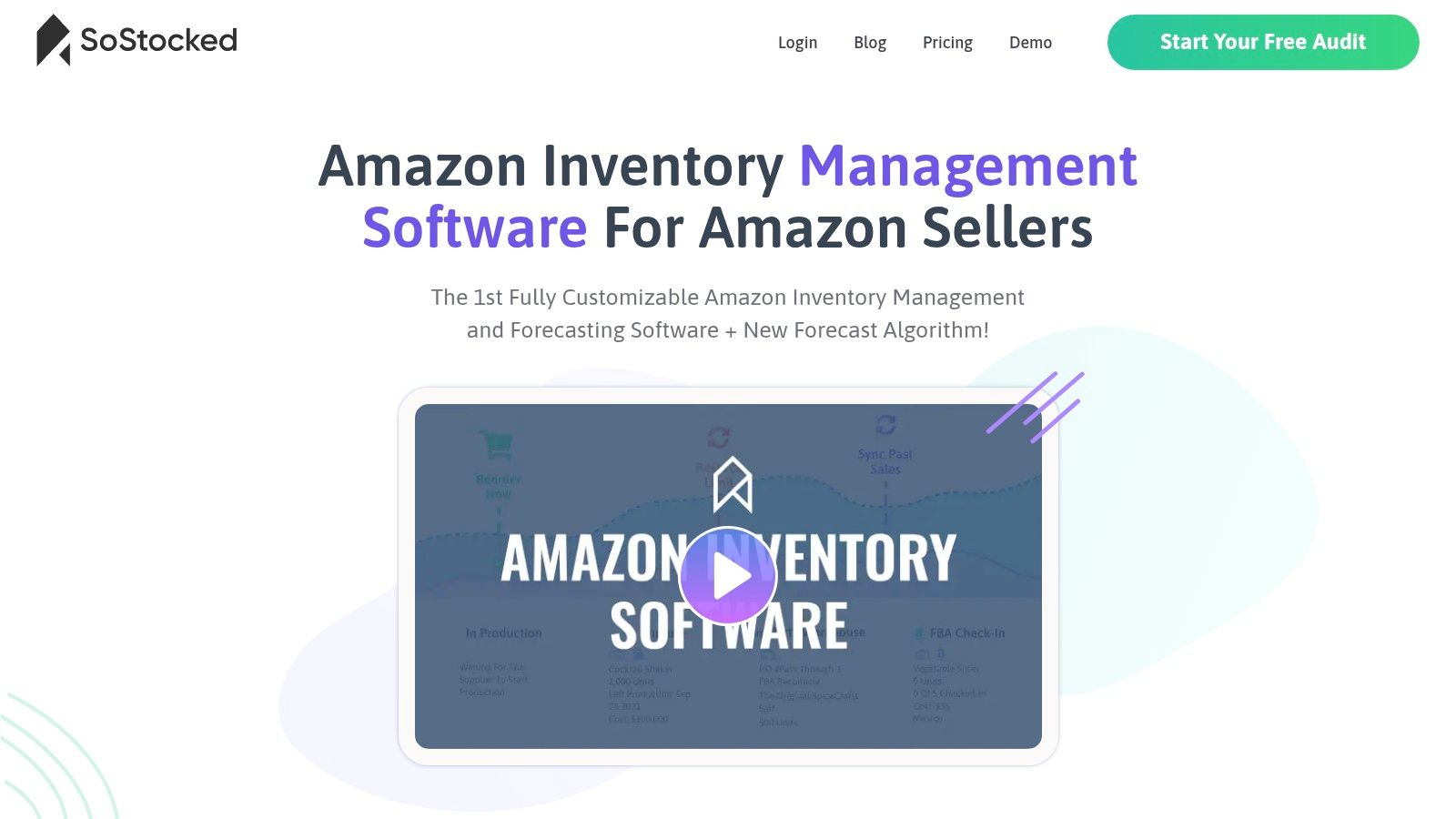
Unlike generic multi-channel systems, SoStocked’s logic is fully integrated with Amazon’s ecosystem. It accounts for seasonality, sales spikes, FBA capacity limits, and complex lead times. The onboarding process is a key feature, as it includes personalized one-on-one sessions and free data migration to make sure you’re set up correctly. This makes it one of the best Amazon inventory management software options for sellers looking for a guided transition to a more powerful tool. Learn more about SoStocked and its role in modern Amazon inventory management.
Key Information
- Best For: Private-label brands that need customizable, data-driven forecasting to optimize FBA stock levels.
- Pricing: Based on order volume; requires a demo for a custom quote.
- Pros: Deep Amazon-specific logic, excellent onboarding support, and functions across all global Amazon marketplaces.
- Cons: Primarily focused on Amazon, so it’s not a complete multi-channel solution. The order-based pricing model can be a drawback for some businesses.
2. RestockPro (eComEngine)
RestockPro by eComEngine is a well-established FBA inventory tool that simplifies demand forecasting, purchase order management, and SKU-level profitability tracking. Built specifically for Amazon sellers, it provides clear restock suggestions and makes it easier to create inbound FBA shipments. The platform is especially useful for sellers who need a straightforward, FBA-centric system without the complexity of a full multi-channel suite.
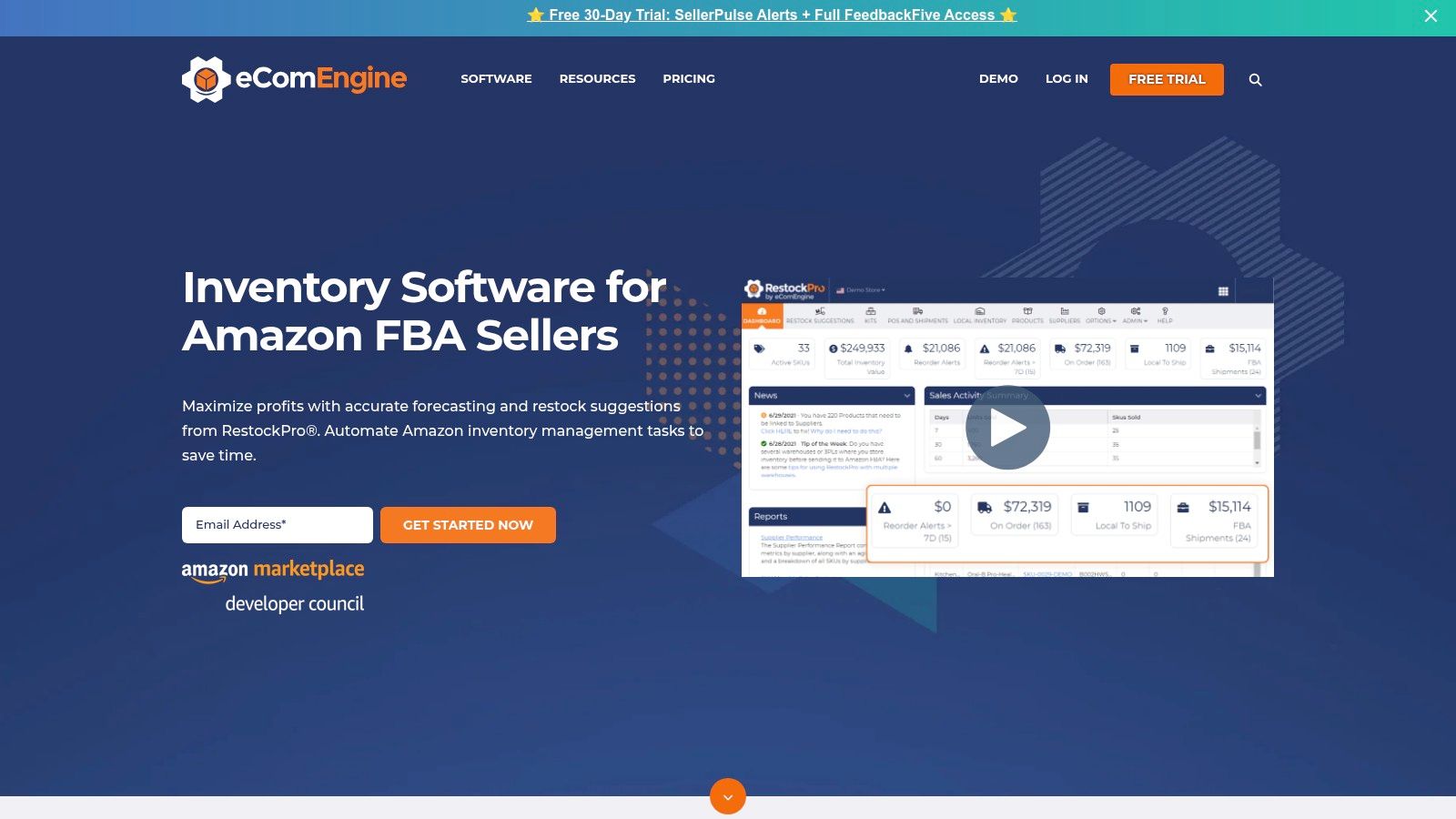
Its strength lies in automating core inventory tasks, from generating purchase orders to managing supplier lead times and creating custom product labels. For brands managing multiple storefronts or agencies handling client accounts, RestockPro offers dedicated support that simplifies operations across different seller accounts. This focused approach makes it a reliable choice among the best Amazon inventory management software for those prioritizing FBA efficiency. The platform’s emphasis on FBA-specific workflows can help sellers better understand the operational differences compared to other fulfillment methods. Learn more about how Amazon FBA vs FBM strategies influence inventory needs.
Key Information
- Best For: FBA-focused sellers and agencies needing an automated system for restock suggestions and purchase order management.
- Pricing: Tiered plans based on FBA order volume, starting at $119/month with a 21-day free trial available.
- Pros: Clear FBA focus with straightforward plans, helpful agency and multi-store support, and includes kit/bundle management.
- Cons: FBA-centric with limited depth for FBM or warehouse operations. Does not consolidate North American (NARF) or Pan-European marketplaces, requiring separate management for each.
3. InventoryLab (now included in Threecolts “Seller 365”)
InventoryLab is a classic tool for sellers who prioritize speed in their listing, labeling, and shipment creation processes. Long favored by retail and online arbitrage (RA/OA) sellers, its strength is in streamlining the workflow from sourcing to shipping. The platform simplifies batch processing, allowing you to list products and print labels efficiently, which is important for high-volume, fast-turnaround business models.
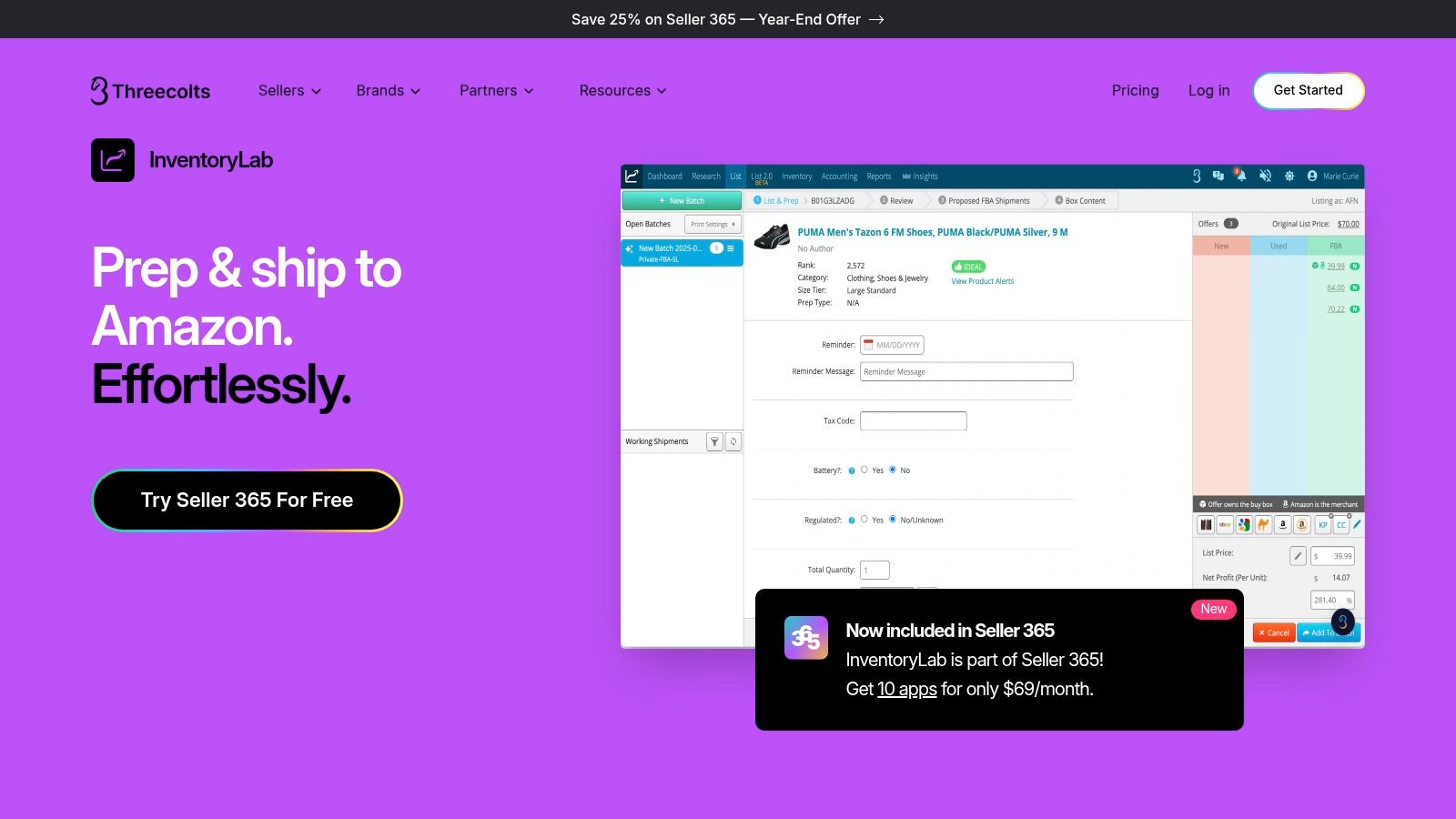
Now part of the Threecolts Seller 365 bundle, InventoryLab’s value has shifted. While it still offers excellent FBA prep tools, its most notable feature is the detailed profitability tracking, including cost of goods sold (COGS) and inventory valuation reports for accounting. This makes it one of the best Amazon inventory management software options for sellers who need accurate financial data without complex enterprise systems. You can find out more about how this simplifies the process of getting products to FBA by learning how to send products to Amazon.
Key Information
- Best For: Retail/online arbitrage sellers and small brands that need fast list-and-ship workflows and accurate COGS tracking for accounting.
- Pricing: Included in the Threecolts “Seller 365” bundle, which has its own pricing structure. It is no longer available as a standalone subscription.
- Pros: Streamlined FBA shipment creation, useful valuation and COGS reporting for accounting, and now part of a broader 10-app bundle.
- Cons: Broader inventory management and warehouse features are limited. Pricing and access are now tied to the entire Seller 365 suite.
4. Helium 10 – Inventory Management
Helium 10 is widely known as an all-in-one suite for Amazon sellers, and its Inventory Management tool brings forecasting and restock planning into that same ecosystem. This module is an excellent choice for sellers already using Helium 10’s other features, such as keyword research or PPC management, because it centralizes operations into a single familiar dashboard. It provides clear restock recommendations by analyzing sales velocity, lead times, and transfer times between warehouses.
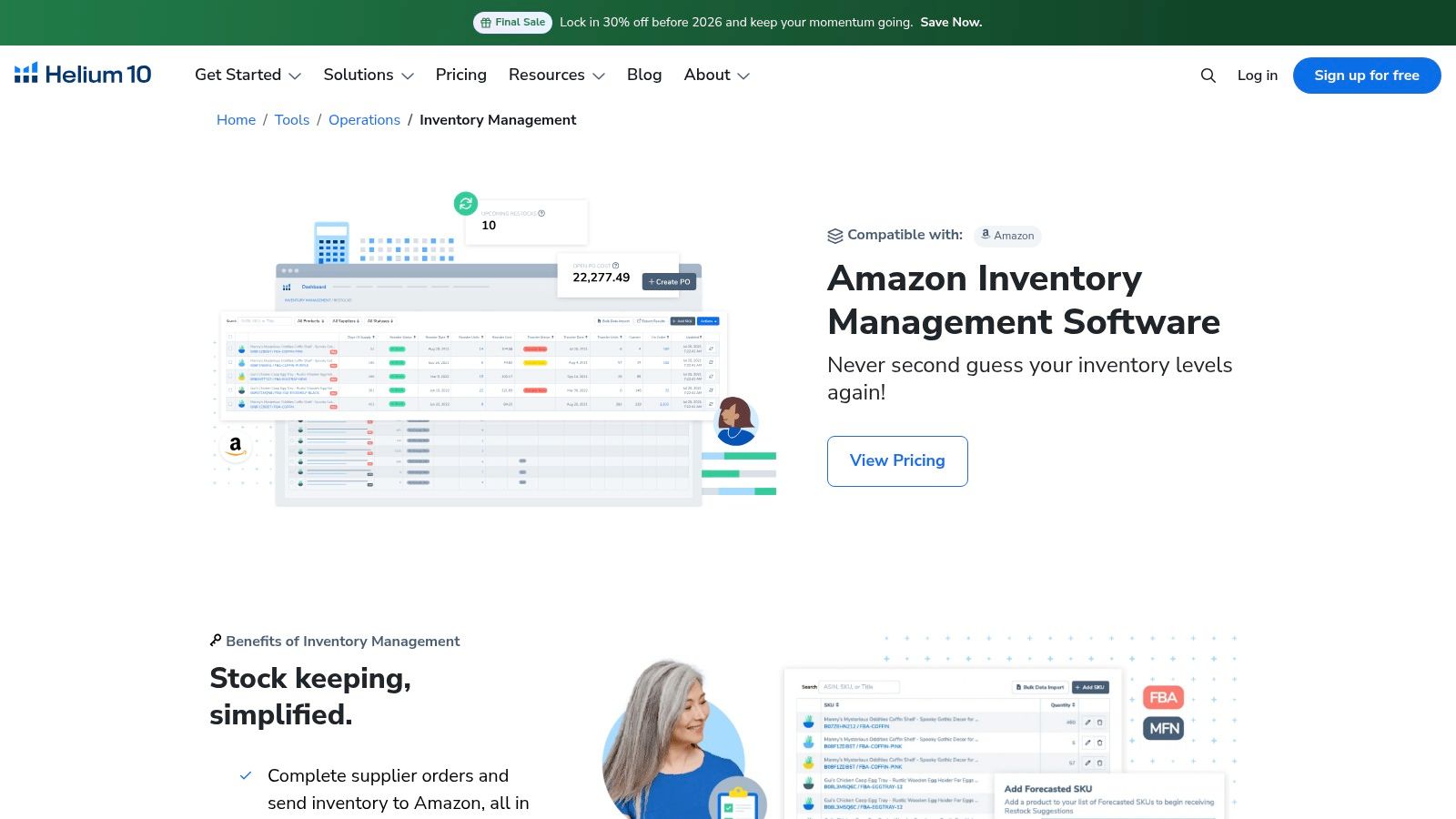
Unlike standalone tools, its value is amplified by its integration with the broader Helium 10 platform. The system supports both US and EU marketplaces and includes features for purchase order creation and supplier management. For sellers wanting a capable inventory tool without adding another subscription to their stack, this is one of the best Amazon inventory management software options available. The extensive documentation also helps users understand the forecasting methodology, a useful resource for managing the complex world of Amazon seller fees.
Key Information
- Best For: Current Helium 10 users who want to consolidate their toolset and add inventory forecasting to their existing workflow.
- Pricing: Included in Helium 10’s Platinum plan and above, starting at $39/month. Advanced features are in higher tiers.
- Pros: Seamless integration with a comprehensive suite of Amazon tools, solid documentation, and supports multi-marketplace inventory management (US & EU).
- Cons: The daily data refresh can sometimes lag behind real-time Seller Central data. Key inventory features are reserved for more expensive plans.
5. Jungle Scout – Inventory Manager
Jungle Scout is well known for its product research and keyword tools, but its built-in Inventory Manager is a valuable asset for sellers already in its ecosystem. It provides clear, actionable data for demand forecasting, reorder timing, and profitability analysis directly within the platform. The system categorizes inventory status as Reorder Now, Reorder Soon, or Overstock, helping sellers make quick decisions to maintain healthy stock levels.

Unlike standalone tools, its main advantage is the seamless integration with Jungle Scout’s broader suite of analytics. This allows sellers to connect inventory performance directly to market trends, keyword data, and competitor activity. For users who value an all-in-one solution, Jungle Scout offers one of the best amazon inventory management software experiences by combining operational tasks with market intelligence, simplifying the entire selling process from research to replenishment.
Key Information
- Best For: Existing Jungle Scout users who want an integrated inventory management solution without adding another subscription.
- Pricing: Included with Jungle Scout plans, which start at $29/month when billed annually.
- Pros: Fully integrated with Jungle Scout’s research and analytics suite, a clear dashboard for stock health, and direct sync with Amazon Seller Central.
- Cons: Primarily FBA-focused with limited features for complex operations. Access to PPC and more advanced tools requires higher-priced tiers.
6. Veeqo (an Amazon company)
Veeqo is a completely free multichannel shipping and inventory platform owned by Amazon. It provides sellers with real-time stock synchronization across multiple channels, including Amazon, Shopify, eBay, and Walmart, which prevents overselling. The platform integrates core inventory functions like purchase order management, bundling and kitting, and demand forecasting without any monthly software fees. Its business model is built around shipping, where users pay for discounted labels from major carriers.

This makes Veeqo one of the best Amazon inventory management software options for sellers focused on cost-effective multichannel fulfillment. The tool helps automate reordering with low-stock alerts and offers visibility into FBA inbound shipments and Amazon Multi-Channel Fulfillment (MCF) orders. For sellers who ship a high volume of orders across different platforms and want a unified, no-cost inventory tool, Veeqo presents an almost unbeatable value, provided they also use its shipping services.
Key Information
- Best For: Multichannel sellers looking for a free, integrated inventory and shipping solution to consolidate operations without monthly fees.
- Pricing: The software is free with unlimited users and orders; users pay for discounted shipping labels.
- Pros: No monthly software cost, deep native Amazon integration with 7-day support, and excellent value for centralizing multichannel operations.
- Cons: The feature set is tied to using its shipping services, and it lacks some of the advanced order management rules found in paid platforms. It requires an Amazon Professional seller plan to connect.
7. Sellercloud
Sellercloud is an enterprise-level platform for high-volume, multichannel sellers who need more than basic inventory tracking. It combines inventory, order, and warehouse management into a single system, offering deep control over complex operations. Its strength lies in handling large catalogs, intricate kitting and bundling, and multi-warehouse fulfillment for both FBA and FBM sellers. The system acts as a central hub for all marketplace activities, from listing creation to shipping.

Unlike simpler tools focused only on forecasting, Sellercloud provides a full solution with predictive purchasing and robust FBA restock suggestions. It is built to scale, offering extensive API access and numerous integrations to connect with your existing tech stack. This makes it one of the best Amazon inventory management software options for established businesses managing complexity across multiple channels. Adhering to strong operational systems is important, and you can explore more on this topic with these inventory management best practices.
Key Information
- Best For: High-volume, multichannel sellers with complex catalogs, kitting needs, and multi-warehouse operations.
- Pricing: Custom pricing based on business needs and order volume; requires a demo.
- Pros: Enterprise-grade breadth with extensive API and integrations, robust Amazon-specific controls for FBA and FBM workflows, and scales for high-volume operations and complex catalogs.
- Cons: Higher cost and heavier implementation than SMB tools, with a steeper learning curve for small teams.
8. Cin7 (Core and Omni)
Cin7 offers a robust inventory platform for established brands that need comprehensive stock control beyond just Amazon. Positioned as an ERP-lite solution, it excels at managing complex operations involving purchasing, light manufacturing or kitting, and multi-location warehouse controls. Its strength is in unifying inventory data across numerous channels, including Amazon, B2B, POS, and various e-commerce storefronts.

Unlike tools built solely for FBA, Cin7 is designed for businesses that view Amazon as one part of a larger sales strategy. With over 700 integrations, including deep connections with accounting software like QuickBooks and Xero, it provides a centralized system for tracking costs and profitability. This makes it one of the best Amazon inventory management software options for brands scaling their operations and requiring a single source of truth for their entire supply chain, from production to final sale.
Key Information
- Best For: Multi-channel brands with complex needs like manufacturing, kitting, or multi-location warehousing that require a powerful, centralized system.
- Pricing: Starts at $399/month, with tiers based on order volume, users, and included integrations.
- Pros: Strong ERP-like capabilities for growing businesses, an extensive ecosystem of integrations, and excellent support for complex supply chains.
- Cons: More complex and costly than Amazon-only tools, and per-plan limits on users or integrations can lead to higher costs as you scale.
9. Linnworks
Linnworks is a comprehensive CommerceOps platform for scaling multichannel sellers. It moves beyond basic inventory tracking to automate core operations, including inventory, orders, and shipping across numerous channels. Its strength is its ability to manage complexity, making it ideal for mid-market businesses operating with multiple warehouses, 3PLs, or a diverse mix of online marketplaces. The platform centralizes operations, allowing for rule-based automation that handles everything from order routing to shipping label generation.

Unlike simpler tools focused solely on FBA, Linnworks provides the infrastructure to manage both FBA and FBM (Fulfilled by Merchant) inventory from a single interface. This makes it one of the best Amazon inventory management software choices for sellers expanding beyond a pure FBA model. Its extensive library of over 100 integrations ensures it connects seamlessly with major marketplaces, shipping carriers, and ERP systems, providing a unified command center for your entire e-commerce ecosystem.
Key Information
- Best For: Mid-market to enterprise-level sellers who need robust automation for multichannel and multi-warehouse operations.
- Pricing: Quote-based pricing tailored to order volume; some advanced modules may require separate add-on costs.
- Pros: Highly scalable with powerful automation rules, proven Amazon and FBA workflows, and a large library of integrations.
- Cons: Requires a more involved implementation and onboarding process to unlock its full value, and the quote-based pricing can be less transparent.
10. Ordoro
Ordoro is a shipping-focused order management system with optional inventory and dropshipping modules, making it a flexible fit for growing merchants. Its core strength is unifying stock management across multiple sales channels while providing robust shipping automation and label generation. The platform is designed for businesses that want a single system to handle order fulfillment from start to finish, from purchase order creation to final delivery.
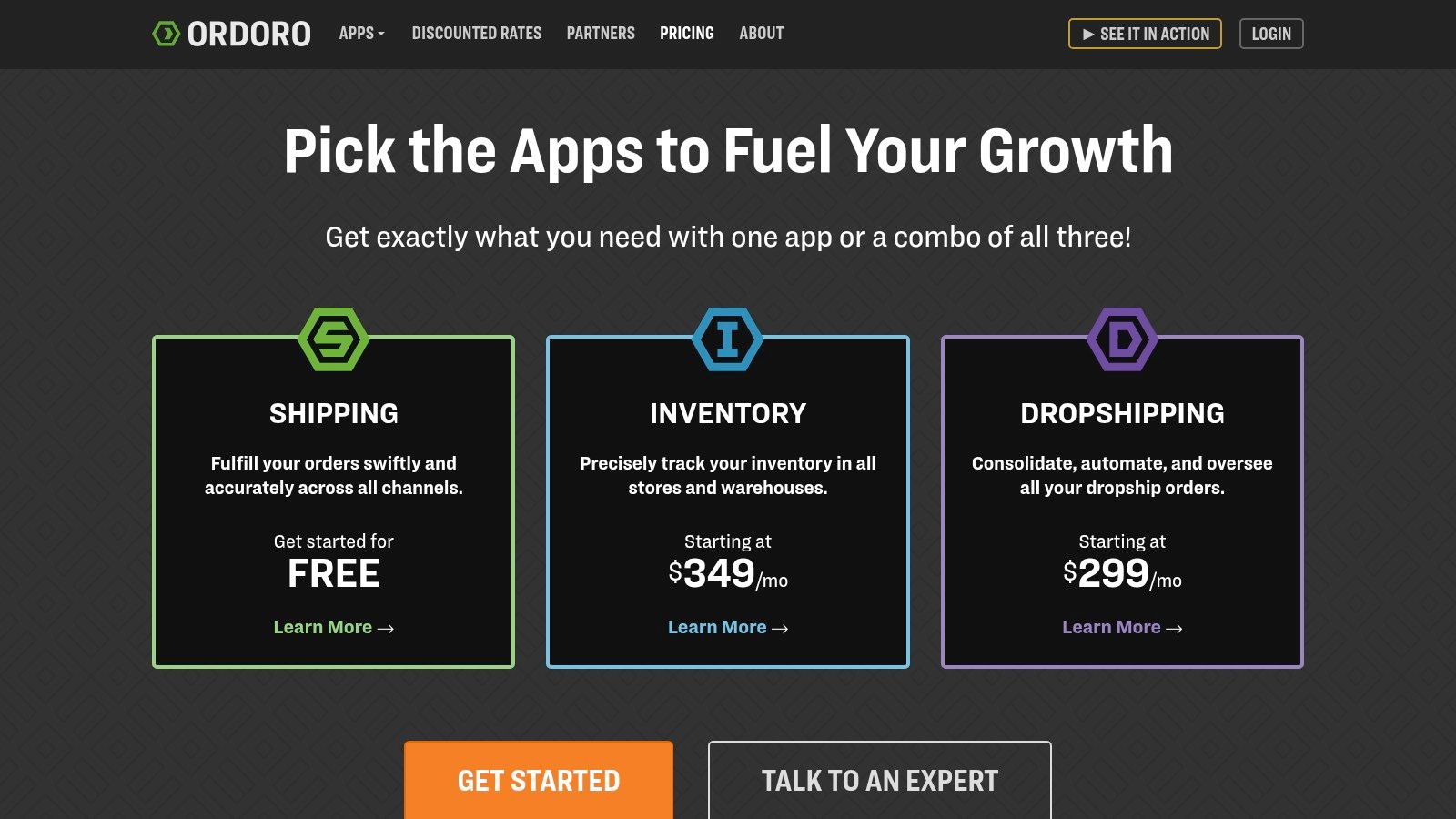
Unlike Amazon-only tools, Ordoro offers a broader multi-channel scope that includes features like kitting, bundling, and purchase order management. This modular approach allows sellers to start with its powerful shipping features and add on more advanced inventory controls as their business scales. For sellers balancing Amazon with other platforms, Ordoro is one of the best Amazon inventory management software choices because it combines logistics and stock control into a single, user-friendly interface.
Key Information
- Best For: Multi-channel sellers who prioritize efficient shipping workflows and need a scalable system to add inventory management.
- Pricing: Modular plans start at $59/month for shipping, with the advanced Inventory Management module starting at $499/month. A 15-day free trial is available.
- Pros: Modular pricing lets you add features as you grow, strong shipping automation and label generation, and a user-friendly interface.
- Cons: The inventory module has a higher price point than some basic tools, and its broader focus may lack the deep, Amazon-specific forecasting of other platforms.
11. Finale Inventory (Descartes Finale)
Finale Inventory is a comprehensive multichannel inventory management system for sellers who need robust warehouse operations alongside their e-commerce sales. Its strength lies in combining barcode-driven warehouse management (WMS) with direct Amazon FBA and FBM integration, making it ideal for brands managing their own physical stock. The platform centralizes inventory levels, preventing overselling across channels like Amazon, Shopify, and eBay.

Unlike forecasting-only tools, Finale Inventory excels at the physical aspects of stock control, including receiving, picking, packing, and shipping with barcode scanners. It supports complex workflows like multi-location transfers and kitting or bundling. For Amazon sellers, its ability to manage alias SKUs across different marketplaces is a significant advantage, simplifying operations for brands with varied listings. This focus on warehouse logistics makes it one of the best Amazon inventory management software options for businesses scaling their fulfillment operations.
Key Information
- Best For: Sellers with a physical warehouse who need barcode scanning and multi-channel synchronization for FBA and FBM.
- Pricing: Starts at $299/month for the “Starter” plan, with higher tiers based on order volume and feature needs.
- Pros: Strong warehouse management and scanning capabilities, handles multi-marketplace alias SKUs, and centralizes inventory across channels.
- Cons: Higher starting price compared to planner-only tools, and requires dedicated implementation to unlock its full potential.
12. Extensiv Order Manager (formerly Skubana)
Extensiv Order Manager is an enterprise-level platform for brands scaling across multiple warehouses, 3PLs, and marketplaces. Its core strength lies in unifying complex fulfillment operations, offering intelligent order routing and robust demand forecasting. This centralization allows growing Amazon sellers to manage inventory not just in FBA, but across their entire fulfillment network, preventing overselling and optimizing shipping costs.
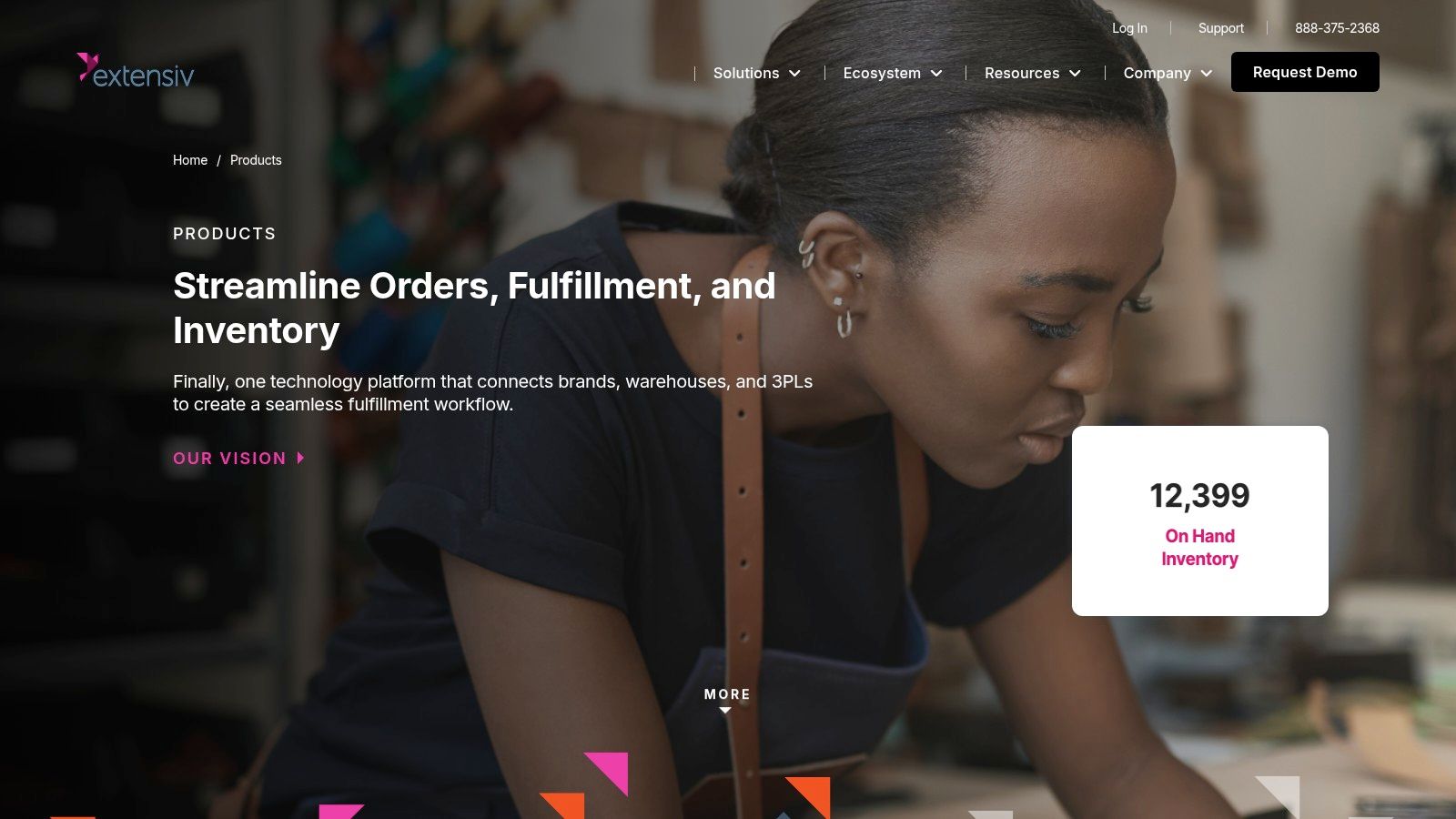
Unlike simpler tools focused only on Amazon, Extensiv provides deep connectivity with 3PLs and is part of a broader fulfillment technology suite. This makes it one of the best Amazon inventory management software solutions for businesses that require multi-node fulfillment capabilities. Its ability to automate order routing based on custom business rules ensures that orders are fulfilled from the most efficient location, reducing both shipping times and expenses.
Key Information
- Best For: High-volume sellers and brands using multiple warehouses or 3PLs that need sophisticated order routing and multi-location inventory control.
- Pricing: Quote-based and sales-led; requires a demo for a custom price.
- Pros: Excellent for complex, multi-node fulfillment strategies and is supported by a larger fulfillment tech suite for end-to-end capabilities.
- Cons: More complex and heavyweight than tools built for SMBs. Pricing is not publicly listed and requires engaging with their sales team.
Top 12 Amazon Inventory Management Software Comparison
| Product | Core features | Unique selling point | Pricing / Trial |
|---|---|---|---|
| SoStocked (by Carbon6) | Advanced forecasting, KPI alerts, PO & supplier management, overstock dashboards | Amazon‑specific logic to avoid FBA fees; 1:1 onboarding & data migration | Order‑based pricing (limited public info) |
| RestockPro (eComEngine) | Forecasting, restock suggestions, PO & inbound FBA workflows, SKU profitability | Mature FBA workflow with agency/multi‑store support | Clear plans; 21‑day free trial |
| InventoryLab (Seller 365) | FBA labeling, shipment creation, COGS & valuation, sourcing apps | Streamlined list‑and‑ship + year‑end valuation, Scoutify sourcing | Now bundled in Seller 365 (bundle access required) |
| Helium 10 – Inventory Management | Restock suggestions, PO management, inbound tracking, supplier views | Centralized with Helium 10 toolset (SEO/PPC/research) | Included in Helium 10 plans (tiered access) |
| Jungle Scout – Inventory Manager | Reorder statuses, customizable sales windows, inbound tracking, stock health | Simple stock health dashboard integrated with JS analytics | Add‑on within Jungle Scout pricing |
| Veeqo (an Amazon company) | Real‑time sync, automated reordering, bulk labels, MCF/FBA visibility | No monthly fee; unlimited users/orders — pay for labels | Free software; pay for labels and require Amazon Pro to connect |
| Sellercloud | Real‑time multichannel sync, predictive purchasing, kitting, API access | Enterprise‑grade controls for complex catalogs and FBA/FBM | Quote‑based (higher cost) |
| Cin7 (Core & Omni) | Multi‑location inventory, purchasing/MRP, POS, 700+ integrations | Strong manufacturing/kitting and accounting integrations | Per‑plan pricing with add‑ons (public tiers) |
| Linnworks | Real‑time sync, automation rules, forecasting, reporting | Robust automation and large integration library | Quote‑based pricing; module add‑ons |
| Ordoro | Multichannel sync, kitting, PO/vendor routing, shipping automation | Modular approach — start with shipping, add Inventory/Dropship | Modular pricing; 15‑day free trial |
| Finale Inventory (Descartes) | Near real‑time Amazon sync, barcode/WMS, transfers, dynamic reorder points | Strong warehouse workflows and scanning capabilities | Higher starting price (public info) |
| Extensiv Order Manager (formerly Skubana) | Centralized orders/inventory, forecasting, intelligent routing, 3PL connectivity | Robust multi‑node fulfillment and deep 3PL integrations | Quote‑based, sales‑led pricing |
Making the Right Choice for Your Amazon Store
We’ve explored a wide range of tools, from dedicated FBA forecasting platforms like SoStocked to comprehensive multi-channel systems such as Cin7 and Sellercloud. The main takeaway is that the best amazon inventory management software isn’t a one-size-fits-all solution. Your ideal choice depends entirely on your business’s current scale, complexity, and future goals.
For a new seller or a brand operating exclusively on Amazon FBA, a specialized tool like RestockPro or the inventory modules within Helium 10 and Jungle Scout offer a focused, cost-effective starting point. These platforms excel at preventing stockouts and overstocking without overwhelming you with features you don’t need yet. They provide the core functionality to manage FBA inventory, track sales velocity, and make informed restocking decisions.
However, as your brand grows, your needs will change. If you’re expanding to your own DTC Shopify store, Walmart, or managing your own warehouse (FBM), your software needs to grow with you. This is where platforms like Veeqo, Linnworks, or Extensiv Order Manager become necessary. They are built to synchronize inventory levels across multiple sales channels, manage warehouse operations, and handle complex order routing, preventing the costly mistake of selling an out-of-stock item on a different marketplace.
Actionable Steps for Choosing Your Software
Before committing to a platform, take these practical steps to ensure you make a sound investment:
- Map Your Current Workflow: Document every step of your inventory process, from ordering from suppliers to receiving at an FBA warehouse. Identify the biggest bottlenecks and time sinks. This map will highlight which software features will have the most immediate impact.
- Define Your 18-Month Goals: Are you planning to launch on Walmart? Will you add FBM or a 3PL? Choosing a tool that can support your future plans will save you from a difficult migration down the line.
- Run a Trial with Real Data: Don’t just click through a demo. Most top-tier platforms offer a free trial or a guided demo. Use it to connect your Amazon account and see how the software interprets your actual sales data. Does its forecast make sense? Is the interface easy to work with daily?
To effectively evaluate potential solutions, it’s helpful to understand the fundamental 9 Inventory Management Best Practices for Retailers that these platforms aim to support. Aligning your choice with these principles ensures your software is a strategic asset, not just a data dashboard.
Ultimately, the right software is a powerful tool, but it requires a solid operational strategy to unlock its full potential. By carefully assessing your needs and future direction, you can select a tool that not only solves today’s inventory headaches but also provides the foundation for sustainable, profitable growth.