
Selling on Amazon starts with a choice between three paths: Private Label, Wholesale, or Arbitrage. Each requires a different strategy for sourcing products and managing your budget, but the goal is the same: find a profitable product to sell to Amazon’s massive audience.
This process involves understanding market demand, calculating all the fees, and building a brand that can last.
Finding Your Niche in a Crowded Marketplace
The first question new sellers ask is, “What should I sell?” With millions of sellers, choosing a product you like isn’t enough. A successful Amazon business depends on selecting the right product and business model for your budget and goals.
The competition is significant. As of Q1 2025, there are over 9.7 million Amazon sellers worldwide. In North America alone, you’re competing with roughly 1.1 million active sellers. Success comes from finding a small, defensible market segment you can own, not just entering the most popular categories.
1. Choosing Your Amazon Business Model
Before thinking about products, you need to decide how you’ll sell. This choice affects everything from your initial investment to your daily tasks.
Here is a breakdown of the three main business models on Amazon.
Amazon Business Model Comparison
| Business Model | Initial Investment | Profit Margin | Best For |
|---|---|---|---|
| Private Label | $3,500+ | 30-40% | Entrepreneurs who want to build a long-term, sellable brand asset. |
| Wholesale | $1,500 – $3,000 | 15-25% | Sellers focused on logistics and volume, not brand creation. |
| Arbitrage | $500 – $1,000 | 10-20% | Beginners looking to learn the ropes with minimal financial risk. |
Private Label involves creating your own brand from scratch. Wholesale is about selling established brands in high volume. Arbitrage is about finding discounted products and reselling them for a profit, which is a good way to learn the platform without a large investment.
If you’re looking for ideas on what kinds of products fit these models, our guide on what products sell best on Amazon is a helpful resource.
2. Product Research
The old method of finding a “high-demand, low-competition” product is no longer effective. Today, product research is about identifying weaknesses in an existing market. To find your place, you need to conduct competitor analysis thoroughly.
Tools like Jungle Scout or Helium 10 are essential for this. They help you find real opportunities, not just “good” products.
You can use a tool’s Opportunity Finder to filter for niches with high customer demand but are served by mediocre products.
This data shows you keywords with high search volume where the top sellers have poor reviews or low-quality photos. That’s your opportunity.
Specifically, look for markets where the top sellers have:
- Poor Reviews: Look for consistent complaints like “The zipper breaks,” “it doesn’t fit,” or “the color is off.” These are not just bad reviews; they are instructions on how to improve your product.
- Weak Listings: If their photos are blurry, their title is stuffed with keywords, or their bullet points are unconvincing, you can outperform them with better copywriting and professional images.
- Inconsistent Stock: If top sellers frequently run out of inventory, they lose sales and ranking. This creates an opening for a reliable seller to enter the market.
Finally, always calculate the costs. Use Amazon’s FBA Revenue Calculator to input your sourcing costs, shipping estimates, and the prices of competing products. Remember to account for FBA fees, storage costs, and a launch budget for PPC ads. If you can’t achieve a potential profit margin of at least 25-30%, the risk may not be worth it.
Amazon Account and Fulfillment
Correctly setting up your Seller Central account from the beginning will save you from future problems. This isn’t just about paperwork; it’s about building the operational foundation for your business. A mistake here can lead to an account suspension before you make your first sale.
Your first decision is between an Individual and a Professional seller account. This choice often comes down to simple math.
The Individual plan has no monthly fee, but you pay $0.99 for every item you sell. The Professional plan costs $39.99 per month with no per-item fee. If you plan to sell more than 40 items a month, the Professional plan is more economical.
The Professional plan also gives you access to essential tools, like the ability to win the Featured Offer (the “Buy Box”), run ads, and use advanced inventory management features.
1. Account Verification
Amazon’s verification process is strict because they need to confirm your identity. Having all your documents ready and correctly formatted is a requirement.
Here’s what you’ll need:
- Government-Issued Photo ID: A passport or driver’s license is best. The name on the ID must match the name on your seller account exactly.
- Bank Account Statement: This must clearly show your name and address, which must also match what you provided during registration. Even small discrepancies, like “St.” instead of “Street,” can cause rejection.
- A Valid Credit Card: Amazon uses this to charge monthly fees and other selling costs. They often do not accept debit cards for this purpose.
Ensure your scanned documents are high-resolution, in color, and show all four corners. Any blurriness or cropping will likely get your application rejected.
To become familiar with the dashboard, our guide on what is Amazon Seller Central can provide a good overview.
2. Fulfillment: FBA vs. FBM
Once your account is approved, you must decide how to get products to your customers. This is the choice between Fulfillment by Amazon (FBA) and Fulfillment by Merchant (FBM).
With Fulfillment by Amazon (FBA), you ship your inventory to an Amazon warehouse. Amazon then handles picking, packing, and shipping for each order, as well as most customer service and returns. The main benefit is that your products automatically become eligible for the Prime badge, which can significantly increase sales.
With Fulfillment by Merchant (FBM), you manage everything yourself. You store the inventory, pack orders, and ship them directly to the customer. You also handle all customer inquiries and returns. This model offers more control but also places the entire operational burden on you.
Seller Insight: Choosing FBA is often a strategic move to leverage customer trust. The Prime badge is associated with fast, reliable shipping and Amazon’s A-to-z Guarantee, which can lead to higher conversion rates, even at a slightly higher price.
This decision affects your brand’s perception and sales velocity. FBA sellers typically have an advantage in winning the Featured Offer because Amazon guarantees the delivery experience.
However, FBM can be more cost-effective for large, heavy, or slow-moving items where FBA storage fees could be high.
How to Source Products
Your sourcing strategy is the engine of your business, but the fuel differs for every model. You cannot use a “one-size-fits-all” approach; a Private Label seller needs a factory, while a Wholesale seller needs a distributor. Below is the exact roadmap of where to look for each specific business model to ensure you find profitable, legitimate inventory.
1. Amazon Private Label
You are the brand owner creating a unique product. You need a manufacturer who can produce goods in bulk and apply your logo. You are looking for factories, not middlemen.
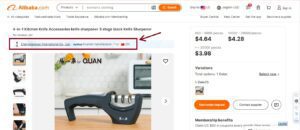
- Alibaba.com: The primary source for most sellers. Connects you with Chinese manufacturers. Tip: Filter by “Trade Assurance” and “Verified Supplier” to avoid scams.
- GlobalSources.com: Often has higher quality standards than Alibaba; excellent for sourcing electronics and fashion.
- 1688.com: The domestic Chinese version of Alibaba. Prices are often 15-20% lower, but the site is in Chinese and you will need a “Sourcing Agent” to handle payment and shipping.
- ThomasNet.com: The best directory for finding “Made in USA” manufacturers.
- Competitor Reverse Engineering: Use tools like Jungle Scout or Helium 10 (Supplier Database) to see exactly which factory your top competitors are importing from.
2. Amazon Wholesale
You are reselling established brands (e.g., Lego, Dove, Sony). You must buy from the brand itself or their authorized distributors to get a valid invoice that Amazon accepts. Do not source these from Alibaba.
- Google Search Strings: Search [Brand Name] + “authorized distributor” or [Brand Name] + “wholesale application”.
- Trade Shows: Attend ASD Market Week (Las Vegas) or NY NOW. This is the most efficient way to open wholesale accounts face-to-face.
- LinkedIn: Search for the “National Sales Manager” or “Regional Sales Rep” of the brand you want to sell. Message them directly to ask for a wholesale account application.
- SaleHoo: A paid directory that vets wholesalers to ensure they are legitimate.
- Wholesale Central: A free B2B directory to find lists of distributors by category.
3. Retail Arbitrage (RA)
You are capitalizing on price differences between physical retail stores and Amazon. You source by physically visiting stores and scanning clearance items.
- Big Box Clearance:
Walmart: Check “Hidden Clearance” aisles near the Garden Center and Electronics. - Target: Look for “End Caps” (shelves at the end of aisles) with red clearance stickers.
Off-Price Retailers: - TJ Maxx / Marshalls / Ross: Source branded sneakers, toys, and beauty products here.
- Ollie’s Bargain Outlet: Buy out discontinued stock in bulk.
You cannot source products without scanning. Use the Amazon Seller App (Free) or ScoutIQ (Paid/Speed) to scan barcodes. Only buy if the app shows you are eligible to sell the item and the profit margin is over 30%.
Create High Converting Product Pages
A great product with a mediocre listing won’t sell. On Amazon, your product listing acts as your 24/7 digital salesperson, convincing shoppers to click “Add to Cart.” A weak listing undermines all your previous efforts.
The goal is to create a page that immediately solves a customer’s problem. Amazon Marketplace sellers have surpassed $2.5 trillion in cumulative sales, making the competition intense. A high-converting listing is what sets top sellers apart.
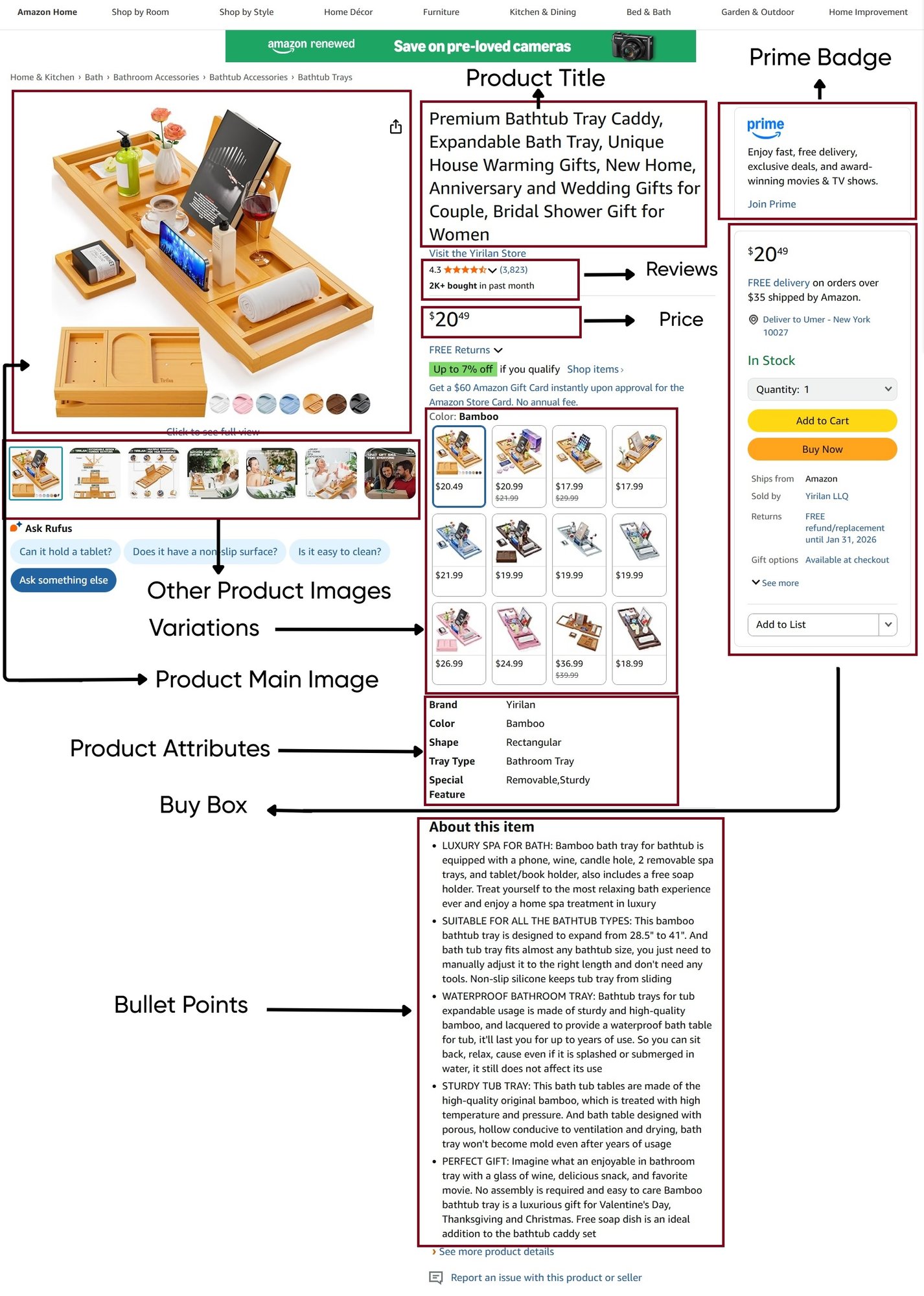
1. Title Is Everything First
Your product title is the most important part of your product page. It’s the first thing shoppers see in search results and heavily influences Amazon’s A9 search algorithm.
You need to balance keywords for the algorithm with readability for customers.
A common mistake is to stuff the title with keywords, making it unreadable. A better approach is to place your most important keyword phrase at the beginning.
Seller Tip: Put your main keyword and the product’s biggest benefit within the first 80 characters. This is important because longer titles are cut off on mobile devices, where much of Amazon’s traffic originates.
For example, don’t write:
Stainless Steel Coffee Mug, 16oz Insulated Travel Tumbler, Double Wall Vacuum Sealed, Hot and Cold Drinks, Leakproof Lid, BPA Free, for Men Women, Blue
Instead, write:
Insulated Coffee Travel Mug (16oz) by [Brand Name] - Keeps Drinks Hot for 12 Hours, Leakproof Stainless Steel Tumbler, Blue
The second version is cleaner, highlights the main benefit immediately, and is easier to read on a phone.
2. Use Bullet Points to Answer Questions
Your five bullet points should function as a quick Q&A session. Shoppers clicked on your listing because the title and image caught their attention; now, your bullets need to answer their questions.
Don’t just list features; explain what the product does for the customer.
- Feature: “Made with 18/8 stainless steel.”
- Benefit: “Rust-Proof & Flavor-Free: Built with food-grade 18/8 stainless steel, so your coffee always tastes like coffee, not like yesterday’s tea.”
Each bullet point should address a potential concern or highlight a key selling point. Mention the material, dimensions, usage, and what’s included in the box. This builds trust and prevents customers from leaving for a competitor’s page. For more details, see our complete guide on Amazon listing optimization.
3. Let Visuals Do the Talking
Visuals are critical. No matter how good your copy is, poor images will result in a low conversion rate. Your photos and videos must demonstrate your product’s value.
Here is a visual strategy to follow:
- The Main Image: This must be on a pure white background and adhere to all of Amazon’s technical guidelines. Its purpose is to be clear and stand out in search results.
- Lifestyle Images: Show your product in use in a real-world context. If you’re selling a yoga mat, show someone using it in a studio. This helps shoppers visualize themselves using your product.
- Infographics: Use these to visually highlight key features and benefits. An infographic can convey information like dimensions or materials more quickly than text.
- Product Video: A short, 30-60 second video can be a powerful conversion tool. It can demonstrate how the product works, showcase its quality, and create an emotional connection.
4. Tell Story with A+ Content
If you are brand-registered, A+ Content allows you to turn your product description into a visually appealing mini-landing page. It’s located further down the listing and is where serious buyers look for final answers.

Use A+ Content to:
- Share your brand’s story and mission.
- Create comparison charts to upsell or cross-sell other products.
- Show detailed use-cases or instructions.
- Visually explain complex features.
A well-designed A+ Content layout looks professional, builds brand trust, and can persuade hesitant shoppers to make a purchase.
Amazon Product Launch Strategy
The first 30 days on Amazon are crucial. This is your opportunity to build the sales momentum needed for long-term success. A weak launch can lead to a difficult struggle for visibility, while a strong one can create a positive cycle of sales, reviews, and higher organic rankings.
A successful launch is not a single event but a series of strategic actions designed to get your product noticed by the Amazon algorithm.

The goal is to achieve the “flywheel effect.” Early sales and reviews signal to Amazon that your product is relevant, which improves your organic rank. A better rank leads to more visibility and sales, which in turn generates more reviews.
1. Using PPC Drive Initial Sales
Amazon Pay-Per-Click (PPC) is the most important tool for generating initial sales before you have any organic ranking. Launching in 2024 without an ad budget is like opening a store with no sign.
Your initial PPC strategy should include two campaigns running simultaneously:
- The Automatic Campaign: Let Amazon handle the initial targeting. Set a budget, and Amazon will show your ad for search terms it deems relevant. Use this as a discovery phase. After a week or two, you will receive a search term report with the actual queries customers used to find and buy your product.
- The Manual Campaigns: Use the data from your automatic campaign to create manual campaigns. You can pull the best-performing keywords from the report and target them directly. This allows you to set specific bids on converting search terms and focus your ad spend effectively.
Many sellers make the mistake of starting with a manual campaign, which amounts to guessing which keywords will work. The auto-to-manual approach uses real data to identify what your customers are searching for.
2. Getting Your Launch Price Just Right
During a launch, your price is a tool to drive initial sales. It’s a common and effective strategy to launch with a lower introductory price for the first few weeks.
The goal is not to start a price war but to set a price that encourages shoppers to take a chance on a new product with no reviews. The lower price reduces their perceived risk.
Seller Insight: A good rule of thumb is to price your product about 10-15% below your intended long-term price. This can significantly boost your initial conversion rate, a metric Amazon’s algorithm monitors closely.
Once you have a few positive reviews and steady sales, you can gradually increase the price to your target.
3. How to Get Your First Reviews (The Right Way)
Reviews are essential for social proof and convincing shoppers to buy. Amazon has strict rules about how sellers can obtain reviews, so you must use compliant methods to avoid risking your account.
Your best and safest options for getting early reviews are:
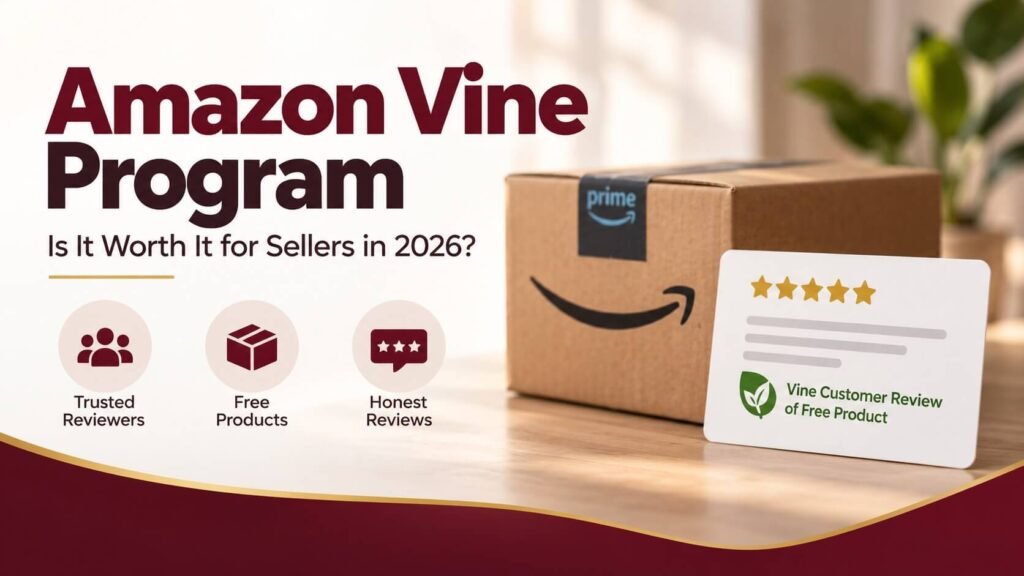
- Amazon Vine: If you are Brand Registered, you can enroll your product in the Vine program. Amazon will send up to 30 units of your product to trusted reviewers called “Vine Voices” for free. They are encouraged to leave an honest review, which will have a special “Vine Voice” badge for added credibility.
- The “Request a Review” Button: In Seller Central, on each order detail page, there is a “Request a Review” button. Clicking it sends a standardized, Amazon-approved email to the customer asking for a product review and seller feedback. The response rate is not high, but it is a compliant and free way to request reviews.
Combining smart PPC, strategic pricing, and compliant review generation creates a foundation for a successful launch. For more detailed information, see our complete guide on how to execute a powerful Amazon product launch.
Scaling Your Business and Managing Operations
After your first sale, the real work of building a sustainable business begins. This involves transitioning from launching a product to managing a business, optimizing operations for the long term.
You’ll need to monitor your store’s key metrics, make data-driven decisions, and plan for expansion.

1. Inventory Management
Running out of stock can quickly halt your momentum. A stockout leads to a drop in sales rank, paused PPC campaigns, and lost customers to competitors.
Smart inventory management is a key part of your business strategy.
Your Inventory Performance Index (IPI) score in Seller Central is a crucial metric. This number, from 0 to 1,000, reflects how well you manage your FBA inventory. Amazon uses it to set your storage limits for the next quarter. If your score falls below the threshold (usually around 400), your ability to send in new inventory could be restricted.
Here’s a look at the IPI dashboard in Seller Central.
It shows your excess inventory, sell-through rate, stranded inventory, and in-stock inventory, all of which contribute to your IPI score.
To maintain a high IPI and keep products in stock:
- Calculate Your Reorder Point: Use a formula that includes your supplier’s manufacturing lead time, shipping time, and average daily sales. For example, if it takes 45 days to receive new stock and you sell 10 units per day, you need to reorder when you have at least 450 units left, plus a safety buffer.
- Address Stranded Inventory Immediately: This is inventory in a warehouse that cannot be sold due to a listing error or other issue. Fix these problems as soon as they appear to avoid paying storage fees on unsellable products.
- Liquidate Excess Inventory: If a product isn’t selling, don’t let it accumulate long-term storage fees. Be decisive: run a sale, increase ad spend to clear it out, or create a removal order.
2. Key Performance Metrics
Seller Central provides data on your business’s health. Beyond the IPI score, you should regularly check other critical numbers.
Tracking the right numbers gives you an objective view of your store’s performance. Here are the essentials to watch.
| Metric | What It Measures | Why It Matters |
|---|---|---|
| Unit Session Percentage | The number of units purchased divided by the number of sessions (visits). | This is your conversion rate. A low rate may indicate problems with your listing, price, or reviews. |
| Order Defect Rate (ODR) | The percentage of orders with negative feedback, A-to-z claims, or credit card chargebacks. | Must be kept under 1% to avoid account suspension. It directly measures customer satisfaction. |
| Pre-Fulfillment Cancel Rate | The percentage of FBM orders you cancel before shipping. | For FBM sellers, this needs to stay below 2.5%. High rates suggest inventory tracking issues. |
These metrics provide quantitative data, but qualitative feedback from customer reviews, questions, and returns is also important for product improvement.
3. Scaling Strategies
Once your first product is consistently profitable, it’s time to expand. Scaling on Amazon means building a lasting brand, not just selling more units.
The number of sellers with over $1 million in annual sales is expected to grow from around 60,000 in 2021 to over 100,000 by 2025. You can find more discussions on this growth on Amazon’s seller forums. These sellers are building real brands.
Here are a few ways to expand:
- Expand Your Product Line: Use customer feedback and sales data to launch complementary products. If your bestseller is a yoga mat, consider adding yoga blocks, towels, or carrying straps. This increases brand loyalty and customer lifetime value.
- Enter International Markets: Amazon makes it easy to sell in other marketplaces like Canada, the UK, or Germany. The tools are available in Seller Central, but research demand in those regions before expanding.
- Advance Your Advertising: If you have Brand Registry, move beyond basic Sponsored Products ads. Use Sponsored Brands to create headline ads at the top of search results and Sponsored Display to retarget shoppers who viewed your product but didn’t buy.
Got Questions?
Let’s address some of the most common ones from new sellers.
1. How Much Does It Really Cost to Start Selling on Amazon?
The cost depends on your chosen business model. You don’t need a fortune, but starting with a very small amount is unrealistic.
For Retail Arbitrage, you can start with $500 to $1,000. This covers initial inventory and shipping supplies and is the most affordable way to learn the platform.
A Wholesale model requires more capital, typically between $2,000 and $5,000, to meet minimum order quantities from distributors.
Launching a Private Label brand is the most expensive option. A realistic starting budget for 2024 is $3,500 to $7,500+. This covers your first inventory order, professional photos, a PPC launch budget, and brand registration fees. For a detailed breakdown of costs, see our guide on how much it costs to sell on Amazon.
2. How Long Until I’m Actually Making a Profit?
Patience is key. It’s a long-term endeavor.
- Arbitrage sellers often see profits the fastest, within 30-60 days, due to the short buy-and-sell cycle.
- Wholesale sellers usually need 3-6 months to build supplier relationships and increase sales volume.
- Private Label sellers are in it for the long haul. It can take 6 to 12 months to become consistently profitable after factoring in product development, manufacturing, shipping, and launch costs.
3. What Are the Biggest Mistakes New Sellers Make?
Learning from others’ mistakes can help you avoid them. Here are common pitfalls for new sellers:
- Picking a Hyper-Competitive Product: Avoid entering categories dominated by sellers with thousands of reviews, like garlic presses or yoga mats. Find a niche instead.
- Ignoring PPC (or Not Budgeting for It): You must have a dedicated ad budget to gain initial sales velocity. Launching organically is not feasible in today’s market.
- Running Out of Stock: This harms your sales rank. Regaining your position in search results after a stockout is difficult.
- Not Understanding the Fees: FBA fees, storage fees, and referral fees add up. Calculate your true profit margins before ordering inventory to avoid losing money on each sale.