
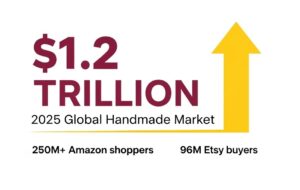
The handmade marketplace exceeded $1.2 trillion globally in 2025, yet most artisans struggle to capture even a fraction of this opportunity. The difference between thriving sellers and those who close shop within their first year often comes down to one critical decision: choosing the right platform.
Amazon Handmade and Etsy represent two fundamentally different paths to market. One offers the unparalleled reach of 250+ million active shoppers and the infrastructure of the world’s most sophisticated e-commerce engine. The other provides a curated community of buyers who specifically seek handmade goods and are willing to pay premium prices for authentic craftsmanship.
This isn’t a question of which platform is objectively better. It’s about understanding which marketplace infrastructure aligns with your production capabilities, business model, and growth objectives. After analyzing seller data from thousands of artisans across both platforms, the patterns are clear: success follows strategic fit, not conventional wisdom.
Differences Between Amazon Handmade and Etsy
Amazon Handmade and Etsy represent fundamentally different approaches to selling handmade goods online. These differences go far deeper than fees or audience size, they reflect contrasting philosophies about what online marketplaces should be and how artisans should build their businesses.
1. Amazon Handmade Marketplace
Amazon Handmade launched in 2015 as a curated section within Amazon’s massive retail ecosystem. It’s designed for artisans who want to plug into Amazon’s infrastructure: FBA warehousing, Prime eligibility, sophisticated PPC advertising, and access to shoppers who value convenience and fast shipping above all else.
The platform’s philosophy centers on operational efficiency. Your products sit alongside millions of other items, competing primarily on price, reviews, Prime eligibility, and conversion metrics.
Amazon’s A10 algorithm doesn’t care about your brand story; it cares about whether shoppers click, buy, and don’t return items.
Think of Amazon Handmade as selling in a massive shopping mall. You get incredible foot traffic, but your booth looks similar to everyone else’s, and shoppers are often just passing through on their way to buy something completely different.
2. Etsy Marketplace
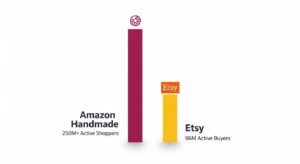
Etsy, founded in 2005, built its reputation as the destination for unique, handcrafted, and vintage items. With 96 million active buyers in 2025, it’s significantly smaller than Amazon, but these buyers specifically came looking for handmade goods.
Etsy’s philosophy emphasizes storytelling, community, and the human touch behind each product. The platform encourages direct seller-buyer communication, customization requests, and building long-term customer relationships. Shop customization options, detailed About pages, and social integration help you create a memorable brand identity.
If Amazon Handmade is a shopping mall, Etsy is an artisan market where shoppers stroll leisurely, chat with makers, and expect to find one-of-a-kind items with personal stories attached.
Breaking Down the Cost of Selling on Each Platform
Understanding true profitability requires calculating your contribution margin at multiple levels, not just looking at referral fees. Most new sellers make the mistake of comparing only the headline percentages without factoring in all the hidden costs, payment timing, and how different fee structures impact various business models.
Let’s examine the complete cost picture for both platforms, including the often-overlooked expenses that can make or break your profit margins.
1. Amazon Handmade Fee Structure
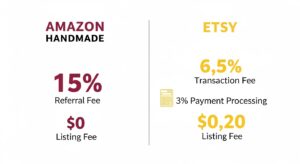
Amazon keeps its fee structure straightforward with a single referral fee and no hidden listing costs. You pay 15% on the total sale price, which includes both the item price and any shipping fees you charge.
There are no listing fees, so you can add as many products as you want to your catalog without worrying about upfront costs.
The Professional Seller subscription, which normally costs $39.99 per month, is completely waived for approved Handmade sellers.
Basic fee example: For a $50 product with $8 shipping (total $58), Amazon takes $8.70 in fees (15%), leaving you $49.30 before fulfillment or advertising costs.
However, there are additional costs to consider. If you use Fulfillment by Amazon (FBA), which is highly recommended for achieving Prime eligibility and better search rankings, you’ll pay fulfillment fees based on product size and weight.
Storage fees accumulate monthly based on cubic footage your inventory occupies in Amazon’s warehouses. Long-term storage fees kick in for items sitting over 365 days. Advertising costs through Amazon PPC are often essential for achieving good search rankings, and successful sellers typically allocate 15-25% of revenue to advertising campaigns.
Finally, payment holds mean your funds are released 3-5 days after shipment confirmation, which affects cash flow planning.
2. Etsy Fee Structure
Etsy’s fee structure involves multiple smaller charges that add up across each transaction. Understanding all these components is crucial for accurate pricing.
You’ll pay $0.20 to list each item, and this fee renews every four months whether the product sells or not. If you have multiple quantities of the same item, you pay the listing fee again each time one sells.
The transaction fee is 6.5% of the total sale price, which includes not just the item price but also shipping costs and even gift wrapping charges. Payment processing fees vary by country but typically run around 3% plus $0.25 for U.S. sellers, calculated on the full amount the customer pays.
Fee breakdown for a $50 product with $8 shipping (total $58):
- Transaction fee: $3.77 (6.5%)
- Processing fee: $1.99 (3% + $0.25)
- Listing fee: $0.20
- Total fees: $5.96, leaving you $52.04
But there’s more to consider. Once your shop makes over $10,000 in annual sales, you’re automatically enrolled in Etsy’s Offsite Ads program. This is mandatory, not optional.
If a customer clicks an ad for your product on Google, Facebook, or other sites and then makes a purchase, Etsy charges an additional 12-15% fee on that sale.
For shops under $10,000 annually, the fee is 15%; for those over $10,000, it’s 12%. The optional Etsy Plus subscription costs $10 per month and provides enhanced shop features like custom shop layout, business card designs, and restock notifications.
3. Calculating Your Real Profit Margins
To truly understand profitability, you need to calculate contribution margins at three levels. Let’s use that $58 sale with $15 in material costs, $5 in labor costs (simplified), and $8 in actual shipping costs.
Amazon Handmade profitability:
- CM1 (Revenue – Product Costs): $58 – $28 = $30 (51.7% margin)
- CM2 (CM1 – Platform Fees): $30 – $8.70 = $21.30 (36.7% margin)
- CM3 (CM2 – Advertising at 15%): $21.30 – $8.70 = $12.60 (21.7% final margin)
Etsy profitability:
- CM1 (Revenue – Product Costs): $58 – $28 = $30 (51.7% margin)
- CM2 (CM1 – Platform Fees): $30 – $5.96 = $24.04 (41.4% margin)
- CM3 (CM2 – Advertising at 15%): $24.04 – $8.70 = $15.34 (26.4% final margin)
The data shows Etsy provides higher profit percentages, but Amazon’s higher conversion rates, typically 2-3x standard e-commerce rates can generate more absolute dollar profits despite lower margins.
Audience Size and Buyer Intent
Getting your products in front of the right buyers is everything. A massive audience means nothing if those shoppers aren’t looking for what you sell.
This represents the fundamental difference when comparing Amazon Handmade versus Etsy. One platform offers sheer volume, while the other provides a highly targeted community with specific shopping intent.
Understanding these audience differences helps you predict conversion rates, pricing flexibility, and the amount of effort required to achieve consistent sales.
1. Amazon’s Massive Customer Base and Shopping Behavior
Amazon Handmade taps into Amazon’s ecosystem of 250+ million active customers globally. These aren’t casual browsers, they’re committed buyers with saved credit cards, active Prime memberships, and purchase decisions measured in minutes rather than days.
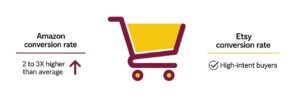
The conversion advantage is substantial, with Amazon shoppers converting at 2-3x the rate of typical e-commerce traffic. When they search “leather wallet,” they’re ready to buy within the next 24-48 hours.
However, there’s a significant challenge to consider. Most Amazon shoppers aren’t specifically seeking handmade goods. Your artisanal leather wallet competes directly with mass-produced options from established brands. Unless you optimize for Prime eligibility, accumulate reviews quickly, and achieve strong search rankings through a combination of organic optimization and PPC advertising, you’ll struggle to gain traction.
Amazon Handmade captures only 0.3-0.8% of handmade-specific search traffic, meaning most Handmade sellers rely heavily on Amazon PPC advertising for adequate product exposure.
Success requires combination of Amazon SEO and PPC to get more rankings and sales.
2. Etsy’s Focused Buyer Community
Etsy’s 96 million active buyers specifically seek handmade, personalized, and unique items. They understand that handmade products take time to create, expect to communicate with sellers about customization options, and typically accept premium pricing for quality craftsmanship and authenticity.
The search intent difference between platforms is striking. An Etsy shopper searching “leather wallet” more commonly searches “handmade vegetable tanned leather wallet with personalized initials.” These long-tail searches indicate high purchase intent and willingness to pay for specific features that mass-produced items cannot offer.
Etsy captures 2.9-8.4% of handmade-specific search traffic, significantly higher than Amazon Handmade.
The platform is specifically designed for browsing and discovery through curated collections, personalized recommendations, and category-specific showcases. The algorithm rewards listing quality, customer engagement metrics, and comprehensive shop policies rather than just sales velocity.
Etsy shoppers also invest more time in their research process. They read complete product descriptions, examine multiple product photos from different angles, thoroughly check shop reviews and policies, and frequently message sellers with detailed questions before purchasing.
Platform-Specific Customer Demographics
Amazon Handmade attracts customers who value convenience and fast shipping above all else. They trust Amazon’s established return policy and customer service infrastructure.
These shoppers make quick purchase decisions, are less likely to request customization, and expect Prime-level service standards including two-day shipping and hassle-free returns.
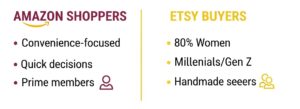
Here is Etsy’s typical customer profile:
- 80% women, primarily Millennials and Gen Z
- Actively seeking unique gifts and personalized items for special occasions
- Willing to wait longer for custom work
- Highly value supporting small businesses and independent artisans
- Actively engage with brand stories and creative processes
These buyers often become repeat customers and brand advocates when they have positive experiences, creating higher lifetime customer value compared to Amazon’s more transactional buyer relationships.
Application and Approval Processes
The barrier to entry differs dramatically between these platforms. Understanding what’s required upfront helps you plan your timeline and set realistic expectations for when you can start making sales.
1. Amazon Handmade’s Rigorous Vetting Process
Getting approved for Amazon Handmade requires passing through a multi-step verification process designed to ensure only genuine artisans join the platform.
First, you need an Amazon Professional Seller account. During your first month, you’ll pay the $39.99 monthly subscription fee, which gets waived after your Handmade application is approved.
The Handmade application itself requires detailed information about your production process, including photos or videos of your workspace and creation process.
Application requirements:
- Photos of your production process and workspace
- Demonstration of where you create products (workshop/studio photos)
- Explanation of materials and tools used
- Confirmation that team size is under 20 people
- Proof items are genuinely handcrafted, not mass-produced or assembled
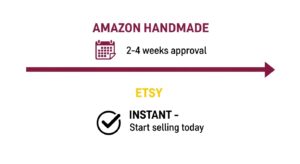
Amazon’s review period typically takes 2-4 weeks, though some artisans report waiting 6 weeks or longer. There’s no guarantee of approval, and Amazon doesn’t provide detailed feedback on rejections, which can be frustrating for sellers who aren’t sure what went wrong.
Additionally, only specific product categories qualify for Handmade placement. Your products must fit within Amazon’s predetermined categories: Accessories, Artwork, Baby, Beauty & Personal Care, Clothing, Home & Living, Jewelry, Kitchen & Dining, Outdoor & Houseplants, Party Supplies, Pet Supplies, Shoes, Sporting Goods, and Toys & Games.
2. Etsy’s Quick and Simple Setup
Etsy’s setup process takes under an hour and requires no approval waiting period. Simply sign up with your email address or Facebook account. Choose your shop name, language, country, and currency during the initial setup. Keep in mind that shop names are permanent once chosen, so take time to select something that represents your brand well.
You can add product listings immediately after setup. Each listing costs $0.20 to make live, but you’ll start selling the same day your shop opens.
Connect your bank account and set up payment processing to receive funds. There’s no vetting process or approval required if you can create an account, you can start selling.
This low barrier to entry means more competition in popular categories, but it also allows you to test product-market fit quickly without weeks of waiting or uncertainty about approval.
Which Products Succeed on Each Platform
Your production capacity and business model drastically affect which platform works better. Some product types naturally align with one marketplace’s strengths, while others could potentially thrive on either platform with the right strategy.
1. Products That Excel on Amazon Handmade
Amazon Handmade strongly favors standardized handmade items that can be produced in batches and stocked in FBA warehouses. These products work best when you can create 25-100+ identical units with consistent quality control, maintain sufficient inventory for warehouse storage, ship quickly without requiring customization, photograph once for multiple units, and sell at competitive price points typically between $20-$200.
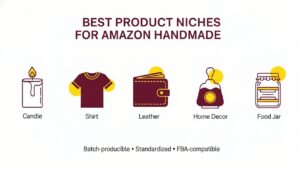
Product examples that thrive on Amazon:
- Hand-poured soy candles in standard scents and sizes
- Handmade leather goods (wallets, belts) without personalization
- Screen-printed apparel in set designs and sizes
- Handcrafted home decor in reproducible styles
- Artisan food products with stable shelf life
These product types leverage FBA’s operational efficiency, achieve Prime eligibility which significantly boosts conversion rates, and don’t require the complex custom order management that would negate Amazon’s fulfillment advantages. You can produce 50-100 units, send them to FBA, and let Amazon handle all fulfillment logistics while you focus on production and marketing optimization.
2. Products That Thrive on Etsy
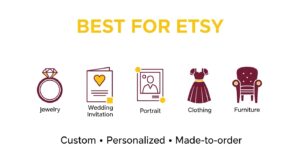
Etsy excels with custom, personalized, or made-to-order items that require direct buyer communication, specific measurements or design elements, longer production timelines, unique materials or techniques, and higher price points justified by customization and craftsmanship.
Product examples that succeed on Etsy:
- Custom wedding invitations and stationery with personalized details
- Personalized jewelry featuring engraved names or birthstones
- Made-to-order clothing in custom sizes and fabric choices
- Hand-painted portraits created from customer photos
- Custom furniture built to specific dimensions and wood preferences
These products work perfectly with Etsy’s messaging system, which facilitates detailed customization conversations. Buyers on Etsy expect longer processing times and understand they’re paying for personalized service. Shop policies can clearly outline custom order procedures, revision policies, and production timelines. The Etsy audience specifically seeks this level of personalization and deeply understands the value proposition.
Fulfillment and Logistics: Operational Realities
How you handle order fulfillment dramatically impacts your daily workload, customer satisfaction, and ability to scale your business. The platforms offer vastly different approaches, each with specific advantages and trade-offs.
1. Fulfillment by Amazon
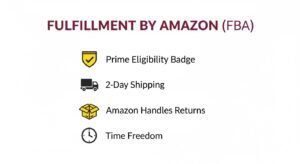
Amazon’s FBA program transforms your fulfillment operations completely. Your role becomes creating products in bulk batches, packaging them according to FBA’s specific requirements, shipping inventory to Amazon warehouses using their discounted shipping rates, monitoring inventory levels through the seller dashboard, and replenishing stock as needed before running out.
Amazon handles everything after that point: receiving and storing your inventory in their warehouse network, picking items when orders come in, packing them according to Amazon’s standards, shipping orders to customers, handling all customer service inquiries about shipping and delivery, managing returns and processing refunds.
Key FBA benefits:
- Prime eligibility: Boosts conversion rates by 2-3x
- Two-day shipping: Meets customer expectations automatically
- Time freedom: Focus on product development instead of daily packing
- Scalability: Grow without hiring fulfillment staff
- Professional handling: Reduces damage and return rates
However, FBA comes with important constraints. Custom or personalized items cannot use FBA because they require individual handling. Fragile items may require extra protective packaging, increasing your prep costs. Slow-moving inventory accumulates storage fees that can erode profits. Seasonal products require strategic timing to avoid excessive storage charges.
Many successful Handmade sellers adopt a hybrid approach, using FBA for their core product line while handling custom orders through seller fulfillment. This combines the best of both worlds: scalability for standardized items and flexibility for personalized work.
2. Etsy’s Self-Fulfillment Model
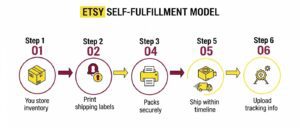
Etsy puts shipping responsibilities entirely on sellers, which provides complete control but requires ongoing time investment. You’ll maintain inventory at your physical location, process orders daily as they come in, purchase and print shipping labels, pack items securely with appropriate materials, ship within your stated processing timeframe, upload tracking information to customer orders, and handle all customer service related to shipping questions or issues.
Etsy does provide helpful support systems. You can access discounted shipping labels through partnerships with USPS, FedEx, and UPS. The platform offers printable shipping labels directly from each order page. Shipping profile templates allow you to set consistent pricing across products. Tracking numbers automatically update customers when you purchase labels through Etsy.
Self-fulfillment benefits:
- Complete control: Manage packaging and unboxing experience
- Brand touchpoints: Add custom packaging, inserts, thank-you notes
- Lower overhead: No FBA fees eating into margins
- Flexibility: Adjust processing times seasonally
- Direct carrier relationships: Build rapport for volume discounts
Self-fulfillment challenges:
- Time-consuming: Daily shipping tasks reduce production time
- Scaling difficulty: Eventually requires hiring help
- Packaging costs: Boxes, bubble wrap, supplies add up
- Shipping errors: Directly impact seller performance metrics
- Customer expectations: Competing with Prime’s two-day standard
Third-party fulfillment services do exist for Etsy sellers, and many shops generating over $100,000 annually eventually partner with these services. However, outsourced fulfillment adds costs and reduces the hands-on brand experience that Etsy buyers often expect and value as part of purchasing from small artisan businesses.
Marketing and Advertising
Both platforms offer advertising tools, but they operate under completely different philosophies and require distinct skill sets to use effectively. Your comfort level with digital advertising and willingness to invest time in campaign management should influence your platform choice.
1. Amazon PPC Advertising
Amazon’s advertising platform offers unprecedented control and detailed performance data but requires ongoing expertise and management time. The primary tool is Sponsored Products, which are keyword-targeted ads appearing directly in search results alongside organic listings.
You can choose automatic targeting where Amazon’s algorithm selects keywords based on your product listing, or manual targeting where you select specific keywords to bid on.
You’ll manage bids for cost control, with higher bids generally leading to better ad placement. Detailed performance metrics show exactly which keywords drive sales and which waste budget.
The budget reality is sobering but necessary. Successful Handmade sellers typically allocate 15-25% of total revenue to advertising. During product launch phases or competitive seasonal periods like Q4, advertising spend can temporarily reach 35-50% of revenue. This investment is necessary for search ranking gains and customer acquisition, but it requires careful cash flow management.
2. Etsy Ads
Etsy’s advertising options prioritize simplicity over granular control. Etsy Ads for on-site promotion require you to set a daily budget with a $1 minimum, but Etsy’s algorithm determines where ads appear based on relevance and bid amounts.
You cannot target specific keywords or demographics. The bidding system is simplified compared to Amazon’s. Performance tracking shows results by individual listing but without the keyword-level detail Amazon provides.
Offsite Ads are even more automated but become mandatory once you exceed $10,000 in annual sales. Etsy promotes your products on Google, Facebook, Instagram, and Pinterest without requiring any action from you.
You only pay when someone clicks the advertisement AND makes a purchase within 30 days. The fee structure charges 15% of the sale for shops with under $10,000 annual revenue and 12% for shops exceeding $10,000. You cannot opt out if you’re above the threshold.
The budget reality for Etsy is generally more modest. Many sellers see profitability with just 5-10% of revenue allocated to Etsy Ads. However, mandatory Offsite Ads fees can push total advertising costs to 15-25% for high-volume shops, similar to Amazon’s spending levels.
Brand Building and Customer Relationships
How much control you have over your brand presentation and customer relationships fundamentally differs between these platforms. For some sellers, this factor outweighs all others in importance.
1. Amazon Handmade
Amazon’s ecosystem consistently prioritizes the Amazon brand over individual seller brands. Your Artisan Profile page includes your shop name and logo, a brief brand story limited to a few hundred characters, product listings displayed in Amazon’s standard format, and a basic Storefront page with minimal customization options.
What you cannot control on Amazon:
- Overall page layout and design beyond basic templates
- Customer communication (filtered through Amazon’s system)
- Customer email addresses (Amazon retains these)
- Follow-up marketing without Amazon Attribution tracking
- Cross-selling outside Amazon’s ecosystem
Building brand equity on Amazon requires enrolling in Brand Registry, which demands a registered trademark. Once enrolled, you can create A+ Content with enhanced product descriptions featuring additional images and comparison charts.
Brand Stores allow custom multi-page storefronts showcasing your full product catalog. Subscribe & Save programs work well for consumable products. Encouraging customer reviews becomes critical for credibility. Maintaining high seller performance metrics protects account health.
2. Etsy Brand Building Tools
Etsy provides extensive brand customization options that feel more like running your own website.
Shop customization includes:
- Custom banners and logos prominently displayed
- Shop sections for organized product browsing
- Featured listings highlighting your best or newest work
- Detailed About sections with photos and video capabilities
- Shop policies clearly displayed (shipping, returns, custom orders)
- FAQ sections addressing common customer questions
- Shop updates and announcements for seasonal changes
Direct customer access creates relationship-building opportunities. You can message customers directly with order updates and questions, access customer email addresses within Etsy’s guidelines for post-purchase communication, encourage Etsy Favorites and shop follows for ongoing engagement, offer special discounts to past customers to encourage repeat purchases, and build an email list through newsletter signup encouragement.
Brand storytelling opportunities abound through workspace photos and videos showing your creative environment, behind-the-scenes content revealing your process, detailed explanations of materials and techniques used, personal stories about your journey and mission as an artisan, and connection with buyers on a human level rather than purely transactional.
To stand out, learning how to build a strong personal brand is key.
Strategic Framework: Making Your Platform Decision
Rather than relying on general advice, use this framework to evaluate which platform aligns with your specific business situation, capabilities, and goals. Understanding the difference is important as explained in this guide on how to choose between Etsy and Amazon Homemade.
1. Choose Amazon Handmade When These Factors Apply
Evaluate whether Amazon Handmade aligns with your business model, resources, and goals.
Production capabilities you need:
- Can produce 25-100+ identical units maintaining quality control
- Maintain sufficient inventory for FBA warehouse storage
- Comfortable with standardized products without customization
- Have reliable production timelines and processes
Business objectives that match:
- Want to reach maximum audience quickly
- Prefer operational efficiency over creative control
- Can invest meaningfully in advertising (15-25% of revenue)
- Building higher volume, lower margin business model
- Want Prime eligibility to drive conversion improvements
Financial requirements:
- Afford 15-25% revenue allocation to advertising campaigns
- Handle 3-5 day payment delays without cash flow strain
- Invest in professional photography and listing optimization
- Cover FBA prep costs and inventory shipping to warehouses
Time and skills available:
- Focus on production rather than daily fulfillment tasks
- Dedicate time to PPC campaign management
- Prefer fewer customer interactions focused on products
- Willing to learn Amazon’s complex ecosystem through training
2. Choose Etsy When These Factors Apply
Determine if Etsy’s platform matches your business approach and personal strengths.
Production model characteristics:
- Specialize in custom or personalized items requiring buyer input
- Work on made-to-order basis rather than maintaining inventory
- Have unique techniques or materials that differentiate work
- Prefer small-batch or one-off creations over mass production
- Value creative freedom in product development
Business goals alignment:
- Want to build recognizable brand with loyal customer base
- Enjoy direct customer relationships and personalized service
- Prefer higher margins on fewer sales over volume-based model
- Target niche audiences specifically seeking handmade authenticity
- Want complete control over customer experience
Financial considerations:
- Need immediate payment access for healthy cash flow
- Prefer lower advertising costs (5-10% of revenue)
- Can absorb 9.5-10.5% in platform fees
- Have budget for quality packaging creating memorable unboxing
Personal preferences and skills:
- Can handle daily shipping and fulfillment as routine
- Enjoy customer communication and relationship building
- Have capacity for managing custom orders and revisions
- Want to manage social media and content marketing yourself
- View customer service as business strength, not burden
Consider Multi-Platform When You Meet These Criteria
Selling on both platforms can maximize reach but multiplies operational complexity. This strategy makes sense only when your annual revenue exceeds $100,000 on your primary platform, demonstrating you’ve mastered that marketplace.
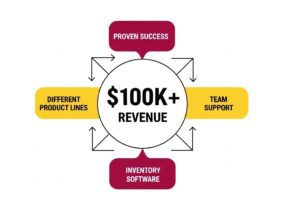
You should have product lines naturally suitable for different audiences perhaps standardized items for Amazon and custom work for Etsy.
You’ll need to afford inventory management software to prevent the disaster of overselling products.
Having team members or virtual assistant support for daily operations becomes necessary. Most importantly, you must understand each platform deeply already, not learning both simultaneously.
Making the Final Decision
Treat platform choice as an infrastructure decision. Align it with how your business actually operates, not how you want it to feel.
Start with a hard business assessment
- Production model: Batch-capable production favors scale-driven systems. One-off or heavily customized work favors relationship-driven marketplaces.
- Cash flow tolerance: Ability to absorb payout delays, inventory buy-ins, and fulfillment costs matters more than gross margin.
- Core strengths: Operational discipline, logistics, and ads versus storytelling, community, and direct customer interaction.
- Growth horizon: Short-term cash generation versus long-term brand equity and resale value.
Validate before committing
- Launch with 10–20 listings.
- Run a controlled 90-day test on one platform.
- Measure net profitability, not revenue: fees, ads, fulfillment, refunds, time cost.
- Scale only what shows repeatable, stable profit.
Market reality
- The global handmade market exceeded $1.2 trillion in 2025.
- Opportunity exists on both platforms.
- Outcomes are driven by execution and platform–business fit, not platform popularity.
Decision principle
- Select the platform that reduces friction for your operating model.
- Commit fully to its rules, algorithms, and constraints.
- Optimize depth before expansion.
The strongest artisan businesses choose platforms as tools, not identities. The platform serves the business. Not the reverse.
Frequently Asked Questions
Can I sell on both Amazon Handmade and Etsy simultaneously?
Yes, you can maintain shops on both platforms, but this strategy works best after you’ve achieved success on one platform first. Running two shops doubles your operational workload: twice the listing creation and optimization, doubled customer service volume, complex inventory management to prevent overselling, and platform-specific marketing requiring different strategies.
Which platform is better for personalized or custom items?
Etsy is significantly better for personalized or custom products. The platform’s messaging system facilitates detailed back-and-forth communication that customization requires. Etsy shoppers expect and seek customization options. Shop policies can clearly outline custom order procedures and timelines.
How long does Amazon Handmade approval take?
Amazon’s Handmade approval process typically takes 2-4 weeks, though some artisans report waiting 6+ weeks. The timeline depends on application volume and how clearly your application demonstrates genuine handmade production.
Do I need a business license to sell on these platforms?
Requirements vary by location. Both platforms require tax information and will report your earnings to tax authorities. Many localities require business licenses once you exceed certain revenue thresholds, typically $500-$1,000 annually. Check your specific city, county, and state requirements.