
Amazon’s third-party marketplace continues to dominate eCommerce, and private labeling remains the most popular and profitable business model among serious sellers. Whether you are launching your first product or scaling an existing brand, this guide breaks down every stage of the Amazon private label process with real numbers, verified benchmarks, and actionable strategies.
Private label selling means sourcing generic products from manufacturers, branding them under your own label, and selling them through Amazon FBA. It gives you control over pricing, branding, and listing optimization that no other Amazon business model offers.
The data below outlines the important metrics that describe the current private label market. All figures come from aggregated seller surveys, Amazon’s published reports, and verified industry research.
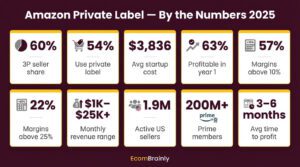
| Metric | Value |
| Third-party seller share of Amazon paid units | ~60% |
| Most popular Amazon seller business model | Private Label (54% of sellers) |
| Average startup investment for Amazon sellers | $3,836 |
| Sellers profitable within first year | 63% |
| Sellers with profit margins above 10% | 57% |
| Sellers with profit margins above 25% | 22% |
| Average monthly revenue for private label sellers | $1,000 to $25,000+ |
| Amazon active third-party sellers (US) | ~1.9 million |
| Amazon Prime members globally | 200+ million |
| Average time to first profit | 3 to 6 months |
Why Amazon Private Label Still Works?
Some sellers worry that Amazon is too saturated for private label. The data tells a different story. Amazon’s marketplace GMV continues growing year over year, Prime membership keeps expanding, and new product categories are constantly emerging.
Below is a look at recent Amazon marketplace growth trends based on publicly reported figures.
| Year | Amazon Third-Party Seller Revenue (Estimated GMV) | Year-over-Year Growth |
| 2021 | $390 billion | 15% |
| 2022 | $410 billion | 5% |
| 2023 | $440 billion | 7% |
| 2024 | $480 billion+ (estimated) | 9% |
Step 1: Product Research for Amazon Private Label
Product research is the foundation of Amazon private label business. Not every product is suitable for private labeling. You need products that hit specific criteria across demand, competition, margins, and logistics.
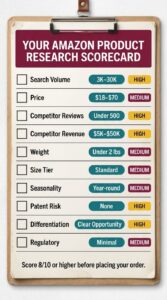
Your product research should filter for the following benchmarks.
- Monthly search volume of 5,000+ for the main keyword (use Helium 10 or Jungle Scout)
- Monthly revenue of $5,000 to $50,000 for top sellers in the niche (avoid niches dominated by one mega-brand)
- Average selling price between $18 and $70 (enough margin after fees, not so high it increases risk)
- Average review count of the top 10 listings under 1500 (indicates room for new entrants)
- Lightweight and small products preferred for first-time sellers (keeps FBA fees low)
- No legal or regulatory complexity (avoid supplements, electronics, and items requiring FDA approval for your first product)
- Not dominated by major brands (avoid categories where Nike, Apple, or Amazon Basics own most of the market share)
- Year-round demand preferred over seasonal spikes (check Google Trends)
1. Product Research Tools Comparison
Several tools dominate the Amazon product research space. Each has different strengths, and many serious sellers use more than one.
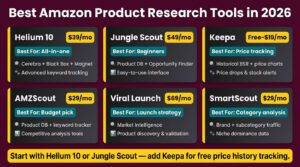
Below is a comparison of the most popular Amazon product research tools available in 2026.
| Tool | Monthly Price (Starter Plan) | Best For | Key Features |
| Helium 10 | $39/month | All-in-one research | Cerebro, Black Box, Magnet, Frankenstein |
| Jungle Scout | $49/month | Beginner-friendly research | Product Database, Opportunity Finder, Supplier Database |
| Keepa | Free (basic) / $19/month (full) | Price and rank tracking | Historical BSR, price history charts |
| AMZScout | $29/month | Budget-friendly option | Product Database, keyword tracker |
| Viral Launch | $69/month | Launch strategy and research | Market Intelligence, keyword research |
| DataDive (SmartScout) | $29/month | Category-level analysis | Brand analysis, subcategory traffic |
For most new sellers, starting with either Helium 10 or Jungle Scout is sufficient. Both offer product databases, keyword research, and competitor analysis.
Step 2: Validating Your Product Idea
Finding a product that looks good on paper is not enough. You need to validate demand, competition, and profitability before placing your first order.
1. Demand Validation Checklist
Run through this checklist before committing to any product.
- Confirm search volume on at least 3 to 5 related keywords (not just the main keyword)
- Check Google Trends for the past 5 years to confirm stable or growing demand
- Review the top 10 Amazon listings manually to assess quality, reviews, and differentiation opportunities
- Read negative reviews (1-star and 2-star) on competitor listings to identify product improvement opportunities
- Verify there is no patent on the product design using Google Patents
- Calculate estimated profit margins using Amazon’s FBA Revenue Calculator (must exceed 25% after all costs)
2. Amazon FBA Fee Structure
Amazon takes between 30% and 40% of your selling price through various fees. New sellers consistently underestimate this and price their products wrong from day one.
The Two Fees on Every Sale
Referral fee is Amazon’s cut for using their marketplace. Most product categories charge 15% of your selling price. Check your specific category in Seller Central because rates vary.
FBA fulfillment fee covers picking, packing, and shipping to the customer. It depends on size and weight, not selling price.
- Items under 10 oz: $3.22 to $3.68 per unit
- Items 10 oz to 2 lbs: $3.86 to $5.40 per unit
- Items 2 to 3 lbs: $5.60 to $7.25 per unit
Storage Fees
Amazon charges monthly rent for warehouse space based on cubic feet.
- January to September: $0.87 per cubic foot
- October to December: $2.40 per cubic foot
- Inventory unsold after 181 days triggers an additional aged inventory surcharge
Keep inventory moving. Slow products become expensive fast.
Two Fees Most New Sellers Miss
Low-inventory-level fee charges $0.32 to $0.47 per unit when your stock drops below 28 days of supply. Keep at least four weeks of inventory at Amazon at all times.
Inbound placement fee applies when sending inventory to a single warehouse. Amazon prefers splitting shipments across multiple fulfillment centers. Choosing their distributed placement option reduces or eliminates this fee.
Use the FBA revenue calculator in Seller Central to calculate margins (aim for 30%+ gross margins) before committing to any product. Here is an example for a standard private label product.
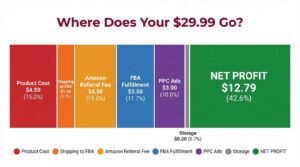
| Cost Component | Amount | Percentage of Sale Price |
| Selling Price | $29.99 | 100% |
| Product Cost (landed from supplier) | $4.50 | 15% |
| Shipping to Amazon FBA (per unit) | $1.50 | 5% |
| Amazon Referral Fee (15%) | $4.50 | 15% |
| FBA Fulfillment Fee | $3.50 | 11.7% |
| Amazon PPC Advertising (estimated) | $3.00 | 10% |
| Monthly Storage Fee (per unit, estimated) | $0.20 | 0.7% |
| Total Costs | $17.20 | 57.4% |
| Net Profit Per Unit | $12.79 | 42.6% |
In reality, after accounting for returns (typically 2% to 5%), product giveaways, photography, and branding costs, your actual net margin will likely settle between 15% and 20% max. That is still significantly higher than most retail businesses.
Always build your cost model conservatively. If a product still looks profitable with pessimistic assumptions, it is a strong candidate.
Step 3: Finding and Vetting Suppliers
Your supplier relationship determines product quality, consistency, and ultimately your brand’s reputation. Rushing this step is one of the most common and most expensive mistakes new sellers make.
1. Where to Source Private Label Products
Most Amazon private label sellers source from overseas manufacturers, though domestic sourcing is growing for specific categories.
Here are the most common sourcing channels for private label products.
- Alibaba.com is the largest B2B supplier marketplace with millions of manufacturers (mostly China-based)
- 1688.com is China’s domestic version of Alibaba with lower prices but requires a sourcing agent
- Global Sources offers verified suppliers and hosts trade shows in Hong Kong
- IndiaMART is a growing alternative for textiles, organic products, and leather goods
- ThomasNet connects you with US-based manufacturers for higher-end or “Made in USA” branding
- Canton Fair (China Import and Export Fair) is the world’s largest trade show for product sourcing
- Sourcing agents on the ground in China can manage factory visits, negotiations, and quality control
For most first-time sellers, Alibaba remains the starting point. It offers the widest supplier selection, competitive pricing, and built-in buyer protections through Trade Assurance.
2. How to Vet a Supplier on Alibaba
Not all Alibaba suppliers are equal. Proper vetting protects you from poor quality, scams, and unreliable shipping.
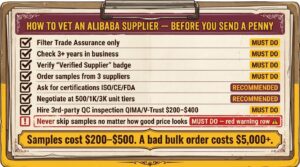
Follow this supplier vetting process before placing any order.
- Filter for Trade Assurance suppliers (Alibaba’s built-in payment protection)
- Check the supplier’s years in business (prefer 3+ years)
- Look for “Verified Supplier” badges (Alibaba’s third-party factory audit program)
- Review their transaction history and customer feedback
- Request product samples from at least 3 different suppliers (expect to pay $20 to $100 per sample plus shipping)
- Ask for certifications relevant to your product (ISO, CE, FDA, CPSC, etc.)
- Negotiate pricing based on order volume (always ask for pricing at 500, 1,000, and 3,000 unit MOQs)
- Discuss customization options including logo placement, packaging, color variations, and material upgrades
- Hire a third-party inspection company like QIMA or V-Trust before shipment ($200 to $400 per inspection)
Never place a large order without first ordering and testing samples. The $200 to $500 you spend on samples from multiple factories is the cheapest insurance you will ever buy.
3. Negotiation Tips for Better Supplier Pricing
Your first quoted price from a supplier is almost never the final price. Strategic negotiation can reduce your landed product cost by 10% to 30%.
Use these tactics when negotiating with manufacturers.
- Get quotes from 20 to 30 suppliers and use competing offers as leverage
- Ask about tiered pricing at different quantity levels
- Negotiate payment terms (30/70 split is standard: 30% deposit, 70% before shipment)
- Build a long-term relationship narrative because suppliers give better pricing to repeat customers
- Avoid haggling too aggressively on your first order because reliability and quality matter more than saving $0.10 per unit
Step 4: Branding and Packaging Your Product
Your brand is what separates you from thousands of generic listings. Investing in professional branding and packaging is not optional if you want to build a sustainable Amazon business.
1. Creating Your Private Label Brand
Your brand name, logo, and visual identity should feel cohesive and professional. Customers form impressions within seconds of seeing your listing or packaging.
Key branding elements every private label seller needs include the following.
- Brand name that is short, memorable, easy to spell, and available as a trademark
- Logo designed professionally (use 99designs, Fiverr Pro, or a branding agency)
- Color palette consistent across packaging, Amazon images, and storefront
- Brand story that communicates your mission or unique angle
- Packaging design that looks premium and includes all required information
- Product inserts (thank you cards, warranty registration, etc.) to build post-purchase loyalty
2. Trademark and Brand Registry
Registering your trademark and enrolling in Amazon Brand Registry is one of the most important steps. Brand Registry gets you powerful tools and protections that unregistered sellers cannot access on Amazon.
To qualify for Brand Registry, you need an active registered trademark (not just pending) in the country where you are enrolling. In the US, trademark registration through the USPTO typically costs $250 to $350 per class and takes 8 to 12 months.
4. Packaging That Sells
Your packaging is often the first physical touchpoint customers have with your brand. Poor packaging leads to negative reviews, higher return rates, and damaged brand perception.
Follow these packaging best practices for private label products.
- Use a professional packaging designer (expect to pay $100 to $500 for a custom design)
- Include all required regulatory information (country of origin, UPC barcode, safety warnings)
- Design for the unboxing experience because it drives positive reviews and social media sharing
- Use frustration-free packaging when possible (Amazon rewards this with better placement)
- Include a product insert card with care instructions, warranty info, and a subtle call to action for reviews
- Ensure packaging protects the product during shipping (test with Amazon’s prep guidelines)
Great packaging does not need to be expensive. A well-designed box, a clear brand presence, and professional print quality can be achieved for $0.50 to $2.00 per unit on most products.
Step 5: Creating Your Amazon Product Listing
Your listing is your sales page. Every element, from the title to the images to the bullet points, must be optimized to convert shoppers into buyers and rank for relevant search terms.
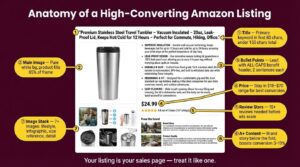
1. Title Optimization
Your title is the single most important text element for both search ranking and click-through rate. It must contain your primary keyword naturally while communicating key product benefits.
Follow this title formula for optimal results.
Brand Name + Primary Keyword + Key Feature 1 + Key Feature 2 + Size/Quantity/Variant
Here is an example for a stainless steel water bottle.
“HydroFlow Stainless Steel Water Bottle, 32 oz Insulated Sports Bottle, Keeps Drinks Cold 24 Hours, Leak-Proof Lid, BPA-Free”
Title optimization guidelines to follow include the following.
- Place your primary keyword within the first 80 characters
- Include 2 to 3 secondary keywords naturally
- Capitalize the first letter of each word (except prepositions)
- Never use promotional phrases like “Best Seller” or “Sale”
- Avoid keyword stuffing or unnatural phrasing
- Keep it under 150 characters for mobile readability
2. Bullet Point Best Practices
Bullet points are where you sell the benefits and address potential objections. Most shoppers read bullets before scrolling to the description.
Each bullet should follow this structure.
- Start with a benefit-driven capitalized header (e.g., “KEEPS DRINKS ICE COLD FOR 24 HOURS”)
- Follow with 1 to 2 sentences explaining the feature and how it benefits the customer
- Address a specific customer concern or use case in each bullet
- Include relevant secondary keywords naturally throughout
- Cover the top 5 purchase decision factors for your product category
Your five bullets should cover these topics at minimum.
- Primary benefit or unique selling proposition
- Quality, materials, or construction details
- Size, dimensions, or quantity information
- Who the product is perfect for (use cases)
- Guarantee, warranty, or satisfaction promise
3. Product Photography Standards
Images drive conversions more than any other listing element. Amazon data shows that listings with 7+ high-quality images convert at significantly higher rates than those with fewer.
Your image stack should include the following types.
- Main image on pure white background (Amazon requirement, product fills 85% of frame)
- Lifestyle image showing the product in use by a real person
- Scale/size reference image showing the product next to a common object
- Feature callout image with text overlays highlighting key benefits
- Infographic image comparing your product to competitors or showing specifications
- Close-up detail image showing material quality, texture, or craftsmanship
- Packaging image showing what the customer will receive
- A+ Content images extending the visual brand story below the fold
Professional Amazon product photography typically costs $150 to $500 per product for a full image set. DIY photography is possible with a lightbox ($30 to $60) and a smartphone, but professional images almost always generate higher conversion rates.
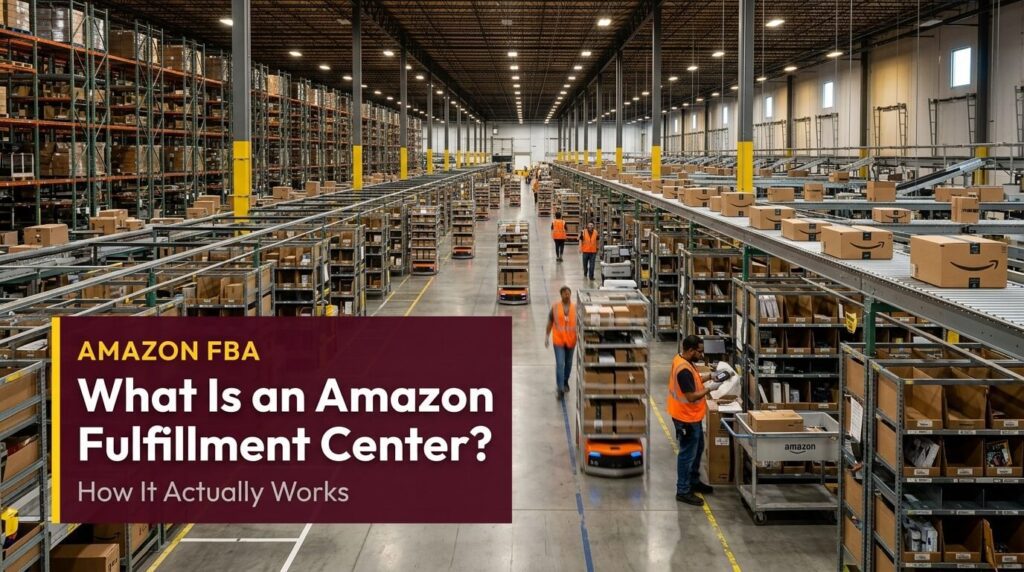
Step 6: Shipping Your Products to Amazon FBA
Getting your inventory from the supplier to Amazon’s warehouses involves several logistics decisions. Choosing the right shipping method impacts your landed cost, lead time, and cash flow.
1. Shipping Methods Compared
Below is a comparison of the three main shipping methods from China to Amazon’s US fulfillment centers.
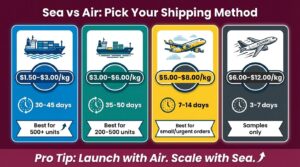
| Shipping Method | Cost Per KG (Approx.) | Transit Time | Best For | Minimum Shipment |
| Sea Freight (FCL) | $1.50 to $3.00 | 30 to 45 days | Large orders (500+ units) | Full container |
| Sea Freight (LCL) | $3.00 to $6.00 | 35 to 50 days | Medium orders (200 to 500 units) | Shared container |
| Air Freight | $5.00 to $8.00 | 7 to 14 days | Small or urgent orders | 50 kg minimum |
| Air Express (DHL/FedEx/UPS) | $6.00 to $12.00 | 3 to 7 days | Samples or very small shipments | No minimum |
For your first order, many sellers use air freight or air express to test the product faster. Once you have validated sales velocity, switching to sea freight dramatically reduces shipping costs per unit.
2. FBA Prep and Shipment Creation
Before Amazon accepts your inventory, products must meet specific labeling and packaging requirements.
Follow these steps to prepare your FBA shipment.
- Apply FNSKU barcodes to each unit (your supplier can do this)
- Ensure products are properly packaged and protected for shipping
- Create a shipping plan in Seller Central specifying quantities and destinations
- Provide box content information for each carton
- Choose between Amazon-partnered carriers (discounted rates) or your own freight forwarder
- Track your shipment and confirm check-in at Amazon’s fulfillment centers
Step 7: Launching Your Private Label Product
A strong product launch determines your initial ranking velocity and sales trajectory. Without a deliberate launch strategy, even great products can get buried on page 5 and never recover.
1. Pre-Launch Checklist
Complete these tasks before your product goes live on Amazon.
- Listing is fully optimized with all keywords, images, and A+ Content
- Initial inventory of 200 to 500 units is received at Amazon FBA
- PPC campaign structure is planned and ready to activate
- Amazon Vine enrollment (if eligible through Brand Registry) for early reviews
- Promotional pricing strategy is set (consider a launch discount of 15% to 25%)
- External traffic sources are identified (social media, email list, influencer partnerships)
- Competitor monitoring is set up to track pricing and ranking changes
2. Amazon PPC Strategy for Launch
Running PPC ads is not optional when launching a private label product in 2025. A brand new listing has zero organic ranking history, so Amazon’s algorithm has no reason to surface it in search results. Paid advertising generates the early clicks, conversions, and ranking signals your listing needs to gain traction.
The first couple of weeks will not be profitable from an ad spend perspective. Think of this phase as purchasing data and training Amazon’s algorithm to identify your ideal buyer.
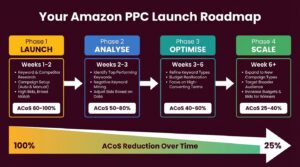
Week 1 to 2: Data Collection Phase
Launch four campaign types simultaneously from day one to maximize the speed at which you collect actionable data.
Below is the recommended campaign structure for your PPC launch.
| Campaign Type | Setup Details | Bidding Approach | Purpose |
| Automatic Campaigns (x4) | One each for close match, loose match, substitutes, complements | Amazon’s suggested bid | Let Amazon surface converting keywords and ASINs |
| Manual Broad Match | 20 to 30 researched keywords | Slightly above suggested bid | Capture long-tail variations and unexpected phrases |
| Manual Phrase Match | Same keyword set as broad match | Equal to suggested bid | Tighter control with moderate reach |
| Manual Exact Match | 5 to 10 highest-priority keywords | 10% to 20% above suggested bid | Guaranteed placement on critical terms |
Expect ACoS between 60% and 100% during this phase. You are buying data and algorithmic signals, not immediate profitability.
Daily Monitoring (Days 3 to 7)
Start checking Search Term Reports daily as data populates. Catching wasteful spend early prevents budget from bleeding into irrelevant clicks.
- Identify search terms consuming budget without generating sales
- Add irrelevant terms as negative keywords immediately
- If any term hits 15+ clicks with zero conversions, negate it
- Track which keywords are earning impressions, clicks, and actual sales
- Note early patterns in high-performing search terms
Week 2 to 3: First Optimization Pass
Run a comprehensive search term analysis at the end of week two. This is where you restructure campaigns around real performance data.
Below is the action framework for sorting keywords by performance tier.
| Performance Tier | Criteria | Action |
| High performers | 2+ sales with acceptable ACoS | Move to dedicated campaigns, increase bids 20% to 30% |
| Moderate performers | 1 sale or strong CTR | Maintain or slightly increase bids |
| Poor performers | 20+ clicks, zero sales | Reduce bids by 40% or pause |
| Non-converters | High spend, no engagement | Add as negative keywords |
Winning keywords should move into their own campaigns with higher daily budgets. Non-converting terms with 20+ clicks need to be paused or negated without hesitation.
Week 3 to 6: Scaling What Works
Build standalone campaigns for your best-performing keywords with aggressive bids and larger budgets. These proven winners deserve maximum volume while organic ranking builds.
- Create isolated campaigns for your top 5 to 10 converting keywords
- Continue auto and broad match campaigns at 50% of original budget for ongoing discovery
- Promote newly discovered winners into your focused scaling campaigns
- Track organic ranking improvements weekly using Helium 10 or Jungle Scout
Target ACoS should compress from 60% to 100% down to 40% to 50% by week six as organic sales begin contributing.
Sponsored Brands and Sponsored Display
Once Sponsored Products campaigns have built initial traction, layer in additional ad types to capture more search result real estate.
Launch Sponsored Brands targeting your highest-converting keywords. These headline ads appear at the top of search results and reinforce brand recognition with your logo and multiple products.
Add Sponsored Display after week two for retargeting. These ads reach shoppers who viewed your listing or competitor listings but did not purchase.
Below is the recommended budget split across ad types.
| Ad Type | Budget Allocation | Primary Goal |
| Sponsored Products | 70% | Direct conversions through keyword and ASIN targeting |
| Sponsored Brands | 20% | Top-of-search visibility and brand awareness |
| Sponsored Display | 10% | Retargeting and competitor audience capture |
Getting Your First Reviews
Reviews are the social proof that drives conversion rates. Products with 15+ reviews convert significantly better than those with zero reviews.
Use these legitimate review generation methods.
- Amazon Vine Program allows Brand Registered sellers to enroll new products (under 30 reviews) and provide free units to Vine Voices for honest reviews. Enrollment costs $200 per parent ASIN for highest package of 30 reviews (as of 2026).
- Amazon’s “Request a Review” button in Seller Central sends Amazon-branded review request emails to buyers
- Provide an excellent product because the best review strategy is selling something customers genuinely love
Never buy fake reviews, offer discounts in exchange for reviews, or use review manipulation services. Amazon’s detection systems are sophisticated, and violations result in listing suspensions or permanent account bans.
7 Private Label Products Worth Your Investment
I pulled seven products that are worth selling right now. Each one has proven demand, manageable competition, and enough margin to survive Amazon’s fee structure.
1. Reusable Silicone Food Storage Bags (Set of 4)
The kitchen organization category continues growing as consumers replace single-use plastics. These bags work for meal prep, freezer storage, and packed lunches.
Most sellers offer standard four-bag sets with basic colors. Below are some of the differentiation options:
- Source thicker gauge silicone (request 1.5mm minimum instead of standard 1mm)
- Upgrade to reinforced double-lock zippers instead of single-track closures
- Include one extra-large bag for marinating meat or full heads of lettuce
- Bundle a small bottle brush designed for cleaning bag corners
- Use reinforced seam welding at stress points where bags typically fail
2. Magnetic Phone Car Mount (Vent Clip Style)
The vent clip design works across most vehicles without dashboard adhesive that renters avoid. Market price sits around $15.99 with 40% margins possible.
One-star reviews tell you everything. Weak magnets fail over bumps. Vent clips break within weeks. Adhesive metal plates damage phone cases. Below are some of the differentiation options
- Request N52 grade neodymium magnets instead of standard N35 (15% stronger)
- Upgrade to reinforced clips with rubber-coated grip points
- Include two metal plates instead of one
- Add a slim magnetic ring alternative to adhesive plates for buyers concerned about case damage
3. Under-Cabinet LED Puck Lights (3-Pack with Remote)
Kitchen and closet lighting upgrades rank high in home improvement projects that don’t require professional installation.
Battery life complaints dominate this category. Standard puck lights use AAA batteries and die within 30-40 hours. Buyers replace batteries monthly and leave frustrated reviews.
- Upgrade to rechargeable lithium batteries with USB charging
- Include a USB charging cable that splits to charge all three lights simultaneously
- Find suppliers offering 30+ foot remote range instead of standard 10-12 feet
- Request four distinct brightness levels plus smooth dimming function
4. Portable Pet Water Bottle with Built-In Bowl
Dog owners who hike, travel, or walk for extended periods need reliable hydration solutions. This product solves an obvious problem without requiring behavior change. Sells around $17.99 with 36% margins.
Leak complaints appear in almost every top listing. Water soaks backpacks and car interiors during transport. Buyers return immediately. Below are some of the differentiation options:
- Source bottles with locking button mechanism instead of standard push-button
- Offer two sizes (12 oz standard and 19 oz for large breeds) as variations
- Request BPA-free, FDA-approved silicone with certification documents
- Add carabiner clip attachment point for hands-free carrying
- Include carbon filter in bowl section for outdoor water sources
- Use thicker silicone bowl material that holds shape when extended
5. Blue Light Blocking Glasses
Screen time increases continue driving demand for non-prescription eye strain relief. The market has competition but tolerates multiple sellers with proper differentiation. Most sellers make identical claims about blue light filtering without proof. Buyers have become skeptical.
Below are some of the differentiation options:
- Request lab certification showing exact percentage of blue light blocked at 380nm-500nm wavelengths
- Offer frames with adjustable nose pads and spring-loaded hinges for extended wear comfort
- Source clear lens coatings instead of yellow-tinted versions
- Include hard case and microfiber cloth instead of cheap pouches
6. Bamboo Bath Caddy Tray
Home spa experiences continue growing as consumers invest in self-care products. This category attracts buyers willing to pay premium prices for quality. Typical price is $39.99 with 38% margins.
Adjustability determines whether buyers can actually use your product. Bathtubs range from 28 to 36 inches wide. Fixed-width trays only fit a portion of customers.
Below are some of the differentiation options:
- Request extending arm mechanism that adjusts from 27 to 37 inches
- Position wine glass holder on right side (most people are right-handed)
- Angle phone slot at 45-60 degrees for comfortable viewing
- Submerge samples in water for 72 hours to test for warping or finish degradation
- Add rubber grips on underside of extending arms to prevent sliding
- Size tray to hold standard paperback book plus wine glass plus candle
7. Collapsible Silicone Travel Coffee Cup
Reusable cup adoption grows but traditional travel mugs create portability problems. Collapsible designs solve the storage issue that prevents consistent use. Sells around $16.99 with 38% margins.
Lid leakage ruins this category. Buyers try collapsible cups, experience leaks in bags, and never buy again. Below are some of the differentiation options:
- Request threaded screw closures with silicone gasket seal instead of snap-on lids
- Test samples by filling with hot liquid, collapsing with lid on, and shaking vigorously
- Find suppliers offering sub-1.5 inch collapsed height for jacket pocket fit
- Request food-grade silicone rated to 450°F instead of standard 230°F
- Target 12-16 oz capacity (sweet spot between too small and won’t collapse compactly)
- Use smooth-edge rims or hard plastic drinking surfaces instead of pure silicone
- Include carabiner clip for attaching to bags or belt loops
Frequently Asked Questions
How much money do I need to start private label on Amazon?
Most sellers start with $3,000 to $5,000 for a lean launch, or $8,000 to $12,000 for a well-funded launch including professional photography, branding, and adequate PPC budget. It is possible to start with as little as $1,500, but underfunding typically extends the timeline to profitability and limits product quality.
Is Amazon private label still profitable in 2026?
Yes. According to Jungle Scout’s 2024 survey data, 63% of Amazon sellers become profitable within their first year, and 57% maintain profit margins above 10%. Private label remains the most popular model among full-time Amazon sellers, with many earning $5,000 to $25,000+ per month in revenue.
How long does it take to start making money with Amazon private label?
Most sellers see their first sales within 10 to 18 weeks of starting. Profitability (after recovering launch costs) typically arrives within 3 to 6 months. This timeline depends on product selection, launch execution, and advertising strategy.
What is the difference between private label and white label?
Private label involves customizing a product (design, features, packaging) and branding it as your own. White label means applying your brand to a completely generic, unmodified product. Private label offers more differentiation and competitive advantage, while white label is faster and cheaper to start but harder to defend against competition.
Do I need a trademark to sell private label on Amazon?
You do not need a trademark to sell on Amazon, but you need one to enroll in Amazon Brand Registry. Brand Registry unlocks A+ Content, Sponsored Brand Ads, Amazon Vine, and brand protection tools. Filing a trademark costs $250 to $350 through the USPTO and takes 8 to 12 months. Amazon’s IP Accelerator program can provide early Brand Registry access with a pending application. Brand Registry also protects you from listing hijackers – unauthorized sellers who jump on your listing and steal your Amazon Buy Box, killing your conversions overnight.
What are the biggest risks of Amazon private label?
The main risks include choosing a product with insufficient demand, inventory sitting unsold and incurring storage fees, cash flow constraints during reorder periods, listing hijacking or IP complaints, Amazon policy changes affecting your category, and supplier quality inconsistency. Most of these risks are manageable with proper research, diversification, and financial planning.
How many units should I order for my first private label product?
For your first order, 200 to 500 units is the recommended range. This quantity is enough to negotiate reasonable per-unit pricing, test market demand, and generate initial sales data without overcommitting capital. If the product sells well, you can reorder in larger quantities to reduce per-unit costs.
Should I use Amazon FBA or FBM for private label?
Amazon FBA is strongly recommended for private label products. FBA provides Prime eligibility, which significantly increases conversion rates and visibility. FBA also handles customer service and returns, allowing you to focus on product development and marketing. FBM (Fulfilled by Merchant) may make sense for oversized or slow-moving items, but for standard private label products, FBA delivers the best results.