
Amazon sent a quiet email to thousands of vendors between 2023 and 2025. No press release. No blog post. Just a short notice: “We will no longer be placing purchase orders for your products.”
Those brands had been selling wholesale to Amazon through Vendor Central for years. Some for over a decade. Overnight, their entire Amazon revenue channel went dark.
They had two choices. Set up a Seller Central account and start selling directly to customers as a third-party seller. Or lose Amazon entirely.
This is not a history lesson. It keeps happening. And it exposes the fundamental question behind the 1P vs 3P decision that most brands get wrong: which model actually puts more money in your account, and which one leaves you dependent on a single buyer who can walk away whenever they want?
The short answer is that 3P sellers keep roughly $9-10 more gross profit per unit than 1P vendors on the same product. The long answer is more complicated and depends on your catalog size, operational capacity, and category. Both answers are in this article, with the actual math.
If you sell products on Amazon or plan to start in 2026, the very first structural decision you face is whether to sell as a first-party (1P) vendor or a third-party (3P) seller. This is not a settings toggle. It changes your margins, your control over pricing, your access to customer data, and how much money actually lands in your bank account from every sale.
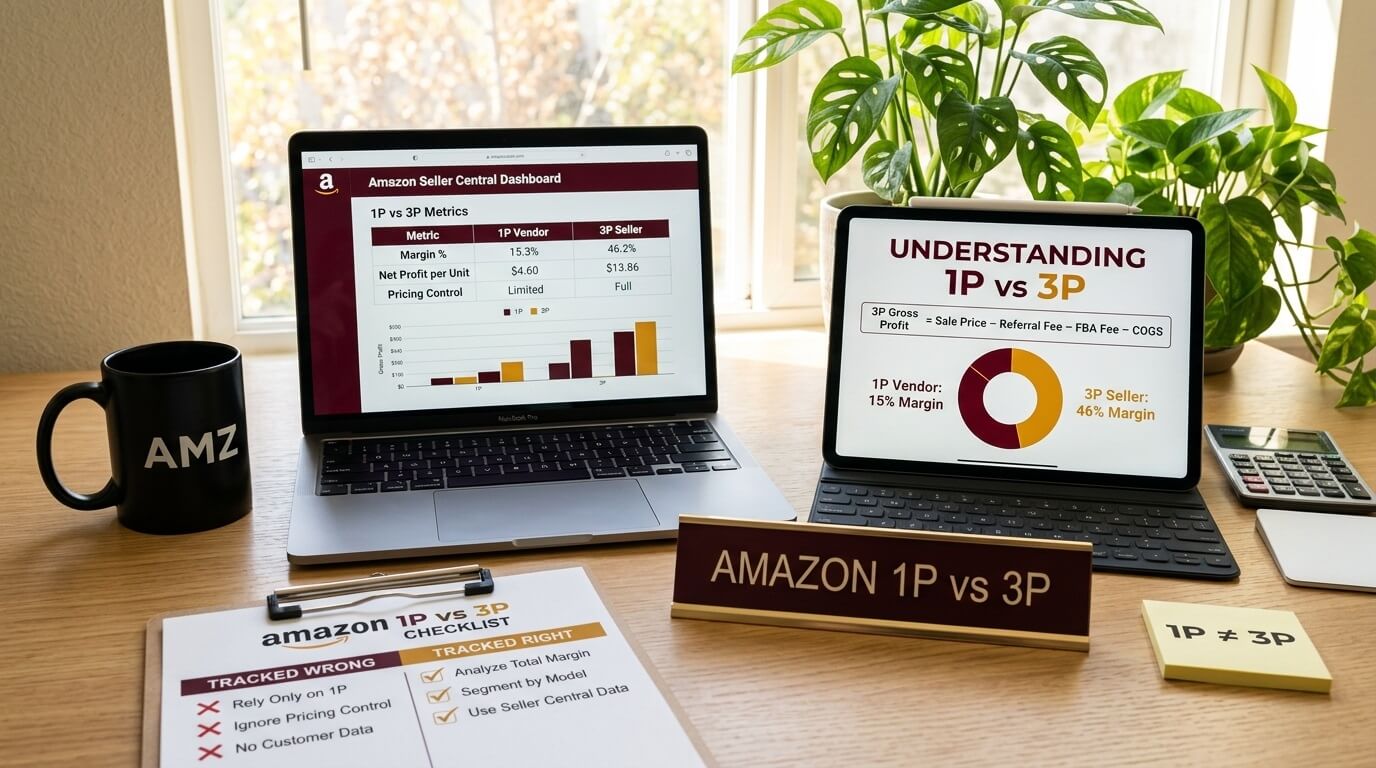
Having managed brands on both Vendor Central and Seller Central, I can tell you the gap between 1P and 3P is often the gap between a 15% margin and a 45% margin on the exact same product. That difference shows up in real deposits every two weeks.
This guide breaks down both models with actual cost math, current fee structures, and specific recommendations based on your brand size, category, and growth stage. No recycled definitions. No generic pros-and-cons lists that say nothing. Just the information you need to make the right call and execute it.
What 1P and 3P Actually Mean
These two terms describe fundamentally different relationships with Amazon, and they operate on entirely separate platforms.
1P (First-Party) means Amazon buys your products at wholesale and resells them. The listing displays “Ships from and sold by Amazon.com.” You are a supplier to Amazon, not a seller on Amazon. You operate through a platform called Vendor Central.
3P (Third-Party) means you sell directly to customers through Amazon’s marketplace. The listing shows “Sold by [Your Brand] and Fulfilled by Amazon” (if using FBA) or “Ships from and sold by [Your Brand]” (if self-fulfilling). You operate through Seller Central.
In 2024, third-party sellers accounted for over 60% of all units sold on Amazon’s marketplace. That share has been climbing steadily since 2015 when it sat closer to 46%. Amazon itself has been actively trimming its 1P vendor base, pushing many former Vendor Central accounts toward Seller Central. This is not speculation. Thousands of small and mid-size vendors received emails between 2023 and 2025 informing them that Amazon would no longer place purchase orders for their products.
How the 1P Model Works
When Amazon invites you to sell as a 1P vendor (Vendor Central is invitation-only and does not accept applications), the relationship mirrors a traditional retail setup.
Amazon places purchase orders for your products. You ship inventory to their fulfillment centers. Amazon warehouses, prices, and sells the product to end customers. Then Amazon pays you based on agreed wholesale pricing, typically on Net 30, Net 60, or Net 90 payment terms.
That structure sounds simple. It is anything but.
Once Amazon buys your inventory, they control everything downstream. They set the retail price. They decide when and whether to reorder. They manage the product detail page. And their vendor management teams negotiate aggressively on cost, year after year, pushing for lower wholesale prices and higher deductions.
1. The Hidden Costs of Vendor Central
The wholesale price you negotiate with Amazon is not the amount that actually hits your account. Amazon layers on several deductions that quietly eat into your margins:
- Co-op fees (accruals): Typically 10-15% of wholesale cost, charged for “marketing support” and merchandising
- Damage allowance: 2-5% of wholesale, covering damaged or defective returns regardless of whether you agree with the claim
- Freight allowance: 4-8% if Amazon collects the goods under collect freight terms
- Chargebacks: Penalties for labeling errors, shipping violations, PO discrepancies, or packaging non-compliance. Individual chargebacks range from $50 to $25,000 depending on the infraction
- Shortage claims: Amazon deducts for units they say were missing from your shipments, and disputing these requires significant time and documentation
A brand selling at a $15 wholesale price often nets $11-$12 per unit after all deductions. That is a 20-27% haircut from an already-discounted wholesale price.
How the 3P Model Works
As a 3P seller on Seller Central, you list your products, set your own retail prices, and sell directly to Amazon customers. The customer pays you through Amazon, and you choose how to fulfill orders.
1. Fulfillment Options
There are three ways to get products to customers as a 3P seller:
FBA (Fulfillment by Amazon): You ship inventory to Amazon’s warehouses in advance. When orders come in, Amazon picks, packs, and ships. Your products qualify for Prime. Most 3P sellers choose this route because Prime eligibility drives significantly higher conversion rates. Amazon reports that Prime-eligible products convert at roughly 2-3x the rate of non-Prime offers.
FBM (Fulfilled by Merchant): You store inventory at your own warehouse or 3PL and ship orders yourself. No Prime badge unless you qualify for Seller Fulfilled Prime.
SFP (Seller Fulfilled Prime): You fulfill from your own facility but meet Amazon’s strict Prime delivery standards. This program has limited enrollment and tough performance requirements in 2026.
2. 3P Fee Structure
Your costs as a 3P FBA seller are transparent and published before you list a single product:
- Referral fee: A percentage of the sale price. Most categories charge 15%. Personal computers are 6%, consumer electronics are 8%, and Amazon device accessories are 45%.
- FBA fulfillment fee: Based on product size and weight. A standard-size item under 1 lb costs roughly $3.06-$3.68 per unit (2025 rates).
- Monthly storage fee: $0.78 per cubic foot from January through September, $2.40 per cubic foot from October through December.
- Inbound placement service fee: Charged when you send inventory to a single fulfillment center instead of splitting shipments across Amazon’s network.
- Low-inventory-level fee: Applied to standard-size products with under 28 days of supply, at a per-unit surcharge.
- Professional seller subscription: $39.99 per month.
The big difference: these fees are predictable. There are no surprise co-op negotiations, no chargebacks for ASN labeling errors, and no shortage claims to dispute.
1P vs 3P: Side-by-Side Comparison
Before going deeper into specific areas, here is a consolidated look at how the two models differ across every major dimension of selling on Amazon.
| Factor | 1P (Vendor Central) | 3P (Seller Central) |
|---|---|---|
| Relationship with Amazon | You are a wholesale supplier | You are a marketplace seller |
| Platform access | Invitation only | Open to anyone |
| Who owns inventory after shipment | Amazon | You |
| Who sets retail price | Amazon | You |
| Payment terms | Net 30, 60, or 90 days | Every 14 days |
| Fulfillment | Amazon handles everything | FBA, FBM, or SFP |
| Listing control | Limited (Amazon can edit) | Full (with Brand Registry) |
| Customer data access | Restricted | Order-level data available |
| Typical net margin | 10-20% of retail price | 25-50% of retail price |
| Returns handling | Amazon handles, deducts costs | Amazon handles (FBA), per-item fees |
| A+ Content | Available | Available (with Brand Registry) |
| Advertising access | Full access | Full access |
| Brand Store | Available | Available (with Brand Registry) |
| Chargebacks | Common, often substantial | Not applicable |
| Scalability | Depends on Amazon’s purchase orders | You control inventory and growth |
The Real Cost Breakdown
Abstract comparisons do not close deals or change strategies. Here is what the actual numbers look like on a real product.
Scenario: A health and wellness brand sells a supplement with a $7.00 cost of goods. The Amazon retail price is $29.99.
1. 1P Vendor Economics
This table shows what a typical 1P vendor actually receives per unit after Amazon applies its standard deductions.
| Line Item | Amount |
|---|---|
| Wholesale price (50% of retail) | $15.00 |
| Co-op accrual (12%) | -$1.80 |
| Damage allowance (3%) | -$0.45 |
| Freight terms (5%) | -$0.75 |
| Average chargeback allocation per unit | -$0.40 |
| Net revenue per unit | $11.60 |
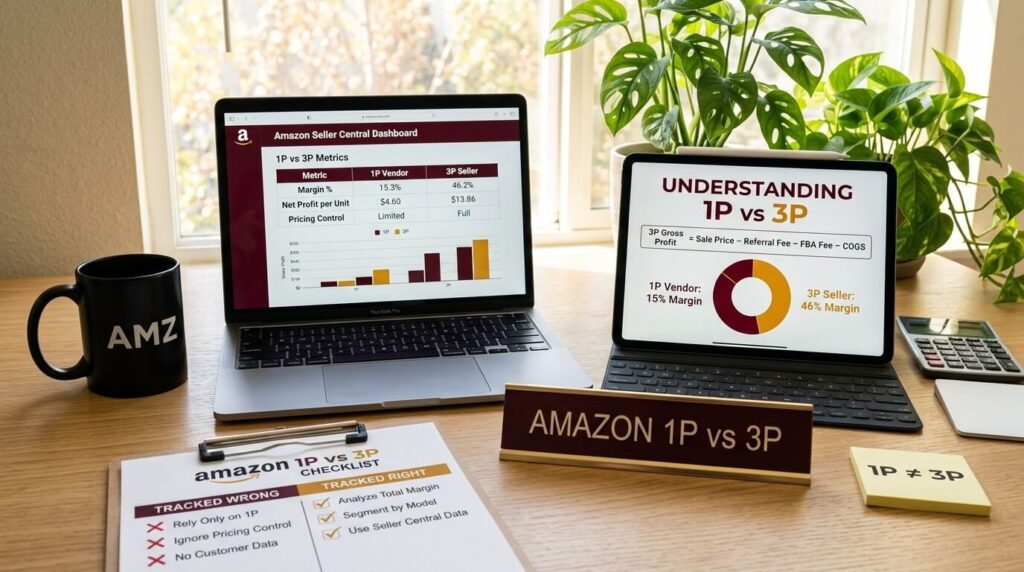
| COGS | -$7.00 |
| Gross profit per unit | $4.60 |
| Gross margin (% of retail) | 15.3% |
2. 3P Seller Economics (FBA)
This table shows the same product sold through Seller Central using Fulfillment by Amazon.
| Line Item | Amount |
|---|---|
| Sale price | $29.99 |
| Referral fee (15%) | -$4.50 |
| FBA fulfillment fee | -$3.68 |
| Monthly storage (average) | -$0.35 |
| Inbound shipping to FBA | -$0.60 |
| Net revenue per unit | $20.86 |
| COGS | -$7.00 |
| Gross profit per unit | $13.86 |
| Gross margin (% of retail) | $46.2% |
The 3P model yields $9.26 more gross profit per unit. Sell 10,000 units a month and that gap becomes $92,600 in additional monthly profit.
3. 3P After Advertising Costs
The 3P model does require you to fund your own advertising. But even with meaningful PPC spend, the math stays in your favor.
| Additional Expense | Amount |
|---|---|
| PPC spend (25% ACoS on 40% of revenue) | -$3.00 per unit avg |
| Adjusted gross profit per unit | $10.86 |
| Adjusted margin (% of retail) | 36.2% |
After advertising, the 3P seller still earns more than double the 1P vendor’s per-unit profit. This is why brands with the operational capacity to manage a 3P business rarely look back.
Pricing Control and the Buy Box
This is where the day-to-day frustration gap between 1P and 3P becomes most obvious.
1. 1P Pricing
When Amazon buys your product, they own it. They can sell it at whatever price their algorithm determines. Amazon’s automated pricing system adjusts retail prices constantly based on competitor pricing, marketplace conditions, and internal margin targets.
If a competing retailer drops their price, or a distributor offers Amazon a lower wholesale cost, Amazon may lower your product’s retail price below your MAP (Minimum Advertised Price). You have no contractual mechanism to prevent this.
There is also the “CRaP” problem. CRaP stands for “Can’t Realize a Profit,” Amazon’s internal label for products whose margins fall below their profitability threshold (measured as “net PPM” or net pure profit margin). CRaP items lose advertising eligibility, get suppressed in search results, and eventually stop receiving purchase orders. Heavy, bulky, or low-margin products are most at risk.
2. 3P Pricing
As a 3P seller, you set your own retail price. If you want to sell at $29.99, the price stays at $29.99 unless you change it. You run promotions, coupons, and Lightning Deals on your terms and your timeline.
The risk on 3P is unauthorized reseller competition. If someone acquires your product through wholesale or retail arbitrage and lists it at a lower price, they can win the Buy Box from you. But this is a brand protection challenge, not a platform limitation. Brand Registry, Amazon’s Transparency program, and Project Zero give you tools to fight unauthorized sellers and protect your pricing.
Advertising and Marketing
Both 1P vendors and 3P sellers now have access to Amazon’s full advertising suite. This was not always the case. Before 2018, 1P vendors had access to advertising formats through Amazon Marketing Services (AMS) that were locked out for 3P sellers. That gap has closed almost entirely.
1. What Both Models Can Access
Regardless of whether you sell 1P or 3P, you can run:
- Sponsored Products (keyword and product-targeted PPC ads)
- Sponsored Brands (headline search ads with your logo and custom copy)
- Sponsored Display (retargeting and audience-based ads)
- Amazon Brand Stores (custom multi-page storefronts)
- A+ Content (enhanced product descriptions with images and comparison modules)
- Amazon Posts (social-style content appearing in your brand feed)
2. Where Differences Still Exist
There are a few areas where 1P vendors and 3P sellers still have slightly different experiences.
Amazon DSP. The Demand-Side Platform is available to both, but 1P vendors historically received more hands-on support and earlier access to new DSP features. Self-service DSP access exists for 3P sellers now, though the minimum spend for Amazon-managed DSP campaigns typically starts around $50,000.
Amazon Vine. Both models can use Vine to generate early reviews on new ASINs. The program costs $200 per parent ASIN for 3P sellers (as of 2025 pricing). Some 1P vendors still receive Vine at no cost, though Amazon has started charging certain vendor participants as well.
Subscribe & Save. 1P vendors can request enrollment, but Amazon controls the discount structure and delivery frequency. 3P sellers (on FBA) can self-enroll products and set their own discount tiers, typically 5% for standard subscriptions and 10% for customers with five or more items in a delivery.
Data and Analytics
The data available to you differs significantly between the two platforms, and this affects your ability to optimize listings, manage advertising, and plan inventory.
1. Vendor Central Data (1P)
Amazon provides 1P vendors with Amazon Retail Analytics (ARA), which comes in two tiers:
ARA Basic (free) gives you aggregate shipped revenue, ordered revenue, and customer review data. The granularity is limited.
ARA Premium (now largely rolled into Brand Analytics for vendors or bundled with SAS Core, Amazon’s paid Strategic Account Services program) adds search term data, repeat purchase behavior, and market basket analysis. SAS Core pricing has historically started around $1,600 per month.
The biggest limitation is what you cannot see. You do not get individual order data, customer contact information, or session and conversion metrics for your product listings. You know what Amazon bought from you. You do not fully see what happened after that.
2. Seller Central Data (3P)
Seller Central gives you substantially more actionable information:
- Business Reports: Sessions, page views, unit session percentage (conversion rate), and Buy Box ownership percentage per ASIN
- Brand Analytics (free with Brand Registry): Search term frequency ranking, top clicked ASINs per keyword, market basket analysis, repeat purchase behavior, and customer demographics
- Inventory reports: Real-time inventory levels, aged inventory, stranded inventory, and restock recommendations
- Advertising reports: Campaign-level data including search term reports, placement reports, and ASIN-level ad performance
This data directly informs listing optimization, ad bidding strategy, and inventory planning. You can see which keywords drive traffic to your listing, what your conversion rate is, and how quickly your inventory is turning. On Vendor Central, you are largely operating blind by comparison.
Brand Control and Listing Ownership
Your ability to control how your products appear to customers varies drastically between the two models.
1. 1P Listings
When Amazon is the seller of record, their catalog team or automated systems can edit your product titles, bullet points, images, and backend keywords. You can submit content updates through Vendor Central, but approval is not guaranteed, and your changes can be overridden at any time.
Many vendors have experienced situations where Amazon shortened their SEO-optimized titles, rewrote their bullet points, or merged their listing data with incorrect information from other catalog contributors. There is no reliable way to prevent this.
2. 3P Listings
If you own the brand and are enrolled in Amazon Brand Registry, you get meaningful content protection. Brand Registry locks your listing content so only you (the registered brand owner) can modify the title, bullet points, images, and A+ Content. Other sellers can still list offers against your ASIN, but they cannot alter your listing content.
This matters for conversion rate. Your product title, images, and bullet points directly influence click-through rate and purchase rate. If Amazon overwrites your carefully optimized content with generic text or pulls in incorrect data, your sales take a hit. Brand Registry prevents that on 3P.
Amazon’s Strategic Shift Away from 1P
This context matters for anyone weighing this decision in 2026.
Amazon has been systematically reducing its 1P vendor base since 2019. Three forces are driving this:
Margin math. Amazon’s 1P retail operation runs on razor-thin margins. Every product Amazon buys wholesale carries inventory risk, price-matching obligations, warehousing costs, and return liabilities. The 3P marketplace is simply more profitable for Amazon because they earn referral fees, FBA fees, and advertising revenue without ever touching the inventory.
Revenue diversification. Third-party seller services (referral fees, FBA fees, advertising) now represent one of Amazon’s fastest-growing and highest-margin revenue segments. In Amazon’s 2024 annual filings, third-party seller services generated over $140 billion in revenue.
Operational scale. Managing hundreds of thousands of individual vendor relationships with purchase orders, freight negotiations, and chargeback processing is expensive. Seller Central is largely self-service, which dramatically lowers Amazon’s cost to onboard and support sellers.
Between 2023 and 2025, Amazon notified thousands of vendors, particularly those generating under $10 million in annual wholesale revenue, that their Vendor Central accounts would no longer receive new purchase orders. These brands were directed to set up Seller Central accounts.
If you are a small or mid-size 1P vendor today, the possibility of Amazon reducing or eliminating your purchase orders is real. Planning for a 3P contingency is not optional. It is something every 1P vendor should have ready.
The Hybrid Approach
Some brands sell on both 1P and 3P at the same time. This is more common than most articles acknowledge, and it can be effective when managed carefully.
1. How Hybrid Works
The typical hybrid setup looks like this:
- Keep your best-selling, high-volume SKUs on 1P where Amazon’s purchase orders provide scale and the “Ships from and sold by Amazon” badge adds credibility
- Sell long-tail products, new launches, and higher-margin items on 3P where you control pricing and keep more profit per unit
- Use 3P as a safety net for any SKU that Amazon fails to reorder on time, preventing costly out-of-stock gaps
2. Risks of Hybrid
Running both models simultaneously creates complications:
Buy Box conflicts. If both you (3P) and Amazon (1P) are selling the same ASIN, Amazon almost always wins the Buy Box. You end up spending FBA storage fees on inventory that barely sells because Amazon’s offer sits in front of yours.
Pricing tension. If Amazon drops the retail price on a 1P listing and you are also selling that ASIN on 3P at a higher price, you will never win the Buy Box. Your 3P inventory sits.
Double the operations. Two platforms, two sets of inventory, two sets of reports, and two advertising strategies means more headcount, more complexity, and more room for errors.
The hybrid model works best for brands with large catalogs (200+ SKUs) where different products have meaningfully different margin profiles and demand patterns.
When 1P Makes More Sense
Despite the margin disadvantage, there are specific situations where Vendor Central remains the right path:
- Very high-volume, low-complexity products. If you move millions of units per year of a commodity product and Amazon provides reliable purchase orders, the operational simplicity of 1P has genuine value. You do not need to manage FBA shipments, monitor inventory health scores, or troubleshoot listing suppressions.
- Established brands with wholesale infrastructure. If your company already operates as a wholesale business selling to Target, Walmart, Costco, and other major retailers, adding Amazon as another wholesale account slots into your existing operations without requiring new capabilities.
- Categories where “Sold by Amazon” drives conversion. In certain categories like electronics, premium personal care, and baby products, the “Ships from and sold by Amazon.com” badge measurably increases buyer confidence. Internal and third-party tests have estimated a 2-5% conversion lift for listings sold by Amazon versus third-party sellers.
- Brands without Amazon operations resources. Running a 3P business well requires advertising management, inventory planning, listing optimization, customer service handling, and ongoing account health monitoring. If you lack the team or agency support for this, 1P removes the operational burden.
When 3P Makes More Sense
For most brands in 2026, particularly those with annual Amazon revenue under $50 million, 3P is the stronger financial and strategic play:
- You want higher margins. The calculations above are not outliers. Across nearly every product category, 3P delivers 2-3x more net profit per unit than 1P.
- You need pricing control. If MAP enforcement and brand equity matter to you, 3P is the only model that guarantees your retail price stays where you set it.
- You want to own your listings. With Brand Registry, no one, including Amazon’s own catalog systems, can overwrite your images, titles, or A+ Content without your approval.
- You need better data. Session metrics, conversion rates, keyword-level traffic, and customer demographics are all available on 3P and restricted on 1P.
- You are launching new products. On 3P, you decide when a product goes live, how aggressively you promote at launch, and how much inventory to stock. On 1P, you wait for Amazon to place a purchase order and have no control over order timing or quantity.
- You need faster cash flow. Net 60 or Net 90 payment terms on 1P strain working capital, especially for growing brands. Seller Central pays every 14 days.
How to Transition from 1P to 3P
If you are currently a Vendor Central seller considering the switch, here is what the transition process involves at each step.
1. Set Up Your Seller Central Account
Create a Professional Seller account at sell.amazon.com ($39.99/month). You can use the same business entity and tax information as your Vendor Central account. The two platforms operate independently, and Amazon allows both to remain active simultaneously.
2. Enroll in Brand Registry
If you are not already enrolled, register your brand at brandregistry.amazon.com. You need an active registered trademark (word mark or design mark registered with the USPTO or equivalent office in your country). Brand Registry gives you listing control, A+ Content access, Sponsored Brands eligibility, and brand protection tools.
3. List Your Products on Seller Central
You do not need to create new ASINs. If your products already exist in Amazon’s catalog from your 1P listings, you create offers against those existing ASINs. Go to Catalog > Add Products in Seller Central, search for your product by UPC or ASIN, and create a new offer.
4. Send FBA Inventory
Create a shipping plan in Seller Central and send initial inventory to Amazon’s fulfillment centers. Start with your top 10-20 SKUs rather than your entire catalog. This limits your financial exposure while you learn the FBA workflow and test your supply chain to Amazon’s warehouses.
5. Manage the Buy Box Transition
This is the trickiest part of any 1P-to-3P move. If Amazon still holds 1P inventory, they will almost certainly win the Buy Box on those ASINs. Your 3P offer sits behind Amazon’s until their stock runs out or they stop reordering.
Strategies to accelerate the transition:
- Gradually reduce quantities you accept on Vendor Central purchase orders
- If Amazon has already stopped ordering (vendor purge scenario), the transition happens naturally as their 1P inventory depletes
- Price your 3P offer competitively but not below Amazon’s 1P price, since undercutting Amazon on their own listing rarely wins the Buy Box anyway
6. Rebuild Your Advertising Campaigns
Vendor Central ad campaigns do not transfer to Seller Central. You need to create new Sponsored Products, Sponsored Brands, and Sponsored Display campaigns from scratch. Before winding down your Vendor Central advertising, export your keyword data and search term reports so you can rebuild your campaign structure based on proven performers.
7. Monitor the First 90 Days
The initial three months after a 1P-to-3P switch require close attention. Track these metrics weekly:
- Buy Box ownership percentage per ASIN
- Conversion rate compared to your 1P baseline
- Organic keyword rankings (watch for any drops during the transition)
- FBA inventory turnover and restock timing
- Customer review continuity (reviews stay attached to the ASIN regardless of seller, so you should not lose any)
Decision Framework
If you want a quick reference to match your situation to the right selling model, use this table as a starting point.
| Your Situation | Recommended Model |
|---|---|
| Annual Amazon revenue under $10M | 3P |
| Annual Amazon revenue $10M-$50M | 3P or Hybrid |
| Annual Amazon revenue over $50M | Hybrid or 1P (with favorable terms) |
| Received a vendor purge notification | 3P (immediate priority) |
| Selling in a category with strict MAP concerns | 3P |
| No internal team for Amazon operations | 1P, or 3P with agency support |
| Launching a new brand on Amazon | 3P |
| Selling private label products | 3P |
| Manufacturer selling to multiple retailers | Hybrid |
| Maximum control over brand presentation is priority | 3P |
Frequently Asked Questions
Can I sell on both Vendor Central and Seller Central at the same time?
Yes. Amazon allows brands to operate on both platforms simultaneously. The main challenge is Buy Box competition. If Amazon holds 1P inventory on an ASIN, they will typically win the Buy Box over your 3P offer on the same ASIN, which means your 3P inventory may sit idle until Amazon’s stock sells through.
Is Vendor Central still accepting new vendors in 2026?
Vendor Central remains invitation-only. Amazon’s vendor recruitment team does extend invitations, but primarily targets brands with significant market presence, proven retail demand, or products in categories Amazon specifically wants to carry as 1P. There is no application form or self-enrollment path.
What happens to my reviews if I switch from 1P to 3P?
Nothing. Reviews are tied to the ASIN, not to the seller. Every review your product accumulated while sold by Amazon stays on the listing when you start selling as a 3P seller. You will not lose a single review during the transition.
Does the “Ships from and sold by Amazon” badge meaningfully affect sales?
It depends on the category. Studies and split tests have shown a 2-5% conversion rate advantage for listings sold by Amazon versus third-party sellers. However, the Prime badge (which FBA sellers also carry) accounts for the majority of consumer trust benefit. The incremental lift from “sold by Amazon” specifically is meaningful in categories like electronics and baby products, but marginal in most others.
How long does a 1P to 3P transition take?
Plan for 3-6 months from start to full transition. The timeline depends on how quickly Amazon depletes existing 1P inventory, how fast you build FBA stock levels, and how efficiently you reconstruct your advertising campaigns. Buy Box ownership on individual ASINs typically shifts within 4-8 weeks after Amazon’s 1P stock runs out on that product.
What referral fee does Amazon charge 3P sellers?
It varies by product category. Most categories carry a 15% referral fee. Notable exceptions include personal computers (6%), consumer electronics (8%), automotive parts (12%), and Amazon device accessories (45%). The complete fee schedule is published on Amazon Seller Central and updated annually.
Can Amazon force me to switch from 1P to 3P?
Amazon cannot compel you to open a Seller Central account. But they can stop placing purchase orders on Vendor Central, which effectively ends your 1P business on the platform. This has happened to thousands of vendors since 2019. When Amazon stops ordering, your only path to continued Amazon sales is 3P.
Which model is better for selling on Amazon’s international marketplaces?
For most brands, 3P is significantly easier to scale internationally. You can open Seller Central accounts across Amazon’s European, Japanese, Australian, and other marketplaces through the Global Selling program with relatively straightforward enrollment. Vendor Central operates country by country, requiring separate negotiations, separate terms, and separate vendor managers for each marketplace.