
Amazon PPC advertising is the smartest door to capture instant sales. Every purchase from Sponsored Products sends a strong ranking signal to Amazon’s A10 algorithm. The result is high organic visibility.
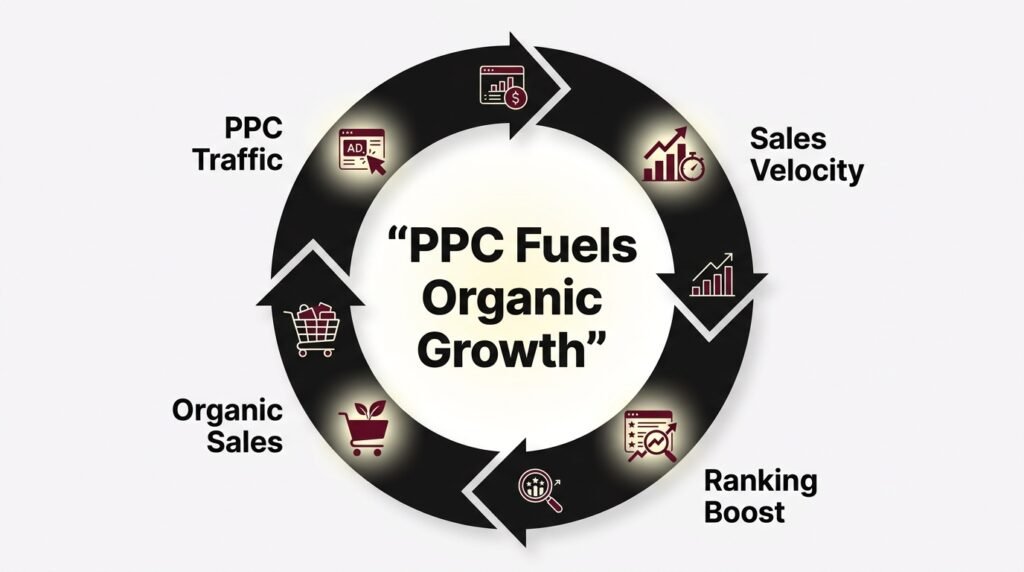
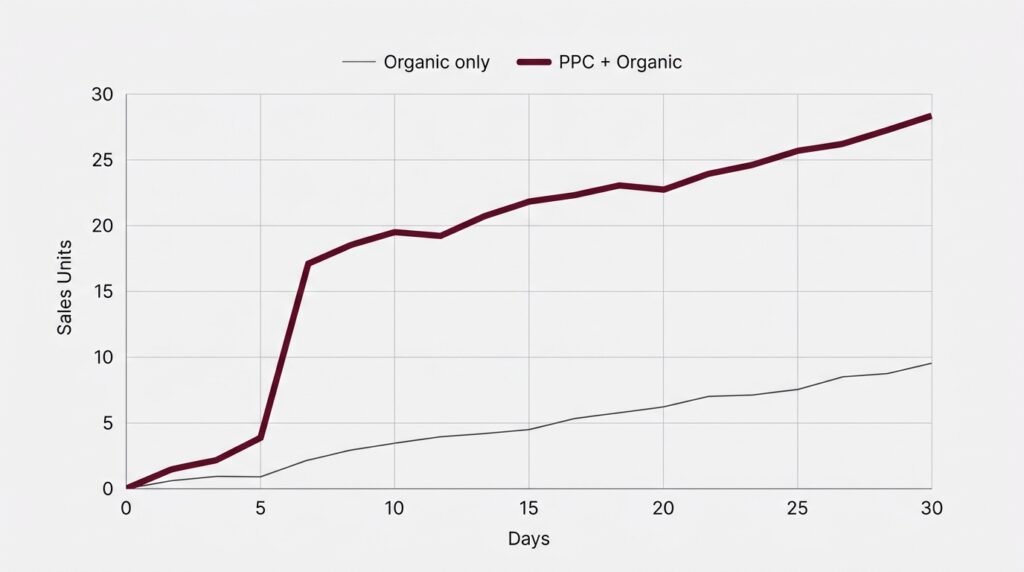
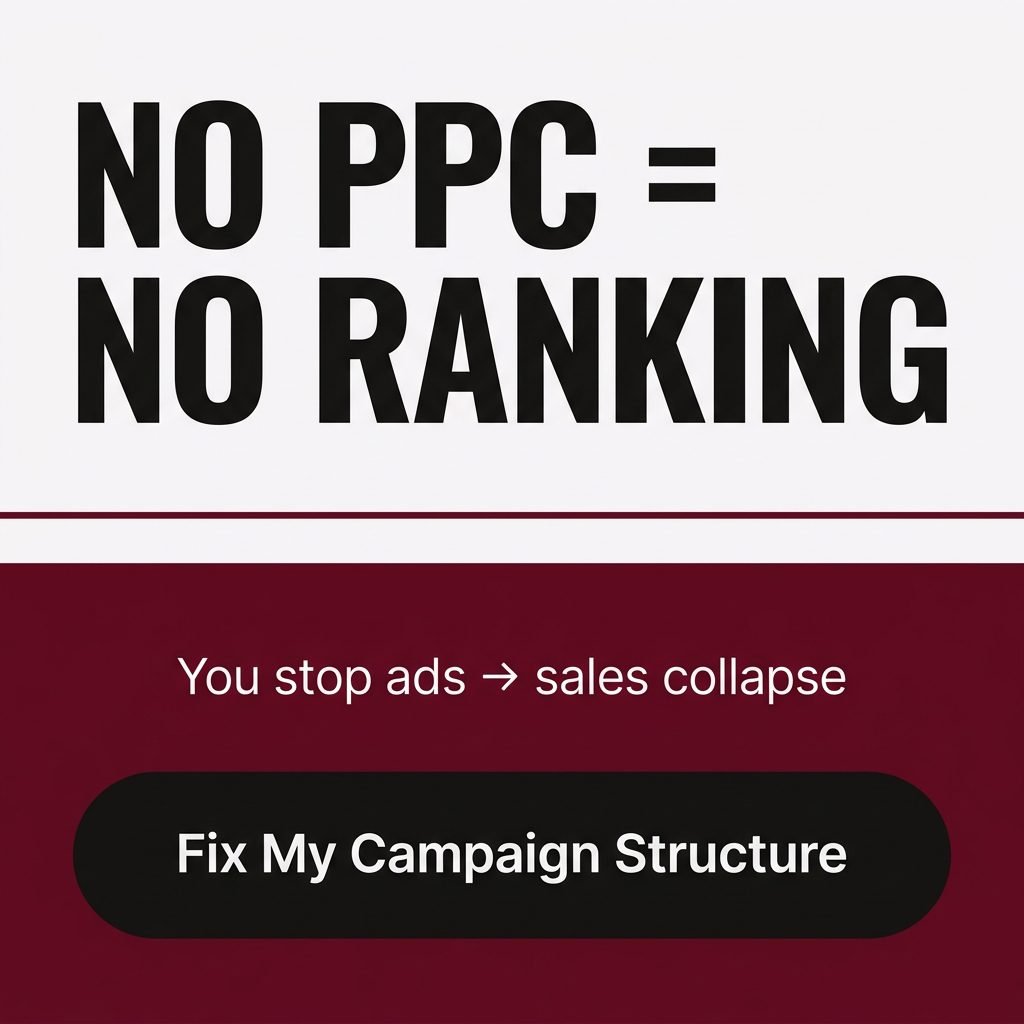
Amazon merchants who stick to optimized PPC campaigns observe 40-60% spike of their total revenue in terms of organic sales. Pause the ads and watch the collapse. Sales velocity will die. Rankings will drop in two weeks. Organic revenue will collapse by 30-40%. The organic traffic was actually fed by PPC.
PPC sales translate into stable rankings and your campaign structure determines whether you are building assets or burning cash.
Foundation of Amazon PPC
PPC routes traffic to your listings but it cannot fix a broken listing. Weak images, vague bullet points, zero reviews; your ads will burn money.
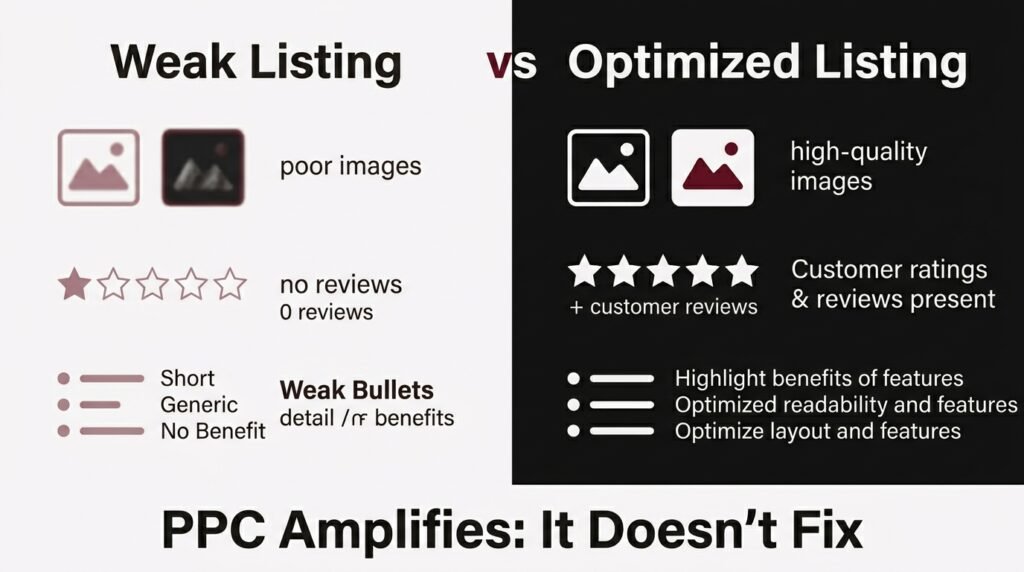
Get the listing right first. Images that make buyers pause. Bullets that handle objections instantly. A+ Content that keeps them reading. Pricing that competes. At least 15 reviews above 4 stars. FBA for the Prime badge. None of this is optional. This is the baseline. PPC stacks results on top of it. Skip it and every ad dollar goes nowhere.
PPC Conversions To Stack Up Total Brand Revenue
Amazon ranks products that acquire consistent sales. PPC creates that consistency. The algorithm doesn’t care why. It just observes the decline and demotes you. The absolute pause of PPC completely backfires, even when organic sales are strong.
PPC sales secure permanent rankings and your campaign structure determines whether you are building assets or burning cash.
1. Ranking Velocity
A product moving 3 units daily sits buried in organic results. Add PPC to attain double or even triple the sales velocity. Within a week, organic rank climbs to position 15-25. The rank improvement sticks even after you cut Ad spend.
2. Conversion Rate Compounding
Amazon prioritizes listings with high conversion rate (C.V.R). An 18% conversion rate beats a 12% competitor every time, even with identical keywords. PPC drags you to conversion thresholds faster. Organic traffic alone might take 60-90 days to generate that data. PPC delivers those conversions in 7-14 days. This acceleration matters in competitive categories where ranking windows close quickly.
3. Keyword Indexing Priority
Amazon tracks purchases, not merely clicks. Someone searches “portable yoga mat” but buys yours. Amazon locks that keyword to your listing. Do it once. Do it hundreds of times through PPC, now you own that term.
Without ads, your listing rots on page three. Nobody clicks. Amazon forgets you exist. PPC skips that death spiral. You land on page one day one. Stack enough conversions on a keyword and organic rank follows.
The math is brutal but simple. Paid traffic builds the purchase history. Purchase history earns organic rank. Organic rank delivers free traffic. PPC pays for itself and then disappears into profit.
Strategy 1: PPC Campaign Structure That Scales Up Sales Momentum
Running a single auto campaign is a recipe for wasted budget. The majority of spend bleeds into irrelevant traffic while high-intent keywords slip through the cracks entirely. Sellers who scale successfully run three campaign types simultaneously:
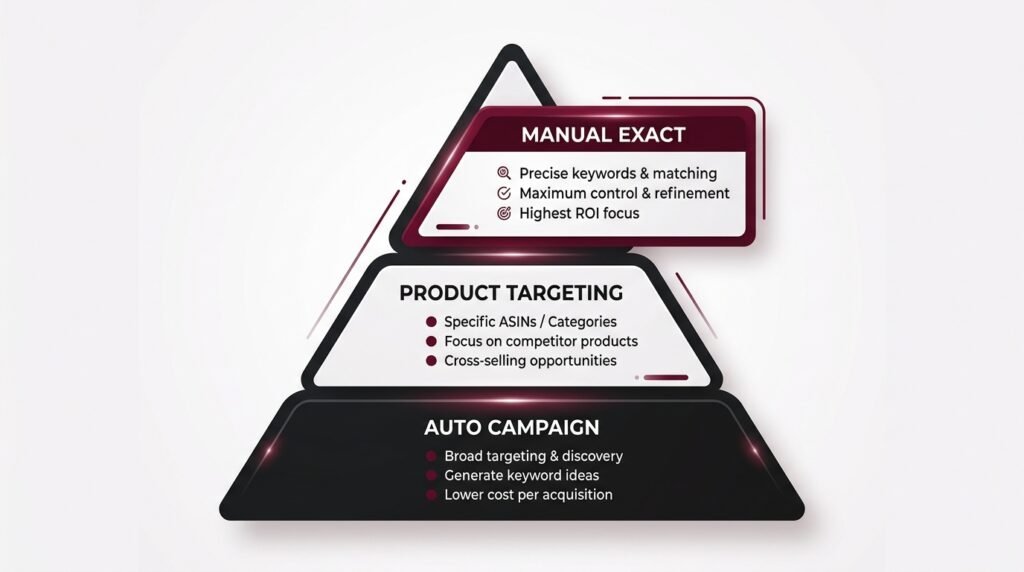
- Auto Campaigns for Discovery
- Manual Exact Campaigns for Ranking
- Product targeting for stealing competitor traffic
1. Auto Campaign Foundation
Auto campaigns let Amazon do the digging. It scans your listing, reads your content, and discovers new keywords. Dozens of fresh keywords surface every month.
Keep bids conservative. Start at roughly half your target CPC for main keywords. Lower bids will naturally filter out low-intent clicks. This campaign will not serve as profit center. It’s built to hunt. Feed it just enough budget to keep pulling data.
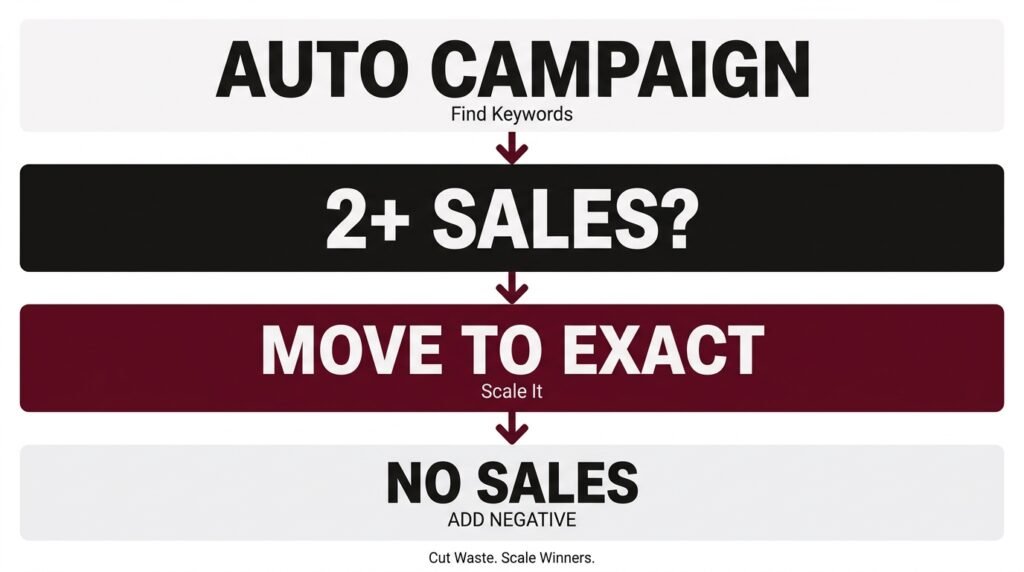
Mine search term reports weekly. A search term that lands two conversions at solid profit margins; promote it to manual exact. Conversely, the terms that rack up clicks without sales; bury them in negative match.
2. Manual Exact Campaigns
Manual exact prints money. No guessing. No testing. Just results on repeat. Throw the biggest chunk of your budget at these campaigns and watch them outperform everything else in your account.
Structure by performance, not product. Separate your manual campaigns into tiers: top performers, mid-range keywords, and a testing bucket. This separation empowers budget allocation with surgical precision.
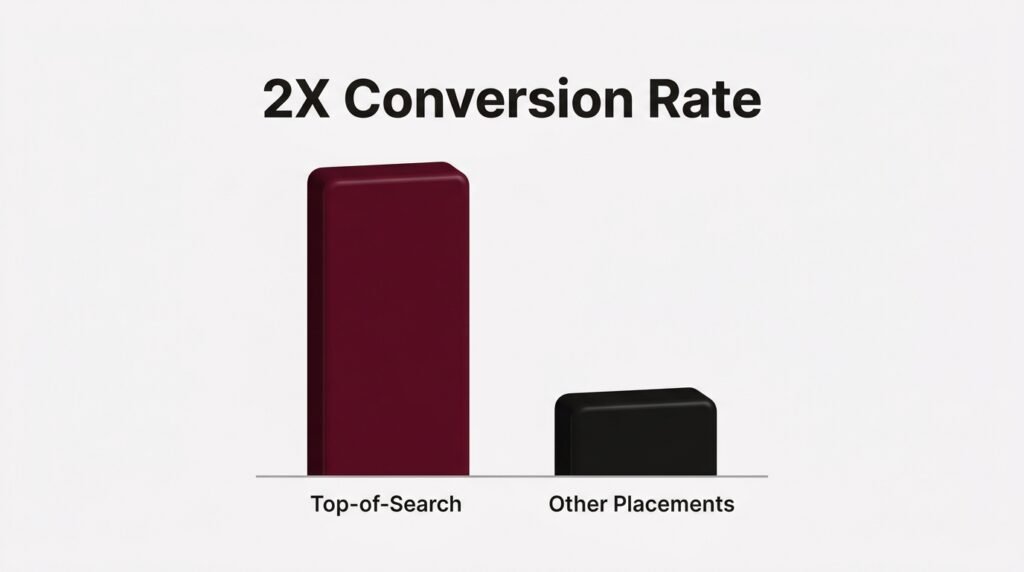
Invest Heavily in Top-of-Search placement for your best keywords. The top sponsored position converts at nearly double the rate of lower placements. Applying strong top-of-search multipliers to your highest-performing keywords is one of the highest-ROI moves in Amazon PPC.
3. Product Targeting
Product targeting places your ad directly on competitor listings. A shopper already evaluating a higher-priced alternative sees your product at a better value — and you’re catching them at the moment of decision.
Target strategically. Focus on competitors with a moderate number of reviews. Avoid going after dominant listings with thousands of reviews: the credibility gap is too wide for most shoppers to bridge. Your review count should be within striking distance. This strategy to convert well.
Bid lower than keyword campaigns. The purchase intent is already validated. This channel works best with a smaller budget allocation. Treat it as an incremental conquest layer rather than a primary growth driver. Product targeting campaigns should run at 25-35% ACoS with 10-15% of total budget allocation.
Strategy 2: PPC Launch Strategy: New Products vs Established Products
Two different situations. Two different playbooks. Running the same PPC strategy on a new product and an established one wastes money on both.
New Product Launch
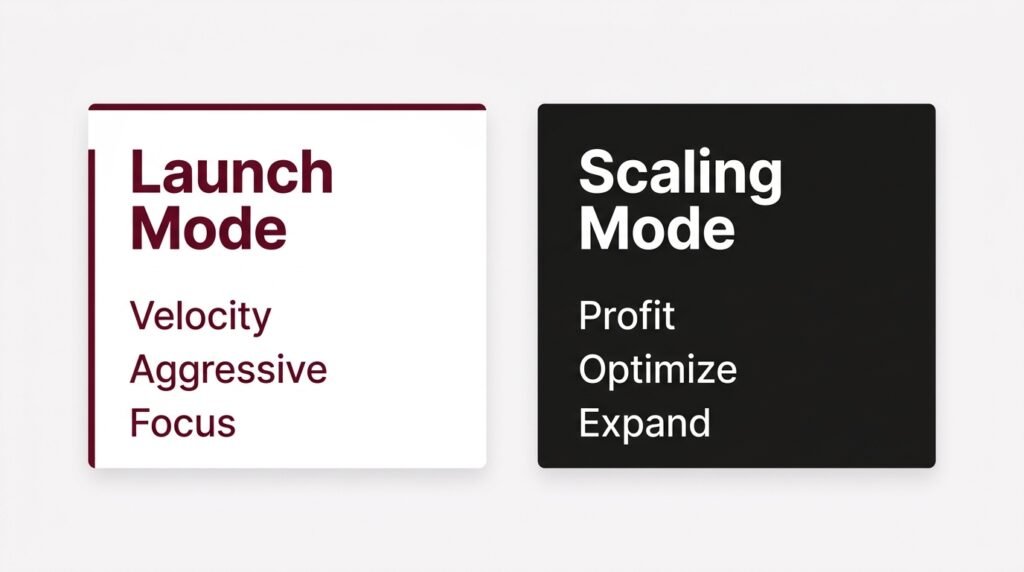
Day one. Zero reviews. Zero sales history. Amazon doesn’t trust your listing yet. Your only job is building velocity fast.
Start with auto campaigns. Low bids. Let Amazon find relevant traffic. Run simultaneously with manual exact on five to eight core keywords. These are the terms you must own. Bid aggressively on them. Overpay if needed. Early rank matters more than early profit.
Budget runs heavy upfront. 40-50% ACoS is normal. Expected. Necessary. This is not the time to optimize for efficiency. This is the time to feed the algorithm data. Sales velocity. Conversion signals. Keyword associations. Every sale teaches Amazon where to place you.
First thirty days. Focus on core keywords only. No broad expansion. No product targeting yet. Spread too thin and nothing gains traction. Concentrate spend. Dominate a few terms. Let rank build on those before expanding.
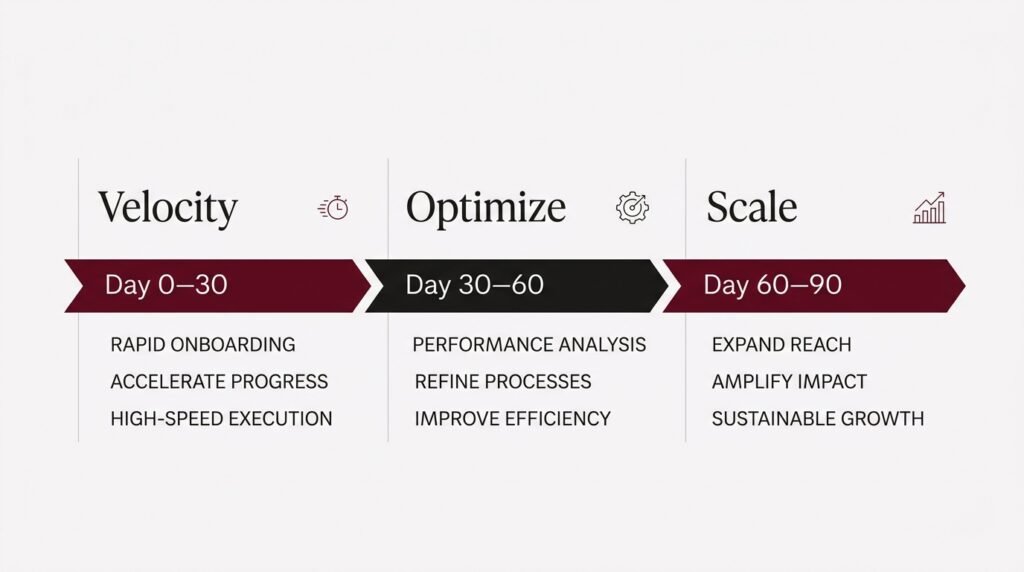
Days thirty to sixty. Search term reports show what converts. Promote winners to manual exact. Cut dead terms. Start product targeting against weaker competitors. Ones with similar review counts. Similar price range. Winnable fights only.
Days sixty to ninety. TACoS should trend downward. Organic sales should increase. If both happen, PPC is working. Scale winning campaigns by 25% increments. Add Sponsored Brand Video if your product demonstrates well. Begin testing broader keywords.
By month three, the foundation is set. Profitable campaigns funded. Organic rank climbing. Testing budget exploring new terms. The launch phase is over. Growth phase begins.
Established Product Scaling
Different starting point. You have sales history. You have reviews. Amazon already trusts your listing. The goal shifts from survival to dominance.
Audit existing campaigns first. Most established sellers carry dead weight. Keywords that stopped converting months ago still eating budget. Match types that bleed spend on irrelevant traffic. Clean house before scaling anything.
Structure campaigns into the three-tier system. Top performers separated from mid-range. Testing isolated from both. This structure probably doesn’t exist yet. Build it. Every scaling decision depends on it.
Push top-of-search multipliers on proven keywords. These terms already convert. Pay more for the slot that converts hardest. This single move often delivers the biggest profit jump for established products.
Launch product targeting campaigns against new competitors. The category shifted since your last audit. New sellers entered. Some gained traction. Target them before they target you.
Expand keyword coverage through auto campaigns. Established listings match to more queries. Amazon has more data on your product now. Auto campaigns surface opportunities that didn’t exist during launch.
Test Sponsored Brand Video. Established products have customer feedback. You know the objections. You know the selling points. Build videos around what actual buyers care about. Not assumptions.
Scale budget in 25% increments on campaigns holding target ACoS for two weeks. Never double overnight. Monitor TACoS monthly. It should stay flat or decline as organic revenue grows alongside ad spend.
The difference between launch and scaling is simple. Launch builds the machine. Scaling feeds it. We structure both phases so every dollar has a purpose from day one through year three.
Strategy 3: Bid Optimization To Scale Up Profitable Conversions
Bidding on gut feeling burns cash. Profitable bidding runs on math. Break-even calculations. Placement data. Conversion thresholds. Nothing else.
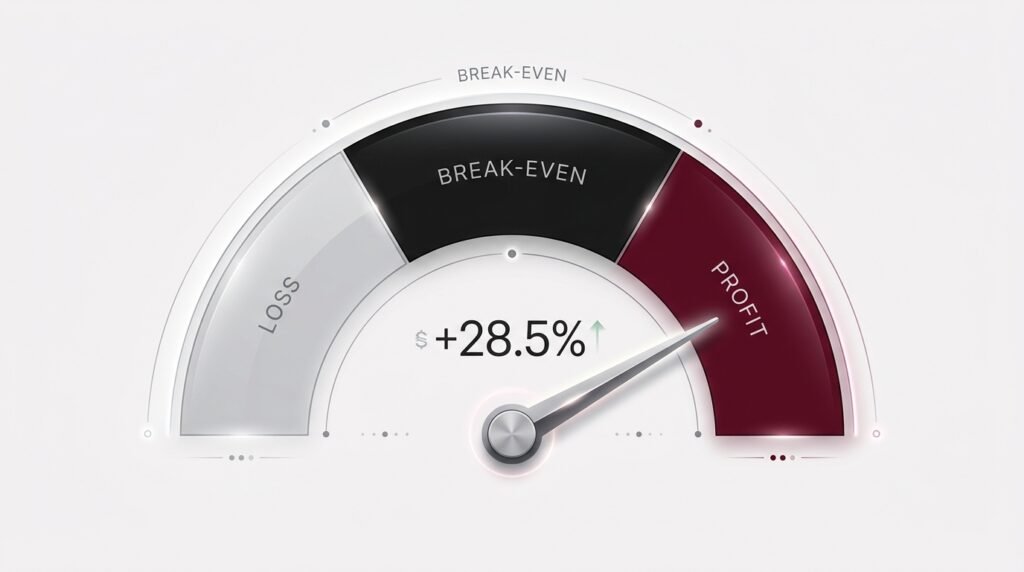
Break-even ACoS equals your profit margin. Memorize it. Every campaign either runs under it or it doesn’t. If you’re well below your break-even, you are inefficient. Push harder.
But, where to push and where to pull back, the insight is below:
1. Placement Multipliers
Top-of-search converts nearly twice as well as product page placements. That gap justifies paying significantly more per click for that slot. Keywords running well under your target ACoS have room. Use it. Crank top-of-search multipliers and let those keywords fight for the spot that actually closes sales.
Conversely, product page placements are a different animal. These clicks interrupt browsing. Conversion rates drop hard. Keep these multipliers low. Cut cost without losing presence.
2. Time-Based Adjustments
Conversion rates fluctuate by hour and day. Most consumer products peak between 8 PM and 11 PM. Early morning traffic burns budget on low-intent clicks and browsers rarely convert.
Amazon doesn’t offer dayparting. Do it manually. Bump bids during peak evening hours. Pull them back late night. Simple discipline, real impact.
Day-of-week patterns matter too. Sundays crush Wednesdays for consumer products. B2B converts harder midweek. Track your own data. Shift budget and refrain from spreading spend evenly across days.
3. Defensive Brand Bidding
Competitors bid on your brand name. They sit above your organic listing and rob clicks you earned. Branded searches convert at the highest rate in your entire account. Letting someone else capture that traffic is handing away profit.
Run brand defense campaigns. Exact brand name. Bid for the top spot. These campaigns run at the lowest ACoS in your portfolio because the buyer already came looking for you.
Track impression share. If it dips, competitors are winning your own name. Raise bids until you dominate branded results again. This is not the place to penny-pinch. Protect your asset.
Strategy 4: Budget Allocation For Exponential Growth
Random budget splits cap your growth potential. Money needs direction. The 60-25-15 rule works: 60% to campaigns already delivering, 25% to campaigns trending in the right direction, 15% to fresh tests.
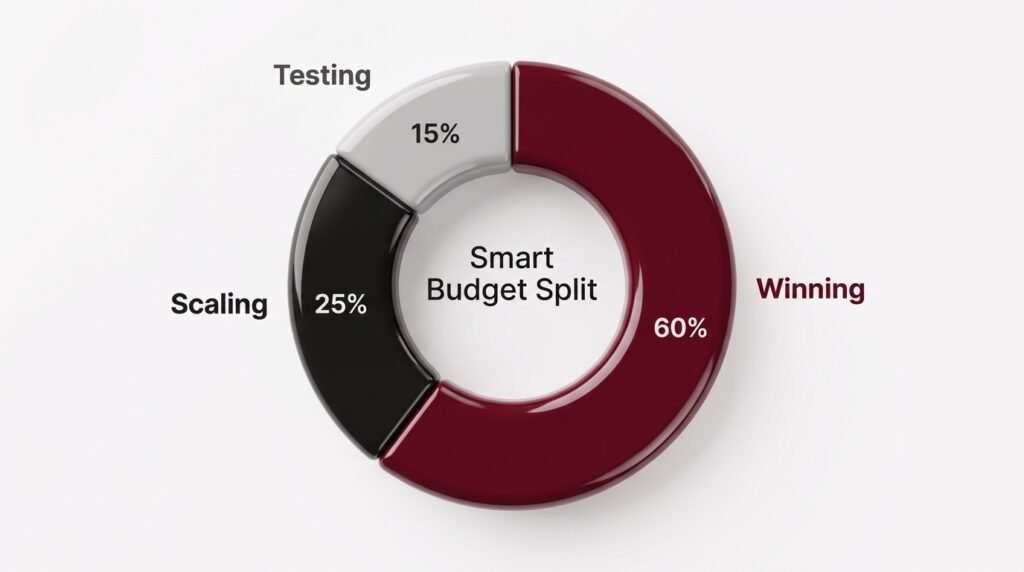
Successful campaigns achieve targeted ACoS for 60+ days. They eat most of the budget because they earn it. Conversely, scaling campaigns run slightly above targeted ACoS but the numbers keep improving. Testing budget feeds new campaigns, new keywords, new match types where data is minimal.
1. Daily Budget Impact
Amazon pauses campaigns when daily budget is drained. That cutoff usually hits mid-afternoon or during peak traffic hours. Your best-performing campaign goes dark exactly when buyers are most active to shop.
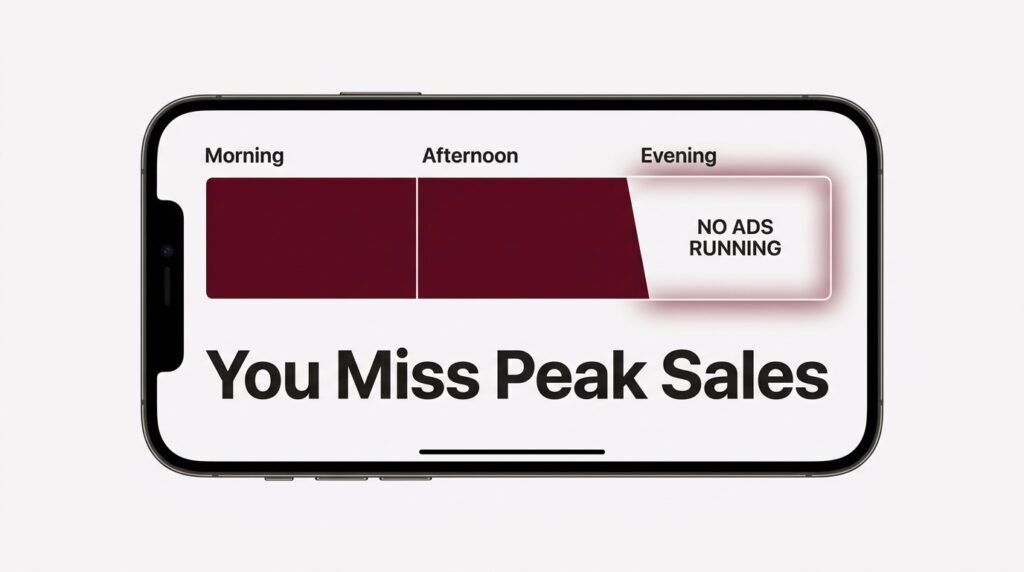
Set daily budget higher than your target pace. Missing peak hours in the light of a budget cap is an expensive mistake that never shows up in reports. Monitor lost impression share due to budget in campaign reports. If this metric exceeds 15%, you’re missing traffic volume.
2. Budget Scaling Triggers
Refrain from increasing budgets randomly. Use triggers that indicate readiness. A campaign that holds target ACoS for 14+ days while draining out its daily budget. That’s the trigger. Increase by 25%. The campaign is ready for a 25-40% budget increase.
However, seasonal categories don’t wait for triggers. Dog products surge November through December. Fitness spikes in January. Pre-load budget increase before the wave hits. If you are scaling when demand is already peaking, you are already late.
3. Testing Budget Protection
Protect 10-15% of total PPC budget for scientific testing. Non-negotiable. This money is not meant to outperform your main campaigns. However, without testing budget, you’ll endlessly optimize existing campaigns while missing new growth avenues.
Testing budget has an altogether a different success criteria. A test campaign at 55% ACoS isn’t a failure if it uncovers a keyword cluster. Give tests time. Thirty days minimum before you judge. Plenty of tests bleed in week one and turn profitable by week three.
Different rules apply here. A test running at high ACoS isn’t a failure if it uncovers a keyword cluster nobody else is bidding on. Give tests time. Thirty days minimum before you judge. Plenty of tests bleed in week one and turn profitable by week three.
Strategy 5: Advanced Tactics From High-Revenue Sellers
Basics work, but advanced strategies create separation from competitors. Sellers running $500,000+ annual revenue through Amazon use tactics that 90% of competitors never attempt. These aren’t complex, just disciplined applications of platform features most sellers ignore.
Basics get you in the game. Advanced tactics pull you ahead. Sellers earning massive revenue on use these tactics most. They are not complicated. However, they require discipline. You can learn more by checking these in-depth Amazon statistics and trends.
1. Sponsored Brand Video
Video ads outsell static images. Not always. But when your product needs demonstration, nothing else comes close.
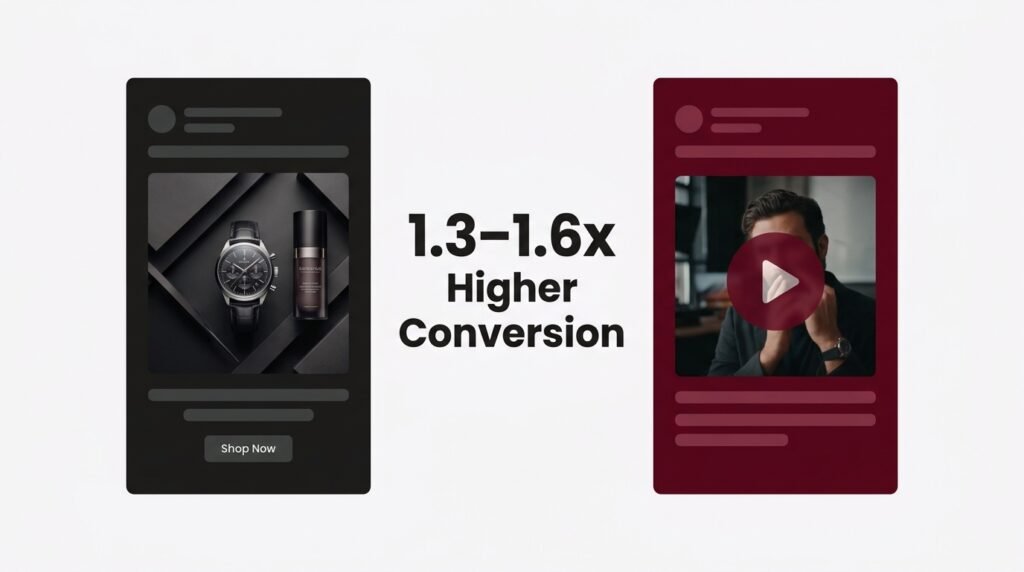
A collapsible dog bowl. A yoga mat with alignment lines. A quick-release buckle on a collar. These features flatten in photos. Video ads cost 15-25% more per click but generate 1.3-1.6x higher conversion rates. The math favors video every time the product has a feature worth showing.
Format matters. Amazon requires 1920×1080 resolution minimum. 6 to 45 seconds long. MP4 or MOV format. File size under 500MB. Aspect ratio 16:9. Anything outside these specs gets rejected. No wasted upload time.
The first three seconds decide everything. Buyers scroll fast. Your video either stops them or loses them. Lead with the product in use. Not a logo. Not text. Not a slow fade-in. Show the product solving the problem immediately. A water bottle proving leak-proof. A dog collar snapping on in one motion. Action first. Always.
Structure the remaining seconds tight. One feature per scene. Three to four scenes maximum. Show size in someone’s hand. Show durability under stress. Show the result after use. Close with the product against a clean background and your brand name. No voiceover needed. Captions work harder. Most buyers watch on mute.
What to cut. Brand origin stories. Lifestyle montages. Slow pans across packaging. Music-driven mood pieces. None of these convert in a search result. The buyer has one question. “Does this solve my problem.” Every second of video answers that or gets cut.
Length recommendation. 15 to 25 seconds performs strongest. Long enough to demonstrate. Short enough to hold attention. Videos over 30 seconds see drop-off rates climb sharply. Tighter is always better.
2. Brand Analytics Report
Brand Analytics exhibit every converting keyword in the category. Not impressions. Not clicks. Conversions. Amazon hands this out free.
Search Frequency Rank exposes which terms acquire sales in today’s calendar. Today. Not last month. From there, Market Basket Analysis goes deeper. It reveals products which buyers are “Adding to The Cart”. Then Repeat Purchase Behavior answers the last question. Are customers returning to your listing or vanish after one order.
3. Amazon Brand Story
Your listing gets one shot at trust. Brand Story builds it when curious buyers scroll after the bullet points. This is not fluff but this section can actually scale up your conversion to 10 folds.
Lead with the problem. Follow with the solution Real images. Real use. No stock shots. No corporate speak. Your Brand Story gets one scroll. One chance. The buyer decides in seconds. Give them a reason to stay.
4. Premium A+ Content
Standard A+ is table stakes. Premium A+ is the competitive edge. Bigger images. Interactive modules. Video placement directly on your listing. Premium A+ dominates the screen.
Comparison charts lay it bare. Your product. Their product. Same screen. The gaps speak. The buyer doesn’t abandon your page. Premium A+ extends that attention. More seconds on page. Fewer bounces. Stronger conversions. Your listing does the selling.
5. Customized Amazon Storefront
Amazon storefront serves as a mini-website and Sponsored Brand can route buyers explicitly land on your customized storefront. The buyer breathe inside. No search results. No competitor listings. Just pool of your own products. Every second is a second away from competition. One PPC click does the work of five and average order value jumps.
6. Amazon Brand Registry
Every premium feature listed above mandates Brand Registry. Premium A+ Content. Brand Story. Sponsored Brand Video. Brand Analytics. Customized Storefront. None of it exists without enrolment in Amazon Brand Registry.
Enrolment is free though it requires a registered trademark. The application takes two to four weeks. Once approved, every advanced tool instantly comes into your grip. This is the entry ticket to serious PPC performance.
Strategy 6:Calcuting KPIs That Piles Up Profit
ACoS alone is a worthless metric. A campaign at low ACoS might be stealing your organic sales. Conversely, a campaign at high ACoS might be printing money via repeat buyers. One number never pictures the full story. TACoS, new-to-brand percentage, and organic rankings are core metrics in parallel to ACoS.
1. TACoS Calculation
TACoS measures ad spend against total revenue. The distinction matters. ACoS hides the bigger picture. TACoS exposes it.
TACoS = [Ad Spend ÷ Total Revenue] * 100
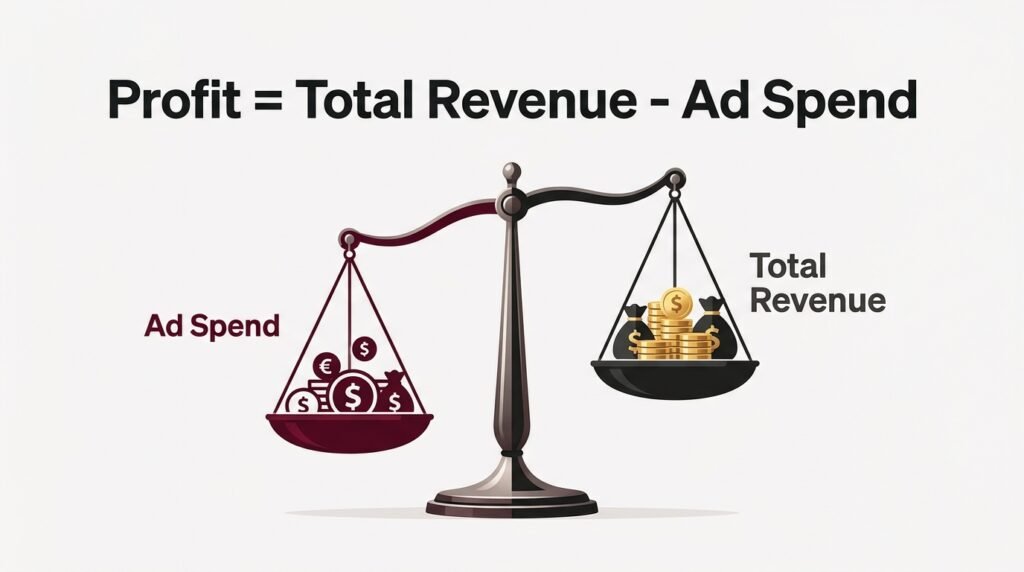
Healthy TACoS for an established brand sits at 8-12%. New launches bear high TACoS for the first few months. That’s expected. Rankings need building. Reviews need stacking. But the number should fall month over month. If PPC strengthens organic rankings, organic sales rise. Ad spend stays the same. TACoS drops. That’s the green signal. You can explore these numbers further with Amazon sales growth statistics on Oberlo.com.
However, TACoS sticks above 25% after six months is a red flag. The listing is not fetching optimal conversion. It is not fatal. It just needs diagnosing.
2. New-to-Brand Metrics
Amazon tracks every PPC buyer. New-to-brand metric exhibits what percentage of PPC sales come from customers who haven’t purchased from your brand in the last 12 months. This one metric separates growth from recycling.
High new-to-brand rates mean fresh customers. Low rates mean wasted spend. You’re paying for buyers already coming. That’s not growth. That’s a tax on demand.
When 70% of PPC buyers are new to your brand, spend more. Those buyers don’t stop at one purchase. They come back. Second order. Third order. Each reorder stretches the value. ACoS only sees the first sale. New-to-brand sees the full revenue trail behind it.
New-to-Brand % = [New Brand Customers ÷ Total Customers] * 100
3. Organic Rank Tracking
The ultimate PPC success is improved organic rankings. Not sponsored position but organic positions. Track your top keywords weekly. Optimized PPC should push organic rank higher within the first four weeks of consistent spend.
However, if rankings are stagnant after thirty days of heavy spend, your listing is broken. Conversion rate. Listing quality. Competitive price. The spend alone cannot plug the deficiencies of weak listings.
Use third-party rank tracking tools to monitor daily organic ranks. Correlate every budget change with rank movement. That connection is your feedback machine. If more spend produces higher rank, scale harder. If more spend produces nothing, stop and fix the foundation first.
Frequently Asked Questions
What is a good ACoS for Amazon PPC in 2026?
Profit margin minus desired profit. That’s your number. New products run 40-50% for sixty days. That spend buys rank. Established products sit at 15-30%. Category competition shifts the range. High-competition niches run higher. Low-competition categories tighten faster. We nail profitable ACoS within month one because we build targets around your actual margins. Not industry averages.
How much should I spend on Amazon PPC daily?
10-15% of target monthly revenue. We set exact budgets per product. Your campaigns never shut off during peak hours. Most sellers underspend and wonder why rank doesn’t move. Others overspend on the wrong campaigns. Budget without structure wastes money. We allocate Ad budget to winning campaigns.
Can PPC help a product with low reviews rank better?
Absolutely. Fifteen reviews can hit page one with enough velocity. Reviews affect conversion rate. Not ranking eligibility. PPC pushes velocity regardless. We time your scaling so every dollar lands when your listing is ready to convert. Too early wastes budget. Too late loses momentum. The window matters.
Should I run PPC on products already ranking organically?
Yes. Competitors advertise on your ranking keywords and steal 20-35% of organic traffic. Every click they take is revenue you earned but never received. Defensive PPC prevents that loss. It also compounds your rank further. We set up brand defense at minimal cost so your organic position strengthens instead of eroding.
How long does it take for PPC to improve organic ranking?
Three to four weeks. Consistent daily conversions trigger rank movement. Medium-competition keywords respond fastest. High-competition keywords need heavier volume. We track ad spend on DataDive and monitor organic ranking daily. Every budget change maps to a rank result. No guessing. No waiting months to find out.
What is the difference between ACoS and TACoS?
ACoS sees ad sales only. TACoS sees total revenue. A campaign can look expensive on ACoS while driving massive organic growth. TACoS catches that. Most sellers only watch ACoS. They cut spend too early. Rank drops. Organic revenue disappears. We track both so you see the full return on every dollar spent.
How often should I optimize PPC campaigns?
Weekly keyword reviews together with bid adjustments. Budget shifts every two to three weeks. We run tight cycles to sharpen campaigns fast. Most sellers either optimize daily and choke the data or wait months and bleed budget. Neither works. Disciplined intervals produce consistent improvement. We handle every cycle so you focus on product and supply chain.
Do Sponsored Brand ads work better than Sponsored Products?
Different tools. Different jobs. Sponsored Products convert high-intent searches at 14-20% CVR. Sponsored Brands capture broader attention across your catalog at 8-12% CVR. Most budget belongs in Sponsored Products. Sponsored Brands fill strategic gaps. We structure the split based on your catalog size and growth stage. Ad spent ought to be allocated to winning campaigns.