



Purchase Orders and Supply
We review incoming POs, confirmation dates, quantities, ship windows, open lines, cancellations and supply constraints so the team knows what Amazon ordered and what must happen next.

Vendor Central is not Seller Central with a different login. Amazon is your retail customer. It sends the purchase orders, receives the inventory, pays the invoices and applies deductions when the operating record does not line up.
We manage the daily 1P workload across purchase orders, shipments, shortages, chargebacks, catalog, forecasting, vendor terms and Amazon Ads, so the account is run from one operating view instead of several disconnected queues.
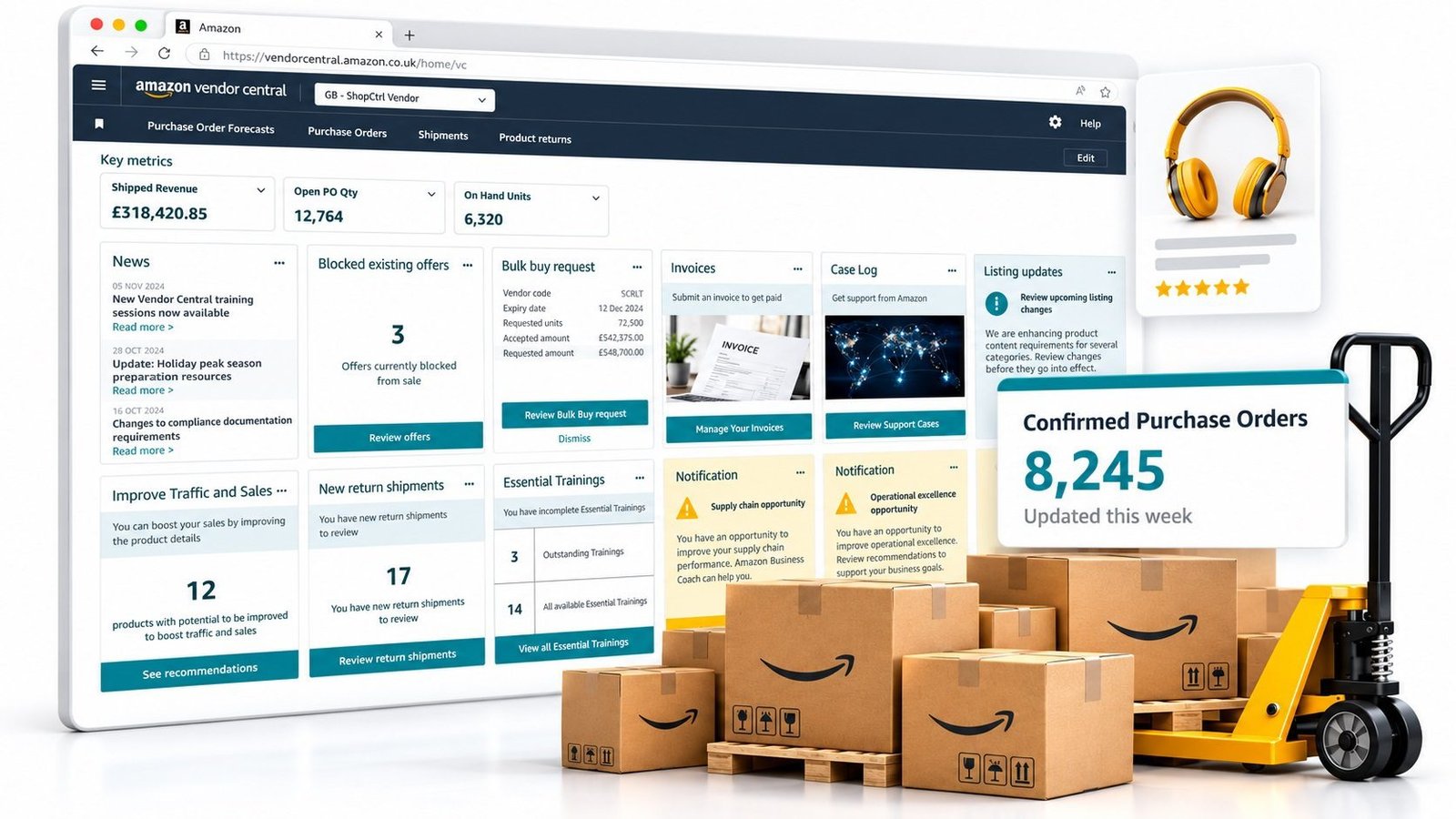
One missed shipment detail can become a chargeback. One receiving mismatch can become a shortage claim. One catalog issue can leave an ASIN unavailable while Amazon still has inventory. The service has to connect operations, finance, retail content and media.
We review incoming POs, confirmation dates, quantities, ship windows, open lines, cancellations and supply constraints so the team knows what Amazon ordered and what must happen next.
We check routing requirements, shipment records, carton data, labels and Advance Shipment Notification details before errors reach receiving and turn into deductions.
We trace deductions back to the PO, shipment, ASN, receiving record and invoice, then dispute eligible items with the evidence available for that transaction.
We handle new item setup, attribute corrections, content changes, A+ Content, unavailable ASINs, variation issues and the cases needed to keep the retail detail page usable.
Forecasts are read beside PO history, sell-through, seasonality, current inventory and supply constraints so planning does not depend on a single forecast number.
We connect 1P economics, recurring allowances, cost discussions and Amazon Ads with the products Amazon is buying and the inventory it can actually sell.
The operating model changes because the commercial relationship changes. A Seller Central playbook cannot simply be copied into a 1P account.
Most Vendor Central finance problems begin earlier in the operating chain. We track the handoffs from the order Amazon places through shipment, receiving and settlement.
Review quantities, dates, warehouse requirements, item status and lines that need attention before confirmation.
Confirm what can be fulfilled, document constraints and avoid promising quantities the supply chain cannot ship.
Check routing, labels, carton information, shipment records and ASN data against the PO before departure.
Watch receiving differences, shortages and chargebacks while proof of shipment and delivery is still easy to retrieve.
Match invoices and remittances back to the order and shipment so deductions are not reviewed without the original transaction.
Accepting every PO line is not good PO management. The confirmation has to match inventory, production timing and the shipment the warehouse can actually execute.
A shortage claim and an operational chargeback are not the same problem. We review each deduction against the records that created it instead of sending the same generic dispute for every case.
Disputing a valid chargeback does not solve the underlying issue. When the same code repeats, we work backward from the deduction to the warehouse or data step that created it.
Patterns matter more than one-off disputes. We group deductions by code, value, ASIN, warehouse, carrier and timing so the team can see where money is leaking repeatedly.
Amazon can have inventory while the detail page still has a content, variation or buyability problem. We manage the retail side alongside the supply side so traffic is not being sent to an ASIN that is not ready to sell.
Prepare identifiers, attributes, variation structure and retail content before a new item is expected to receive meaningful traffic.
Handle title, bullets, images, A+ Content, attributes and catalog cases when the live detail page does not match approved product information.
Separate content, compliance, offer, inventory and catalog causes before deciding which case path or internal action is needed.
Review parent-child structure and item relationships so the retail family stays logical, supported and easy to maintain.
Coordinate A+ Content, Brand Store and creative changes with the ASINs Amazon is actively ordering and advertising.
Track cases by issue, evidence, latest response and next action so important retail problems do not disappear into a shared support queue.
Amazon forecasts are useful planning signals, not purchase commitments. We compare them with what Amazon has actually ordered and sold before they influence production or inventory decisions.
A forecast can move before the purchase-order pattern moves. We use forecast data as one input, then compare it with PO history, retail demand and supply constraints before the brand commits inventory.
Reporting only helps when it changes an action. We bring retail performance, inventory, PO activity, deductions and advertising into one weekly view instead of sending separate exports from each area.
Sales direction, traffic, conversion and ASIN-level changes that need an explanation.
What Amazon ordered, what was confirmed, what shipped and where availability is becoming a risk.
New shortage claims, chargebacks, invoice issues, open disputes and recurring reasons.
Spend and retail performance beside inventory and contribution so media is not reviewed in isolation.
Wholesale revenue can rise while contribution falls. We build the operating view around what is left after the commercial and operational costs of the 1P relationship.
When Amazon asks for new terms or a cost conversation starts, we prepare the numbers before the commercial decision is made.
Advertising cannot be separated from the retail account. Media decisions should reflect whether the ASIN is buyable, whether Amazon has stock and whether the product still makes sense after wholesale economics and deductions.
Budget follows products that can stay buyable instead of pushing traffic toward items already running low.
Content, availability, buyability and ads are coordinated so a new item is not promoted before the retail setup is ready.
We compare ad performance with the wider retail result rather than treating platform ROAS as the only measure.
Brand defense, generic discovery, competitor targeting and launch campaigns are reviewed against the job each one is meant to do.
Promotional periods are planned beside inventory and PO timing so extra demand does not arrive when supply is already constrained.
We show which products are consuming spend, which are producing retail sales and which need an operating fix before more media is added.
Some brands use Vendor Central and Seller Central at the same time. That can work, but the rules need to be explicit so the two models do not create avoidable pricing, inventory or catalog conflicts.
For vendors using Amazon Direct Fulfillment, we can include those orders in the same operating cadence, with attention to order flow, shipment data, inventory availability and service-level exceptions.
EDI or SP-API automation can also be part of the operating setup when the account and internal systems support it. Amazon provides both EDI and API options for vendor workflows, so the right path depends on the systems your team already uses.
Vendor Central needs repeated operational ownership. The exact cadence changes by account size, but these queues should always have a named next action.
New POs, confirmations, open lines, ship windows, fill-rate risks and low-stock ASINs.
Shortages, chargebacks, invoices, deductions, disputes and settlement follow-up.
Catalog errors, unavailable detail pages, content changes, variations, buyability and pricing issues that need review.
Retail sales, advertising, promotional readiness, new items and ASINs that need a commercial decision.
We keep the parts of the account that already work. The first month is used to understand the current operating model, clear urgent problems and put ownership around the recurring work.
Map vendor codes, users, active terms, open disputes, case history, integrations and current reporting.
Review confirmation practices, open orders, fill-rate issues, shipment workflow and ASN problems.
Group shortages and chargebacks by reason, value, frequency, evidence and dispute status.
Find unavailable ASINs, content conflicts, item setup problems and catalog issues affecting retail readiness.
Prioritize revenue and margin issues first, then assign a weekly cadence to the remaining account work.
Vendor Central can be managed as a dedicated 1P service, or combined with the areas below when the same team needs to handle advertising, account operations, SEO, catalog or creative work.
Campaign structure, bids, budgets, placements, search-term work and reporting across Sponsored Ads.
Learn moreSeller Central operations, account health, inventory, cases, catalog coordination and recurring account work.
Learn moreKeyword research, listing copy, backend terms, attributes, indexing checks and search-performance analysis.
Learn moreKeyword-level rank tracking, indexing checks, exact-match PPC support and search-performance monitoring.
Learn moreSuppressed listings, variations, bulk files, category corrections, duplicate listings and catalog conflicts.
Learn moreMain images, listing image sets, A+ Content, Premium A+ and Brand Story creative for Amazon product pages.
Learn moreChoose a time to discuss your Amazon 1P account with our team. We’ll talk through the main operational or commercial issue, what you have tried so far and which areas deserve attention first.
No account access is needed for the first conversation. Bring your main concern and we’ll start there.
Choose an Available TimeBook directly using the calendar below