
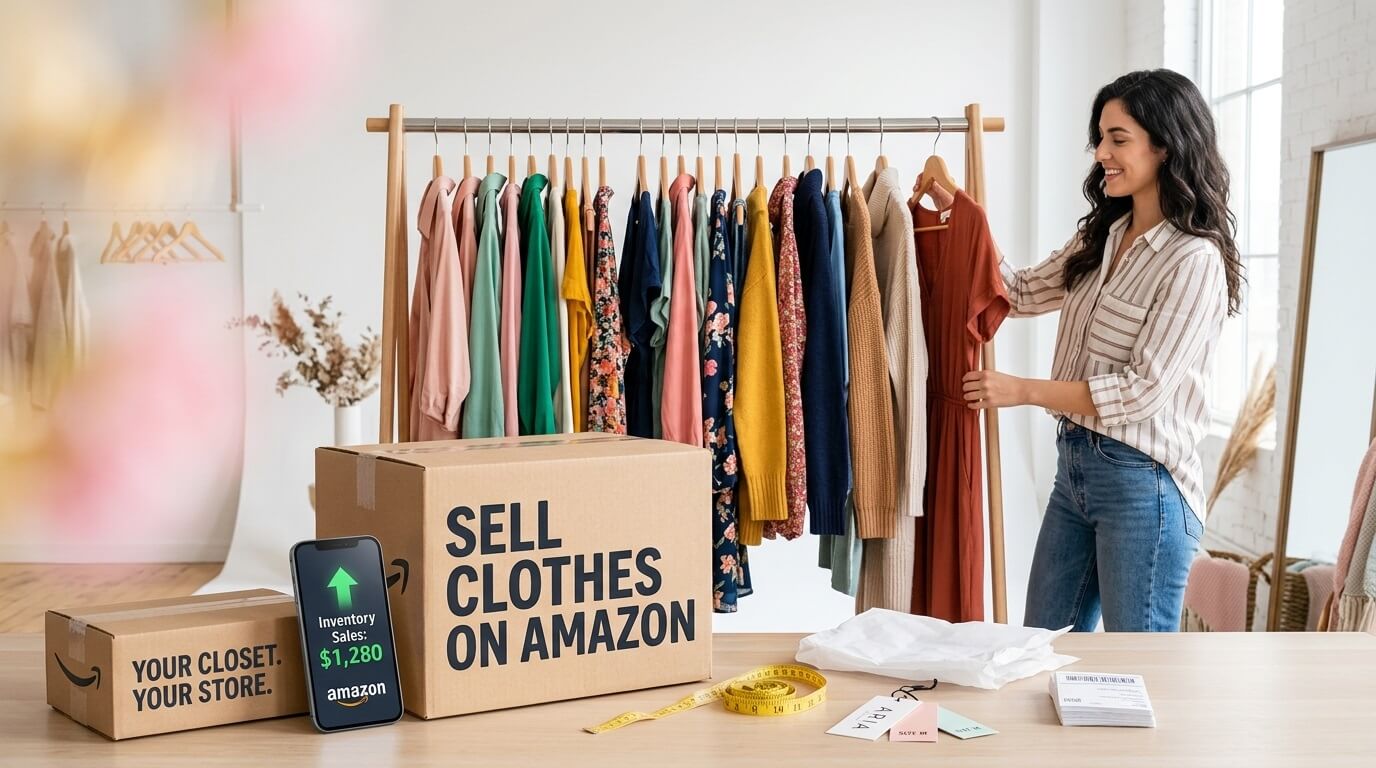
Selling clothes on Amazon is one of the most profitable ecommerce opportunities available today, but it also comes with unique challenges that most generic guides overlook. From navigating the platform’s strict prep requirements to managing return rates that are double the Amazon average, clothing sellers need a specific playbook that goes far beyond “create a listing and ship it in.”
This guide covers everything you need to know, including real fee breakdowns, profit calculations, compliance rules, and proven strategies that separate profitable clothing sellers from those who burn through inventory. Whether you are launching a private label brand or reselling wholesale apparel, every step is mapped out with specific numbers and actionable details.
Choosing the Right Business Model for Clothing
Not all Amazon clothing sellers operate the same way. Your choice of business model determines your startup costs, profit potential, time investment, and level of control over branding. Picking the wrong model for your situation is one of the fastest ways to fail.
Business Model Comparison
The following table breaks down the six most common approaches to selling clothing on Amazon, comparing them across the factors that matter most.
| Business Model | Startup Cost | Profit Margin | Control Over Brand | Complexity | Best For |
|---|---|---|---|---|---|
| Private Label | $3,000-$15,000+ | 25-45% | Full | High | Long-term brand builders |
| Wholesale | $1,500-$10,000 | 10-20% | None | Medium | Volume-focused sellers |
| Retail Arbitrage | $200-$2,000 | 15-30% | None | Low | Beginners testing the waters |
| Online Arbitrage | $500-$3,000 | 15-30% | None | Medium | Part-time sellers |
| Print on Demand (Merch on Demand) | $0 | 10-25% royalty | Partial (design only) | Low | Designers, low-risk entry |
| Handmade (Amazon Handmade) | $500-$5,000 | 30-60% | Full | Medium | Artisans and crafters |
Step-by-Step Guide to Selling Clothes on Amazon in 2026
Getting started requires a specific sequence of actions. Below is the complete process from account setup to your first sale.
Step 1: Set Up Your Amazon Seller Account
You need either an Individual or Professional seller account. For clothing sellers, the Professional plan is almost always the right choice because it unlocks bulk listing tools, advertising access, and eligibility for the Buy Box.
Here is what each plan includes.
| Feature | Individual Plan | Professional Plan |
|---|---|---|
| Monthly Fee | $0 (pay $0.99 per item sold) | $39.99/month |
| Per-Item Selling Fee | $0.99 per sale | $0 |
| Access to Advertising (PPC) | No | Yes |
| Bulk Listing Tools | No | Yes |
| Buy Box Eligibility | Limited | Full |
| Category Approval Requests | Yes | Yes |
| Brand Registry Eligible | Yes | Yes |
| Best For | Selling fewer than 40 items/month | Selling 40+ items/month |
To create your account, go to sellercentral.amazon.com and have the following ready.
- Government-issued photo ID
- Bank account and routing number for deposits
- Credit card for billing
- Tax information (SSN or EIN)
- Phone number for verification
Amazon’s identity verification process can take 24 hours to several days. Plan ahead so you are not stuck waiting when your inventory is ready to ship.
Step 2: Understand Category Approval and Gating
Amazon’s Clothing, Shoes & Jewelry category was historically gated, meaning sellers needed explicit approval before listing products. As of recent updates, Amazon has ungated many clothing subcategories for Professional sellers, making it significantly easier to get started.
However, certain situations still require approval.
- Gated brands such as Nike, Adidas, Under Armour, and other major labels require brand authorization or invoices to sell
- Certain subcategories may still require approval depending on your account history and selling metrics
- New seller accounts with no sales history may face temporary restrictions on specific categories
- Used clothing may have additional condition guidelines and restrictions
If you need category approval, Amazon typically asks for the following documentation.
- Invoices from a legitimate wholesale supplier showing a minimum quantity (usually 10+ units)
- Product images matching the listings you intend to sell
- Business license or incorporation documents (in some cases)
For private label sellers creating their own brand, the approval process is generally smoother since you are not selling restricted third-party brands.
Step 3: Source Your Clothing Products
Where you get your inventory directly affects your cost structure, product quality, and profit margins. Each sourcing method has distinct advantages and risks.
Private Label Sourcing Options
If you are building a private label clothing brand, these are the most common sourcing channels.
- Alibaba and Global Sources for finding overseas manufacturers (primarily in China, Bangladesh, Vietnam, and India). Expect minimum order quantities (MOQs) of 100 to 500 units per style per size.
- Domestic manufacturers in the US, Portugal, or Turkey for higher quality and faster shipping. Costs are typically 2 to 4 times higher than Asian manufacturers, but quality control is easier.
- Local cut-and-sew operations for small-batch, high-end clothing. MOQs can be as low as 25 to 50 units.
Wholesale Sourcing
For wholesale reselling, you need authorized distributor relationships.
- Attend trade shows like MAGIC Las Vegas, Texworld, and ASD Market Week
- Use wholesale directories such as FashionGo, LAShowroom, and Tundra
- Contact brands directly for wholesale pricing and territory agreements
Arbitrage Sourcing
For retail and online arbitrage, focus on clearance sections at major retailers like TJ Maxx, Marshalls, Nordstrom Rack, and department store end-of-season sales. Use the Amazon Seller App to scan barcodes and check profitability before buying.
Step 4: Get UPC Codes or Apply for GTIN Exemption
Every product listed on Amazon needs a unique product identifier. For clothing, this means UPC (Universal Product Code) barcodes.
You have two options.
- Purchase UPC codes from GS1, the official barcode authority. A single barcode costs $30 (one-time fee with annual renewal), and a pack of 10 starts at $250.
- Apply for a GTIN exemption if you are selling private label clothing under your own brand. Amazon grants exemptions for brands that do not have GS1 barcodes, and the approval process typically takes 24 to 48 hours.
For private label sellers, the GTIN exemption route saves significant money, especially when you have dozens of size and color variations that would each need a separate UPC.
To apply for a GTIN exemption, go to Seller Central and navigate to the “Add a Product” section, then follow the GTIN exemption link. You will need to provide your brand name and product images.
Step 5: Create Your Product Listings
Your listing quality directly determines your search ranking, click-through rate, and conversion rate. Amazon’s algorithm favors listings that are complete, keyword-rich, and aligned with what shoppers are searching for.
Title Optimization
Amazon allows up to 200 characters for clothing titles. A well-structured title follows this formula.
- Brand Name + Gender + Product Type + Key Feature + Material + Size/Color Info
- Example: “Everwell Women’s High-Waisted Yoga Pants Buttery Soft Leggings with Pockets Squat Proof 4-Way Stretch”
Bullet Points
You get five bullet points (sometimes seven for Brand Registered sellers). Each bullet should highlight a specific selling point.
- Lead with the most compelling benefit (fit, comfort, material quality)
- Include sizing guidance in at least one bullet to reduce returns
- Mention care instructions if relevant (machine washable is a strong selling point)
- Address common customer concerns proactively (shrinkage, color fading, transparency)
- Use natural keyword integration without stuffing
Product Description and A+ Content
If you have Brand Registry, replace the basic product description with A+ Content (formerly Enhanced Brand Content). A+ Content lets you add comparison charts, lifestyle images, brand story modules, and detailed size charts directly on your listing.
The impact of A+ Content on clothing listings is significant.
| Listing Element | Without A+ Content | With A+ Content |
|---|---|---|
| Average Conversion Rate Lift | Baseline | +3% to 10% (Amazon internal data) |
| Return Rate Impact | Higher | Lower (better-informed customers) |
| Brand Credibility | Low | High |
| Cross-Selling Ability | None | Comparison charts drive discovery |
| Content Format | Plain text only | Rich media, images, charts |
Step 6: Optimize Product Images
Clothing is a visual category. Shoppers cannot touch or try on your products, which makes images the most important conversion factor on your listing. Amazon allows up to 7 images plus a video for most categories.
Amazon’s image requirements for clothing include the following.
- Main image must have a pure white background (RGB 255, 255, 255)
- Product must fill at least 85% of the image frame
- Main image should show the product on a model or as a flat lay (on-model performs better for most clothing)
- No text, logos, watermarks, or borders on the main image
- Minimum 1,000 pixels on the longest side (1,600+ pixels recommended to enable zoom)
- Images should be in JPEG, PNG, TIFF, or GIF format
Recommended image stack for clothing listings:
- Main image: On-model, front view, white background
- Back view: On-model, showing rear design and fit
- Detail/close-up shot: Fabric texture, stitching, zippers, or unique design elements
- Lifestyle image: Model wearing the item in a real-world setting
- Size chart infographic: Visual size guide with measurements
- Feature callout infographic: Highlighting key features with text overlays
- Comparison or use-case image: Showing versatility or styling options
Investing in professional photography is one of the highest ROI decisions a clothing seller can make. Budget $25 to $50 per image for quality product photography, or $150 to $500 per style for a full image set including model shots.
Step 7: Set Up Size and Color Variations (Parent-Child Listings)
Clothing products almost always require variation listings so shoppers can select their preferred size, color, or both from a single product page. Amazon uses a parent-child listing structure for this.
How parent-child listings work for clothing:
- The parent listing is a non-buyable shell that groups all variations together
- Each child listing represents a specific size-color combination (e.g., Medium / Black)
- All reviews and sales velocity roll up to the parent listing, boosting overall ranking
Setting up variations correctly is critical. Common variation themes for clothing include the following.
| Variation Theme | Example | When to Use |
|---|---|---|
| SizeName | S, M, L, XL, XXL | Single-color products |
| ColorName | Black, Navy, Gray | Single-size products (one-size-fits-all) |
| SizeName-ColorName | Medium/Black, Large/Navy | Products offered in multiple sizes and colors |
| StyleName | V-Neck, Crew Neck | Different style options in same product family |
When listing through Seller Central, use the “Variation” tab in the listing creation workflow. For bulk uploads, use Amazon’s Flat File templates for the Clothing category, which require specific column formatting for variation data.
Pro tip: Launch with your best-selling size and color combination first. Once that child ASIN gains reviews and sales momentum, add additional variations. This concentrates early sales velocity rather than diluting it across dozens of SKUs.
Step 8: Choose Between FBA and FBM
Fulfillment by Amazon (FBA) and Fulfillment by Merchant (FBM) each have trade-offs for clothing sellers. Your choice affects your fees, Prime eligibility, return handling, and workload.
The comparison below covers the factors most relevant to clothing sellers specifically.
| Factor | FBA | FBM |
|---|---|---|
| Prime Badge | Automatic | Only with Seller Fulfilled Prime (hard to qualify) |
| Fulfillment Fee (typical clothing item) | $3.86-$6.75 per unit | Your own shipping cost ($3-$8 typical) |
| Storage Fees | $0.87/cu ft (Jan-Sep), $2.40/cu ft (Oct-Dec) | Your own warehouse costs |
| Return Handling | Amazon handles returns | You handle returns yourself |
| Customer Service | Amazon handles | You handle |
| Buy Box Advantage | Strong | Moderate |
| Scalability | High | Depends on your infrastructure |
| Best For | High-volume sellers, Prime-focused | Oversized items, slow movers, custom orders |
For most clothing sellers, FBA is the default recommendation. The Prime badge alone can increase conversion rates by 25% or more, and Amazon’s fulfillment network handles the logistics of shipping, customer service, and returns.
However, FBM can make sense in specific scenarios.
- You sell custom or made-to-order garments that cannot be pre-stocked
- Your clothing items are oversized (winter coats, formal gowns) and FBA fees are prohibitively high
- You already have a fulfillment infrastructure from another sales channel
- You are testing new styles and do not want to commit inventory to FBA
Step 9: Prep and Ship Your Inventory to Amazon FBA
Amazon has specific prep requirements for clothing items that, if not followed, result in rejected shipments, additional prep fees, or even account warnings.
Mandatory FBA prep requirements for clothing include:
- Poly bagging: All clothing items must be sealed in transparent poly bags with a suffocation warning
- Suffocation warning: Required on all poly bags. The warning must be printed on the bag or attached as a sticker. Text must read: “WARNING: To avoid danger of suffocation, keep this plastic bag away from babies and children.”
- Minimum bag thickness: 1.5 mil thickness for poly bags
- FNSKU barcode: Each unit needs a scannable FNSKU label. You can print these from Seller Central or have Amazon apply them for $0.55 per unit
- Removable hangers: If your clothing arrives on hangers, remove them before shipping to FBA unless the hanger is part of the product packaging
- Folding: Items should be neatly folded and placed in the poly bag
If you find the prep process too time-consuming, third-party FBA prep services handle everything for approximately $1.00 to $2.50 per unit, depending on the service level and volume.
Amazon Clothing Fees: Complete Breakdown
Understanding every fee that Amazon charges is essential for accurate profit projections. Clothing sellers face a layered fee structure that can quickly erode margins if not accounted for.
Referral Fees
Amazon charges a percentage-based referral fee on every sale. For the Clothing & Accessories category, the standard referral fee is 17% of the total sale price (including the item price and any shipping charges).
Amazon has periodically introduced reduced referral rates for low-priced apparel items, so it is worth checking the current fee schedule in Seller Central for the most up-to-date tiers.
FBA Fee Estimate for a Typical Clothing Item
The table below shows estimated FBA fulfillment fees based on common clothing product sizes and weights.
| Clothing Item Example | Size Tier | Approximate Weight | Estimated FBA Fee |
|---|---|---|---|
| T-shirt (folded, poly bagged) | Large Standard | 6-8 oz | $4.08-$4.55 |
| Hoodie or Sweatshirt | Large Standard | 1-1.5 lb | $5.38-$5.75 |
| Jeans or Pants | Large Standard | 1.5-2 lb | $5.75-$6.10 |
| Lightweight Dress | Large Standard | 8-12 oz | $4.55-$5.38 |
| Winter Jacket | Large Oversize | 2-4 lb | $9.73-$13.00+ |
| Socks (3-pack) | Small Standard | 4-6 oz | $3.22-$3.86 |
These are approximate figures based on 2024/2025 fee schedules. Amazon updates fulfillment fees annually, typically in January and again mid-year.
Full Cost Stack for a Single Clothing Sale
Here is a realistic cost breakdown for selling a private label t-shirt at $24.99.
| Cost Component | Amount | % of Sale Price |
|---|---|---|
| Sale Price | $24.99 | 100% |
| Product Cost (COGS) | $4.50 | 18% |
| Shipping to Amazon FBA | $1.25 | 5% |
| Amazon Referral Fee (17%) | $4.25 | 17% |
| FBA Fulfillment Fee | $4.55 | 18.2% |
| FBA Monthly Storage (prorated) | $0.15 | 0.6% |
| PPC Advertising (estimated) | $2.50 | 10% |
| Total Costs | $17.20 | 68.8% |
| Net Profit | $7.79 | 31.2% |
Adjusted Profit After Returns
Clothing returns have a direct and measurable impact on profitability. The following scenario accounts for a 25% return rate on the same $24.99 t-shirt.
| Metric | Calculation | Result |
|---|---|---|
| Units Sold | 100 | 100 |
| Units Returned (25%) | 100 x 0.25 | 25 |
| Net Units Kept by Customers | 100 – 25 | 75 |
| Gross Revenue | 100 x $24.99 | $2,499 |
| Refunds Issued | 25 x $24.99 | $624.75 |
| Net Revenue | $2,499 – $624.75 | $1,874.25 |
| Total COGS (all 100 units) | 100 x $4.50 | $450 |
| Referral Fees (on kept sales) | 75 x $4.25 | $318.75 |
| FBA Fees (all 100 units, outbound) | 100 x $4.55 | $455 |
| Return Processing Fee | 25 x $3.25 (approx.) | $81.25 |
| Shipping to FBA | 100 x $1.25 | $125 |
| PPC (on all units) | 100 x $2.50 | $250 |
| Storage | 100 x $0.15 | $15 |
| Total Costs | $1,695 | |
| Net Profit | $179.25 | |
| Effective Margin | $179.25 / $1,874.25 | 9.6% |
This is the reality check that most Amazon clothing guides skip. A 25% return rate drops a 31% margin to under 10%. This is exactly why return reduction strategies are not optional for clothing sellers.
How to Reduce Clothing Returns on Amazon
Returns are the single biggest margin killer for Amazon clothing sellers. The average return rate for clothing sold online ranges from 24% to 30%, compared to roughly 10% to 12% for general Amazon products. Reducing your return rate by even 5 percentage points can double your effective profit.
Top Strategies for Lowering Return Rates
Each of these strategies targets a specific reason customers return clothing items.
- Detailed size charts with body measurements: Include bust, waist, hip, inseam, and shoulder measurements in both inches and centimeters. A generic S/M/L chart is not enough.
- On-model photography with model measurements listed: Showing a model wearing size Medium who is 5’7″ and 135 lbs gives shoppers a tangible reference point.
- Fabric weight and stretch information: Describe whether the material is thick, lightweight, sheer, or stretchy. Use specific GSM (grams per square meter) numbers when possible.
- Fit type callout: Clearly state whether the garment is slim fit, regular fit, relaxed fit, or oversized. Different customers interpret “medium” very differently.
- Customer Q&A monitoring: Answer sizing questions quickly and accurately. These responses become permanent reference material for future shoppers.
- Review analysis: Read your 1 to 3 star reviews to identify recurring complaints (runs small, color differs from photos, fabric quality). Fix these issues at the product level.
- Pre-purchase fit guidance in bullet points: Add a bullet that says something like “For a relaxed fit, we recommend ordering one size up” when applicable.
Compliance and Legal Requirements for Amazon Clothing Sellers
Selling clothing on Amazon comes with regulatory requirements that many new sellers overlook. Non-compliance can result in listing removals, account suspensions, or even legal liability.
Textile Labeling Requirements
In the United States, the Federal Trade Commission (FTC) requires that most clothing items include specific information on their labels.
- Fiber content: Must list all fibers that make up 5% or more of the garment by weight (e.g., “60% Cotton, 40% Polyester”)
- Country of origin: Where the product was manufactured (e.g., “Made in Vietnam”)
- Manufacturer or brand identification: Your brand name or RN (Registered Number) issued by the FTC
- Care instructions: Using either standard ASTM care symbols or written instructions (e.g., “Machine wash cold, tumble dry low”)
Children’s Clothing: CPSIA Compliance
If you plan to sell children’s clothing (designed for ages 12 and under), the Consumer Product Safety Improvement Act (CPSIA) imposes additional requirements.
- Lead content testing: Clothing must meet lead content limits
- Tracking labels: Each product must have a permanent, distinguishing mark that allows tracing back to the manufacturer and production batch
- General Certificate of Conformity (GCC): Required for most children’s products, certifying compliance with applicable safety rules
- Children’s sleepwear: Must meet flammability standards (CPSC 16 CFR 1615/1616). This is strictly enforced and Amazon frequently requests documentation.
- Third-party testing: Testing must be conducted by a CPSC-accepted laboratory
Amazon actively audits children’s clothing listings and may require you to submit compliance documentation at any time. Failure to provide it results in immediate listing removal.
Amazon-Specific Compliance Checks
Amazon has its own layer of product compliance beyond federal regulations.
- Restricted products policy: Certain items (counterfeit goods, items with misleading claims) are prohibited
- Product detail page accuracy: Claims on your listing must match the actual product. Misrepresenting fabric content, country of origin, or product features can trigger enforcement actions.
- Intellectual property: Do not use trademarked brand names, logos, or copyrighted images that you do not own or have authorization to use
Amazon Advertising for Clothing Sellers
Organic visibility alone is rarely enough to drive consistent sales for clothing on Amazon. The platform’s advertising ecosystem gives clothing sellers multiple options to reach shoppers, but each ad type serves a different purpose.
Ad Types and When to Use Them
Below is a breakdown of the main Amazon ad formats relevant to clothing sellers.
| Ad Type | Best For | Targeting | Average CPC (Clothing) | Minimum Budget |
|---|---|---|---|---|
| Sponsored Products | Driving sales on individual listings | Keyword and product targeting | $0.50-$1.50 | $1/day |
| Sponsored Brands | Brand awareness, driving to storefront | Keyword targeting | $0.70-$2.00 | $1/day |
| Sponsored Brands Video | High engagement, visual storytelling | Keyword targeting | $0.60-$1.80 | $1/day |
| Sponsored Display | Retargeting, competitor conquesting | Audience and product targeting | $0.30-$1.00 | $1/day |
| Amazon DSP | Large-scale brand awareness | Programmatic, audience-based | Higher (managed service) | $10,000+ (managed) |
PPC Strategy for New Clothing Listings
When launching a new clothing product, your advertising strategy should follow a phased approach.
Phase 1: Discovery (Weeks 1 to 4)
- Start with automatic Sponsored Products campaigns to discover converting keywords
- Set daily budget at $20 to $50
- Let data accumulate for at least 7 to 14 days before making major changes
Phase 2: Optimization (Weeks 5 to 8)
- Move top-converting keywords from automatic campaigns into manual exact match campaigns
- Add negative keywords to eliminate wasteful spend
- Target competitor ASINs with product targeting campaigns
Phase 3: Scaling (Weeks 9 and beyond)
- Increase budgets on profitable campaigns
- Launch Sponsored Brands campaigns with your best-performing keywords
- Test Sponsored Brands Video ads, which often achieve 30% to 50% higher click-through rates than static ads in clothing
Key Advertising Metrics to Track
Successful clothing advertisers monitor these metrics weekly.
- ACOS (Advertising Cost of Sales): Target 20% to 30% for clothing. Above 35% usually means unprofitable campaigns.
- TACOS (Total ACOS): Measures ad spend as a percentage of total revenue (organic + paid). Aim for 8% to 15%.
- Conversion Rate: Healthy clothing listings convert at 8% to 15% from ad clicks.
- Click-Through Rate (CTR): Above 0.40% is good. Below 0.25% signals your main image or price needs improvement.
Seasonal Strategy for Amazon Clothing Sellers
Clothing sales on Amazon follow strong seasonal patterns. Inventory planning, advertising budgets, and product launches should align with these cycles to maximize revenue and avoid costly storage fees during slow periods.
The following calendar outlines the major selling seasons and strategic priorities for each period.
| Season | Months | Top-Selling Clothing | Strategy Focus |
|---|---|---|---|
| Winter Clearance | January – February | Basics, loungewear, athleisure | Clear winter inventory, plan spring launches |
| Spring Launch | March – April | Lightweight jackets, dresses, activewear | Launch spring styles, increase PPC |
| Summer Peak | May – July | Swimwear, shorts, t-shirts, sundresses | Peak sales for warm-weather clothing |
| Back to School | August – September | Kids’ clothing, uniforms, basics | Target parents, bundle deals |
| Fall Transition | October | Sweaters, long sleeves, outerwear | Build inventory for Q4 |
| Holiday/Q4 | November – December | Gift sets, cold-weather gear, loungewear | Maximum ad spend, promotions, Lightning Deals |
Amazon vs. Other Platforms for Selling Clothes
Amazon is not the only option for selling clothing online, and many successful sellers diversify across multiple platforms. Understanding how Amazon compares helps you decide where to focus your energy and budget.
The following table compares Amazon with the other major platforms where clothing sells well.
| Factor | Amazon | eBay | Poshmark | Etsy | Shopify (Own Store) |
|---|---|---|---|---|---|
| Monthly Traffic | 2.7B+ visits | 1.2B+ visits | 80M+ visits | 400M+ visits | Depends on marketing |
| Seller Fees | 17% referral + FBA fees | 13.25% final value fee | 20% commission | 6.5% + $0.20/listing | 2.9% + $0.30 + platform fee |
| Built-in Audience | Massive | Large | Niche (fashion) | Medium (handmade/unique) | None (build your own) |
| Brand Control | Moderate | Low | Low | Moderate | Full |
| Best For | Volume, Prime customers | Used/vintage, branded resale | Used, trendy, women’s fashion | Handmade, custom, vintage | Brand-focused DTC |
| Fulfillment Support | FBA | None (self-ship) | Seller ships | Seller ships | Third-party 3PL |
| Return Policy | Buyer-friendly (high returns) | Moderate | Buyer-friendly | Seller-defined | Seller-defined |
| Advertising Platform | Advanced (PPC, DSP) | Promoted Listings | None | Etsy Ads | Facebook/Google Ads |
When Amazon Is the Best Choice
Amazon is the strongest platform when you want to reach the largest possible audience with minimal marketing effort. The built-in traffic, Prime shipping advantage, and FBA infrastructure make it the default for high-volume clothing sales.
When to Consider Alternatives
Other platforms may be a better fit in specific situations.
- Poshmark or eBay are better for selling used, pre-owned, or vintage clothing due to their established resale communities
- Etsy is ideal for handmade, custom, or artisan clothing that would get lost in Amazon’s massive catalog
- Shopify makes sense once you have an established brand and want full control over pricing, branding, and customer relationships without platform dependency
Many profitable clothing sellers use Amazon as their primary revenue driver while maintaining a Shopify store for direct-to-consumer sales and brand building.
Frequently Asked Questions
Do I need approval to sell clothes on Amazon?
For most clothing subcategories, Amazon no longer requires category approval for Professional seller accounts. However, selling certain gated brands (like Nike, Adidas, or Levi’s) requires authorization through invoices or brand approval. Always check your specific subcategory in Seller Central before listing.
How much does it cost to start selling clothes on Amazon?
Startup costs vary by business model. Private label clothing brands typically need $3,000 to $15,000 for initial inventory, photography, branding, and launch advertising. Retail arbitrage sellers can start with as little as $200 to $500. Print on Demand (Merch on Demand) has zero upfront cost beyond your design time.
What is the referral fee for selling clothing on Amazon?
Amazon charges a 17% referral fee on clothing and accessories based on the total sale price. Amazon periodically adjusts fee structures for low-priced items, so check the current fee schedule in Seller Central for the latest rates.
Can I sell used clothes on Amazon?
Yes, Amazon allows selling used clothing in conditions ranging from “Like New” to “Acceptable.” Each item must be clean, accurately described, and free from odors. Used clothing sellers must follow Amazon’s condition guidelines precisely to avoid customer complaints.
What is the return rate for clothing on Amazon?
Clothing consistently has one of the highest return rates on Amazon, averaging 24% to 30%. Sizing issues, fit expectations, and color discrepancies are the primary reasons. Sellers who invest in detailed size charts, on-model photography, and accurate descriptions can reduce returns to 12% to 18%.
Is FBA or FBM better for selling clothes on Amazon?
FBA is the better option for most clothing sellers because it provides the Prime badge, handles returns and customer service, and generally results in higher conversion rates. FBM is preferable for custom or made-to-order clothing, oversized items with high FBA fees, or sellers who already operate their own fulfillment infrastructure.
How much profit can I make selling clothes on Amazon?
Profit margins for Amazon clothing sellers typically range from 15% to 28% after all fees, advertising costs, and returns. A private label t-shirt priced at $24.99 can generate roughly $5 to $8 net profit per unit sold, but actual margins depend heavily on your cost of goods, return rate, and advertising efficiency.
Do I need a trademark to sell clothes on Amazon?
A trademark is not required to sell clothing on Amazon, but it is strongly recommended. Having a registered trademark allows you to enroll in Amazon Brand Registry, which unlocks A+ Content, Sponsored Brands ads, brand protection tools, and access to Brand Analytics. These tools give registered brands a measurable competitive advantage.
What are the FBA prep requirements for clothing?
All clothing items sent to FBA must be sealed in transparent poly bags (minimum 1.5 mil thickness) with a printed suffocation warning. Each unit needs an FNSKU barcode label. Hangers must be removed unless they are part of the product packaging. Items should be folded neatly inside the poly bag.
Can I sell clothes on Amazon without inventory?
Yes, through two models. Amazon’s Merch on Demand program lets you sell custom-designed apparel with zero inventory since Amazon handles printing and fulfillment. Alternatively, some sellers use dropshipping arrangements with clothing suppliers, though this model carries risks related to quality control and shipping times that can affect your seller metrics.
How do I find profitable clothing to sell on Amazon?
Use product research tools like Jungle Scout, Helium 10, or Keepa to analyze sales volume, competition levels, and pricing trends in clothing subcategories. Focus on niches where monthly search volume is high but the number of competing listings with strong reviews is low. Analyze the Best Sellers and New Releases sections in Amazon’s clothing categories for trend signals.
Is Amazon Brand Registry free?
Brand Registry itself is free to join, but you need a registered trademark to qualify, which costs $250 to $350 for a USPTO filing (or more if you use an attorney). Amazon’s IP Accelerator program connects you with vetted law firms and can speed up the process, though legal fees apply.